4 Disciplines of Execution (4DX)
The 4 Disciplines of Execution is a method for getting one important goal done inside the daily whirlwind of running a business, using lead measures, a visible scoreboard and a weekly accountability meeting.
The 4 Disciplines of Execution (4DX) is a method for getting one important goal done inside the daily grind of running a business, the whirlwind. It sets a single wildly important goal (WIG), tracks the few actions that predict it, lead measures, instead of only the outcome, lag measures, posts a visible scoreboard, and runs a weekly accountability meeting. McChesney, Covey and Huling published it in 2012.
- Origin
- Chris McChesney, Sean Covey, Jim Huling, FranklinCovey, 2012; revised 2021
- Level
- 201 · Tool
- Fits
- Small and mid-size, Scale-up, Enterprise
- Time to apply
- half a day to set the WIG and lead measures, then a 20-minute meeting every week
- What you need
- one goal the team agrees is the priority, stated as a number and a date · a person who owns the weekly WIG session
The 4 Disciplines of Execution, or 4DX, is a method for getting one important goal done without stopping the rest of the business to do it. It splits a team’s work into two parts: the whirlwind, the volume of ordinary tasks that keeps an operation running, and the wildly important goal, or WIG, the one result that will not happen on its own inside that whirlwind. Chris McChesney, Sean Covey and Jim Huling, consultants at FranklinCovey, published the method in a 2012 book and revised it in 2021 after nearly a decade of further client work.
The whirlwind problem the method starts from
The whirlwind is the ordinary volume of a running operation, and left alone it beats a new goal by default, because nothing protects the goal’s time against it. FranklinCovey describes the whirlwind as the energy needed just to keep an operation going day to day, and its Discipline 1 material states that in its own client surveys, few employees can name their organization’s top priority. Independent research backs the general pattern: a ten-year study by Heike Bruch and Sumantra Ghoshal found that most of the managers they tracked confused constant motion with progress, reacting to whatever arrived instead of working a plan. Survey-based research by Donald Sull, Rebecca Homkes and Charles Sull found that two-thirds to three-quarters of large organizations report struggling to execute a strategy they have already agreed on. 4DX starts from that gap: a goal usually fails less because it was the wrong goal and more because daily work never gave it room.
Discipline 1: focus on the wildly important
A WIG is written as a move from one number to another by a date, not as a theme or a direction. Locke and Latham’s review of three decades of goal-setting research found that specific, difficult goals produce higher performance than vague or easy ones, which supports writing a WIG as a number and a deadline. It does not, on its own, require limiting a team to a single goal; that part is FranklinCovey’s own operating rule, built to stop the whirlwind from quietly out-competing five goals for attention instead of one. A larger organization can run several WIGs across different teams, but each team keeps to one at a time.
Discipline 2: act on the lead measures
A lag measure reports the goal itself, usually after the fact and too late to change: last quarter’s revenue, this month’s rebooking rate. A lead measure reports an activity that predicts the lag measure and that the team can still move this week. FranklinCovey states the difference directly: a lag measure tells a team whether it achieved the goal, a lead measure tells it whether it is likely to.
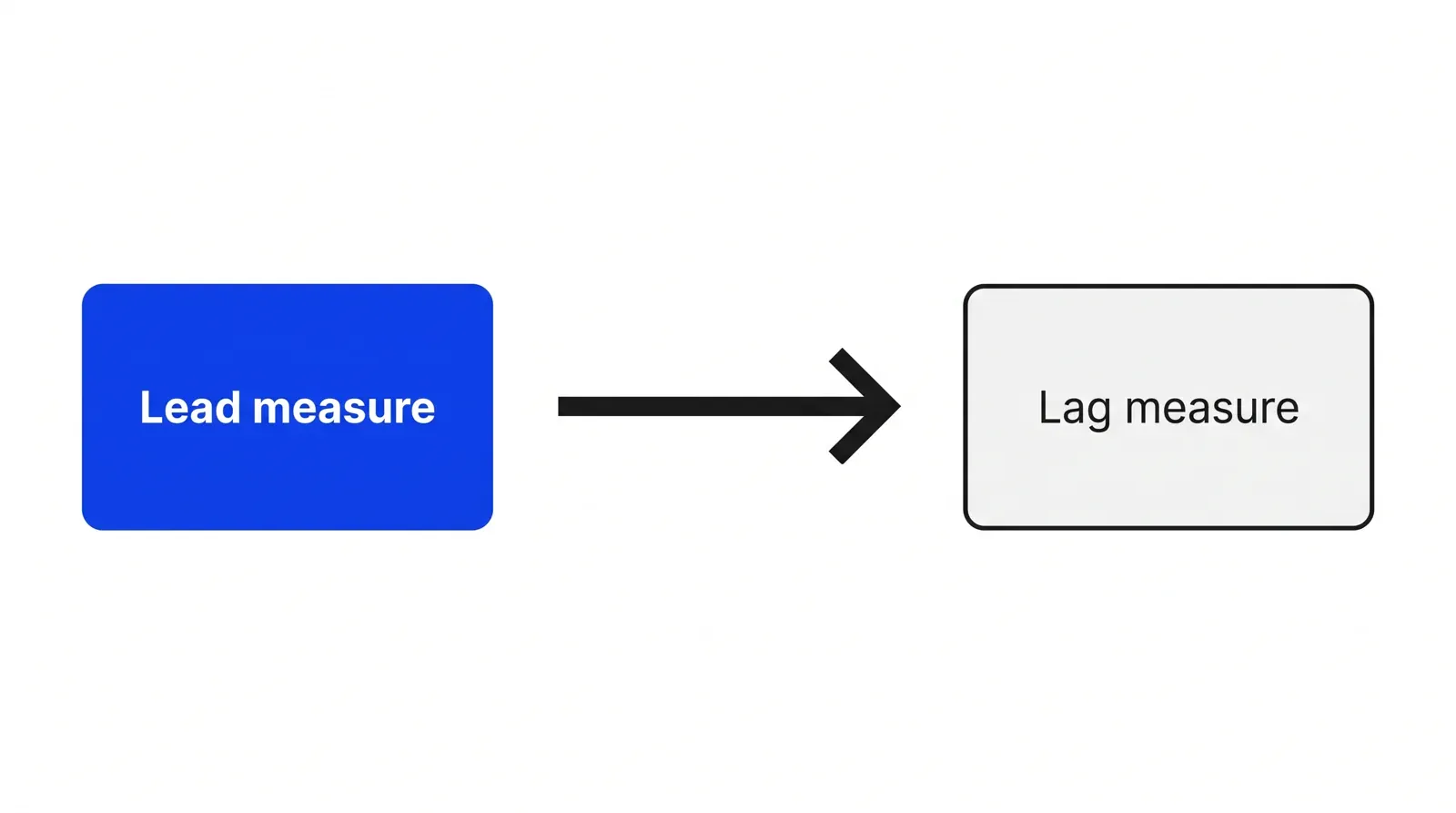
The distinction is older than the book. Robert Kaplan and David Norton made the same case in their 1992 Harvard Business Review article introducing the balanced scorecard: what a company measures is what it gets, and financial results alone arrive too late to correct anything. Kaplan and Norton later built a full method, the Execution Premium, around linking strategic goals to operational measures a team can act on immediately, the same move 4DX makes at the level of one team. A workable lead measure has two properties: it predicts the lag measure, and the team doing the work can move it without waiting on anyone else. Picking the wrong one has a known failure mode. Steve Kerr’s classic account of organizations rewarding one behavior while hoping for another applies directly: a lead measure chosen because it is easy to count, rather than because it drives the lag measure, gets optimized on its own terms while the goal drifts.
Discipline 3: keep a compelling scoreboard
A scoreboard is a visible record of the lead and lag measures against target, built for the people doing the work rather than for a leadership deck. FranklinCovey’s own standard is specific: anyone should be able to tell within five seconds whether the team is winning.

Visibility changing behavior is not unique to 4DX. A meta-analysis by Avraham Kluger and Angelo DeNisi, covering more than 600 studies, found feedback interventions improved performance on average, but more than a third of them made performance worse, usually when the feedback pointed attention at the person instead of the task. A scoreboard tied tightly to the two measures a team is working, rather than a general performance review, sits on the safer side of that finding.
Discipline 4: create a cadence of accountability
The weekly WIG session runs about 20 minutes. Each person reports on last week’s commitment, the team checks the scoreboard, and everyone makes one or two new commitments tied to the lead measure for the coming week, not a status update on everything they did.
Two strands of research support why a short weekly ritual works better than a memo. A review of goal-commitment research by Howard Klein and colleagues found that stating a commitment to a person, rather than to a form, strengthens the link between a goal and actual follow-through. Separately, Peter Gollwitzer’s research on implementation intentions found that a plan phrased as a specific trigger and action reliably outperforms a general intention to try harder. A small study by Gail Matthews at Dominican University of California, presented at a conference rather than published in a journal, tested writing goals down, committing to actions and reporting progress to another person, and reported that the accountability step changed how much of a goal people completed. A weekly WIG session forces that same shape: a named action, this week, tied to the scoreboard, in place of a vague promise to focus more.
4DX against OKRs
Where 4DX assumes one team on one WIG at a time with a weekly meeting, OKRs, the method John Doerr carried from Andy Grove’s Intel into Google and popularized in Measure What Matters, set multiple objectives with measurable key results and cascade them across an organization on a quarterly cycle. Neither framework starts from nothing: Grove built his version, first called iMBOs, out of Peter Drucker’s 1950s management-by-objectives idea, and a disagreement worth naming is whether that makes Grove an inventor or an adapter, a point the Balanced Scorecard Institute has argued directly. 4DX, in the same way, extends the leading-and-lagging-measure logic Kaplan and Norton set out for the balanced scorecard two decades earlier.
| 4DX | OKRs | |
|---|---|---|
| Scope | One WIG per team at a time | Multiple objectives, cascaded across an organization |
| Cadence | Weekly WIG session | Set quarterly, often reviewed monthly |
| Core mechanic | A lead measure the team can move this week | Key results scored against a target |
| Best fit | Getting one execution priority done inside daily operations | Aligning many teams’ priorities each quarter |
Use 4DX when the problem is a single goal losing to the daily whirlwind. Use OKRs when the problem is coordinating many teams’ priorities at once. The two can coexist: some organizations set OKRs quarterly and run 4DX underneath the one objective that needs weekly discipline to happen.
Running a WIG this way inside a written weekly rhythm, the kind of operating cadence covered in Pushers’ marketing-operational-system work, turns the four disciplines into a weekly habit instead of a launch event that fades by the second month.
How to apply 4 Disciplines of Execution (4DX), step by step
- Name the one goal that won't happen on its own. Write the wildly important goal as a move from X to Y by a date. If a team already has five priorities, none of them is the WIG yet; picking one is the actual work of this step.
- Find the lead measures that predict it. List the few activities the team can still influence this week that, done consistently, would move the lag measure. Drop anything the team cannot directly control.
- Set a target for each lead measure. Give every lead measure a number, not just a direction. 'Call more customers' is not a lead measure; 'call 90% of customers within 48 hours' is.
- Build a scoreboard the team reads in five seconds. Plot the lead measure and the lag measure against target on one simple chart, placed where the team works, not buried in a shared drive.
- Run a weekly WIG session. In 20 minutes, each person reports on last week's commitment, the team checks the scoreboard, and everyone makes one or two new commitments aimed at the lead measure for the coming week.
- Protect the WIG from the whirlwind. Keep the weekly session even in a busy week, and resist adding a second WIG until the first one is either won or deliberately closed.
Examples
A multi-location clinic group
Illustrative. A clinic group sees 1,200 patients a month and wants to raise its rebooking rate, the share who schedule a next visit before leaving, from 42% to 60% in a quarter. That rate is the lag measure; it only shows up weeks later. The lead measure is the share of patients called within 48 hours of their visit to book the next one, which front desk staff can move today. The team starts at 20% of patients called within that window, sets a target of 90%, and tracks both numbers on a scoreboard by the front desk. Eight weeks in, calls within 48 hours reach 85% and the rebooking rate has climbed to 55%, still short of target but visibly moving.
A fintech operations team
Illustrative. A payments company's compliance team takes an average of 6.5 days to clear a new account through KYC review, and the WIG is to cut that to 3 days within two months. Average review time is the lag measure. The lead measure is the share of files arriving at an analyst's desk with every required document already checked and attached, which starts at 40%. The team assigns an intake coordinator to pre-check files before handoff, tracks the percentage weekly, and by week six pre-checked files reach 92%. Average review time drops to 3.4 days, close enough to target that the team resets the WIG rather than declaring victory early.
When to use it
Use it when a team already knows its priority goal but keeps losing it to daily operations, a support desk that never gets to the process fix, a sales team that never builds the pipeline habit. It fits one team or a small number of aligned teams working one goal at a time.
When not to use it
Skip it when the real problem is that the goal itself is unclear or contested; 4DX assumes the destination is already agreed and only asks how to get there. It also strains at scale: coordinating many teams' separate priorities each quarter is closer to what OKRs are built for than what one team's weekly WIG session can carry.
Common mistakes
- Running two or three WIGs at once because every department wants its own, which recreates the whirlwind the method was meant to escape.
- Choosing a lead measure because it is easy to count rather than because it predicts the lag measure, so the number moves while the goal does not.
- Building a scoreboard for a leadership review instead of for the team doing the work, so nobody checks it between meetings.
- Turning the weekly WIG session into a status report on everything, instead of a short, specific commitment tied to the lead measure.
- Never revisiting the lead measure once it is set, even after weeks of data show it does not move the lag measure.
FAQ
What is the 4 Disciplines of Execution (4DX)?
4DX is a method for reaching one important goal, a wildly important goal or WIG, while a team's regular workload keeps running. It combines a single goal, lead measures the team can influence this week, a visible scoreboard, and a weekly accountability meeting. FranklinCovey's Chris McChesney, Sean Covey and Jim Huling published it in 2012.
What is the difference between a lead measure and a lag measure in 4DX?
A lag measure reports the goal itself, usually too late to act on, like last month's revenue or a rebooking rate. A lead measure tracks an activity the team can still influence this week that predicts the lag measure, like the share of customers called within 48 hours. Lead measures are what a team manages day to day.
What is a WIG in 4DX?
A WIG, or wildly important goal, is the one objective a team names as its priority for the period, written as a move from a current number to a target number by a date. 4DX asks a team to run one WIG at a time so the daily whirlwind of normal work does not quietly crowd it out.
How is 4DX different from OKRs?
4DX runs one team on one goal at a time with a weekly accountability meeting and a lead measure the team can move immediately. OKRs, the method Andy Grove built at Intel and John Doerr carried to Google, set multiple objectives with measurable key results and cascade them across an organization on a quarterly cycle. Some organizations use both, OKRs to align priorities, 4DX to execute the one that needs weekly discipline.
Does 4DX require special software?
No. The method needs a written WIG, a small number of lead measures with targets, a visible scoreboard and a recurring short meeting; a whiteboard and a spreadsheet run it as well as any app. FranklinCovey sells a companion app and course, but the four disciplines themselves do not depend on it.
Sources
- FranklinCovey, book page for The 4 Disciplines of Execution
- FranklinCovey, The 4 Disciplines of Execution course overview
- FranklinCovey, Discipline 1: Focus on the Wildly Important
- FranklinCovey, Discipline 2: Act on the Lead Measures
- FranklinCovey, Discipline 3: Keep a Compelling Scoreboard
- FranklinCovey, Discipline 4: Create a Cadence of Accountability
- Edwin A. Locke, Gary P. Latham, Building a Practically Useful Theory of Goal Setting and Task Motivation, American Psychologist, 2002
- Peter M. Gollwitzer, Implementation Intentions: Strong Effects of Simple Plans, American Psychologist, 1999
- Avraham Kluger, Angelo DeNisi, The Effects of Feedback Interventions on Performance, Psychological Bulletin, 1996
- Howard Klein, Michael Wesson, John Hollenbeck, Bradley Alge, Goal Commitment and the Goal-Setting Process, Journal of Applied Psychology, 1999
- Steven Kerr, On the Folly of Rewarding A, While Hoping for B, Academy of Management Journal, 1975
- Robert Kaplan, David Norton, The Balanced Scorecard, Measures That Drive Performance, Harvard Business Review, 1992
- Robert Kaplan, David Norton, The Execution Premium, Harvard Business Review Press, 2008
- Donald Sull, Rebecca Homkes, Charles Sull, Why Strategy Execution Unravels, Harvard Business Review, 2015
- Gary Neilson, Karla Martin, Elizabeth Powers, The Secrets to Successful Strategy Execution, Harvard Business Review, 2008
- Heike Bruch, Sumantra Ghoshal, Beware the Busy Manager, Harvard Business Review, 2002
- John Doerr, official page for Measure What Matters
- What Matters, OKRs History: Andy Grove and Intel
- David Wilsey, No, Andy Grove Didn't Invent OKRs, Balanced Scorecard Institute
- Gail Matthews, The Impact of Commitment, Accountability, and Written Goals on Goal Achievement, Dominican University of California
Last updated Sep 25, 2026


Fractional COO or embedded operations team? How to choose at Series A
The two models solve different problems. Here is how to tell which one your company has, and what each costs you in time and control.

What a revenue operations manager actually owns
Pipeline definitions, CRM hygiene, forecasting and the handoffs between marketing, sales and success. What the role covers, and how it differs from sales ops.

What is a fractional executive? Models, pricing and failure points
Fractional, interim, advisory or embedded team: four different models get lumped under one word. Here is how they differ and when each one fails.