Competitor teardown
A competitor teardown is a step-by-step audit of one rival's funnel, ad to support, that turns vague competitive worry into a short list of what to copy, what to beat and what to ignore.
A competitor teardown is a hands-on audit where you experience a rival's product exactly as a real customer would: click their ad, read their landing page, sign up, get onboarded, hit their pricing page, and contact their support. You record what happens at each step, then decide, step by step, what to copy, what to beat, and what to ignore.
- Origin
- Practice-based: rooted in hardware teardown culture and Michael Porter's 1980 competitor-analysis chapter; competitive intelligence formalized as a discipline by SCIP, 1980 (Porter); 1986 (SCIP founded); practice-based, no single founding date
- Level
- 201 · Tool
- Fits
- Startup, Small and mid-size, Scale-up
- Time to apply
- half a day for one competitor and one job; repeat per competitor
- What you need
- a real account or trial on the competitor's product, not just their homepage · one specific job a customer is trying to get done, not the whole product · someone who will change something based on what you find
A competitor teardown is a step-by-step audit of what one rival does, seen through the eyes of a real customer chasing one specific job: click their ad, read their landing page, sign up, sit through their onboarding, open their pricing page, and ask their support a real question. No single person invented it. The practice draws on two older lineages: hardware teardown culture, where a firm like Munro & Associates takes a competitor’s product apart to see how it is built and sells the findings to other manufacturers, and Michael Porter’s 1980 book Competitive Strategy, whose third chapter set out the first formal way to study a rival’s goals, assumptions, strategy and capabilities. Competitive intelligence became its own named discipline once the Society of Competitive Intelligence Professionals, now the Strategic Consortium of Intelligence Professionals (SCIP), was founded in 1986 and gave the practice a shared code of conduct.
Why one competitor and one job
Picking the wrong competitor wastes the exercise before it starts. Ming-Jer Chen’s 1996 Academy of Management Review article gave the choice a name: market commonality, how much two companies fight for the same customers, and resource similarity, how alike their capabilities are. A rival high on both is a real competitor worth a teardown. A company that merely sells something adjacent is not, no matter how often its name comes up in a meeting.
The job matters as much as the rival. Clayton Christensen, Taddy Hall and Karen Dillon’s 2016 Harvard Business Review article on jobs to be done argued that customers “hire” a product for a specific outcome, not for the product as a whole. A teardown scoped to one job, opening an account, booking a first visit, filing a claim, stays sharp. A teardown of “their whole product” turns into a long list nobody acts on.
Walking the whole funnel
Most competitive reviews stop at the landing page, because it is the easiest part to screenshot. A teardown goes further: the ad that brought a buyer in, the sign-up form, the onboarding sequence, the pricing page, and a real support request, in that order.
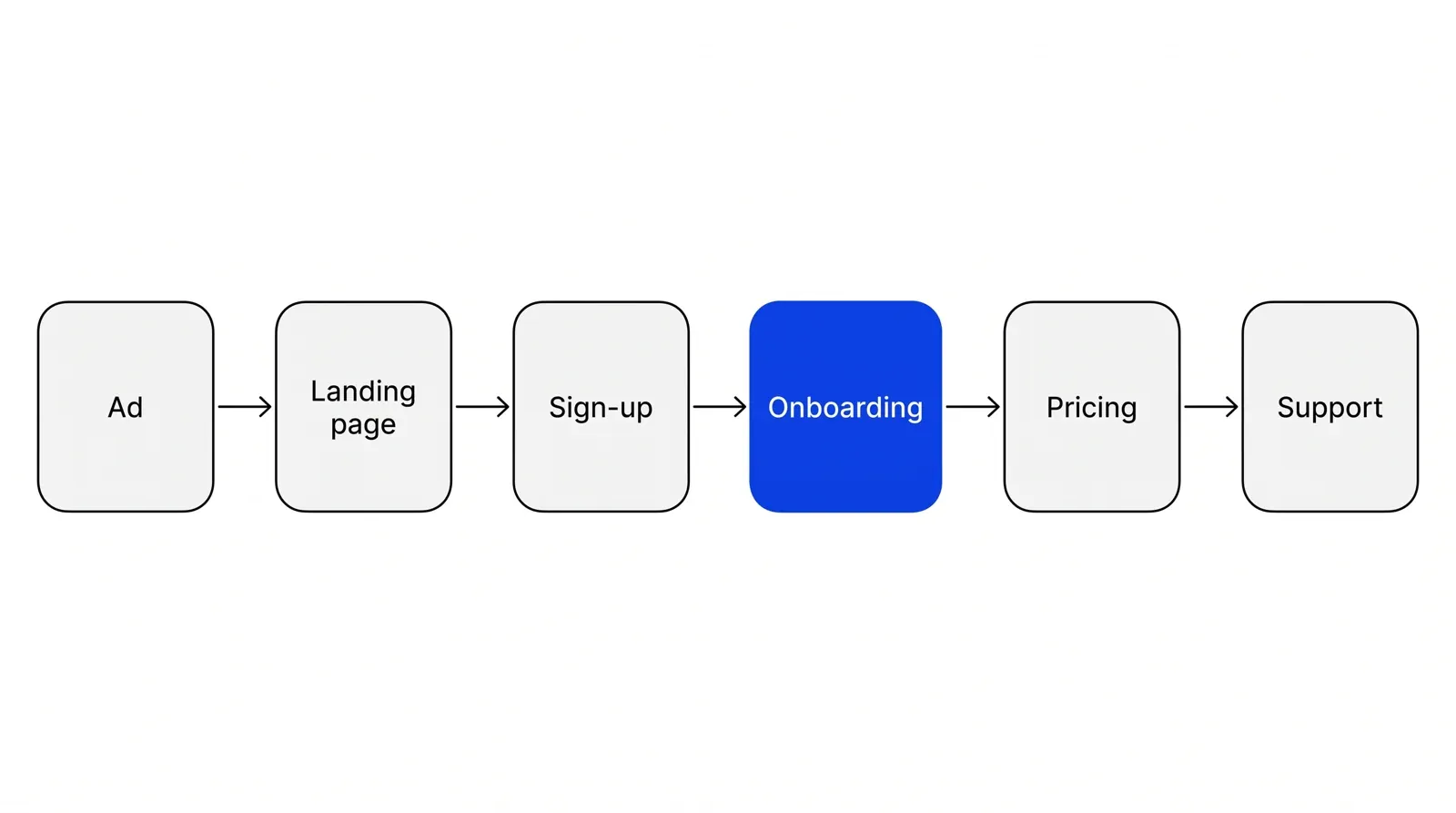
Nielsen Norman Group calls the software-side version of this a competitive usability evaluation, run early in a design project to “understand how your competitors solve certain design problems and how you might outperform them.” Onboarding and support are the steps teardowns skip most, since they take longer to reach than a homepage, and they are frequently where a rival’s real weakness sits: a form that asks for information too early, a confirmation that never arrives, a support reply that takes a day.
What is fair game, and what is not
A teardown built on public information is fair game. One built on misrepresentation or stolen material is not, and the difference has both an ethics code and a body of law behind it.
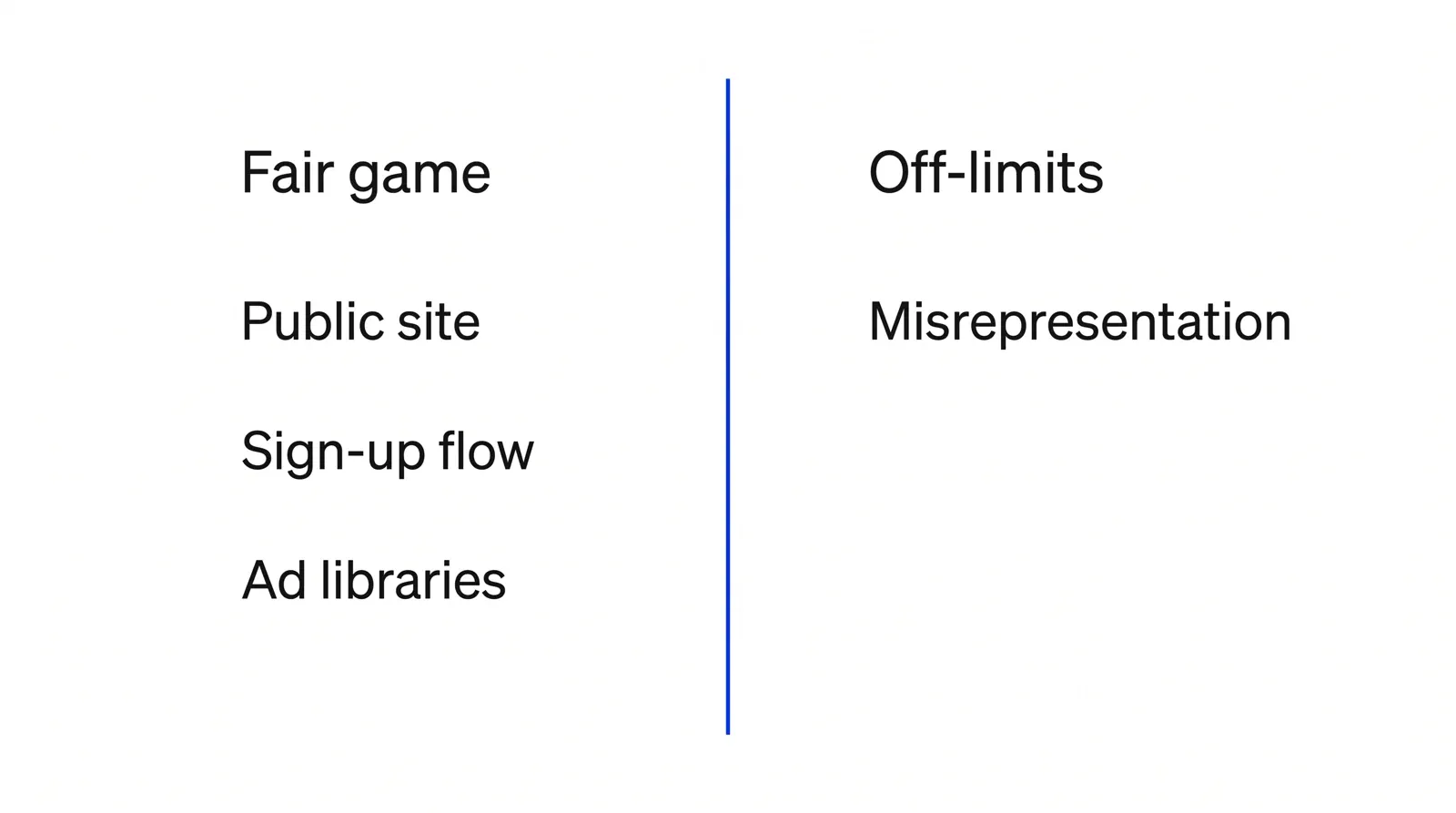
SCIP’s own code of ethics is direct about where the line sits: patents are public and expected to be reviewed, mystery shopping is acceptable as long as it does not break a retailer’s own rules, and obtaining a password without authorization is illegal outright. The code does require disclosing “one’s identity and organization… before all interviews,” which is a narrower rule than it first sounds: signing up for a trial or browsing a pricing page as an ordinary prospective customer is not an interview, so it does not require disclosure the way asking a competitor’s employee direct questions would. Meta’s Ad Library and Google’s Ads Transparency Center exist for exactly this kind of public research, showing any visitor which ads a company is currently running, with no login required for either.
The legal boundary runs alongside the ethical one. The Uniform Trade Secrets Act, the model law adopted by 49 US states, defines “improper means” as “theft, bribery, misrepresentation, breach or inducement of a breach of a duty to maintain secrecy, or espionage through electronic or other means.” The federal Economic Espionage Act of 1996 makes the theft of a trade secret a crime, and the Defend Trade Secrets Act of 2016 gave trade secret owners a federal civil claim on top of the older state-by-state rules. None of these apply to a public site, a real sign-up, or a public ad library. All of them apply to a stolen document or a password you were never given. One more line to check before signing up: many software companies’ terms of service forbid competitors from opening an account for research, and breaking those terms can create a contract claim even where no trade-secret law is involved. This section summarises the rules as written; it is not legal advice for a specific case.
Turning what you saw into copy, beat or ignore
A teardown that ends with a stack of screenshots and no verdict was not worth doing. Every step gets sorted three ways: copy what already works, beat what a competitor is doing worse than you could, or ignore what will not move your own customer.
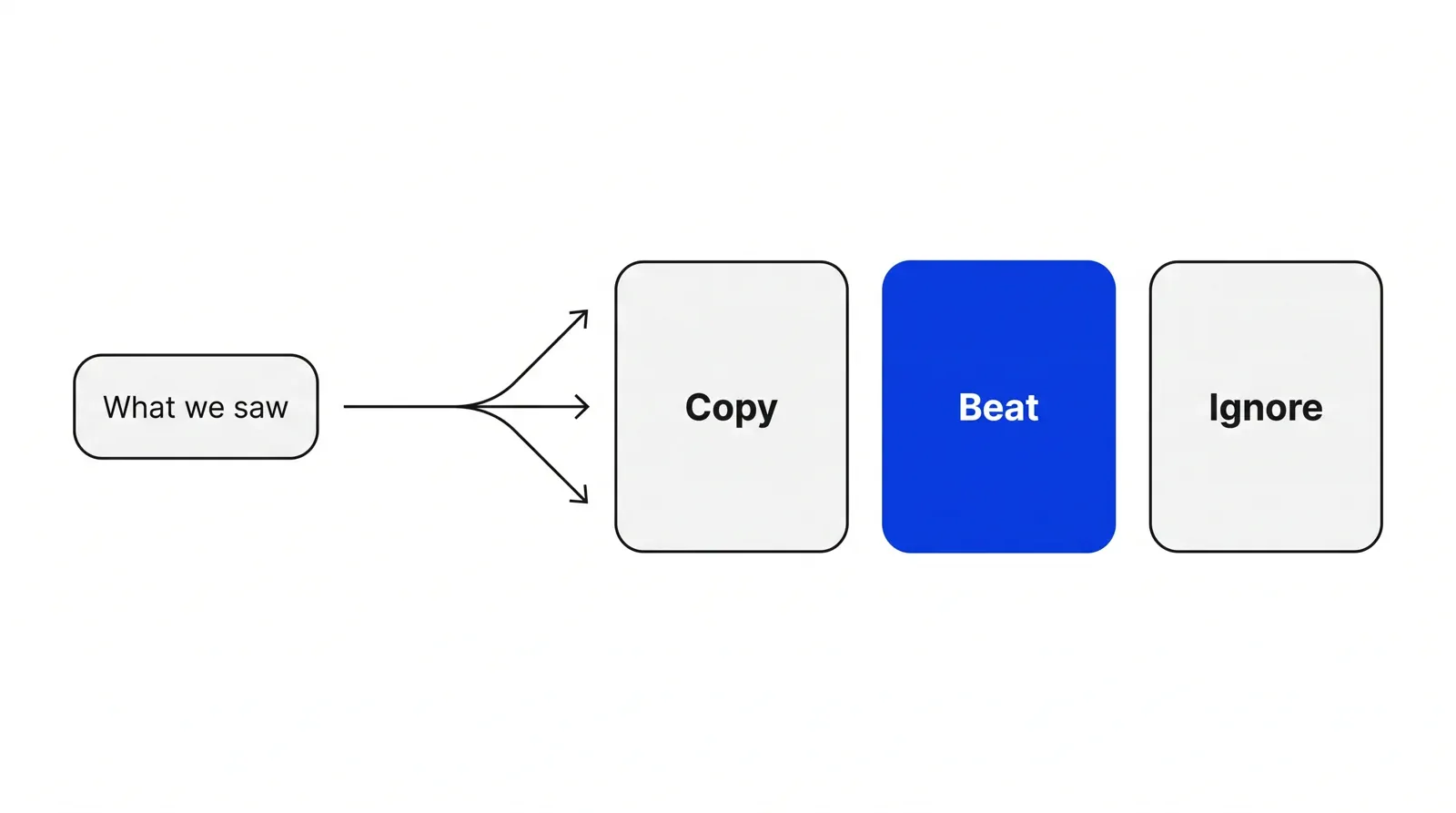
A short table forces the sort instead of leaving it to memory.
| Step | What you saw | Verdict | Why |
|---|---|---|---|
| Sign-up form | Six screens, two asking for data used later | Beat | Cut the two unnecessary screens |
| Confirmation email | Nine minutes, no message shown on screen | Ignore | Not the real friction point |
| Pricing page | Clear, one plan, no hidden fees | Copy | Already works, nothing to add |
Lynn Sharp Paine’s 1991 Journal of Business Ethics article on competitor intelligence gathering found that most companies had no written policy on where this line sits, and Shaker Zahra’s 1994 study of 137 executives found unethical shortcuts common enough to be a real pattern rather than a rare exception. Terri Rittenburg, Sean Valentine and James Faircloth’s 2007 follow-up in the same journal argued individual judgment on what counts as fair game varies too much to leave unstated. A written verdict per step, copy, beat or ignore, with a reason, is a small piece of exactly the kind of policy those three studies found missing.
Teardown, five forces or journey map
A teardown gets confused with two frameworks that sound similar on a whiteboard.
| Competitor teardown | Porter’s five forces | Customer journey map | |
|---|---|---|---|
| Looks at | One rival’s product, step by step | An entire industry’s structure | Your own customer’s experience |
| Answers | What this competitor does, and what to do about it | Whether this industry is worth competing in at all | Where your own customer’s experience breaks |
| Built from | A real account and a real walkthrough | Scores on rivalry, entrants, substitutes, and supplier and buyer power | Interviews, support data and real customer behavior |
Run five forces to judge whether the industry is worth being in, a teardown to judge one specific rival inside it, and a journey map to judge your own funnel once the teardown has shown you where the bar sits.
A teardown is cheap, fast, and it expires. Run it as a standing check inside a growth-systems engagement, redone whenever a competitor changes pricing or onboarding, and it stays a live comparison instead of a slide deck from a planning meeting eighteen months ago.
How to apply Competitor teardown, step by step
- Pick one competitor and one job. Choose the single rival prospects compare you against this quarter, and one job a customer is trying to get done, opening an account, booking a first visit. A teardown that tries to cover every rival and every path shows nothing clearly.
- Follow their ad like a real prospect. Search or scroll until you find their ad the way a buyer would, then click it. Note the promise the ad makes and whether the landing page it lands on delivers on that promise.
- Sign up and get onboarded as a customer. Create a real account with your own details, the way any visitor could. Go through onboarding exactly as instructed, and write down every screen, email and delay along the way.
- Test pricing and support. Open the pricing page and note what it does and does not disclose, then send one real support question and time the reply. This is the step most teardowns skip, and it is often where a rival loses a customer.
- Record each step as it happened. For every step, write what happened, not what you expected to happen. A screenshot and one sentence per step turns the walkthrough into something a colleague can check the following week.
- Sort each step into copy, beat or ignore. Decide for each step: copy it because it already works, beat it because you can do better with what you have, or ignore it because it will not move your customer. Give the step marked beat an owner and a date.
Examples
A rival fintech's onboarding
Illustrative, no real company implied. A challenger bank's teardown of a rival's sign-up counts six screens and about eleven minutes end to end, two screens asking for information the app does not use until month two, and a confirmation email that arrives nine minutes after signup with nothing shown on screen in between. The verdict: copy the short first screen, which only asks for an email and a password; beat the two unnecessary screens by cutting them, which should bring the eleven minutes closer to five; ignore the slow confirmation email, since the real gap is the two extra screens, not the wait for a message.
A competing clinic's booking flow
Illustrative, no real company implied. A dental clinic's teardown of a nearby competitor calls their number, books a first visit and counts the steps: a phone tree with four options before a human answers, a nineteen-minute hold, then a booking confirmed by text within a minute. The verdict: copy the instant text confirmation, which costs little and reassures a patient the call worked; beat the nineteen-minute hold, the more likely reason a caller hangs up, by adding a callback option; ignore the four-option phone tree, since callers who get through rarely mention it.
When to use it
Use it before entering a market where you already know the two or three real competitors, when a sales team keeps losing deals to the same rival and nobody on the team has used that rival's product, or before redesigning your own funnel, so the comparison is against what a competitor does today instead of what the team remembers from a year ago.
When not to use it
Skip it when you cannot name one specific competitor and one specific job; a teardown of 'the market' in general produces a pile of screenshots and no decision. Skip it too as a one-off exercise before a launch and never again, since a competitor's funnel changes and a teardown from eighteen months ago describes a rival that no longer exists.
Common mistakes
- Tearing down five competitors at once instead of one, producing a wall of screenshots nobody reviews before the next planning meeting.
- Marking every step 'copy,' which turns the output into a clone instead of a list of what to copy, beat or ignore.
- Skipping pricing and support because they take longer to reach than the landing page, when they are often where a rival wins or loses a deal.
- Misrepresenting who you are to get information an interview would require disclosing, which crosses from a teardown into the kind of intelligence gathering SCIP's own code rules out.
- Running the teardown once and treating the findings as permanent, when a competitor's onboarding or pricing page can change within a quarter.
FAQ
What is a competitor teardown?
A competitor teardown is a step-by-step audit where you use a rival's product as a real customer would, from their ad through sign-up, onboarding, pricing and support, then sort each step into copy, beat or ignore. It answers what a competitor does, not what your team assumes.
Is a competitor teardown legal?
Yes, when it uses public information and a real account: their website, sign-up flow, pricing page, and public ad libraries such as Meta's or Google's. It becomes a legal problem under the Economic Espionage Act of 1996 or the Uniform Trade Secrets Act's definition of improper means once it involves misrepresentation, theft or unauthorized access.
How is a competitor teardown different from Porter's competitor analysis?
Porter's 1980 framework predicts what a rival will do next from their goals, assumptions, strategy and capabilities, an outside strategic read. A teardown is the hands-on version: you become the customer and record what happens at each step of one journey, then decide what to copy, beat or ignore.
How often should a competitor teardown be redone?
Redo it whenever a rival changes pricing, redesigns onboarding, or after your team loses a deal it did not expect to lose. A teardown from a year ago describes a competitor that has likely already moved.
What is off-limits in a competitor teardown?
Misrepresenting who you are in an interview, using stolen or leaked documents, and accessing anything without authorization, such as a password you were not given. SCIP's code of ethics and the Uniform Trade Secrets Act's definition of improper means both draw the line at theft, bribery and misrepresentation.
Sources
- Michael E. Porter, Competitive Strategy: Techniques for Analyzing Industries and Competitors, Free Press, 1980, Internet Archive record
- Ming-Jer Chen, Competitor Analysis and Interfirm Rivalry: Toward a Theoretical Integration, Academy of Management Review 21(1), 1996
- Lynn Sharp Paine, Corporate Policy and the Ethics of Competitor Intelligence Gathering, Journal of Business Ethics 10, 1991
- Shaker A. Zahra, Unethical Practices in Competitive Analysis: Patterns, Causes and Effects, Journal of Business Ethics 13, 1994
- Terri Rittenburg, Sean Valentine, James Faircloth, An Ethical Decision-Making Framework for Competitor Intelligence Gathering, Journal of Business Ethics 70(3), 2007
- Strategic Consortium of Intelligence Professionals (SCIP), Code of Ethics
- Strategic Consortium of Intelligence Professionals (SCIP), homepage
- United States Congress, Economic Espionage Act of 1996, Public Law 104-294, GovInfo
- Uniform Trade Secrets Act with 1985 amendments, definition of improper means, WIPO Lex
- Uniform Law Commission, Trade Secrets Act
- United States Congress, Defend Trade Secrets Act of 2016, S.1890 (Enrolled), GovInfo
- Meta, Introduction to the Advertising Standards, Transparency Center
- Google, Ads Transparency Center
- iFixit, What Is a Teardown
- Electrek, Teardown guru Sandy Munro sells Tesla reports mostly to Asian automakers, 2020
- Benjamin Gilad, Early Warning: Using Competitive Intelligence to Anticipate Market Shifts, Control Risk, and Create Powerful Strategies, AMACOM, 2004, Internet Archive record
- Craig S. Fleisher, Babette E. Bensoussan, Business and Competitive Analysis: Effective Application of New and Classic Methods, 2nd ed., Pearson, 2015, Internet Archive record
- Clayton M. Christensen, Taddy Hall, Karen Dillon, Know Your Customers' Jobs to Be Done, Harvard Business Review, September 2016
- Jack C. Collins, Rebekah J. Moles, Jonathan Penm, Carl R. Schneider, Ethical Considerations for Mystery Shopper Studies of Pharmaceutical Sales, Bulletin of the World Health Organization, 2020
- Nielsen Norman Group, How to Conduct a Competitive Usability Evaluation
Last updated Sep 25, 2026


The compliance layer under fintech marketing operations
A fintech marketing agency can build campaigns. It cannot own the compliance review, the KYC drop-off or the multi-market licensing rules that decide whether a lead ever becomes a customer.

Fractional CMO: what you get, and what has to exist underneath
A fractional CMO brings strategy and judgment. Without reporting, CRM hygiene and a named owner per number, the engagement produces a slide deck instead of a system.

The operations layer behind healthcare patient acquisition
Ads and search bring the request in. What happens between the click and the booked, attended visit decides whether the spend paid off.