Account-based marketing (ABM)
Account-based marketing is a B2B strategy that treats a short list of named companies as individual markets, instead of running one campaign for a broad, anonymous audience.
Account-based marketing (ABM) is a B2B strategy that targets a short, named list of high-value companies and treats each one as its own market, instead of generating anonymous leads at scale. ITSMA's Bev Burgess codified it in 2003. It runs in three tiers, one-to-one, one-to-few and one-to-many, that trade personalization for account coverage.
- Origin
- Bev Burgess, ITSMA (Information Technology Services Marketing Association), 2003; first published ITSMA study in 2004
- Level
- 201 · Tool
- Fits
- Scale-up, Enterprise
- Time to apply
- a quarter to build the first named-account list, agree the tier split with sales, and launch one pilot account
- What you need
- a named account list that sales and marketing both sign off on · someone who can pull firmographic and intent data on each account · a CRM or ABM platform that reports on the account, not only the individual lead
Account-based marketing is a B2B strategy that treats a short list of named companies as individual markets instead of a mass of anonymous leads to filter down. Instead of running one campaign for everyone who might buy, a team picks specific accounts by name, researches each one, and builds content and outreach around what that particular company needs. Bev Burgess codified the practice as account-based marketing while managing director of ITSMA Europe in 2003, and the field still carries her framing.
Where the term came from
ITSMA, the Information Technology Services Marketing Association, is where the practice got its name. Bev Burgess, then managing director of ITSMA Europe, codified account-based marketing as a formal strategy in 2003, a date confirmed independently by George Mason University’s profile of her work and by Demandbase’s own account of ITSMA’s history. One widely read history of ABM puts the date a year later, in 2004, tied to ITSMA’s first in-depth published study of the practice. Both figures sit in the same short window, and the underlying idea, treating a named account as a market in its own right, existed inside key account management long before either date. ITSMA went on to run an ABM certification program from 2013, and Burgess co-authored two of the field’s standard handbooks, still publishing on the topic more than two decades after she named it.
The funnel turns upside down
A demand-generation funnel starts wide and narrows: a broad audience goes in at the top, and a filtered handful of customers comes out the bottom. Account-based marketing starts at the narrow end on purpose. A named list of accounts is chosen before any campaign runs, and the work then widens inside each account, more contacts reached, more roles engaged, more of the buying group brought in, until the account converts. MarTech describes the shift directly: ABM “flips” the typical sales funnel by starting with a small group of identified accounts rather than casting a wide net at the top.
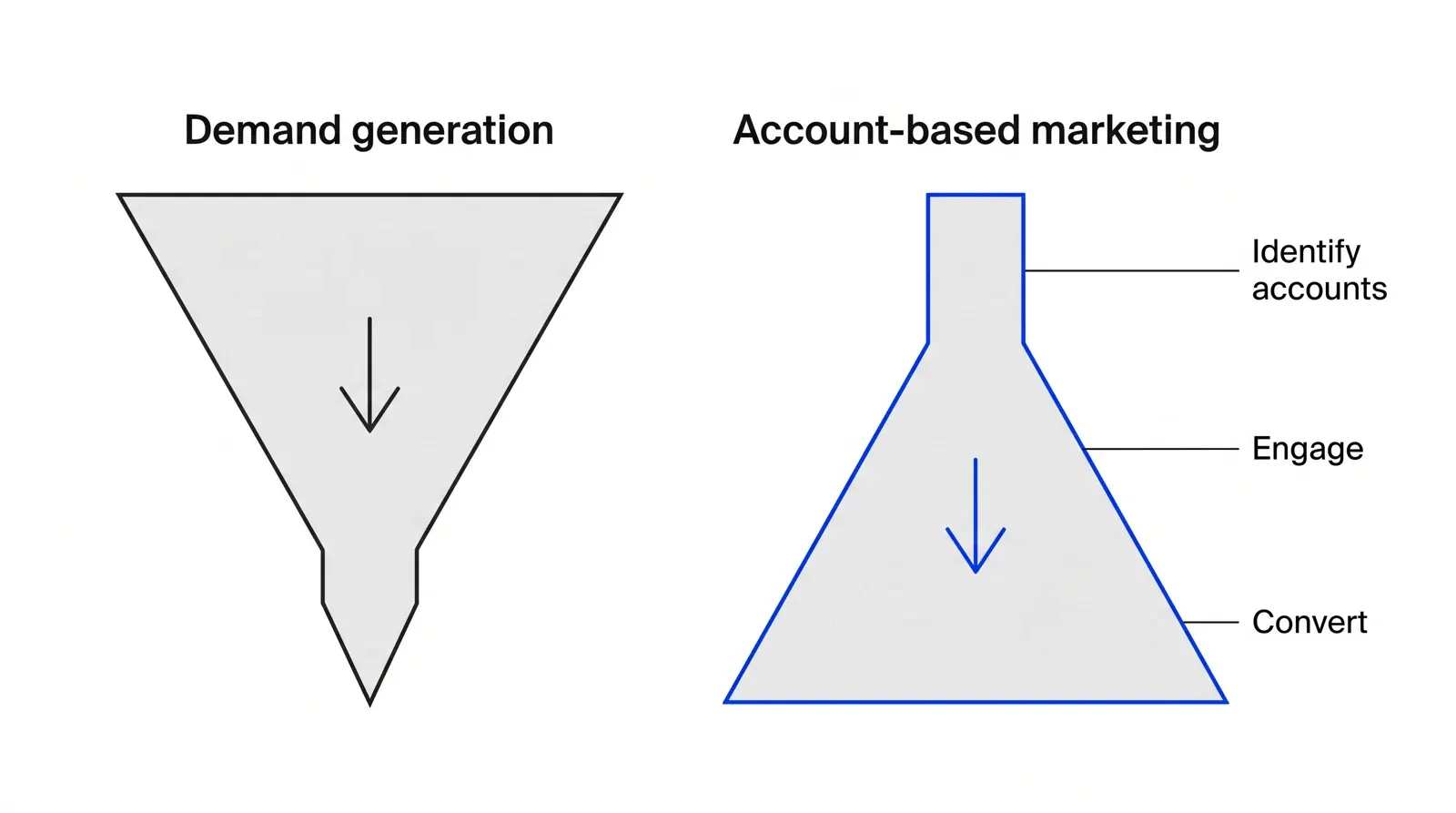
The practical effect shows up in what gets measured. A demand-generation team asks how many leads a campaign produced. An account-based team asks whether a specific named company moved this month, more contacts responding, a meeting booked with a new role, a pilot agreed. The account, not the lead, is the unit the whole program is built around.
Three tiers, one framework
ITSMA’s own version of ABM splits into three tiers by how much personalization each account gets: one-to-one, one-to-few and one-to-many. Strategic ABM, one-to-one, gives each account its own plan: a dedicated account team, research specific to that single company, and content built for no one else. It covers the fewest accounts and costs the most per account. One-to-few groups a handful of accounts that share a trait, the same industry, the same buying trigger, and runs one program tailored to the cluster rather than to each company by hand. One-to-many, sometimes called programmatic ABM, uses shared content and targeted advertising across a much longer list, personalized by data such as industry, role or an intent signal rather than by a person.
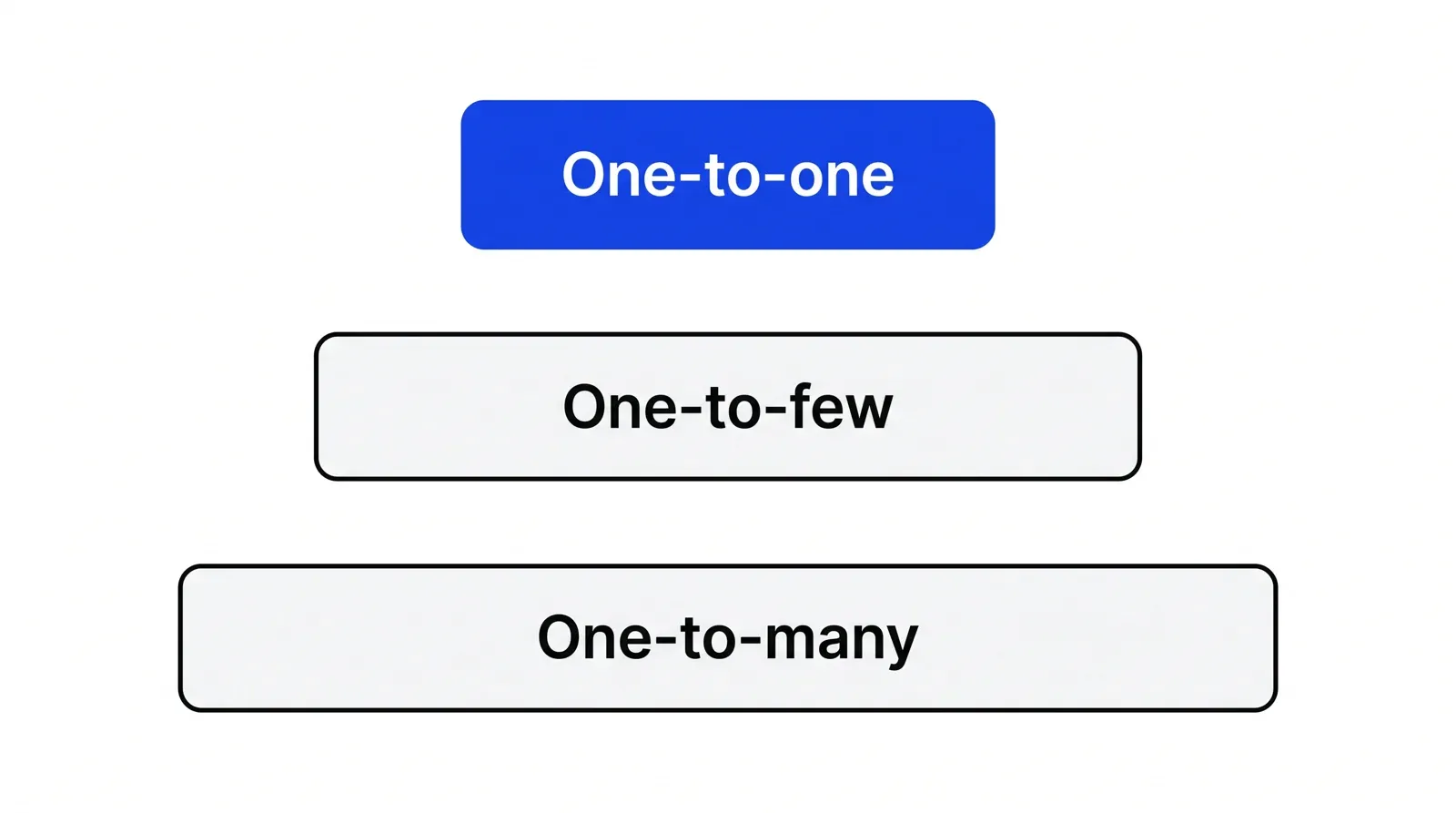
Not every organization draws the same three lines. Forrester’s SiriusDecisions arm names its own three deployment models, large-account, named-account and industry ABM, a different split from ITSMA’s rather than a relabeling of the same one. What both frameworks agree on is the trade-off underneath: fewer accounts buys more personalization, and more accounts buys more reach, and a team has to decide where each account belongs rather than run one tier for everyone on the list.
What sales and marketing both have to agree to
ABM only works when sales and marketing share one account list and one definition of progress on it, and getting there is harder than the diagrams suggest. Peer-reviewed research on sales-marketing integration, published by Rouziès, Anderson, Kohli, Michaels, Weitz and Zoltners in the Journal of Personal Selling & Sales Management, sets out the conditions under which integration improves results, and a shared account list with agreed criteria is exactly the kind of coordination the framework calls for. Skip that step and the handoff breaks: Forrester’s 2024 Demand, ABM, And Customer Marketing Survey found that 56% of opportunities handed to sales fail to close, a gap between what marketing qualified and what sales was ready to pursue that a jointly built account list is meant to close.
The buying group behind each account is bigger and harder to reach through a single contact than a lead-based process assumes. Demandbase, citing Gartner research, reports that 25% of software purchase decisions now involve more than seven people. Harvard Business Review’s 2015 piece “Making the Consensus Sale” states that the authority to decide now “rests with groups of individuals, all of whom have different roles, and all of whom have veto power.” The pattern itself is not new. Webster and Wind’s 1972 model of the organizational buying center and Johnston and Bonoma’s 1981 study of 31 firms’ purchasing groups both described this structure decades before ABM had a name. What ABM adds is a marketing process built around mapping and engaging that whole group, account by account, instead of one contact at a time.
Account-based marketing or demand generation
The two get confused because both are ways to bring in new business, but they start from opposite ends and measure different things.
| Account-based marketing | Demand generation | |
|---|---|---|
| Starts with | A named list of specific companies | A broad target audience or persona |
| Unit of success | The account: engaged and moving, or not | The lead: how many, how qualified |
| Typical content | Built for one account or a small cluster | Built once, reused across everyone who fits |
| Sales role | Involved from the list-building stage | Receives leads once marketing qualifies them |
| Fits best when | The market is small and deals are large | The market is large and no single account decides the quarter |
The two suit different markets, and many companies run both at once: a lead magnet program for the long tail of smaller prospects, and an account-based program for the handful of companies large enough to justify the extra work each one needs. Building both into one working system, instead of two teams pulling in different directions, is part of what Pushers’ marketing operational system work is for.
How to apply Account-based marketing (ABM), step by step
- Build one list, together. Sales and marketing jointly pick the named accounts, using firmographic fit and real buying signals, not a list marketing built alone and handed over. The result is one shared list both teams treat as the plan.
- Pick the tier each account earns. Sort the list into one-to-one, one-to-few or one-to-many based on deal size and strategic value, not on how many accounts feel manageable. The result is a tier assignment that matches effort to what each account is worth.
- Map the buying group inside each account. Research who is in the account's buying group, what role each person plays, and what they each need to see before they will support the deal. The result is a named list of people, not one generic contact.
- Build the account-specific play. Put together content, outreach and a sales motion aimed at that one account or cluster, referencing what the account's own buying group cares about. The result is material a prospect recognizes as written for them.
- Report on accounts, not leads. Track engagement and pipeline at the account level: how many roles are engaged, how far the account has moved, not how many forms were filled. The result is a dashboard sales trusts.
- Review the list every quarter. Drop accounts that never engaged, add new ones that now fit, and move accounts between tiers as their engagement changes. The result is a list that stays worth the effort put into it.
Examples
A cross-border payments provider
Illustrative, no figures implied. A B2B payments company selling to online marketplaces names 30 marketplaces it wants as customers and runs a one-to-few program: three clusters of ten marketplaces grouped by region, each cluster getting a tailored comparison of settlement times and fees against the rails that region's marketplaces already use.
A healthtech vendor and a short list of hospital groups
Illustrative, no figures implied. A healthtech vendor selling a care-coordination platform picks a one-to-one tier for the dozen hospital groups large enough to justify a dedicated account team, building a business case specific to each group's existing systems and procurement process rather than one generic pitch deck for all twelve.
When to use it
Use it when the realistic buyer list is small enough to name individually, a single deal is large enough to justify the extra research and content it takes, and sales is willing to help build and work the list. It fits markets with a handful of large potential customers more than markets with thousands of small, similar ones.
When not to use it
Skip it when the addressable market is broad and each individual deal is small, since the personalization ABM asks for will not pay for itself at that price point. Skip it too if sales will not commit to a shared account list, since a marketing-only version of ABM is just narrower demand generation wearing a new name.
Common mistakes
- Building the account list in marketing alone and handing it to sales afterward, so the two teams end up working from different plans.
- Running generic ads at a named account list and calling it account-based marketing, when the mechanism is still broad targeting, just with a shorter target list.
- Measuring the program by lead volume or MQLs instead of account-level engagement and pipeline movement.
- Putting too many accounts in the one-to-one tier to personalize each one properly, which quietly turns strategic ABM into one-to-few with more spreadsheets.
- Never pruning the account list, so effort keeps going into accounts that stopped engaging months ago.
FAQ
What is account-based marketing in simple terms?
Account-based marketing is a B2B approach where a company picks a short list of named target companies and builds a tailored plan for each one, instead of running one campaign for a broad, anonymous audience and filtering the responses down into leads.
How is ABM different from lead generation?
Lead generation starts with a wide audience and narrows it down to qualified leads. ABM starts narrow, with a named account list chosen up front, and widens engagement inside each account. The unit of success also differs: leads for demand generation, the named account for ABM.
What are the three tiers of ABM?
ITSMA's framework splits ABM into one-to-one (strategic, a dedicated plan per account), one-to-few (a shared program for a cluster of similar accounts) and one-to-many (data-driven personalization across a longer list, sometimes called programmatic ABM). Other frameworks, like Forrester's SiriusDecisions model, split it differently.
Who invented account-based marketing?
Bev Burgess, managing director of ITSMA Europe at the time, is credited with codifying account-based marketing as a named strategy in 2003. One history of the field dates the term to 2004, tied to ITSMA's first published study, though the underlying idea, treating a named account as its own market, predates both dates.
Do you need a large marketing team to run ABM?
No. A one-to-one program for a handful of strategic accounts can run with one marketer and one account team working closely with sales. What ABM needs is a shared account list and sales buy-in, not headcount, though a one-to-many program across a long list does need data and automation to personalize at scale.
Sources
- George Mason University, faculty/guest profile of Bev Burgess
- Demandbase, press release, ITSMA and Demandbase Partner to Advance Account-Based Marketing
- Business 2 Community (via Yahoo Finance), The Untold and Fascinating History of Account-Based Marketing
- The Growth Syndicate, Account-Based Marketing: Strategy, Channels and Metrics
- Tofu, What Is 1:1 ABM? How It Works and Why It Matters
- Forrester (SiriusDecisions), Account-Based Marketing (ABM): The Ultimate SiriusDecisions Guide
- Forrester, Kelvin Gee and Nora Conklin, Revitalizing Deals That Detour With Adaptive Programs
- MarTech, What is account-based marketing? ABM defined.
- Nicholas Toman, Brent Adamson, Cristina Gomez, The New B2B Sales Imperative, Harvard Business Review, March-April 2017
- Karl Schmidt, Brent Adamson, Anna Bird, Making the Consensus Sale, Harvard Business Review, March 2015
- Penguin Random House, book page for The Challenger Customer by Brent Adamson, Matthew Dixon, Pat Spenner and Nick Toman, Portfolio, 2015
- Frederick E. Webster Jr., Yoram Wind, A General Model for Understanding Organizational Buying Behavior, Journal of Marketing 36(2), 1972
- Wesley J. Johnston, Thomas V. Bonoma, The Buying Center: Structure and Interaction Patterns, Journal of Marketing 45(3), 1981
- Denis Rouziès, Erin Anderson, Ajay K. Kohli, Ronald E. Michaels, Barton A. Weitz, Andris A. Zoltners, Sales and Marketing Integration: A Proposed Framework, Journal of Personal Selling & Sales Management 25(2), 2005
- Simone Severini, Harri Terho, Joel Mero, Silvio Cardinali, Unpacking account-based marketing: Conceptualization, key activities, and performance outcomes, Industrial Marketing Management 133, 2026
- Björn S. Ivens, Alexander Leischnig, Catherine Pardo, Barbara Niersbach, Key account management as a firm capability, Industrial Marketing Management 74, 2018
- Agent3, It's a fond farewell to ITSMA, but who will take its place?
- Demandbase, 6 strategies for engaging the buying group through account-based marketing
- Kogan Page, Bev Burgess and Philip Kotler, Account-Based Marketing: The Definitive Handbook for B2B Marketers
- Kogan Page, Bev Burgess and Dave Munn, A Practitioner's Guide to Account-Based Marketing: Accelerating Growth in Strategic Accounts
- ABM Leadership Alliance / Momentum ITSMA, Rethinking ABM: Outperforming the Market in the World of AI (7th annual ABM benchmark report)
Last updated Sep 25, 2026


The compliance layer under fintech marketing operations
A fintech marketing agency can build campaigns. It cannot own the compliance review, the KYC drop-off or the multi-market licensing rules that decide whether a lead ever becomes a customer.

Fractional CMO: what you get, and what has to exist underneath
A fractional CMO brings strategy and judgment. Without reporting, CRM hygiene and a named owner per number, the engagement produces a slide deck instead of a system.

The operations layer behind healthcare patient acquisition
Ads and search bring the request in. What happens between the click and the booked, attended visit decides whether the spend paid off.