BANT
BANT is a four-question checklist, budget, authority, need and timeline, that a salesperson runs through early in a conversation to decide whether a lead is worth pursuing right now.
BANT is a sales qualification checklist, budget, authority, need and timeline, used to decide whether a lead is worth a salesperson's time right now. A rep asks whether the prospect can pay, who signs off, what problem it solves and when it needs to happen, then weighs the answers together before investing more time in the deal.
- Origin
- Credited to IBM sales teams; no primary IBM document confirms it, so the attribution is treated as industry lore, circa 1950s-1960s, undocumented
- Level
- 201 · Tool
- Fits
- Startup, Small and mid-size, Scale-up
- Time to apply
- an hour to write the four questions into a call script; a week or two of calls to see whether the answers predict which deals close
- What you need
- a live conversation with the prospect, not just a form they filled in alone · a shared place to log the answers so the next person does not have to re-ask them
BANT is a sales qualification checklist built around four questions: does the prospect have budget, who has the authority to buy, is there a confirmed need, and what is the timeline. A rep runs through the four in the first substantive conversation with a lead to decide one thing: is this worth a salesperson’s time right now, or should it go back to marketing, or nowhere. Enterprise software sales teams have used some version of BANT for decades, and it is still the fastest qualification pass many B2B teams teach a new hire in the first week.
Where the four letters came from
BANT is almost always credited to IBM, usually dated to the 1950s or the 1960s. Every version of that story traces the same way online: one sales blog repeats another, none links to a dated IBM document, and Wikipedia’s own citation for the claim points to an IBM PartnerWorld page that no longer exists at that address and now redirects to IBM’s general partner portal. What is verifiable is narrower. IBM’s own partner program used “Budget Authority Need Timeframe (BANT)” as a named, mandatory field on opportunity-registration paperwork in the 2000s and 2010s, PDFs still hosted on IBM’s own servers confirm that much. That shows IBM used BANT operationally this century. It does not confirm IBM invented the term in the 1950s or 60s. Industry lore is the fair label for the origin story: widely repeated, documented nowhere.
What each letter checks
Budget asks whether money exists or can be found for this category of purchase. A prospect rarely has an exact figure ready on the first call, and asking for one that early usually produces a guess. Authority asks who has to say yes, which in most organizations is more than one person. Need asks whether there is a specific problem the product solves. The prospect should be able to state it in their own words; a need the rep is assuming on their behalf does not count. Timeline asks what specific event is driving the purchase, a renewal date, a budget cycle, a compliance deadline, something concrete enough to act on.
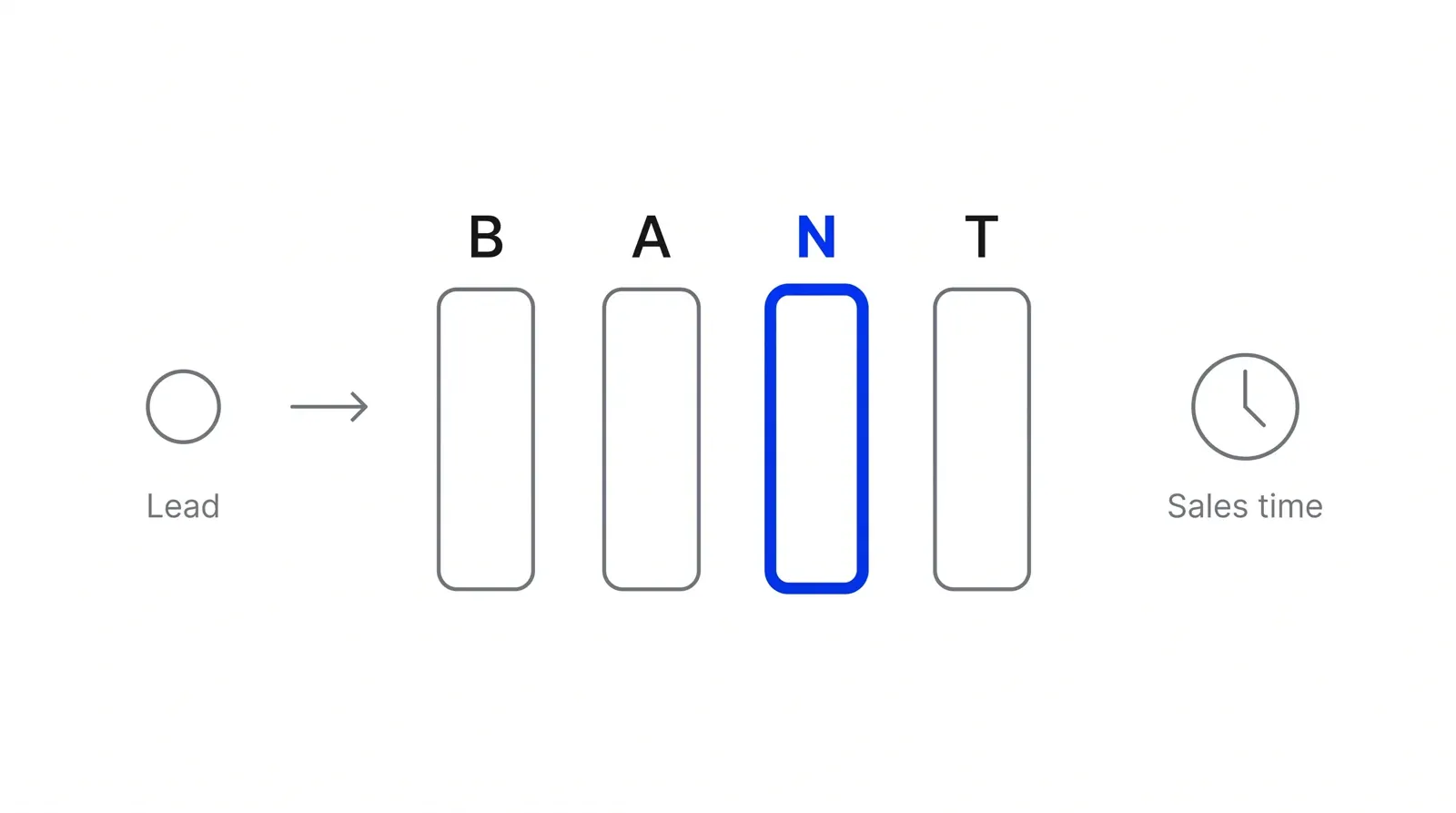
The order those four get asked in is the part of BANT sales teams argue about most.
The case for asking about need first
Opening a call with a budget question puts a prospect on the defensive before they have explained what they are trying to solve, and a long line of sales writing argues the order should flip. Neil Rackham’s 1988 book SPIN Selling built an entire questioning method, Situation, Problem, Implication, Need-payoff, around surfacing the need before anything else gets discussed, years before BANT’s order became a talking point. Matthew Dixon, Brent Adamson and Nicholas Toman went further in their 2012 Harvard Business Review article “The End of Solution Sales”: drawing on a Corporate Executive Board study of more than 1,400 B2B customers, they found buyers now complete a large share of the purchasing decision on their own, researching and comparing before ever speaking to a salesperson. A rep who opens with a budget or authority question to a buyer who has already done that homework is starting in the wrong place. Need has to be confirmed, or reconfirmed, before the other three letters carry any weight.
That reasoning is exactly what produced BANT’s two closest successors. CHAMP (Challenges, Authority, Money, Priority) is credited to Zorian Rotenberg, who built it for venture-backed software sales teams on the idea that opening on a prospect’s challenge earns more of the conversation than opening on their budget. ANUM (Authority, Need, Urgency, Money), associated with Ken Krogue at InsideSales.com, keeps the same underlying questions as BANT but moves Authority to the front, on the reasoning that finding the decision-maker matters more on a first call than knowing their budget. Neither framework claims BANT’s four checks are wrong. Both argue the order was.
Why Authority is the letter modern buying breaks
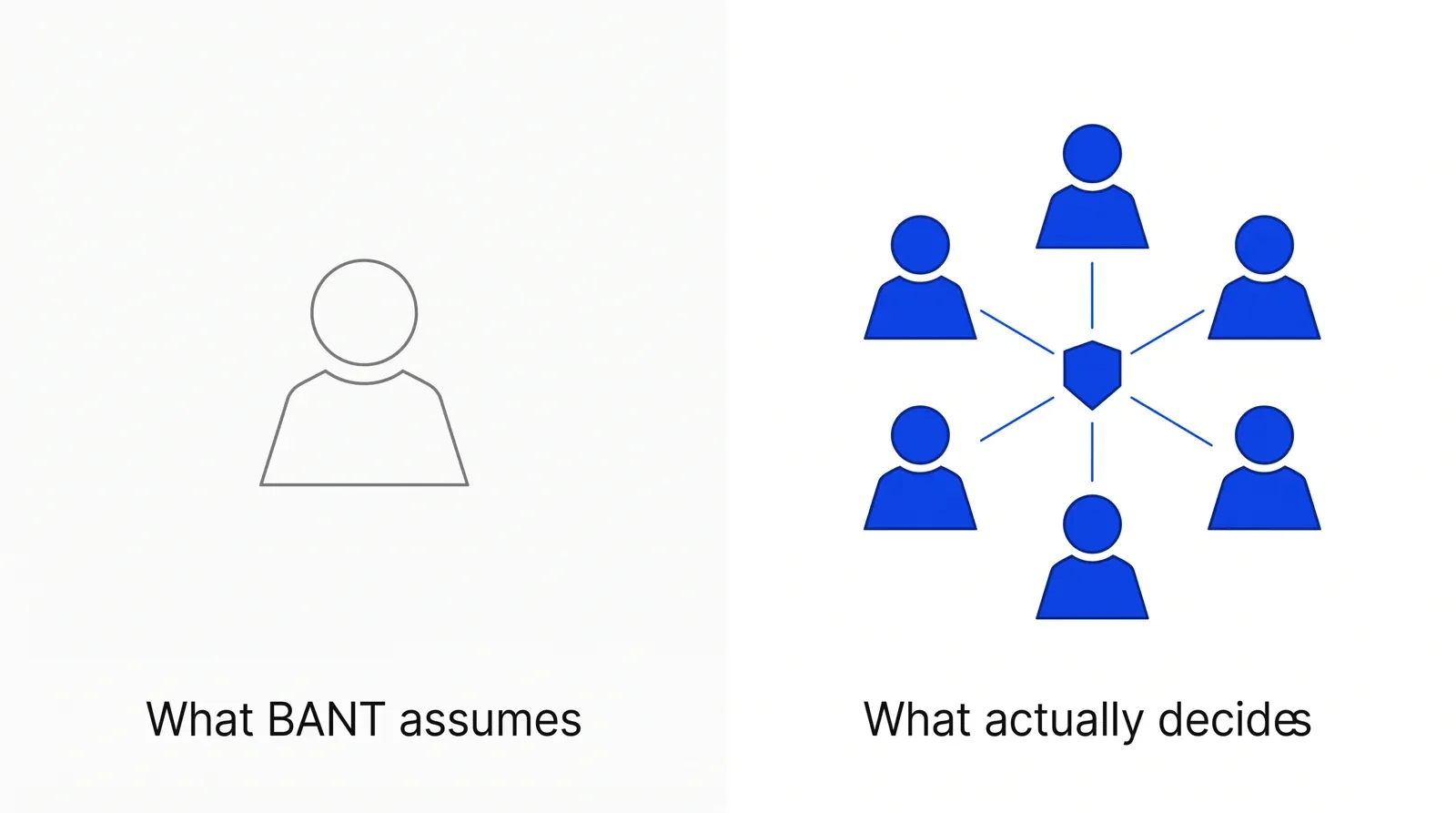
BANT’s Authority question was built around a single decision-maker, and that assumption is the framework’s weakest point today. Forrester’s Buyers’ Journey Survey 2025, published in its State of Business Buying 2026 report, puts the typical B2B purchase at 13 internal stakeholders and nine external influencers, rising further for complex or strategic deals. A qualification call that finds one “authority” contact and stops there has very likely found one voice inside a group that has not agreed on anything yet. This is also where a large share of marketing’s work quietly disappears: research by Gaurav Sabnis and colleagues, published in the Journal of Marketing in 2013, found that sales reps never follow up on roughly seventy percent of marketing-generated leads, a gap the researchers tied to competing demands on reps’ time. A fast BANT pass is partly a defense against that gap. It gives a rep a quick reason to spend time on a lead, or a quick reason not to, before the lead sits untouched.
BANT, CHAMP and MEDDIC compared
For a short sales cycle with one or two decision-makers, BANT’s speed is still an advantage. For a longer, multi-stakeholder enterprise deal, most sales organizations reach for something built with more depth.
| BANT | CHAMP | MEDDIC | |
|---|---|---|---|
| Checks | Budget, Authority, Need, Timeline | Challenges, Authority, Money, Priority | Metrics, Economic buyer, Decision criteria, Decision process, Identify pain, Champion |
| Order | Budget first, by the original design | Challenges first | No fixed order, tracked continuously |
| Best for | A short call, one or two decision-makers | The same deals as BANT, opened on the problem instead of the budget | Complex, multi-stakeholder enterprise deals |
| Runs for | One qualifying conversation | One qualifying conversation | The whole deal, through close |
MEDDIC carries a disputed history of its own that mirrors BANT’s. The training company MEDDICC credits Dick Dunkel with creating it at PTC in 1996, working under sales SVP John McMahon alongside Jack Napoli. A second account, from MEDDIC Academy, describes it instead as the collective output of PTC’s sales organization in the early 1990s under CEO Steve Walske, with a longer list of contributors and no single name attached. Both versions agree on the company, PTC, and on Dunkel and Napoli’s involvement; they disagree on whether one person gets the credit and on the exact year. McMahon later wrote his own account of the period in The Qualified Sales Leader (2021). MEDDIC has since grown two extra letters in wide use: MEDDICC adds Competition, and MEDDPICC adds Paper Process, the prospect’s own procurement steps.
HubSpot took a fourth path, publishing GPCTBA/C&I, Goals, Plans, Challenges, Timeline, Budget, Authority, Consequences and Implications, as a direct response to the same problem: a prospect who has already researched the market needs to be asked about goals and the cost of inaction before anyone raises budget.
Where BANT still belongs
BANT still does what it was built for: a fast first filter before any full deal strategy. A short sales cycle with one or two decision-makers rarely needs MEDDIC’s depth, and a lead that arrived through a lead magnet still deserves a quick BANT pass before anyone invests serious selling time in it. Run it as one early input in a conversation, in whatever order fits how a specific buyer researches and decides, as part of the qualification discipline covered in Pushers’ growth lab work, and reach for a deeper framework the moment several stakeholders enter the deal.
How to apply BANT, step by step
- Ask about the need before anything else. Open with what problem the prospect is trying to solve and why now, before asking about money or approval. A need confirmed early gives every later question something to attach to; skipping it means the budget and authority questions are being asked about nothing in particular. Result: one sentence, in the prospect's own words, describing a specific problem.
- Map who has to say yes. Ask who else touches this decision, not only who is on the call. In a small company the person speaking may be able to approve the purchase alone; in most B2B deals today, several people from different departments have to agree first. Result: a short list of names and roles, not one contact treated as the whole answer.
- Find the budget without demanding a number. Ask whether the organization has spent money on something like this before, or what the problem is currently costing them, instead of requesting a figure on the first call. A prospect who has never priced this category of purchase cannot give an accurate number yet. Result: a sense of whether money exists or can be found, even without an exact figure.
- Pin down what has to happen by when. Ask what event or deadline is driving the timing, not just when the prospect would like to start. A renewal date, a budget cycle or a compliance deadline behaves very differently from an open-ended 'sometime this year.' Result: a specific date or trigger, or a clear admission that neither exists yet.
- Weigh the answers and route the lead. Read the four answers together instead of requiring a perfect score on each one. A strong need with a soft budget is often still worth pursuing; a strong budget with no confirmed need rarely is. Result: a clear next step, active pipeline, a slower nurture track, or letting the lead go.
Examples
A B2B payments provider qualifying a merchant
Illustrative: a card-processing company gets an inbound signup from a mid-size furniture retailer. The rep confirms the need first: the retailer's current processor just raised its rates and they are actively comparing alternatives. The person who filled out the form turns out not to be the one who signs vendor contracts; the finance director is. Budget needs no separate conversation, since the spend already exists with the current processor, and the timeline is concrete: that contract renews in five weeks. Three of the four letters came back strong on one call.
A clinic-software vendor qualifying a dental chain
Illustrative: a company selling scheduling software for dental practices hears from an office manager at a ten-location chain. The need checks out: half the sites still run on paper charts. The office manager has no authority to buy software for locations she does not run, though, and no budget conversation is happening yet at the ownership level. The rep does not drop the lead or force it through a scorecard built for a same-day decision. It goes into a slower nurture track until the office manager can connect the rep to whoever owns the multi-location decision.
When to use it
Use BANT early in a sales conversation, right after a lead shows clear interest, to decide quickly whether it deserves more of a salesperson's time or should go back to marketing for further nurturing. It fits best in shorter sales with one or two decision-makers.
When not to use it
Skip a rigid BANT checklist in complex enterprise deals with a large buying group; running every stakeholder through the same four questions in the same order misses who blocks or approves the purchase. Skip it too as a scripted interrogation on a first call: asking for a budget figure before any need has been established reads as pressure, and tends to end conversations instead of opening them.
Common mistakes
- Opening with the budget question, which can put a prospect on the defensive before they have said what problem they are trying to solve.
- Treating one confirmed contact as 'Authority' without checking who else in the organization has to agree.
- Disqualifying a lead the moment one letter comes back weak, instead of weighing all four together.
- Running the same four questions, in the same order, on a ten-person enterprise buying committee and a single-owner small business.
FAQ
What does BANT stand for?
Budget, Authority, Need and Timeline. A salesperson asks whether the prospect can pay, who has to approve the purchase, what problem it solves and when it needs to happen, then uses the four answers together to decide whether the lead is worth pursuing right now.
Is BANT outdated?
The four questions still matter, but a checklist built around a single decision-maker and one call has not kept pace with how B2B buying works today. Most sales teams now treat BANT as one early input, alongside a deeper framework like MEDDIC once a deal reaches a multi-stakeholder buying group.
What is the difference between BANT and MEDDIC?
BANT is a short, early checkpoint: four questions asked once to decide whether a lead earns more time. MEDDIC is tracked through an entire deal and covers measurable outcomes, the actual budget-holder, the buying process and an internal champion, built for complex sales with several stakeholders.
Should Need or Budget come first in a qualification call?
Most current sales writing argues for Need first. A prospect who has not stated a specific problem has nothing for a budget or authority question to attach to, and opening with money tends to put people on the defensive before they explain what they are trying to solve.
What replaced BANT?
Nothing has fully replaced it. ANUM and CHAMP reorder the same four ideas, asking about authority or challenges first. GPCTBA/C&I adds a prospect's goals and the cost of inaction before money comes up. MEDDIC goes further, built for multi-stakeholder enterprise deals. Many teams still use some version of BANT for a fast first pass.
Sources
- IBM, Budget Authority Need Timeframe (BANT) Criteria Template v3.3
- Salesforce, What Is BANT? The Way to Qualify Better Leads and Close More Deals
- Salesforce, The Better Way For Sales Teams To Approach The BANT Framework
- Brent Adamson, Matthew Dixon, Nicholas Toman, The End of Solution Sales, Harvard Business Review, July-August 2012
- Matthew Dixon, Brent Adamson, The Challenger Sale: Taking Control of the Customer Conversation, Portfolio/Penguin, 2011, Open Library record
- Forrester, Forrester's 2026 Buyer Insights: GenAI Is Upending B2B Buying, press release
- Philip Kotler, Neil Rackham, Suj Krishnaswamy, Ending the War Between Sales and Marketing, Harvard Business Review, July-August 2006
- Neil Rackham, SPIN Selling, McGraw-Hill, 1988, Open Library record
- Gaurav Sabnis, Sharmila C. Chatterjee, Rajdeep Grewal, Gary L. Lilien, The Sales Lead Black Hole: On Sales Reps' Follow-Up of Marketing Leads, Journal of Marketing 77(1), 2013
- MEDDICC, Who Created MEDDIC
- MEDDICC, MEDDIC / MEDDPICC Sales Methodology and Process
- MEDDICC, MEDDICC Versus Other Qualification Frameworks Like BANT
- MEDDIC Academy, MEDDIC Sales Methodology & Checklist
- MEDDPICC.net, MEDDPICC Definition
- John McMahon, The Qualified Sales Leader: Proven Lessons from a Five Time CRO, 2021, Open Library record
- Force Management, MEDDICC Sales Qualification Methodology & Process
- Zorian Rotenberg, CHAMP Selling
- HubSpot Sales Blog, BANT Isn't Enough Anymore: A New Framework for Qualifying Prospects
- InsideSales.com, A Reflection on ANUM: Qualifying Leads
- IBM, EMEA VAP Government BANT Form
Last updated Sep 25, 2026