Customer journey map (CJM)
A customer journey map lays out what a customer does, thinks and feels at each step toward a goal, so a team can see where the experience breaks instead of guessing from the org chart.
A customer journey map is a visual timeline of what one customer does, thinks and feels while pursuing a goal with a business, phase by phase, plotted against an emotion line that shows where the experience breaks. Teams use it to find the one pain point worth fixing first, instead of guessing from a support inbox or an org chart.
- Origin
- Contested: G. Lynn Shostack (service blueprint); Jan Carlzon (moments of truth); the journey-map artifact itself formalized later by UX and service-design practice, 1984; 1987; practice-based, no single founding date
- Level
- 201 · Tool
- Fits
- Startup, Small and mid-size, Scale-up, Enterprise
- Time to apply
- about a day for a first draft from existing support data and analytics; a week or two if new customer interviews are needed first
- What you need
- real notes from customers: interviews, support tickets, call recordings or analytics, not a room full of assumptions · one persona and one journey scoped in advance, not every path through the business at once
A customer journey map is a visual timeline of what one customer does, thinks and feels while working toward a goal with a business, laid out phase by phase and plotted against a line that tracks how the experience feels at each step. Teams reach for it when they already sense something is going wrong in how a customer experiences the business, but nobody agrees on where.
Where the idea came from
No single person invented the customer journey map. The closest thing to a founding document is G. Lynn Shostack’s 1984 Harvard Business Review article “Designing Services That Deliver,” which introduced the service blueprint, the first structured way to map a service process step by step. Three years later, in his 1987 book Moments of Truth, former SAS chief executive Jan Carlzon argued that customers judge a service by thousands of short contacts with front-line employees, more than by anything in a strategy document.
Carlzon’s own book gives a plain example. A passenger who pre-ordered a vegetarian meal asks the check-in agent, who does not know; asks the gate agent, who does not know either; and finally asks the flight attendant, by which point the meal never made it on board. Carlzon’s verdict: a hierarchy that had “ruined three moments of truth” in a single trip.
The journey map itself, as a diagram with phases, actions and an emotion line, came later still, out of UX and service-design practice rather than one book or paper. A 2018 systematic review by Følstad and Kvale in the Journal of Service Theory and Practice, examining 45 papers, found no settled definition before 2013, describing the terminology in use as “rich and at times incoherent.” What holds constant across all three threads, Shostack’s blueprint, Carlzon’s moments of truth, and the later UX artifact, is the instinct to trace one customer’s path rather than judge the business one department at a time.
What the map shows
A journey map starts with one persona and one goal, then breaks that goal into phases a customer would recognize: discover, decide, start, first use, for example, in the customer’s own words rather than the department names a business uses internally. Nielsen Norman Group’s guide to journey mapping lists the standard components: an actor, a scenario and its expectations, the journey’s phases, and for each phase the customer’s actions, thoughts and feelings. Plotted across the top, those feelings become a single emotion line, rising when something goes well and dropping when it does not.
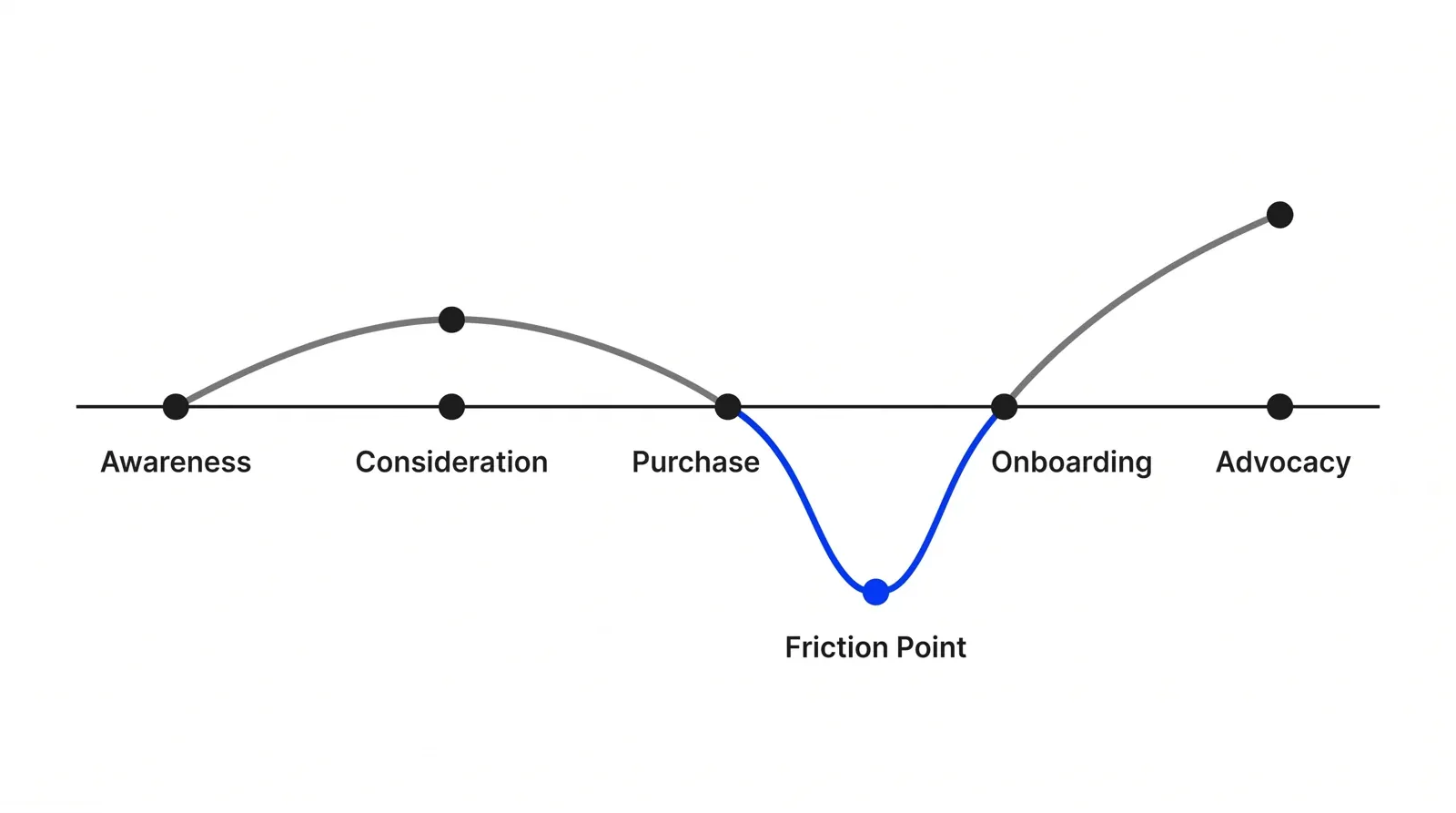
The point that dips lowest is the pain point, the one place in the journey most worth fixing before any other. Most teams already suspect where it is. A map’s job is to test that suspicion against what customers did instead of what a meeting room agreed on.
Touchpoints and the journey
A touchpoint is a single contact: one call, one page, one visit. A journey is what connects those contacts from one customer’s side, in the order that customer lived them. The distinction matters because measuring touchpoints alone can hide a broken journey. A 2013 Harvard Business Review article by McKinsey partners Alex Rawson, Ewan Duncan and Conor Jones argued that touchpoint-by-touchpoint satisfaction scores miss “the bigger, and more important, picture: the customer’s end-to-end journey,” since a customer can rate every step well in isolation and still abandon the process as a whole.
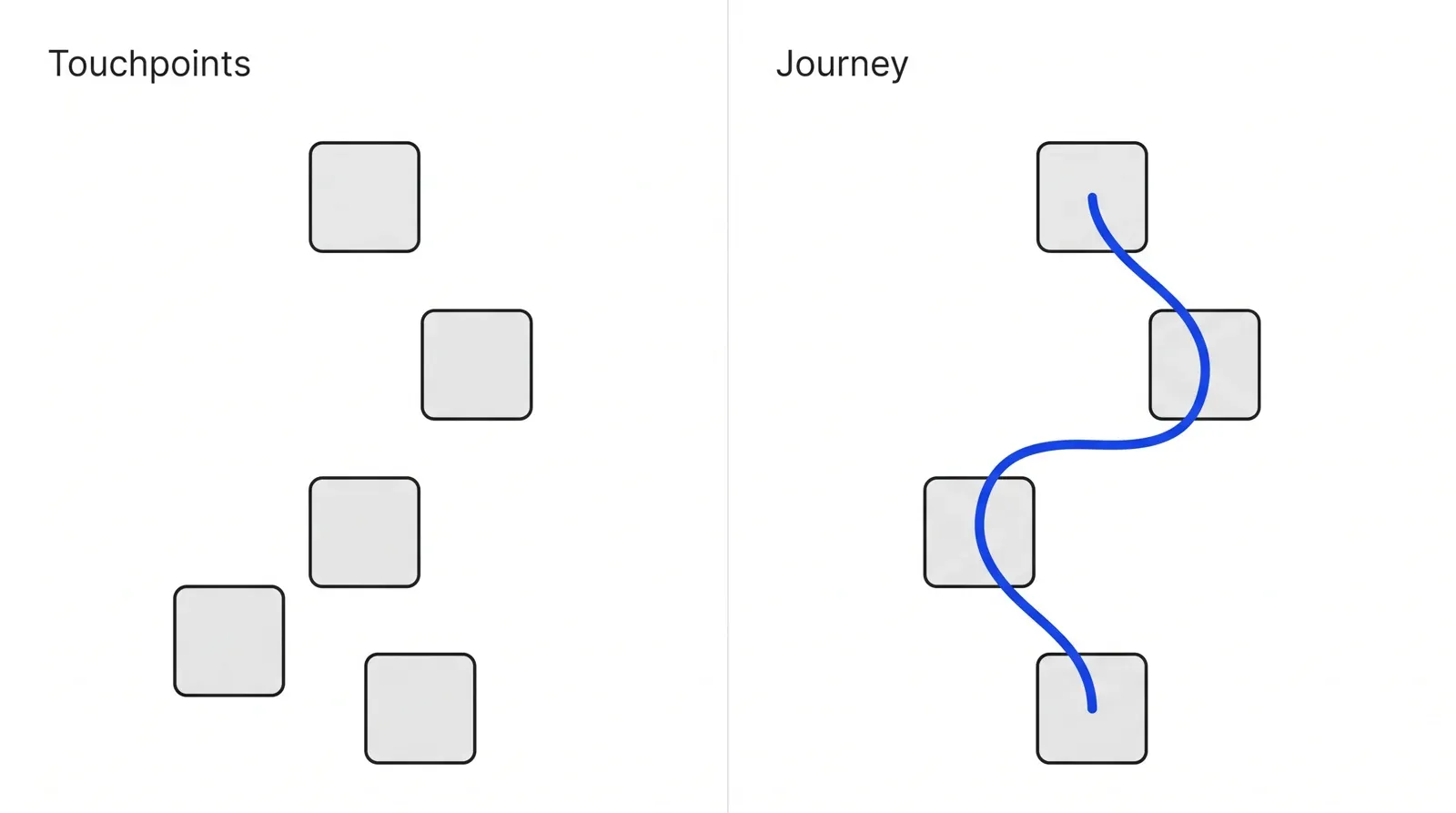
Peer-reviewed service-design research backs the same split. Leonieke Zomerdijk and Christopher Voss, writing in the Journal of Service Research in 2010, argued that what an organization plans for a customer and what that customer lives through are two different things worth tracking separately. Ragnhild Halvorsrud, Knut Kvale and Asbjørn Følstad picked up the same distinction directly in their own 2016 customer journey research: a blueprint shows what an organization plans for a customer, while touchpoints and journeys show what happens from the customer’s point of view. Katherine Lemon and Peter Verhoef’s wider research on customer experience treats that lived experience as something built from a whole set of interactions with a company, not any one of them alone.
Journey map, service blueprint or funnel
Teams confuse the journey map with two other diagrams that look similar on a whiteboard.
| Journey map | Service blueprint | Funnel | |
|---|---|---|---|
| Shows | The customer’s actions, thoughts and feelings | The organization’s frontstage and backstage processes behind the same journey | A single linear path toward one outcome |
| Built from | Interviews, support data, real customer behavior | The same research, plus internal process and system maps | Conversion data at each stage |
| Answers | Where the experience breaks, and how it feels | What has to change internally to fix it | Where people drop off a fixed sequence |
| Assumes | Branches, backtracking, real behavior | The journey it is documenting | One direction, no backtracking |
Nielsen Norman Group calls the blueprint “a sequel to customer-journey maps”: build the journey map first, from the customer’s side, then add the blueprint to show what has to change behind the scenes to fix what the map found. A funnel is a different animal. It assumes, in the tradition of the old AIDA model, that a buyer moves through one fixed sequence toward one action. A 2023 Harvard Business Review article described the funnel as “an inside-out process that assumes buyers move sequentially” through set stages, which is rarely how a real customer behaves. Even AIDA’s own origin story is shakier than the textbooks suggest, as the AIDA model page covers; peer-reviewed historical research by Akinori Iwamoto found the popular claim that advertiser E. St. Elmo Lewis invented AIDA in 1898 is “unsupported or based on weak evidence.” The funnel measures a fixed stage. The journey map explains why a real customer left it.
Where it has spread beyond marketing
Journey mapping did not stay inside marketing departments. A 2024 methods paper in the European Journal of Cardiovascular Nursing lays out a six-step process for patient journey mapping, from defining the gap in care to reporting the findings, and a 2023 scoping review in the Journal of Advanced Nursing found 81 published studies using the method, three-quarters of them from 2015 onward, a sign that health services researchers picked it up quickly once they started. Financial services teams apply the same logic to account opening and onboarding: Deloitte’s research on retail banking found that an account that takes 45 to 60 minutes to open draws far more complaints than one opened in under 15 minutes, exactly the kind of gap a journey map, rather than a funnel report, is built to explain.
None of this needs new software. A journey map is a discipline: pick one persona, gather what customers did instead of what the room assumes, plot the phases and the feeling at each one, then give the lowest point on the line a named owner. Run it as a standing part of a marketing operational system instead of a one-off workshop, and the map stays a live picture of where the business loses people instead of a poster from a kickoff meeting.
How to apply Customer journey map (CJM), step by step
- Pick one persona and one journey. Choose a single customer type and a single goal, opening an account or booking a first visit. A map that tries to cover every path through the business at once ends up showing nothing clearly.
- Gather what customers did, not what the room assumes. Pull from support tickets, call recordings, analytics and a handful of real interviews. A journey map built only from a meeting room maps what the team believes instead of what the customer went through.
- Lay out the phases in the customer's language. Break the goal into phases a customer would recognize: discover, decide, start, first use, rather than the internal department names the business uses for the same steps.
- Plot the actions, thoughts and feelings in each phase. For every phase, note what the customer does, what they are trying to work out, and how they feel about it. This is the step that turns a flowchart into a journey map.
- Draw the emotion line and mark the low point. Connect the feeling from each phase into a single line. The point that dips furthest is the pain point, the one place in the journey most worth fixing before any other.
- Give the pain point an owner and a next step. A journey map that ends without a named owner and a deadline is a poster for the wall. Assign the lowest point on the line to one person, then re-map the journey once the fix ships.
Examples
A patient's path to a first visit
Illustrative: a physiotherapy clinic assumes the low point in a new patient's journey is the wait for an appointment slot. Mapping real call recordings finds an earlier, lower point instead: patients calling three different numbers before reaching someone able to book them in, well before any wait begins.
A fintech account opening
Illustrative: a challenger bank's funnel already shows where people abandon the sign-up form. The journey map adds what the funnel cannot: customers who finish the form, then sit unsure whether the account is open, and call support to ask, a lower point one step past the one the funnel was built to catch.
When to use it
Use it once a team has a defined persona and goal and needs one shared, evidence-based picture of where a real customer's experience breaks, especially when support, product and marketing each blame a different stage for the same drop-off.
When not to use it
Skip it when nobody has interviewed or observed a real customer yet; a map built from assumptions only documents what the room already believed. Skip it too for a single-step interaction with no real sequence to trace, where a plain process map or a service blueprint fits better.
Common mistakes
- Mapping an imagined journey from a meeting room instead of real customer data, so the map confirms what the team already believed.
- Trying to map every persona and every path in one diagram, which produces something too busy for anyone to act on.
- Treating the finished map as a poster for the wall instead of assigning an owner and a deadline to the pain point it found.
- Confusing the journey map with the sales funnel, then measuring conversion at each stage instead of the customer's experience.
- Mapping the journey once and never again, so a fix that worked in year one goes unchecked while the product and the customer both move on.
FAQ
What is a customer journey map?
A customer journey map is a visual timeline of what one customer does, thinks and feels while working toward a goal with a business, phase by phase, plotted against an emotion line that shows where the experience breaks. It gives a team one shared, evidence-based picture instead of separate guesses from support, product and marketing.
Who invented the customer journey map?
No single person did. G. Lynn Shostack's 1984 service blueprint was the first structured way to map a service. Jan Carlzon's 1987 book Moments of Truth argued a service is decided contact by contact. The journey map itself, with phases and an emotion line, was formalized later by UX and service-design practice, with no one founding date.
How is a customer journey map different from a service blueprint?
A journey map shows the customer's outside view: their actions, thoughts and feelings. A service blueprint takes the same journey and adds the organization's inside view, the frontstage staff actions and backstage systems that produce it. Research on service design treats the blueprint as a sequel to the journey map, not a rival to it.
How is a customer journey map different from a sales funnel?
A funnel assumes a single, linear path toward one outcome, moving a buyer through fixed stages. A journey map traces what one real persona does, including detours, waiting and abandonment, and plots how they feel at each phase. The funnel measures a stage; the journey map explains why people leave it.
Sources
- G. Lynn Shostack, Designing Services That Deliver, Harvard Business Review, January 1984
- Mary Jo Bitner, Amy L. Ostrom, Felicia N. Morgan, Service Blueprinting: A Practical Technique for Service Innovation, California Management Review 50(3), 2008
- Jan Carlzon, Moments of Truth (1987), excerpted in Jan Carlzon, Harvard Business School case 8-489-046, rev. 2001
- Katherine N. Lemon, Peter C. Verhoef, Understanding Customer Experience Throughout the Customer Journey, Journal of Marketing 80(6), 2016, University of Groningen research portal
- Alex Rawson, Ewan Duncan, Conor Jones, The Truth About Customer Experience, Harvard Business Review, September 2013
- Nielsen Norman Group, Journey Mapping 101
- Nielsen Norman Group, Service Blueprints: Definition
- Nielsen Norman Group, Service Blueprinting FAQ
- Patient journey mapping: emerging methods for understanding and improving patient experiences of health systems and services, European Journal of Cardiovascular Nursing 23(4), 2024, Oxford Academic
- Davies et al., Reporting and conducting patient journey mapping research in healthcare: A scoping review, Journal of Advanced Nursing, 2023, PMC
- Asbjørn Følstad, Knut Kvale, Customer journeys: a systematic literature review, Journal of Service Theory and Practice 28(2), 2018, Emerald
- Peter C. Verhoef, Katherine N. Lemon, A. Parasuraman, Anne Roggeveen, Michael Tsiros, Leonard A. Schlesinger, Customer Experience Creation: Determinants, Dynamics and Management Strategies, Journal of Retailing 85(1), 2009
- Akinori Iwamoto, The Origin of AIDA: Who Invented and Formulated the AIDA model?, Faculty of Business and Commerce, Kansai University
- Sales Teams Need to Stop Focusing on the Customer Funnel, Harvard Business Review, March 2023
- Salesforce, Customer Journey Mapping: A Complete Guide
- Gainsight, Customer Journey Mapping, glossary
- Deloitte Insights, Improving the account opening process in retail banking
- Ragnhild Halvorsrud, Knut Kvale, Asbjørn Følstad, Improving Service Quality through Customer Journey Analysis, Journal of Service Theory and Practice 26(6), 2016, SINTEF author's accepted manuscript
- Nielsen Norman Group, The 5 Steps to Customer Journey Mapping
- Leonieke G. Zomerdijk, Christopher A. Voss, Service Design for Experience-Centric Services, Journal of Service Research 13(1), 2010, London Business School Research Online
Last updated Sep 25, 2026

The compliance layer under fintech marketing operations
A fintech marketing agency can build campaigns. It cannot own the compliance review, the KYC drop-off or the multi-market licensing rules that decide whether a lead ever becomes a customer.

Fractional CMO: what you get, and what has to exist underneath
A fractional CMO brings strategy and judgment. Without reporting, CRM hygiene and a named owner per number, the engagement produces a slide deck instead of a system.

The operations layer behind healthcare patient acquisition
Ads and search bring the request in. What happens between the click and the booked, attended visit decides whether the spend paid off.