Brand archetypes
Brand archetypes are twelve recognisable character types, from the Hero to the Sage, that a brand plays consistently so people remember it and know what to expect.
Brand archetypes are twelve recognisable character types (the Hero, the Sage and the Caregiver among them) that a brand plays consistently so people remember it and know what to expect. Margaret Mark and Carol Pearson set out the model in their 2001 book The Hero and the Outlaw, adapting Carl Jung's theory of archetypes for brand strategy. Treat it as a planning tool: the psychology behind it is contested.
- Origin
- Margaret Mark and Carol S. Pearson (brand model); Carol S. Pearson (twelve archetypes); Carl Jung (archetype theory), 2001; 1991; 1934-1954
- Level
- 201 · Tool
- Fits
- Startup, Small and mid-size, Scale-up
- Time to apply
- a day to pick the archetype and draft one test asset
- What you need
- a short list of what customers want from the category, in their own words · one live asset (a page, an email or an offer) you can test against the current version
A brand archetype is one of twelve recognisable character types, among them the Hero, the Sage, the Outlaw and the Caregiver, that a company plays consistently across its messaging so a stranger can place it quickly and predict what to expect from it next time. Advertising researcher Margaret Mark and Jungian scholar Carol S. Pearson set the model out in their 2001 book The Hero and the Outlaw, adapting Carl Jung’s idea of archetypes, patterns of character that recur across myths and stories from unrelated cultures, into a tool for brand strategy. Pearson had already laid out the same twelve characters a decade earlier in a self-help book, Awakening the Heroes Within. What the 2001 book adds is the claim that a brand reads as one of these characters whether anyone planned it that way or not, and that naming the character on purpose beats leaving it to chance.
Twelve characters, four motivations
Mark and Pearson group the twelve archetypes under four underlying motivations: independence (Innocent, Sage, Explorer), mastery (Hero, Outlaw, Magician), belonging (Lover, Jester, Regular Guy or Girl) and stability (Caregiver, Creator, Ruler). One axis runs from fitting in to standing apart, the other from holding steady to taking a risk, and the four groups sit at the corners those two axes make. A brand picks one point in that space. It does not spread itself across all four.
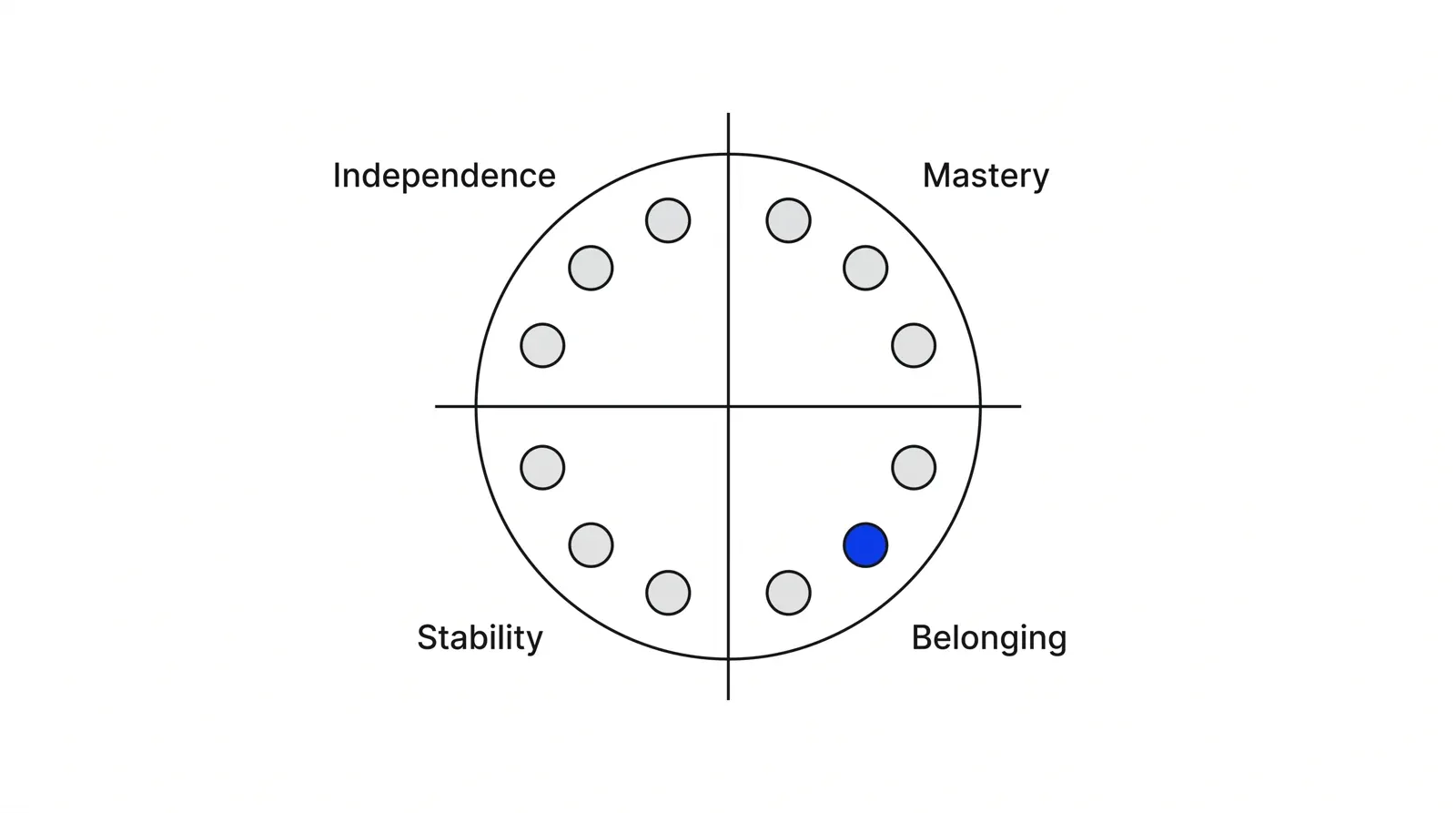
The four-group chart works as a starting filter more than a fixed answer. A 2021 University of Washington dissertation tested the model against real consumer ratings and found the twelve archetypes cluster differently once actual perception data replaces the book’s own grouping. A rough shape survives contact with customers better than a chart fixed in 2001 does.
Choosing one from what customers want
The archetype that fits is the one that matches what customers already want from the category. A founder’s own taste does not decide it. A project-management tool used mostly by overloaded operations managers is answering a demand for order and reliability, which points toward the Ruler or the Caregiver rather than the Jester, however much a founder likes playful marketing. The test stays the same across categories: write down the job customers hire the brand to do, then ask which of the twelve characters would do that job the way customers want it done.
A short customer-motive list beats a mood board here. Ask or survey what customers say they want from the category itself, group the answers against the four motivations above, and the archetype tends to fall out on its own instead of needing a vote in a workshop.
What the choice changes
Picking an archetype sets three things a team has to keep matching afterward: tone of voice, visuals and the kind of offer the brand can credibly make. The work does not stop at a mood board.
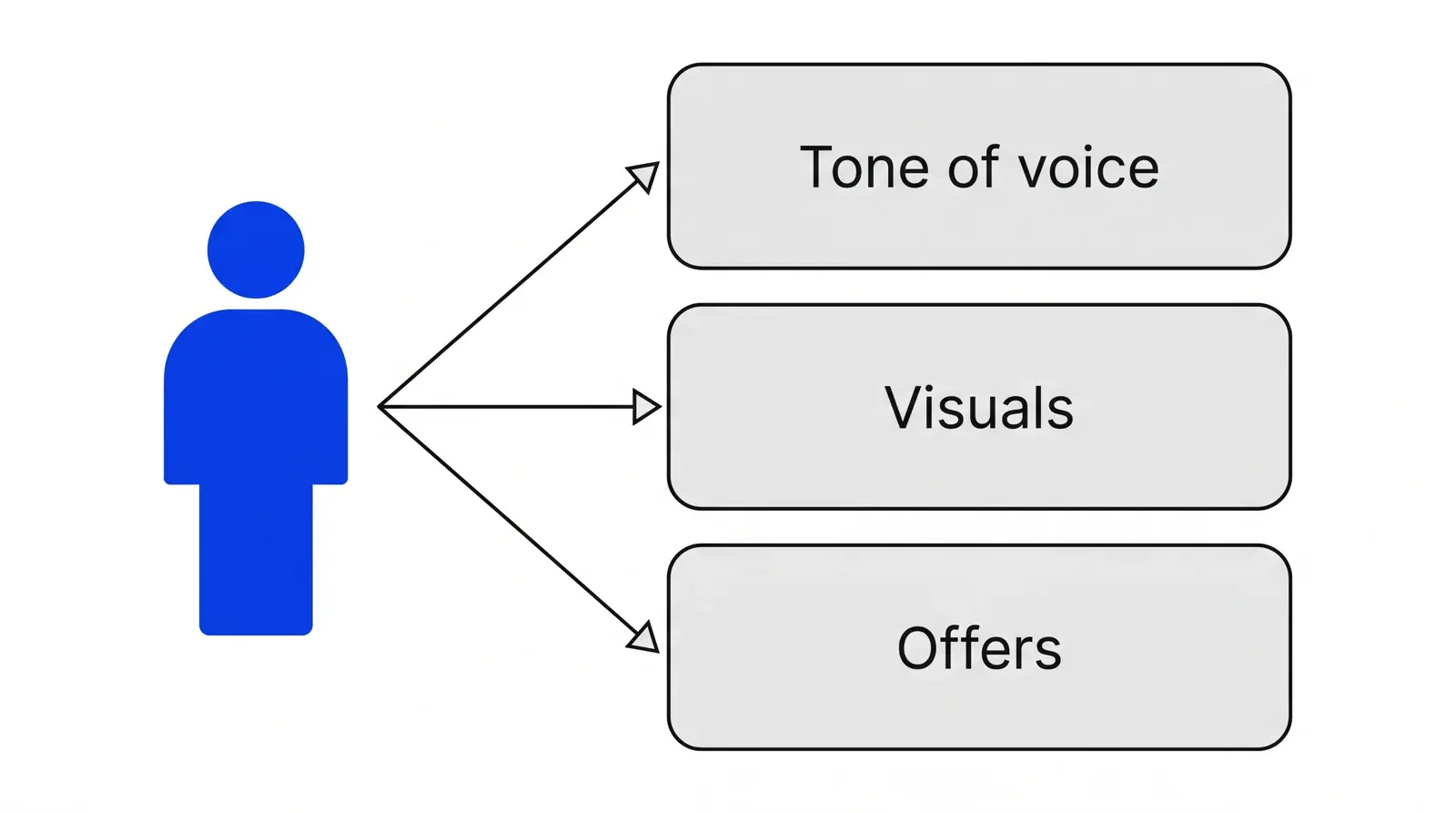
A brand playing the Sage writes in short declarative sentences, cites evidence and shows its reasoning, because a Sage’s whole claim rests on being right. A brand playing the Caregiver writes warmer, checks in first, and leads with reassurance before facts. Visuals follow the same split: clean charts and neutral colour for the Sage, softer imagery and warmer colour for the Caregiver. Offers follow too. A Sage-styled offer looks like a free diagnostic or a detailed comparison; a Caregiver-styled offer looks like a guarantee or a real person to call. A discount that reads as pure Outlaw sits oddly under a brand built as a Ruler, because a Ruler’s whole promise is that it does not need to discount.
Does the psychology hold up
Only partly. Mark and Pearson’s book presents archetype as grounded in Jung’s theory of a shared unconscious, but Jung’s own attempt to frame that theory as natural science has drawn direct criticism from Jungian scholars. Analytical psychologist Christian Roesler argues Jung’s claimed biological and cross-cultural universals are unsupported, and that archetype theory works better as a way of reading culture and myth than as a tested claim about inherited psychology. Marketing’s own evidence-based alternative, Jennifer Aaker’s 1997 brand personality scale (Sincerity, Excitement, Competence, Sophistication and Ruggedness) was built from factor analysis of real consumer ratings rather than depth psychology. A follow-up study by Aaker and coauthors found those same five traits shift by culture (Japan has a Peacefulness trait the US lacks), which weakens any claim to a fixed, universal structure on either side of the comparison.
That does not make archetype useless for planning. It works as a story a team can write from, adapted from Jung’s language, and the planning use does not depend on the underlying science being settled.
Archetype or personality
| Brand archetype (Mark and Pearson) | Brand personality (Aaker) | |
|---|---|---|
| Unit | One of twelve fixed characters | A score across five traits |
| Built from | Jung’s theory of archetypes, adapted for brands | Factor analysis of real consumer ratings |
| Answers | Which story this brand tells | How customers would describe this brand as a person |
| Weak spot | The psychology behind it is contested | The traits shift across cultures |
The two answer different questions rather than compete. An archetype gives a team a story and a default set of choices to write from. A personality score gives a research team something to measure wave over wave. Many brand teams use both, an archetype to brief creative work and a personality survey to check whether the finished work still reads the way it was meant to.
Where this goes wrong
Two mistakes account for most archetype failures, and they sit at opposite ends. The first is mixing archetypes by accident: a retailer whose ads play the Jester, all wit and colour, while its returns policy and support line read as pure Ruler, rigid and procedural, leaves customers unsure which company they are dealing with. Mixing on purpose is a different matter: a 2023 Business Horizons study of more than 2,400 brands found that fast-growing companies often combine two or three archetypes, with one clearly leading. The failure case is drift. Imperial College Business School’s write-up of that research names Harley-Davidson and Barbour as brands that layer archetypes on purpose, with a lead character still doing most of the work.
The second mistake is choosing an archetype the product cannot support. A budget airline that markets itself as the Ruler, control and status, invites a direct comparison with cramped seats and add-on fees at the gate, the exact gap Harvard Business Review’s Rebecca Newton points to when she argues a brand’s promised identity has to match what the organisation delivers. The fix for both mistakes is the same: pick one archetype to lead, write down what it promises, and check that promise against what customers get before the campaign goes out. New hires, new agencies and new campaign briefs all need that same check repeated, which is the kind of recurring review Pushers builds into a marketing-operational system rather than leaving to memory.
How to apply Brand archetypes, step by step
- List what customers want from the category. Interview or survey a handful of real or prospective customers about what they want from this kind of product, in their own words, before opening any archetype list. Result: a short list of motives, not brand adjectives.
- Match the strongest motive to one of four groups. Hold the motive list against the four underlying motivations (independence, mastery, belonging and stability) and see which group the answers cluster into. Result: three candidate archetypes instead of twelve.
- Pick one archetype, not a shortlist. Choose the single character inside that group closest to the motive list, and rule out the other two on purpose. Result: one archetype the whole team can name.
- Write three lines of copy in that character's voice. Draft a headline, a support-email opener and a pricing line the way that character would write them, then read them back without the logo attached. Result: copy a stranger could match to the archetype without being told which one it is.
- Check the promise against what the product delivers today. List where the archetype's promise (control, care or expertise) and the product or service line up, and where they do not yet. Result: a short list of gaps to close before the archetype goes wide.
- Apply it to one visual and one offer, then test. Change one live asset (a landing page hero image or a single offer) to match the archetype, and run it against the current version. Result: one measured comparison instead of a full rebrand on faith.
Examples
A fintech choosing between Sage and Caregiver
Illustrative. A savings app aimed at people who already track spending in a spreadsheet is answering a demand for expertise and clear numbers, which points to the Sage: dense charts, plain explanations of fees, a tone that assumes the reader is capable. The same category aimed at people rebuilding savings after a job loss is answering a demand for reassurance instead, which points to the Caregiver: a simpler dashboard, a human on the support line, copy that checks in before it explains a fee.
A clinic choosing between Caregiver and Ruler
Illustrative. A family clinic whose patients want to feel looked after points to the Caregiver: soft imagery, a doctor's name and face on the booking page, language that reassures before it lists procedures. A specialist clinic whose patients are comparing outcomes and credentials before they book points to the Ruler instead: results tables, board certifications up front, a tone that leads with authority rather than warmth.
When to use it
Use it when a brand needs one consistent character across ads, product copy, support and sales, especially at the point a small team's founder-led voice stops scaling and a newer hire needs a rule to write from without asking each time.
When not to use it
Skip it for a first positioning exercise with no customer research behind it yet; the archetype should follow from what customers want, and cannot substitute for finding that out. Skip it too as a one-off workshop nobody revisits, since a mismatched archetype only shows up once real copy, visuals and offers are tested against it.
Common mistakes
- Mixing archetypes by accident across touchpoints, an ad that plays the Jester next to a support line that reads Ruler, so customers cannot tell which character the company is.
- Picking the archetype a founder or a creative director likes rather than the one the customer-motive list points to.
- Treating the model as tested psychology instead of a marketing framework borrowed from Jung's language, when Jung's claimed universals have been challenged by Jungian scholars.
- Choosing an archetype the product cannot support yet, the Ruler for a company still fixing basic service reliability, which turns the brand promise into the complaint customers file.
FAQ
What are brand archetypes?
Brand archetypes are twelve recognisable character types, among them the Hero, the Sage and the Caregiver, that a brand plays consistently so people remember it and know what to expect. Margaret Mark and Carol Pearson set out the model in their 2001 book The Hero and the Outlaw, adapting Carl Jung's theory of archetypes for brand strategy.
Who invented the 12 brand archetypes?
Carol Pearson developed the twelve-archetype structure in her 1991 book Awakening the Heroes Within, before working with advertising researcher Margaret Mark. Their 2001 book The Hero and the Outlaw applied that existing structure to brands, with Pearson supplying the underlying twelve characters.
Is there scientific evidence for brand archetypes?
Not in the way the model is usually presented. Carl Jung's claim of universal, inherited archetypes has been challenged by Jungian scholars, and marketing's evidence-based alternative, Jennifer Aaker's five-trait brand personality scale, is built from consumer data rather than depth psychology. Archetype still works as a planning tool, separate from any claim about settled science.
Can a brand use more than one archetype?
Yes. A 2023 Business Horizons study of over 2,400 brands found fast-growing brands often combine two or three archetypes, with one clearly leading. The mistake is drifting between archetypes by accident across ads, support and product.
Sources
- Margaret Mark, Carol S. Pearson, The Hero and the Outlaw: Building Extraordinary Brands Through the Power of Archetypes, McGraw-Hill, 2001, Internet Archive record
- Carol S. Pearson, Awakening the Heroes Within: Twelve Archetypes to Help Us Find Ourselves and Transform Our World, HarperOne, 1991, Internet Archive record
- C. G. Jung, The Archetypes and the Collective Unconscious, Collected Works vol. 9 part 1, Princeton University Press, Internet Archive record
- Jennifer L. Aaker, Dimensions of Brand Personality, Journal of Marketing Research 34(3), 1997
- Jennifer L. Aaker, Veronica Benet-Martinez, Jordi Garolera, Consumption Symbols as Carriers of Culture, Journal of Personality and Social Psychology 81(3), 2001
- Audrey Azoulay, Jean-Noel Kapferer, Do Brand Personality Scales Really Measure Brand Personality?, Journal of Brand Management 11(2), 2003
- Christian Roesler, Critique of archetype theory: yesterday and today
- Clemens Bechter, Giorgio Farinelli, Rolf-Dieter Daniel, Michael Frey, Advertising between Archetype and Brand Personality, Administrative Sciences 6(2), 2016
- Susan Fournier, Consumers and Their Brands: Developing Relationship Theory in Consumer Research, Journal of Consumer Research 24(4), 1998
- Jean-Noel Kapferer, The New Strategic Brand Management, Kogan Page
- Kevin Lane Keller, Conceptualizing, Measuring, and Managing Customer-Based Brand Equity, Journal of Marketing 57(1), 1993
- Kevin Lane Keller, Vanitha Swaminathan, Strategic Brand Management: Building, Measuring, and Managing Brand Equity, 5th edition, Pearson, 2020
- Rebecca Newton, If Your Brand Promises Authenticity, You Better Deliver, Harvard Business Review, 2014
- EBSCO Research Starters, Brand Personality
- EBSCO Research Starters, Jungian Archetypes and the Collective Unconscious
- Carol S. Pearson, Archetypal Assessment: Pearson-Marr Archetype Indicator
- Carol S. Pearson, About Archetypes: C. G. Jung and Depth Psychology
- Omar Merlo, Andreas B. Eisingerich, Richard Gillingwater, Jia Jocelyn Cao, Exploring the Changing Role of Brand Archetypes in Customer-Brand Relationships, Business Horizons 66(5), 2023
- David A. Aaker, Building Strong Brands, Free Press, 1996, Internet Archive record
- Katie Spangenberg, Brand Archetypes, PhD dissertation, University of Washington, Foster School of Business, 2021
- Imperial College Business School, Lessons for Leaders: Successful Brands Have Multiple Personalities
Last updated Sep 25, 2026


The compliance layer under fintech marketing operations
A fintech marketing agency can build campaigns. It cannot own the compliance review, the KYC drop-off or the multi-market licensing rules that decide whether a lead ever becomes a customer.
Fractional CMO: what you get, and what has to exist underneath
A fractional CMO brings strategy and judgment. Without reporting, CRM hygiene and a named owner per number, the engagement produces a slide deck instead of a system.

The operations layer behind healthcare patient acquisition
Ads and search bring the request in. What happens between the click and the booked, attended visit decides whether the spend paid off.