Contribution margin
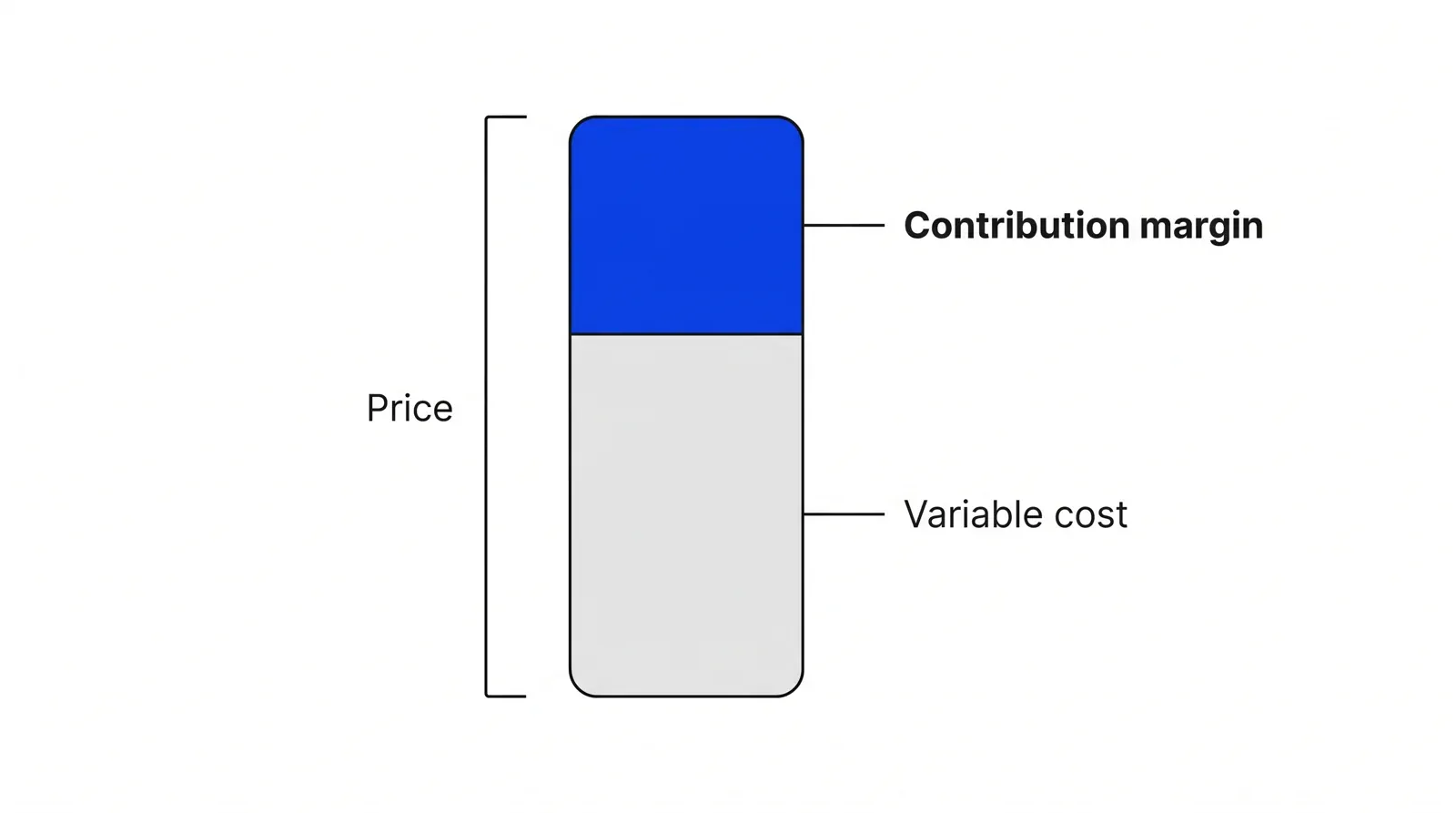
Contribution margin is what's left from one sale after variable costs, the money that covers fixed costs first and turns into profit only after fixed costs are paid.
Contribution margin is the amount left from a sale after subtracting the variable cost of making it, the part of every dollar of revenue that covers fixed costs and, once fixed costs are covered, turns into profit. Unit contribution margin equals price minus variable cost per unit. The contribution margin ratio is that figure divided by price, shown as a percentage.
- Origin
- Cost and management accounting practice, 20th century
- Level
- 201 · Tool
- Fits
- Startup, Small and mid-size, Scale-up
- Time to apply
- 30 minutes to calculate for one product once you have clean cost data; a full pricing review takes a day
- What you need
- the price of one unit, or one service · the variable cost of producing that one unit: materials, per-transaction fees, hourly labor tied to output · your monthly fixed costs, to get to a break-even number
Contribution margin is what’s left from one sale after subtracting the cost of making that one sale. Take the price a customer pays, subtract the variable cost behind it, materials, a transaction fee, an hour of billable labor, and what remains is the contribution margin. It answers a narrow, useful question: how much does this one sale actually contribute toward paying the bills that do not change with volume, rent, salaried staff, a software license, before it turns into profit.
The term comes out of cost and management accounting, not from one named inventor. It sits inside a wider set of tools built around separating variable costs from fixed costs, sometimes called direct costing, which accounting departments and business schools were already formalizing as standard practice by the mid-20th century. For a manager today, the useful part is that finance and operations teams in fintech, healthcare and SaaS use it as the standard test of whether a price, a product or a service line is pulling its weight.
The formula
Unit contribution margin is selling price per unit minus variable cost per unit. If a product sells for $50 and costs $32 in materials, fees and per-unit labor, the unit contribution margin is $18.
The contribution margin ratio takes that figure and divides it by price: $18 ÷ $50 = 36%. The ratio matters because a dollar figure alone cannot be compared across products with different prices. A $2 contribution margin on a $5 product is a much better result than a $2 contribution margin on a $50 product, and only the ratio shows that.
Contribution margin and break-even
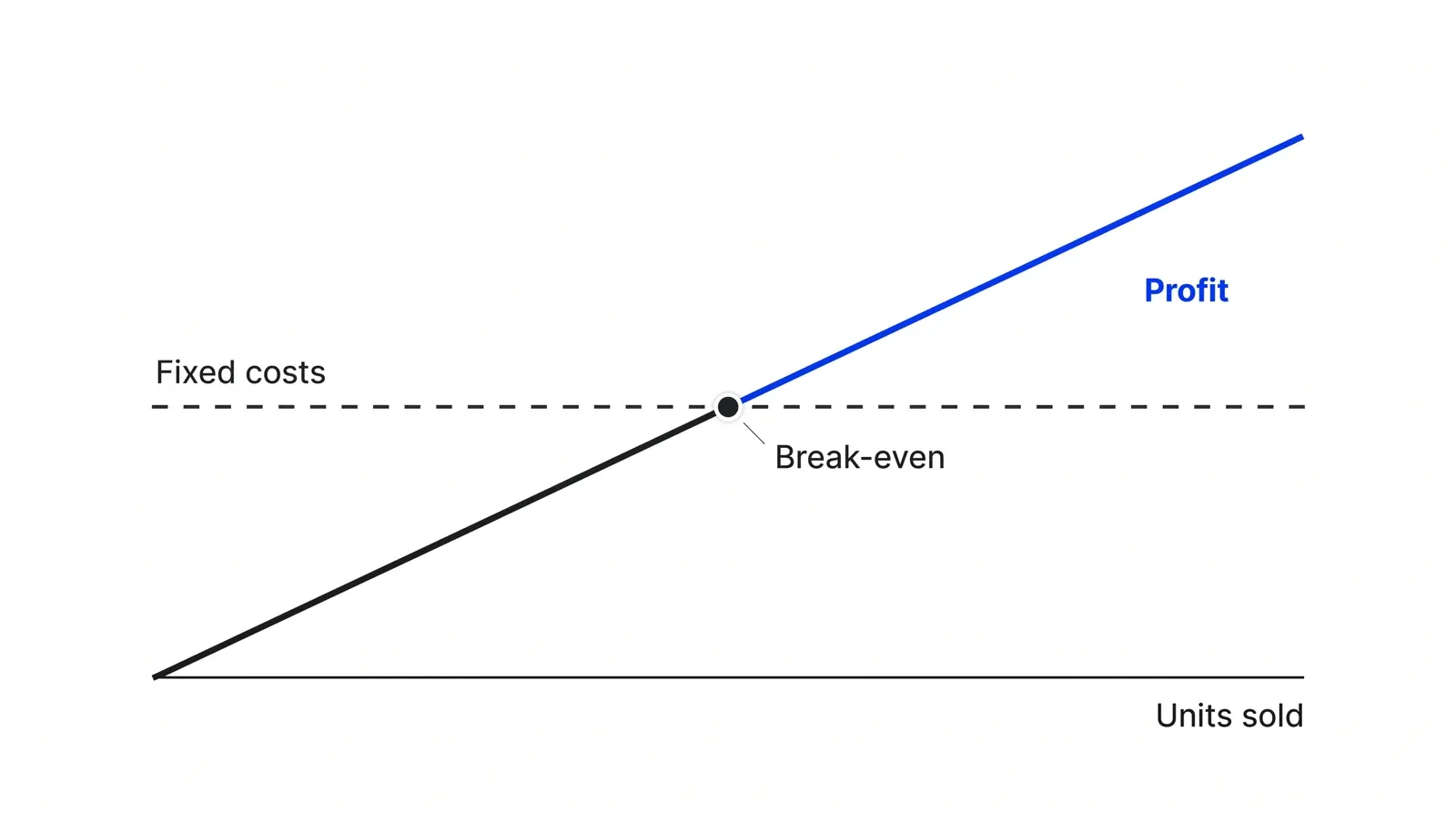
Contribution margin answers a second question once you multiply it by volume: how many units does the business need to sell before fixed costs are covered. Divide total fixed costs for the period by the contribution margin per unit, and the result is the break-even point in units.
A physiotherapy clinic charging $120 a session, with $70 in variable cost per session (the therapist’s per-session pay and disposable supplies), has a $50 contribution margin, a 42% ratio. Against $25,000 a month in fixed costs, rent, front-desk salaries, equipment leases, the clinic needs 500 sessions a month before a single dollar becomes profit. Session 501 contributes $50 straight to profit, because the fixed costs are already paid.
The same math works outside healthcare. Take an illustrative cross-border payments company charging $50 for an international transfer, with $32 in variable cost per transfer, network fees, correspondent bank charges, the per-transaction cost of support. That is an $18 contribution margin, a 36% ratio. With $90,000 a month in fixed costs, mostly the compliance team and core licensing, the company needs 5,000 transfers a month to break even. Below that volume, growth in transfer count matters more than almost anything else in the business. Above it, every additional transfer drops $18 straight to the bottom line, which is why a payments company watches this number closely when it negotiates network fees or adds a new corridor.
Contribution margin versus gross margin
The two get confused constantly, because both start with revenue and subtract a cost. The difference is which costs come out.
| Contribution margin | Gross margin | |
|---|---|---|
| Subtracts | Variable costs only, wherever they sit (production, sales, support) | Cost of goods sold, which includes fixed production costs |
| Answers | What does one more sale contribute right now | How profitable is the product line overall |
| Changes with volume | Stays roughly constant per unit | Moves as fixed production costs get spread over more or fewer units |
| Best used for | Pricing, product mix, break-even, drop or keep decisions | Comparing overall profitability across periods or competitors |
Gross margin includes fixed production costs, like the depreciation on a factory or a clinic’s medical equipment, folded into cost of goods sold. Contribution margin leaves every fixed cost out, whether it belongs to production or to sales and administration. That is why contribution margin, not gross margin, is the number to check before a pricing or product-mix decision: it is not distorted by how fixed costs happen to be allocated across units this month.
Using it to decide, not just to report
The formula is simple enough to compute in a spreadsheet in minutes. The value is in what it is used for. Three decisions come up constantly.
Pricing: a price test that raises the price but adds a variable cost, extra customer support hours, for example, needs to be checked against the contribution margin, not just the sticker price. A price increase that adds more variable cost than it adds in price actually lowers contribution margin.
Product mix under a constraint: when one resource is scarce, an operating room, a senior engineer’s calendar, a compliance officer’s time, the product to push is the one with the highest contribution margin per hour of that scarce resource, not the one with the highest price or even the highest margin ratio.
Drop or keep: a product with a low or negative contribution margin is losing money on every sale, regardless of how much revenue it brings in. A product with a positive contribution margin is still worth keeping even if it has not yet reached break-even volume, because dropping it removes a source of contribution toward fixed costs the business is paying anyway.
None of these three decisions need a finance department to run. A founder or an operations manager can pull the variable costs for one product, do the subtraction, and have an answer inside a day. The harder part is usually the first step, getting a clean split between variable and fixed costs, because a cost that looks fixed at low volume, a part-time support hire, an extra server, often turns variable once volume grows enough to force a second hire or a second server. Revisit the split whenever volume moves by an order of magnitude, not only when someone remembers to.
Pair this with a KPI tree so the number has an owner and a review cadence, and with the wider unit-economics work inside our Marketing-Operational System, where budgets, CAC, LTV and contribution margin get tracked together instead of in separate spreadsheets.
How to apply Contribution margin, step by step
- Separate variable costs from fixed costs. List every cost tied to the product or service and mark each one variable (changes with volume: materials, transaction fees, sales commission) or fixed (stays the same for a period: rent, salaried staff, software licenses). Result: two clean lists instead of one blended cost figure.
- Calculate contribution margin per unit. Subtract variable cost per unit from the selling price per unit. Result: one number, in the same currency as the price, showing what one sale actually contributes.
- Calculate the contribution margin ratio. Divide contribution margin per unit by the selling price. Result: a percentage you can compare across products with different prices, something a dollar figure alone cannot do.
- Find the break-even point. Divide total fixed costs for the period by contribution margin per unit. Result: the number of units, or the revenue, needed before the business stops losing money on that product line.
- Use it in a decision. Apply the number to one live decision: which price to test, which product to push when capacity is limited, or whether a product line still earns its place. Result: a decision made on the economics of one sale, not on revenue alone.
Examples
A payments company negotiating network fees
Illustrative: a transfer priced at $50 carries $32 of variable cost, an $18 contribution margin, and the company needs 5,000 transfers a month to cover $90,000 of fixed costs. If a renegotiated network deal cuts $2 from the variable cost, the margin rises to $20 and break-even falls to 4,500 transfers. The fee negotiation is worth as much as 500 extra transfers every month.
A clinic choosing what to put in a scarce operating room
Illustrative: procedure A leaves a $600 contribution margin and takes two hours of theatre time; procedure B leaves $400 and takes one hour. Per procedure, A looks better. Per hour of the scarce room, A earns $300 and B earns $400, so while the room is the bottleneck, B gets the first slots.
Dropping a product with a healthy price tag
A SaaS company's enterprise tier is priced highest but needs the most implementation support and infrastructure per customer. Once support hours are counted as a variable cost, its contribution margin ratio turns out lower than the mid-tier plan, the opposite of what the price tags suggested.
When to use it
Use it once you have real, itemized variable-cost data for a product or service, before a pricing decision, before choosing which product a sales team should push when capacity is limited, or before deciding whether to keep or drop a product line.
When not to use it
Skip it when costs cannot honestly be split into variable and fixed yet, common in an early-stage product where nearly every cost is still fixed. Skip it too when a decision needs the fully loaded cost per unit, including allocated overhead such as regulatory capital charges at a licensed payments business, where gross margin or full-cost analysis fits better.
Common mistakes
- Treating a semi-variable cost, one that moves in steps rather than smoothly with volume such as support staffing added in blocks, as purely fixed or purely variable. Either choice distorts the ratio.
- Calculating one blended contribution margin for the whole business instead of one per product or service line. A hospital's cardiac procedures and a routine visit have very different contribution margins; averaging them hides which one to prioritize.
- Confusing contribution margin with a company's overall margin, the total profit as a percentage of total revenue. A healthy overall margin can still hide individual products with a negative contribution margin.
- Deciding what to sell more of based on contribution margin alone, ignoring the resource that is actually scarce. When one machine, one operating room or one senior engineer's time is the bottleneck, the product with the best margin per hour of that resource wins, not the one with the best margin per unit.
- Reviewing contribution margin once at launch and never again, so a price increase in a supplier contract erodes it for months before anyone notices.
FAQ
What is the contribution margin formula?
Unit contribution margin equals selling price per unit minus variable cost per unit. The contribution margin ratio equals that figure divided by the selling price, shown as a percentage. Multiply unit contribution margin by units sold for total contribution margin.
What is the difference between contribution margin and revenue?
Revenue is everything a sale brings in. Contribution margin is what remains after subtracting only the variable cost of that sale, before fixed costs are paid. Revenue can grow while contribution margin shrinks, if variable costs grow faster.
Is contribution margin the same as marginal income?
Marginal income and variable profit are older names some textbooks and translated material use for the same calculation: price minus variable cost. The formula and the meaning do not change, only the label.
What is the difference between profit and contribution margin?
Contribution margin subtracts only variable costs from revenue. Profit subtracts variable costs and fixed costs. Contribution margin is always higher than profit until fixed costs are fully covered for the period, at which point the two start moving together.
What is the difference between contribution margin and gross margin?
Gross margin subtracts the full cost of goods sold, including fixed production costs like factory rent, from revenue. Contribution margin subtracts only variable costs, wherever they sit, production or selling. See the comparison table on this page for a worked side-by-side.
Sources
- Harvard Business Review, Amy Gallo, "Contribution Margin: What It Is, How to Calculate It, and Why You Need It"
- CFA Institute, "Company Analysis: Past and Present" (2026 refresher reading)
- OpenStax, Principles of Accounting Vol. 2: Managerial Accounting, 3.1 Contribution Margin
- OpenStax, Principles of Accounting Vol. 2, 3.2 Break-Even Point
- OpenStax, Principles of Accounting Vol. 2, Chapter 3 Summary
- OpenStax, Principles of Accounting Vol. 2, Chapter 3 Why It Matters
- OpenStax, Principles of Accounting Vol. 2, Chapter 3 Key Terms
- Lumen Learning, "Contribution Margin"
- Open Textbook Library, University of Minnesota, "Managerial Accounting" (Heisinger & Hoyle)
- Heisinger & Hoyle, "How Is Cost-Volume-Profit Analysis Used for Decision Making?", Saylor Foundation open textbook
- AccountingTools, "Contribution margin"
- AccountingTools, "The difference between contribution margin and gross margin"
- McGraw Hill, Garrison, Noreen, Brewer and Montague, "Managerial Accounting" (18th edition)
- Eldon Leon Frost, "Direct Costing for External Financial Reporting", MBA thesis, Texas Technological College, 1968
- Plehn et al., "Is it time to rebalance the case mix?", European Journal of Medical Research, 2016
- "Revenues, costs, and contribution margins of major inpatient cardiovascular procedures within the Medicare population", American Heart Journal, 2024
- Dexter, Blake, Penning and Lubarsky, "Calculating a Potential Increase in Hospital Margin for Elective Surgery...", Anesthesia & Analgesia, 2002
- Cecil G. Sheps Center for Health Services Research, UNC Chapel Hill, "A Primer on Interpreting Hospital Margins"
- MIT OpenCourseWare, 15.501/516 Introduction to Financial and Managerial Accounting, "Introduction to Cost Accounting" lecture
- Larry M. Walther, principlesofaccounting.com, Glossary
Last updated Sep 25, 2026


How to calculate channel payback and unit economics
A CAC number that only marketing believes is not a finance number. Here is how to calculate channel payback so both teams work from the same model.

Fractional CFO vs finance operations: which gap do you actually have
A fractional CFO is a person. Finance operations is a system. Most companies searching for one are missing the other, or both.