Double Diamond
The Double Diamond is a four-stage design process that separates finding the right problem from finding the right solution, so a team knows when to widen its options and when to narrow them.
The Double Diamond is a four-stage design process (Discover, Define, Develop, Deliver) published by the UK Design Council in 2005. It groups design work into two cycles of thinking: one that widens then narrows to define the problem, and one that widens then narrows again to build the solution. It exists to stop a team from building an answer to a brief nobody checked.
- Origin
- UK Design Council (Richard Eisermann's team), 2003 (created); 2005 (published)
- Level
- 201 · Tool
- Fits
- Small and mid-size, Scale-up
- Time to apply
- A day to run one Discover-Define pass on a single problem; two to six weeks for a full project cycle through both diamonds
- What you need
- a brief you're allowed to question · time and a mandate to research before anyone designs anything · someone senior willing to accept a redefined problem statement
The Double Diamond is a four-stage design process (Discover, Define, Develop, Deliver) that groups a project into two cycles of thinking. The first cycle widens and then narrows to find the problem. The second widens and then narrows again to find and ship a solution. The UK Design Council published it in 2005, and teams now reach for it on product redesigns, service overhauls and anything else where the brief handed to a team might describe the wrong problem.
Where the model came from
The Design Council’s own account puts the model’s creation in 2003, two years before it went public. Richard Eisermann, then the Design Council’s Director of Design and Innovation, led a small team (Anna White, Chris Vanstone, Gill Wildman, Jennie Winhall and Jonathan Ball) that reviewed a range of recent projects the Design Council had funded across business, science, technology and social challenges. They mapped how each team worked, compared the methods against each other, and codified what they found into the four named stages.
Two years later, in 2007, the Design Council published a separate study, Eleven lessons: managing design in eleven global brands, that visited the design teams at eleven companies, among them Alessi, BT, LEGO, Microsoft, Sony, Starbucks and Xerox. That report already treats the Double Diamond as an established framework and uses it to describe how those companies’ processes “map the divergent and convergent stages of the design process.” It shows the model held up outside the Design Council’s own work. Accounts that date the framework to this 2007 study are mixing up two separate pieces of work.
Where the underlying idea (diverge, then converge) came from before that is disputed. Several write-ups trace it to a divergence-convergence model Béla H. Bánáthy described in his 1996 book Designing Social Systems in a Changing World. The Design Council’s own history page makes no mention of Bánáthy at all, crediting its internal project review instead. Other candidates get cited too: psychologist J.P. Guilford’s convergent and divergent production from the 1950s and 1960s, a 1979 doctoral thesis by Min Basadur, and even a claim that management writer Gary Hamel proposed a version of it in the late 1990s. No source settles which one, if any, the Design Council drew on.
What divergent and convergent thinking mean
Divergent thinking means generating many possible answers before judging any of them. Convergent thinking means narrowing a set of options down to one. The psychologist J.P. Guilford framed the distinction in his 1950 address to the American Psychological Association, arguing that creativity had been neglected by psychology and sat closer to divergent thinking than to the single-right-answer reasoning most intelligence tests measured. He developed the pair further through the 1950s in his Structure of Intellect model, which treated divergent and convergent production as separate mental operations rather than points on the same scale.
Each diamond in the Design Council’s model runs through both operations once. Discover and Develop are the divergent stages, opening a wide range of options. Define and Deliver are the convergent stages, closing that range back down to one.
The two diamonds: one for the problem, one for the solution
The first diamond exists to find the right problem, and the second exists to find the right solution to it. Confusing the two leads to building before the problem is clear.
Discover opens the first diamond. The team researches broadly (interviews, direct observation, data nobody has looked at recently) to build a picture of the situation instead of trusting the brief as handed over. Define closes it: the team sorts what it found and writes one specific problem statement (the brief the original request should have been). The Design Council puts the purpose this way: the first diamond “helps people understand, rather than simply assume, what the problem is.”
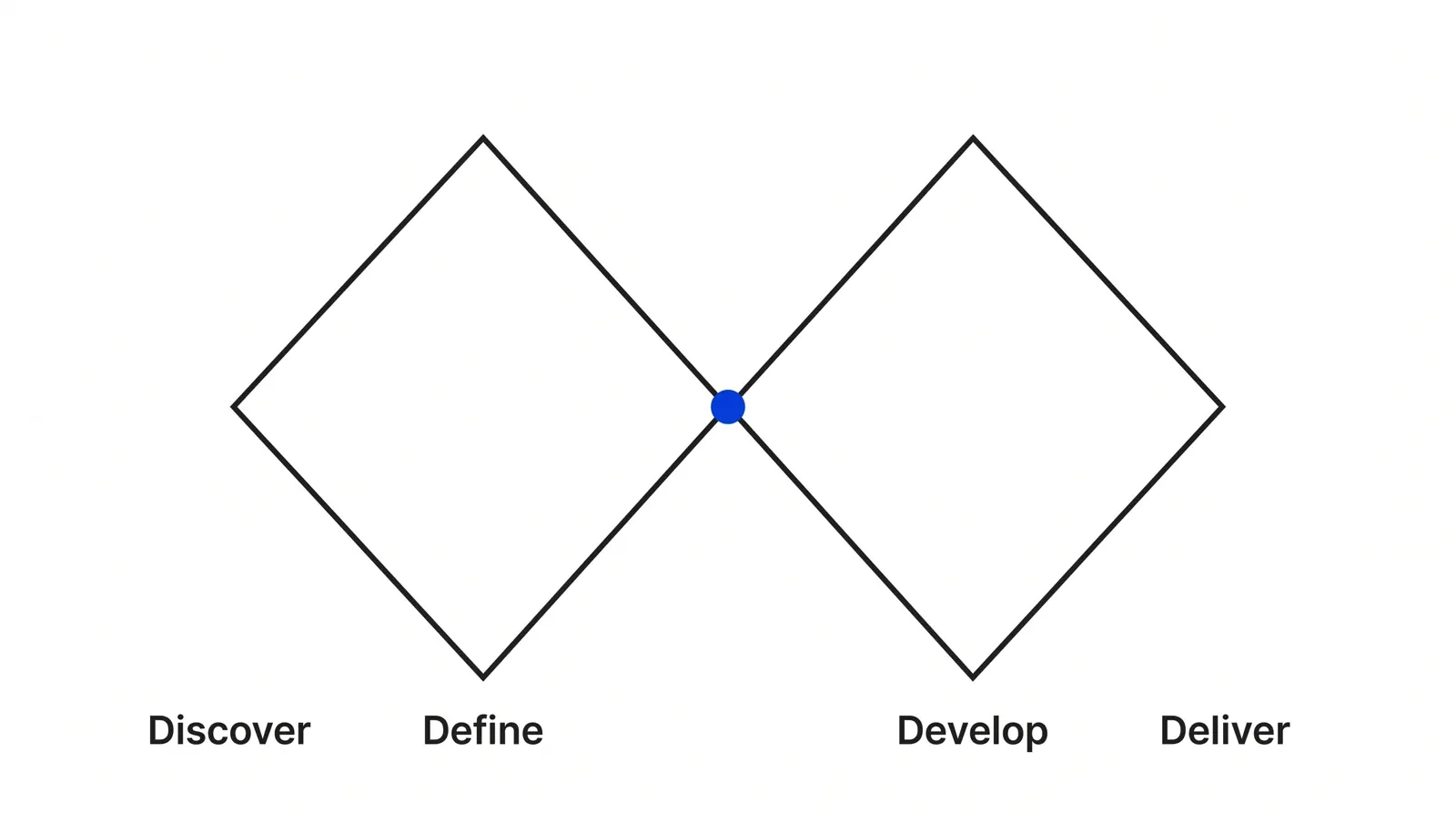
Develop opens the second diamond the same way, generating several different solutions to the defined problem rather than building out the first idea anyone proposed. Deliver closes it: the team tests the shortlist, drops what fails and ships what works. Discover and Define work the problem space; Develop and Deliver work the solution space, and nothing in the second diamond should start until the first one has produced a problem statement worth building against.
The failure the model is built to prevent
A common way a Double Diamond project fails is skipping the first diamond: building a solution to the brief as written instead of the problem underneath it. A team that goes straight from a request to a build is running half the model.
This isn’t a design-specific habit. MIT Sloan Management Review’s Albrecht Enders, Andreas König and Jean-Louis Barsoux found that executives typically “home in quickly on a couple of options” instead of framing a decision widely first, so “the outcome is frequently suboptimal.” A separate MIT Sloan piece describes the same instinct in problem-solving generally: people are “so eager to find (and deliver) the solution to a problem that we jump to conclusions” before investigating what causes it.
Why the diagram looks like a line and the work never is
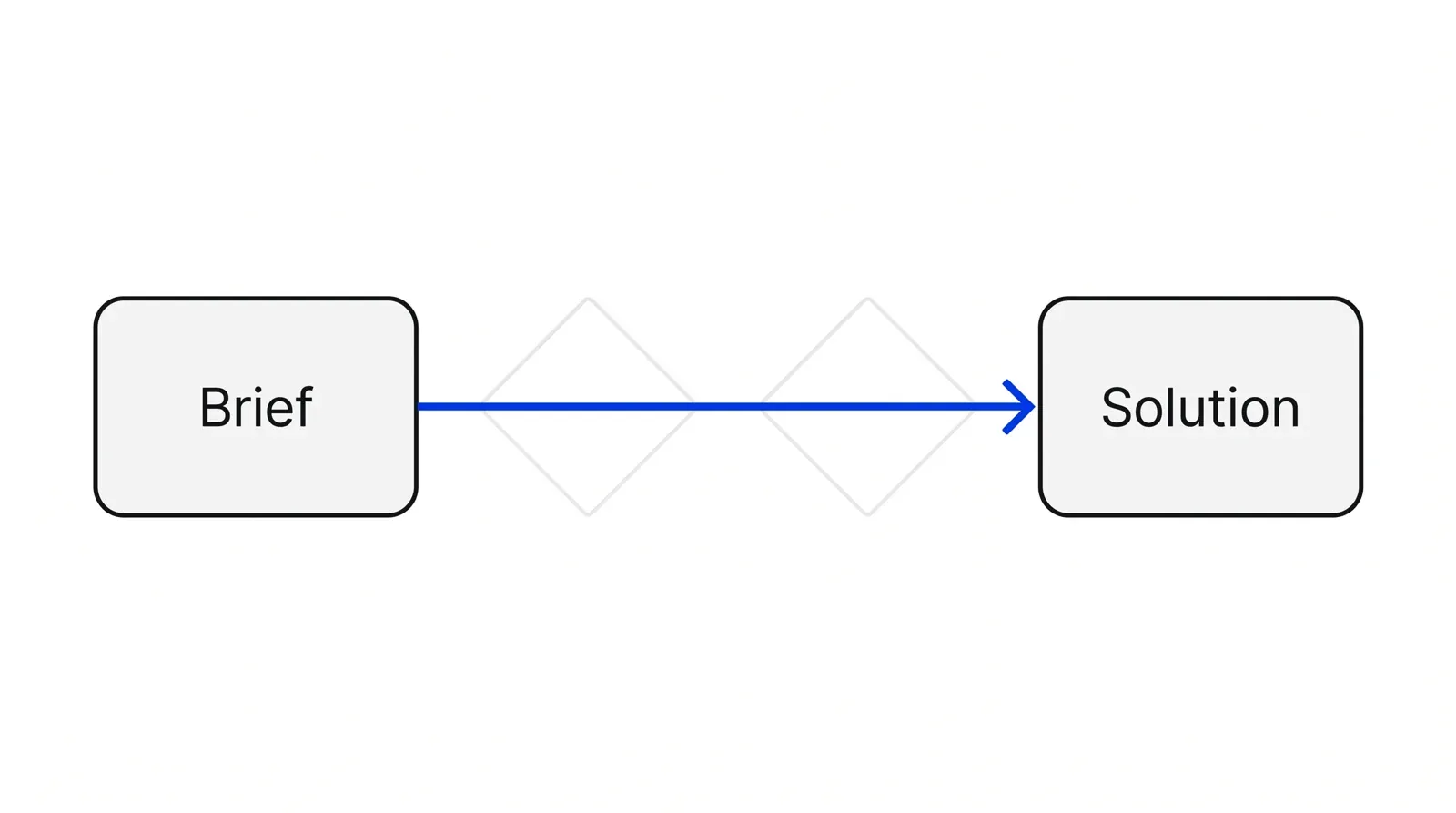
The four boxes read left to right, but neither the Design Council nor the practitioners who use the model treat that as a fixed sequence. The Design Council’s own Framework for Innovation, its 2019 update, wraps the four stages in a wider set of design principles (putting people first, communicating visually, collaborating, iterating) and a bank of methods grouped as Explore, Shape and Build. It states: “This is not a linear process.” A team can learn something in Develop that sends it straight back to Discover, and the framework expects that.
Practitioners outside the Design Council make the same point more bluntly. One critique calls the diagram “an incomplete picture of reality,” since the diamonds “are not the same size in terms of effort or time.” Other practitioners pair the model with Agile or Lean cycles so iteration is built into the plan.
In 2021 the Design Council pushed the same idea further with its Systemic Design Framework, built for climate and biodiversity problems too complex for two clean diamonds. It renames the stages Explore, Reframe, Create and Catalyse, keeps the underlying divergent-convergent logic, and adds activities the diamond diagram never showed: setting a vision, building relationships, and continuing the work after a project formally ends.
Double Diamond or design thinking
The two get confused because both structure work around widening and then narrowing.
| Double Diamond | Design thinking (d.school / IDEO) | |
|---|---|---|
| Stages | Discover, Define, Develop, Deliver | Empathize, Define, Ideate, Prototype, Test |
| Published by | UK Design Council, 2005 | Stanford d.school; carried into business press by IDEO’s Tim Brown in a 2008 Harvard Business Review article |
| Maps | An organization’s whole design process, problem space then solution space | Five modes a project team moves through, in whatever order the work needs |
| Fits best | Planning and governing a project end to end | Running one round of user research, ideation and prototyping inside that project |
Widening the field of options before narrowing them down is the same discipline behind Pushers’ growth lab work: testing more than one route before committing budget to the option that looked obvious first.
How to apply Double Diamond, step by step
- Run Discover: widen before you narrow. Set the brief aside and look at the situation as it is: talk to the people affected, watch how the process runs today, pull data nobody has reviewed recently. Result: a wide set of observations about how things run today.
- Run Define: turn what you found into one problem. Sort the material from Discover and choose the single problem worth solving now. Result: a short, specific problem statement (the brief the original request should have been).
- Check whether the brief changed. Compare the new problem statement with the original request word for word. If they match, the first diamond stayed shallow and needs another pass. Result: a brief someone could disagree with, which is a sign Define did its job.
- Run Develop: generate more solutions than you need. Produce several different answers to the defined problem (sketches, prototypes, a small pilot) instead of building out the first idea anyone had. Result: a shortlist of different options to choose from.
- Run Deliver: test, cut and ship the survivor. Try the shortlisted options with users or a small rollout, drop what fails, refine what works. Result: one solution in use and a short record of what didn't work, so the next project doesn't repeat it.
- Set the trigger that sends the team back to Discover. Name the condition that reopens the process: a metric that stalls again, a complaint pattern that returns, a market shift. Result: a named condition that reopens the process, so the model becomes a standing habit.
Examples
A fintech onboarding redesign
Illustrative: a payments company sees a rising drop-off rate on its business account signup and assumes the application form has too many fields. Discover finds the friction is uploading incorporation documents from a phone camera, which the tool keeps rejecting for a bad angle. Define reframes the brief from shortening the form to fixing document capture. The fix that ships in Develop and Deliver never touches the form.
A clinic's patient intake
Illustrative: a clinic wants to cut the time new patients spend on paperwork at the front desk. Discover shows the delay comes from patients re-entering the same insurance details on three separate sheets. Define narrows the brief to removing duplicate fields across the intake forms. Deliver tests one combined sheet before it replaces the old set for every patient.
When to use it
Use the Double Diamond when the brief itself might be wrong: a metric that's stalled for reasons nobody has diagnosed, a redesign request with no clear problem statement behind it, a new product area with more assumptions than evidence. It fits projects with room for a discovery pass of days or weeks.
When not to use it
Skip it for a well-understood, recurring fix where the problem is already confirmed: a broken link, a known bug, a copy change nobody disputes. It also assumes whoever holds the budget will accept a redefined problem. If the sponsor has already fixed both the problem and the solution and won't reconsider either, a Discover phase produces research nobody reads.
Common mistakes
- Treating the diagram as a straight line (Discover to Deliver once, left to right) when Develop routinely turns up a problem statement that needs revisiting.
- Skipping the first diamond entirely and starting at Develop, building a solution to the brief as written instead of the problem underneath it.
- Running Discover so broadly that Define never lands on one problem statement, so the team enters Develop still arguing about what it's solving.
- Generating a single idea in Develop and calling it the diverge stage, which defeats the point of widening before narrowing.
- Drawing the four-stage diagram on a slide without assigning who decides when the team moves from one stage to the next.
FAQ
What is the Double Diamond?
The Double Diamond is a four-stage design process (Discover, Define, Develop, Deliver) published by the UK Design Council in 2005. The first two stages widen then narrow to define the problem; the last two widen then narrow again to build and test a solution.
What do the four stages of the Double Diamond mean?
Discover means researching the situation widely instead of assuming what's wrong. Define means narrowing that research into one problem statement. Develop means generating several possible solutions. Deliver means testing them, cutting what fails and shipping what works.
Is the Double Diamond the same as design thinking?
They overlap but answer different questions. The Double Diamond maps an organization's whole design process in four stages. Design thinking, as Stanford's d.school teaches it, describes five iterative modes a project team moves through (Empathize, Define, Ideate, Prototype, Test) in whatever order the work needs.
Who invented the Double Diamond?
The UK Design Council developed and published it in 2005, based on an internal review of its own funded design projects. A 1996 divergence-convergence model by Béla H. Bánáthy is often cited online as a precursor, though the Design Council's own account of its history doesn't mention Bánáthy, and other precursors get cited too.
Does the Double Diamond run in a straight line?
No. The Design Council's own Framework for Innovation update says the stages aren't a linear process, since a team often learns something in Develop that sends it back to Discover. Treat the four stages as a loop you re-enter.
Sources
- Design Council, History of the Double Diamond
- Design Council, The Double Diamond
- Design Council, Framework for Innovation
- Design Council, Systemic Design Framework
- Design Council, Eleven lessons: managing design in eleven global brands (2007)
- Chosen Path, The Double Diamond as an example of some challenges of attribution in the history of ideas
- Tom Inns, The limitations of 'Double Diamond' post-it note explosions
- Interaction Design Foundation, The 5 Stages in the Design Thinking Process
- Interaction Design Foundation, What is Design Thinking?
- J.P. Guilford, Creativity, American Psychologist 5, 1950
- Béla H. Bánáthy, Designing Social Systems in a Changing World, Springer/Plenum, 1996
- Harvard Business Review, Tim Brown, Design Thinking
- 8th Light, The Double Diamond: Finding Clarity in an Imperfect Illustration of the Design Process
- Stanford d.school, Design Thinking Bootleg
- Nielsen Norman Group, Design Thinking
- MIT Sloan Management Review, Stop Jumping to Solutions!
- MIT Sloan Management Review, Problem Solving By Design
- Dovetail, Double Diamond Model: The Design Process Framework Explained
- Splunk, The Double Diamond Design Process
- Clinics (São Paulo), New mindset in scientific method in the health field: Design Thinking
- LogRocket, What is the Double Diamond design process?
Last updated Sep 25, 2026
