Porter's five forces
Porter's five forces is a framework for scoring how much profit an industry has to offer before any company inside it does anything smart or dumb.
Porter's five forces is a framework that explains an industry's average profitability by scoring five pressures on it: rivalry among existing competitors, the threat of new entrants, the threat of substitutes, and the bargaining power of suppliers and of buyers. Michael Porter introduced it in a 1979 Harvard Business Review article and expanded it in 2008.
- Origin
- Michael E. Porter, 1979; expanded 2008
- Level
- 201 · Tool
- Fits
- Small and mid-size, Scale-up, Enterprise
- Time to apply
- half a day for a first pass, revisited every six to twelve months
- What you need
- a precise definition of the industry you are scoring, not a vague market label · recent numbers on pricing, concentration and switching costs in that industry · one person who turns the analysis into a go, avoid or reposition decision
Porter’s five forces is a framework for scoring how much profit an industry has to offer before any single company inside it does anything smart or dumb. Michael Porter, then a Harvard Business School professor, introduced it in a 1979 Harvard Business Review article, set out the full method in his 1980 book Competitive Strategy, and reaffirmed it in a January 2008 Harvard Business Review piece. The question it answers is narrow and useful: is this a pond worth fishing in, before anyone asks who is the best fisherman.
The five forces, and what moves each one
Each force is a source of pressure on how much of an industry’s value a company gets to keep. The Institute for Strategy and Competitiveness, Porter’s own research group at Harvard, puts it plainly: industry structure and a company’s position within it are “the two basic drivers of company profitability.”
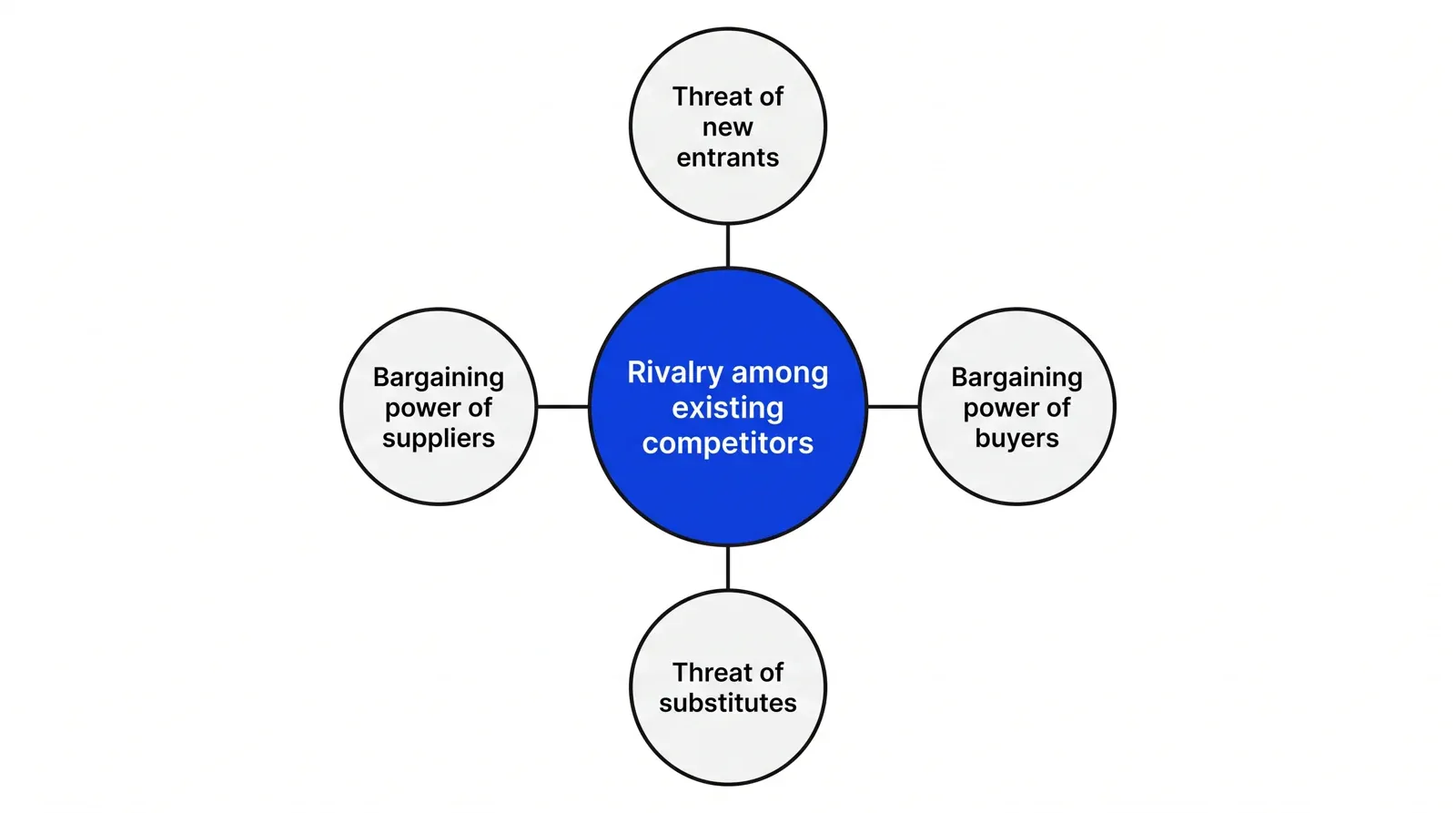
| Force | What raises it | What lowers it |
|---|---|---|
| Rivalry among existing competitors | Many similar-sized rivals, slow-growing demand, high fixed costs pushing everyone to cut price | A clear leader, fast-growing demand, real differences between what rivals sell |
| Threat of new entrants | Low capital needs, no license or patent barrier, easy access to distribution | High capital needs, regulatory approval, an incumbent’s brand or scale advantage |
| Threat of substitutes | A different product does the same job for less, or switching costs nothing | No real substitute exists, or switching means retraining or new infrastructure |
| Bargaining power of suppliers | Few suppliers, no alternative input, the supplier’s product is critical and undifferentiated for the buyer | Many suppliers, commodity input, the buyer purchases a small share of the supplier’s output |
| Bargaining power of buyers | Few large buyers, low switching cost, the product is a big share of the buyer’s spend | Many small buyers, high switching cost, the product is a small share of the buyer’s spend |
Buyer power, looked at on its own
Each force works as a mechanism, and buyer power shows the mechanism most clearly. Buyer power rises specifically when a customer can compare several similar sellers at close to no cost and switch between them without friction.
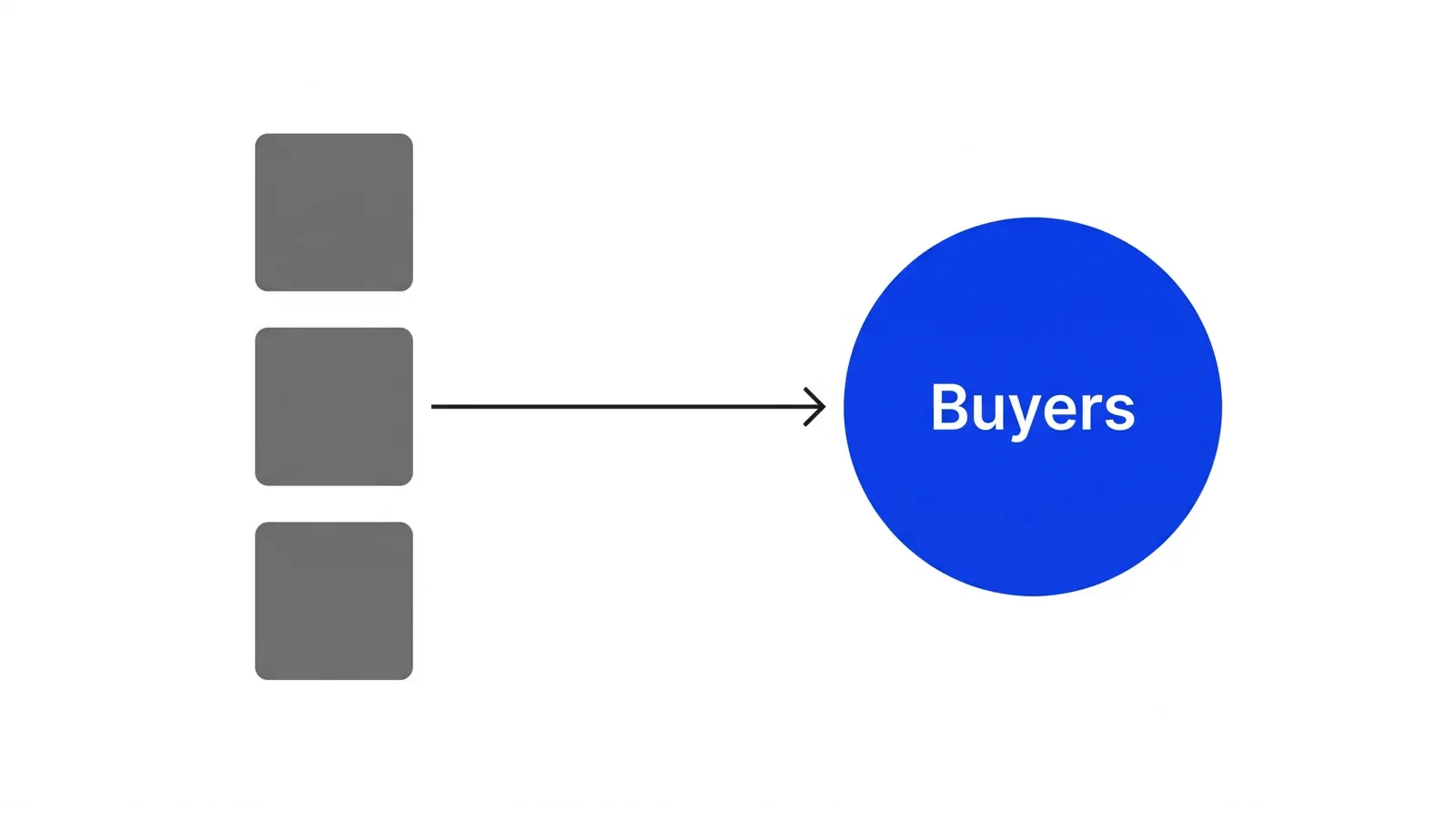
A large retail chain buying a commodity ingredient from ten interchangeable suppliers has high buyer power and will use it every negotiation. A hospital buying a single-source surgical device has almost none. Supplier power works the same way in reverse: a supplier with a hundred small customers holds more power in a negotiation than one that depends on a single customer who could walk away at any time.
What sets the profit ceiling
Growth gets blamed for weak margins more often than it deserves. A fast-growing market with easy entry, weak differentiation and powerful buyers can still be a poor place to make money, and a slow-growing market with real barriers to entry can be a good one. Porter made this point directly in the 2008 article: “the extended rivalry that results from all five forces defines an industry’s structure and shapes the nature of competitive interaction within an industry.” Structure, not the growth rate and not the technology involved, is what the framework claims sets the ceiling.
How much of profit is really structure, and how much is the company
The research has not settled this. Richard Schmalensee’s 1985 study in the American Economic Review found industry membership was the dominant source of profit differences and company-specific effects were weak. Richard Rumelt’s 1991 reply in Strategic Management Journal reversed that conclusion, finding “negligible corporate effects, small stable industry effects, and very large stable business-unit effects,” meaning the individual business, not its industry, did most of the explaining. Anita McGahan and Michael Porter’s 1997 follow-up split profit variance into year (2 percent), industry (19 percent), corporate parent (4 percent) and business-specific factors (32 percent), and found industry mattered far more in some sectors, lodging and retail among them, than in manufacturing. A 2003 study by Gabriel Hawawini, Venkat Subramanian and Paul Verdin pushed back again, arguing that once unusually high- and low-performing firms are set aside, industry effects look larger for the typical company than earlier estimates suggested. Four serious studies, four different weights on the same question. None of them says industry structure is irrelevant, and none says it is destiny either.
The two ways people misuse it
The most common failure is finishing the five scores and stopping. A 2021 Frontiers in Psychology study of Chinese entrepreneurs found 78.2 percent said they used the framework, and also found many layered relationship and cooperative factors on top of it that the original five never named, a sign the raw scores alone were not answering their real question. Porter’s own diagnosis, described in HBS Working Knowledge’s summary of his work on strategy mistakes, is that managers stop at analysis instead of using it to make a choice, the same failure he separately criticized in his 1996 article “What Is Strategy?”: “the more benchmarking companies do, the more they look alike.”
The second failure is treating five forces as a substitute for SWOT, or the reverse.
| Porter’s five forces | SWOT | |
|---|---|---|
| Looks at | The industry’s structure, from outside any one company | A company’s own position, inside and out |
| Answers | Is this industry, or this part of it, worth competing in | What should this specific company do next |
| Output | Five scores and one conclusion about the profit ceiling | Four lists: strengths, weaknesses, opportunities, threats |
Run five forces first to judge the industry, then SWOT to judge the company inside it. Running only one answers half the question.
The force Porter left out: complementors
Adam Brandenburger and Barry Nalebuff, in a 1995 Harvard Business Review article and their 1996 book Co-opetition, added a player the original five forces never named: the complementor, a business whose product makes yours more valuable instead of competing for the same money. Intel’s Andrew Grove reached the same idea from a different direction in his 1996 book Only the Paranoid Survive, calling complementors the sixth force.
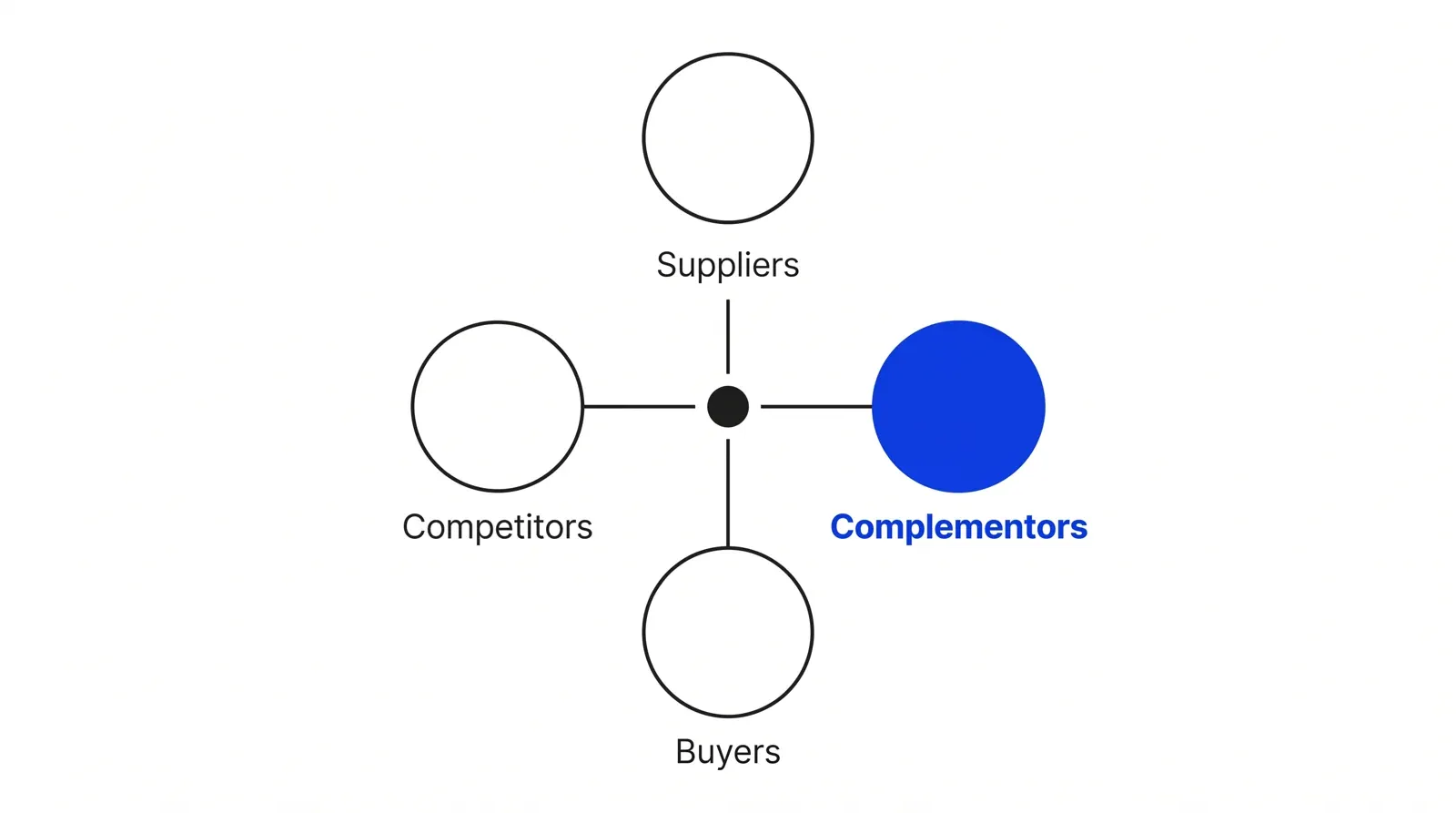
A payments app and the phones it runs on are complementors. A dental clinic and the orthodontist it refers patients to are complementors. Neither the original 1979 article nor the 1980 book scores this relationship, which is why a five forces analysis that only ever counts rivals will miss a real source of upside sitting right next to the threats.
Score the industry with this framework before a Growth Lab engagement decides where a company should compete, covered in Pushers’ growth-systems work, and the five scores stop being a classroom exercise and start being the reason a market gets chosen or passed on.
How to apply Porter's five forces, step by step
- Define the industry precisely. Draw the boundary tight enough that every player inside it faces roughly the same economics. Cross-border remittances and domestic card payments are not the same industry even though both move money, and treating them as one blurs every force you score next.
- Score each force high, medium or low. Rate rivalry, new entrants, substitutes, supplier power and buyer power against evidence: concentration ratios, switching costs, capital requirements, the number of realistic alternatives a buyer has this year. A score without a number behind it is a guess.
- Name what is actually capping profit. Look at the five scores together and say which one or two forces are doing the real damage. An industry can have weak rivalry and still make no money if buyer power is crushing, or the reverse.
- Map where your company sits inside that structure. The five forces describe the industry, not you. Check your own bargaining position against suppliers and buyers, your exposure to substitutes, and whether a new entrant could copy your position in a year.
- Decide: compete here, reposition, or find a complementor. A weak-structure industry is not a reason to quit if you can move to a corner of it with better economics, or find a complementor whose success pulls yours along instead of a rival who erodes it.
- Put a date on redoing it. Set a review date six to twelve months out. Industry structure moves when regulation, a new technology or a new distribution channel changes one of the five scores, and a stale analysis argues for a position that no longer exists.
Examples
A cross-border payments fintech
Illustrative, no market figures implied. A startup moving money between two countries checks new entrants first: licensing and compliance cost real money but are not permanently out of reach, so this force scores medium. Substitutes are banks' own wire transfers, slow but trusted, medium. Supplier power sits with the two or three banking-rail providers it depends on, high, since switching rails mid-flight is expensive. Buyer power is high too: a business customer can get three competing quotes in an afternoon. Rivalry is intense on price. The conclusion is not 'this industry is hard,' it is that supplier and buyer power are the two forces worth negotiating against directly, through a second banking-rail relationship and a product that is not just cheaper.
Private dental clinics in a mid-sized city
Illustrative, no market figures implied. New entrants face a real barrier, a dentist's license and a chair take time and capital, so this force is low. Substitutes are weak too, teeth do not have a substitute. Supplier power from equipment and materials vendors is low, several vendors sell the same instruments. Buyer power is medium: a patient can switch clinics but rarely does once they trust a dentist. Rivalry is the force actually setting the ceiling, a dozen clinics compete on the same few referral sources and insurance panels in the same neighborhoods. Here the conclusion points at rivalry and referral relationships, not a defense against new entrants that barely threaten the business.
When to use it
Use it before entering a new market or a new product line, when a board or an investor asks why margins in a market are what they are, or when a team keeps blaming a competitor for a profit problem that is actually structural. It answers one question: is this an attractive pond, separate from who is the best fisherman.
When not to use it
Skip it for a decision inside a company you already operate in, where the constraint is execution, culture or a resourcing choice rather than the shape of the industry. It also says little in a market with almost no competitors yet, common in a brand-new technology, since several of the five scores have no real data to rest on.
Common mistakes
- Scoring all five forces and stopping there, with no sentence saying which force actually caps the industry's profit.
- Running it as a stand-in for SWOT, listing internal strengths and weaknesses inside a framework built to score external industry structure.
- Defining the industry too broadly (all of 'fintech') or too narrowly (one product feature), which changes every score without anyone noticing.
- Treating a completed analysis as permanent instead of a snapshot that a new regulation, technology or channel can invalidate within a year.
- Scoring rivals only and ignoring complementors, players whose success expands the pie instead of splitting it.
FAQ
What is Porter's five forces framework?
It is a framework that scores five pressures on an industry, rivalry among existing competitors, the threat of new entrants, the threat of substitutes, and the bargaining power of suppliers and buyers, to explain why average profitability differs from one industry to another. Michael Porter introduced it in a 1979 Harvard Business Review article.
Who created Porter's five forces and when?
Michael Porter, a Harvard Business School professor, introduced it in "How Competitive Forces Shape Strategy," Harvard Business Review, March-April 1979, then set out the full method in his 1980 book Competitive Strategy and reaffirmed it in a January 2008 Harvard Business Review article.
What is the difference between Porter's five forces and SWOT analysis?
Five forces scores five specific pressures from outside a company to judge whether an industry's structure supports good margins. SWOT mixes a company's own internal strengths and weaknesses with a loose external scan. They answer different questions and neither replaces the other.
Does industry structure or company strategy explain more of a company's profit?
Researchers disagree and say so directly. Richard Schmalensee (1985) found industry effects dominant; Richard Rumelt (1991) found business-unit effects far larger and industry effects small; Anita McGahan and Michael Porter (1997) put industry at 19 percent of profit variance, more in some sectors than others; a 2003 study by Hawawini, Subramanian and Verdin found industry mattered more once outlier firms were excluded.
What is the sixth force in Porter's five forces?
Complementors, a player whose product makes yours more valuable instead of competing with it. Adam Brandenburger and Barry Nalebuff introduced the idea as the "value net" in a 1995 Harvard Business Review article and a 1996 book, and Intel's Andrew Grove separately called it the sixth force in Only the Paranoid Survive.
Sources
- Michael E. Porter, How Competitive Forces Shape Strategy, Harvard Business Review, March-April 1979
- Michael E. Porter, The Five Competitive Forces That Shape Strategy, Harvard Business Review, January 2008
- Michael E. Porter, Competitive Strategy: Techniques for Analyzing Industries and Competitors, Free Press, 1980, Internet Archive record
- Michael E. Porter, Competitive Advantage: Creating and Sustaining Superior Performance, Free Press, 1985, Open Library record
- Michael E. Porter, What Is Strategy?, Harvard Business Review, November-December 1996
- Institute for Strategy and Competitiveness, Harvard Business School, The Five Forces
- Institute for Strategy and Competitiveness, Harvard Business School, Business Strategy
- Harvard Gazette, Michael Porter Named University Professor, December 2000
- Harvard Business School, HBS Working Knowledge, The Most Common Strategy Mistakes
- Adam M. Brandenburger, Barry J. Nalebuff, The Right Game: Use Game Theory to Shape Strategy, Harvard Business Review, July-August 1995
- Adam M. Brandenburger, Barry J. Nalebuff, Co-opetition, Doubleday, 1996, Internet Archive record
- NYU Stern School of Business, faculty profile of Adam Brandenburger
- Yale School of Management, faculty profile of Barry Nalebuff
- Andrew S. Grove, Only the Paranoid Survive, Currency Doubleday, 1996, Open Library record
- Richard P. Rumelt, How Much Does Industry Matter?, Strategic Management Journal 12(3), 1991
- Anita M. McGahan, Michael E. Porter, How Much Does Industry Matter, Really?, Strategic Management Journal 18, 1997
- Gabriel Hawawini, Venkat Subramanian, Paul Verdin, Is Performance Driven by Industry- or Firm-Specific Factors? A New Look at the Evidence, Strategic Management Journal 24(1), 2003
- Richard Schmalensee, Do Markets Differ Much?, American Economic Review 75(3), 1985
- Chengqi Shi, Comfort Afi Agbaku, Fan Zhang, How Do Upper Echelons Perceive Porter's Five Forces? Evidence From Strategic Entrepreneurship in China, Frontiers in Psychology 12:649574, 2021
- Bain & Company, A History of Bain's Management Tools and Trends Survey
Last updated Sep 25, 2026