Eisenhower matrix
The Eisenhower matrix is a two-by-two grid that sorts tasks by urgency and importance, so a team spends its week on what moves the business instead of whatever feels loudest.
The Eisenhower matrix is a two-by-two grid that sorts any task by two questions: is it important, and is it urgent. Each answer sends the task into one of four actions: do it now, schedule it, delegate it, or delete it. The name comes from a line Dwight Eisenhower quoted in 1954; Stephen Covey built the actual grid in 1989.
- Origin
- Dwight D. Eisenhower (the 1954 remark); Stephen Covey (the matrix), 1954; 1989
- Level
- 201 · Tool
- Fits
- Startup, Small and mid-size
- Time to apply
- 30 minutes for a first pass, then 10 minutes each Monday
- What you need
- a written list of this week's tasks and requests · one person per team who makes the final call on each box
The Eisenhower matrix is a two-by-two grid that sorts a task by two questions, is it important and is it urgent, and sends it into one of four actions: do it, schedule it, delegate it, or delete it. Teams reach for it when the actual problem is not a lack of a to-do list but a lack of a shared rule for which item on that list gets the next hour.
Where the name actually comes from
The matrix is not something Dwight Eisenhower drew. On August 19, 1954, addressing the Second Assembly of the World Council of Churches in Evanston, Illinois, Eisenhower said: “I have two kinds of problems, the urgent and the important. The urgent are not important, and the important are never urgent.” He was quoting someone else. He introduced the line as the words of “a former college president,” a nod aimed at Northwestern’s president at the time, J. Roscoe Miller, who was in the room. The American Presidency Project’s archive of the speech confirms the attribution in Eisenhower’s own words, and separate research by Quote Investigator traces how the phrase then drifted through paraphrase, including a softer “seldom” version repeated by a conference attendee that same year and half the line borrowed by novelist John le Carré in 1962.
The grid itself came later, from someone else again. Stephen Covey built the four-quadrant matrix in his 1989 book The 7 Habits of Highly Effective People, as the tool for Habit 3, “put first things first.” Covey’s own company, FranklinCovey, still teaches it that way: Quadrant I is urgent and important, Quadrant II is important and not urgent, Quadrant III is urgent and not important, and Quadrant IV is neither. Covey argued Quadrant II was where effectiveness actually lived, since it covers planning, relationship-building and prevention, the work that stops next month’s crisis rather than reacting to this one. The popular name “Eisenhower matrix” is a later shorthand that neither man used. Harvard Business Review flagged the same tangle in 2020, adding an editor’s note to an older article once the dual attribution came under scrutiny. In short: Eisenhower gave the line, Covey gave the grid.
The four boxes, in practice
Do holds work where the cost of waiting a day changes the result: a system outage, a patient in pain, a payment stuck mid-transfer. Schedule holds work that matters but has no deadline pulling on it today: the process fix, the hire, the plan. Delegate holds work that feels pressing but does not need the most senior person in the room: routine requests, status updates, vendor calls. Delete holds everything else, the habit or the request that survives only because nobody has said no to it yet.
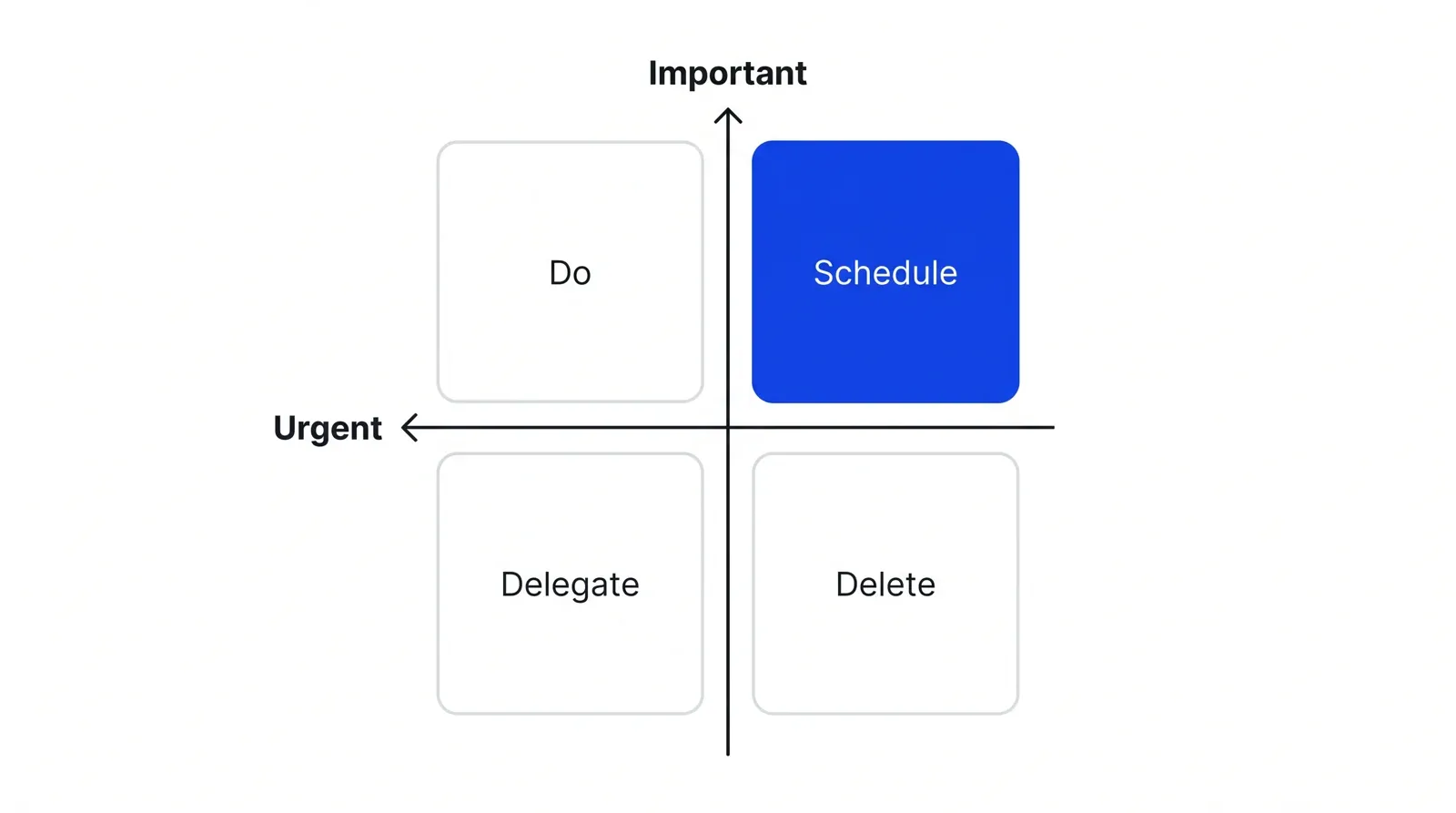
Most of the value sits in the second box. A task moves from Schedule into Do the moment it is left alone long enough, which is why a team that never protects Schedule time spends its life doing damage control on problems that were visible a month earlier.
Why urgent tasks win by default
Sorting tasks by importance sounds simple until the inbox is open. A 2018 study in the Journal of Consumer Research, running five separate experiments, found that people consistently choose a task with a fake deadline over one with a better outcome and no deadline at all, even after the researchers removed every rational reason to do so. The paper’s authors call it the mere urgency effect: a ticking clock pulls attention on its own, independent of what finishing the task is actually worth. This is the mechanism behind Delete and Schedule sitting empty on most people’s lists. Important work rarely loses a direct comparison with the urgent item; it simply never gets compared with it.
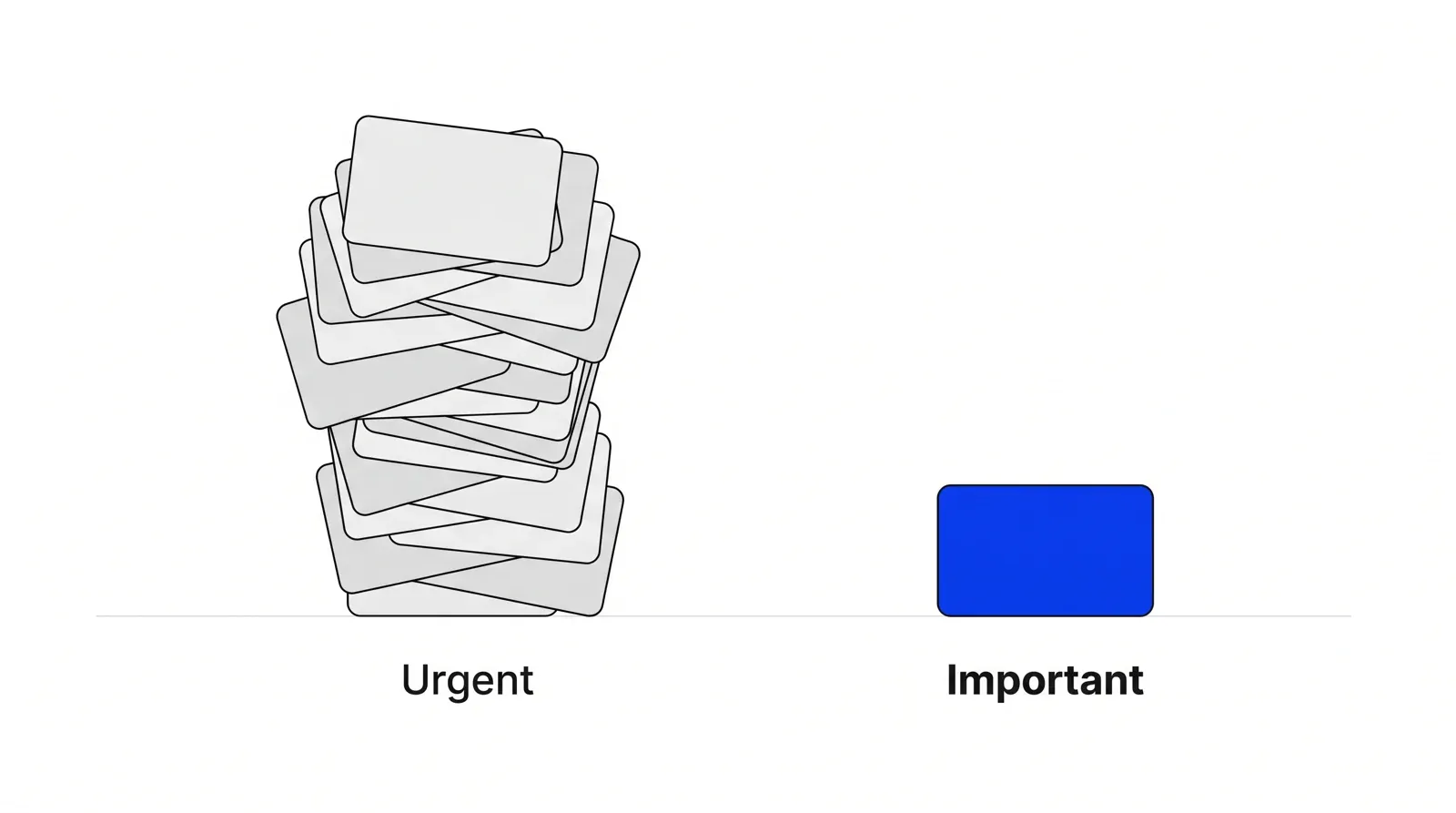
The cost compounds once a task is picked up and then interrupted. Research by Sophie Leroy on what she calls attention residue found that people perform worse on a new task when they switch to it before finishing the one before, because part of their focus stays with the unfinished item. Separate work by Gloria Mark, tracking knowledge workers directly, found it takes roughly 23 minutes to fully return to a task after an interruption, and that people interrupt themselves almost as often as anyone else does. A matrix does not remove interruptions. It gives a team a fast, shared answer for whether the interruption belongs in Do or somewhere else, instead of an improvised judgment call every time.
Delegating means handing over a result
The Delegate box fails most often when it becomes a place to offload work without a result attached. Research on workplace delegation, published in Frontiers in Psychology, found that delegation done well increases the confidence and initiative of the person receiving the task, largely because it comes with real ownership rather than just extra volume. The difference between delegating and dumping is a named outcome and a deadline; without both, the task returns to the original owner within a week, just later and angrier.
In healthcare operations, where triage already runs on an urgency scale, researchers have pushed back on urgency as the only allocation rule. A 2024 commentary in the Journal of Cancer Research and Clinical Oncology argued that treatment decisions need a second axis, the likely benefit of acting, alongside how urgent the situation looks, which is close to what the matrix asks of Important. Urgency alone answers “how soon.” It never answers “how much this matters.”
When it gets confused with MoSCoW
Teams scoping a release often reach for MoSCoW, Must have, Should have, Could have, Won’t have, and assume it is the same tool as the Eisenhower matrix. It solves a different problem.
| Eisenhower matrix | MoSCoW | |
|---|---|---|
| Scores | Urgency and importance, two axes | How essential to one deadline, one axis |
| Fits | An open, changing task list | A fixed list of requirements for one release |
| Output | Do, Schedule, Delegate, Delete | Must, Should, Could, Won’t |
| Cadence | Weekly or daily | Once per planning cycle |
Use the Eisenhower matrix for a task list that changes daily. Use MoSCoW once you already know the full list of candidate requirements and need to cut it down to what ships.
Run this inside a written weekly rhythm, the kind of operational cadence covered in Pushers’ marketing-operational-system work, and the four boxes stop being a one-off exercise and start being how the team decides, every week, what gets the next hour.
How to apply Eisenhower matrix, step by step
- List everything competing for attention. Write down every task, request and open commitment for the week without judging it yet, the ones that arrived an hour ago and the ones that have waited a month.
- Ask whether it is important. A task is important if it moves a goal the business has actually committed to: revenue, a customer promise, a deadline with a regulator, a hire. A loud request is not important just because someone wants it now.
- Ask whether it is urgent. A task is urgent if waiting a day changes the outcome, a system is down, a patient is waiting, a payment is stuck. Most email and most meeting invites fail this test even when they feel urgent.
- Sort each task into one of four boxes. Important and urgent goes in Do. Important and not urgent goes in Schedule. Urgent and not important goes in Delegate. Neither goes in Delete.
- Give Schedule a date and an owner. Put every Schedule item on the calendar before the week starts, with a name attached. A good intention with no slot loses to whatever feels urgent that day.
- Review the boxes on a fixed day. Once a week, move finished tasks out and re-sort what is left. A task sitting in Schedule for a month without a slot is not being scheduled, it is being avoided.
Examples
A clinic front desk
Take a dental clinic with 400 patients a month, an illustrative example. A patient calling in pain for same-day care is Do. Updating the six-month recall list is Schedule, the task that keeps the calendar full three months out. A supplier's sales call is Delegate, handed to a receptionist with a two-line script. A weekly debate about the break room snacks is Delete.
A fintech operations team
Illustrative: a payments team watching a live transaction failure is Do. Rebuilding the reconciliation script that keeps causing those failures is Schedule, the fix that never gets a slot until it breaks again. A routine document request from a compliance auditor is Delegate to an ops analyst. Forwarding every monitoring alert to the whole team channel is Delete, replaced with a filter for the two alerts that matter.
A founder's Monday queue
Illustrative: a funding wire that has to go out today is Do. Writing next quarter's hiring plan is Schedule, the task most founders push a week at a time for months. Approving a routine expense report is Delegate to a finance lead. Reading every competitor's newsletter the moment it lands is Delete.
When to use it
Use it when a team or a founder has more requests than hours and no shared way to say no to any of them. It works best once the goals are already set; the four boxes sort tasks against a goal, they do not choose the goal.
When not to use it
Skip it when nobody has agreed on the goal yet, or when the backlog is one type of work, twenty items on a product roadmap, say, that all need finer-grained scoring against each other. A single urgent/important split does not replace a proper roadmap method for that case.
Common mistakes
- Marking almost everything both urgent and important, which turns the matrix into one overflowing Do box.
- Filling Schedule with good intentions and no date or owner, so the work never actually happens.
- Delegating a task without a clear result and deadline, which just moves the interruption to someone else's day.
- Running the exercise once and never repeating it, so new urgent noise refills Do within a week.
- Sorting a task into Do because doing it feels important, instead of testing it against the goal it actually serves.
FAQ
What is the Eisenhower matrix?
The Eisenhower matrix is a two-by-two grid that sorts tasks by two questions, is it important and is it urgent, into four actions: do it now, schedule it, delegate it, or delete it. It helps a team spend more time on work that moves a goal and less on whatever feels loudest that day.
What two questions does the Eisenhower matrix ask about a task?
Whether the task moves a goal the business has actually committed to, which makes it important, and whether waiting a day would change the outcome, which makes it urgent. A task can score high or low on either, and the combination decides which of the four boxes it lands in.
Did Eisenhower or Covey invent the Eisenhower matrix?
Neither drew the grid people use today. In a 1954 speech, Eisenhower quoted a one-line remark about urgent and important problems and credited it to another speaker. Stephen Covey built the actual four-quadrant matrix in his 1989 book and made Quadrant II, important but not urgent, its center.
What are the four quadrants of the Eisenhower matrix, and what do you do with each?
Do covers tasks that are urgent and important, handled today. Schedule covers important tasks that are not urgent, given a calendar slot. Delegate covers urgent tasks that are not important, handed to someone else. Delete covers tasks that are neither, dropped from the list entirely.
How is the Eisenhower matrix different from MoSCoW?
The Eisenhower matrix scores any task against two axes, urgency and importance, and fits daily or weekly triage. MoSCoW, Must, Should, Could, Won't, scores a fixed list of requirements against one axis, how essential each is to a single deadline, and fits scoping a release or a project.
Sources
- Dwight D. Eisenhower, Address at the Second Assembly of the World Council of Churches (Aug 19, 1954), The American Presidency Project
- Garson O'Toole, What Is Important Is Seldom Urgent And What Is Urgent Is Seldom Important, Quote Investigator
- Meng Zhu, Yang Yang, Christopher K. Hsee, The Mere Urgency Effect, Journal of Consumer Research 45(3), 2018
- FranklinCovey, Intro to Habit 3 and the Time Matrix, FranklinPlanner
- Ellen Auster, Shannon Auster-Weiss, Conquer Your To-Do List with This Simple Hack, Harvard Business Review, 2020
- Piers Steel, The Nature of Procrastination, Psychological Bulletin 133(1), 2007
- Sophie Leroy, Why is it so hard to do my work?, Organizational Behavior and Human Decision Processes 109(2), 2009
- Gloria Mark, Daniela Gudith, Ulrich Klocke, The Cost of Interrupted Work: More Speed and Stress, CHI 2008
- Gloria Mark, Too Many Interruptions at Work?, Gallup Business Journal
- Johansson, Fodor, Forberg, Ekwall, Ekelund, Triage effectiveness: a framework for quantifying the effect of emergency triage prioritization, BMC Medical Research Methodology, 2026
- Zhang, Qian, Wang, Jin, Wang, Wang, Leaders' Behaviors Matter: The Role of Delegation in Promoting Employees' Feedback-Seeking Behavior, Frontiers in Psychology, 2017
- Elsbeth Johnson, Fiona Murray, What a Crisis Teaches Us About Innovation, MIT Sloan Management Review, 2020
- Eisenhower Presidential Library, Dwight D. Eisenhower and Mamie Doud Eisenhower chronologies
- Joshua Rubinstein, David Meyer, Jeffrey Evans, Executive Control of Cognitive Processes in Task Switching, Journal of Experimental Psychology: Human Perception and Performance 27(4), 2001, APA
- Agile Business Consortium, MoSCoW Prioritisation, DSDM Project Framework Handbook
- Harvard Business School Online, How to Prioritize Tasks Effectively Using the Eisenhower Matrix
- Stephen R. Covey, The 7 Habits of Highly Effective People, Simon and Schuster, 1989, Open Library record
- World Council of Churches, Evanston after fifty years
- Aaron Lawson McLean, Operationalizing urgency in oncology: ethical challenges amidst the pandemic, Journal of Cancer Research and Clinical Oncology, 2024
- Li, Li, Ma, Zhou, Yan, Tian, Dai, Xie, Xie, Yang, Liu, Dai, Li, Xu, Decision fatigue among Chinese nurse managers, Journal of Nursing Management, 2026
Last updated Sep 25, 2026


Fractional COO or embedded operations team? How to choose at Series A
The two models solve different problems. Here is how to tell which one your company has, and what each costs you in time and control.

What a revenue operations manager actually owns
Pipeline definitions, CRM hygiene, forecasting and the handoffs between marketing, sales and success. What the role covers, and how it differs from sales ops.

What is a fractional executive? Models, pricing and failure points
Fractional, interim, advisory or embedded team: four different models get lumped under one word. Here is how they differ and when each one fails.