Five Dysfunctions of a Team
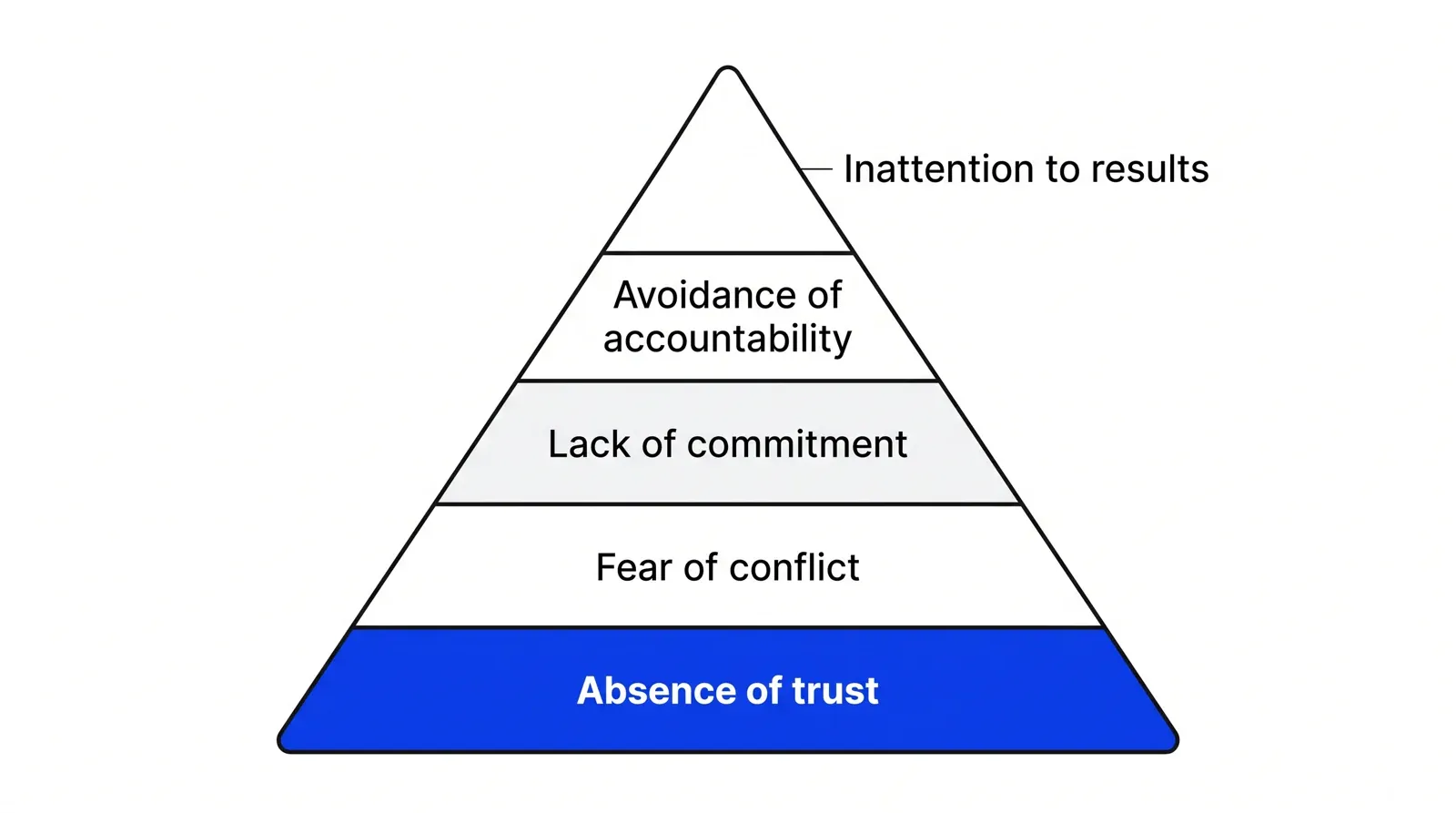
The Five Dysfunctions of a Team is a model that explains team underperformance as five stacked problems, trust, conflict, commitment, accountability and results, each resting on the one below it.
The Five Dysfunctions of a Team is a model by consultant Patrick Lencioni that explains why capable teams still underperform. It stacks five problems into a pyramid, each enabling the next: absence of trust, fear of conflict, lack of commitment, avoidance of accountability and inattention to results. Lencioni introduced it in a 2002 leadership fable, not a research study, though parts of it map onto later academic work on teams.
- Origin
- Patrick Lencioni, 2002
- Level
- 201 · Tool
- Fits
- Startup, Small and mid-size, Scale-up
- Time to apply
- Half a day to name the level a team is stuck on; weeks of repeated practice to move up one level
- What you need
- a team that meets regularly enough to build a pattern, not a one-off project group · a leader willing to go first on admitting a mistake or a weakness
The Five Dysfunctions of a Team is a model that explains why a team of capable, well-intentioned people can still underperform. It stacks five problems into a pyramid, each one resting on the one below it: absence of trust, fear of conflict, lack of commitment, avoidance of accountability and inattention to results. Patrick Lencioni, a management consultant, introduced the model in a 2002 book written as a leadership fable, a fictional story about a struggling executive team, rather than a research report. The book became a best-selling team-management title, and Lencioni later published a field guide and an online team assessment built on the same five levels.
The order is the point. Lencioni does not claim the five problems are equally likely. He claims they compound bottom up: a team that has not built trust cannot disagree, a team that cannot disagree cannot commit, a team that has not committed will not hold each other accountable, and a team without accountability drifts from the results it was supposed to deliver. Skipping straight to accountability or results, the two problems that show up first in a bad quarter, usually fails, because the block sits lower down.
Trust means being able to admit a mistake
Trust, in Lencioni’s sense, means a teammate can admit a mistake, ask for help or say “I don’t know” without the admission being used against them later, what he calls vulnerability-based trust. This differs from predictive trust, simply knowing a colleague will hit a deadline; a team can have plenty of the second kind and none of the first.
The closest independent research is Amy Edmondson’s work on team psychological safety. Her 1999 study of 51 manufacturing work teams, in Administrative Science Quarterly, found that psychological safety, a shared belief that the team is safe for interpersonal risk-taking, predicted how much a team engaged in learning behavior such as asking questions or discussing mistakes, which in turn predicted performance. Google reached a related conclusion: its Project Aristotle study of 180 internal teams listed psychological safety first among the five dynamics separating its effective teams from the rest. Neither study uses Lencioni’s language, but both point at the same mechanism: a team that quietly punishes candour stops getting it.
Conflict has to be about the work
Fear of conflict follows directly from absent trust. A team that cannot be vulnerable will not risk an open disagreement, so meetings stay polite and the argument happens afterward, in hallway conversations that never reach the room where a decision could change. Lencioni’s fix is to make conflict a discipline, mining for disagreement on purpose, rather than avoiding it or letting it erupt unplanned.
Research on team conflict adds detail to this level, and a warning. Karen Jehn’s 1995 study of 105 work groups split conflict into task conflict, disagreement about the work itself, and relationship conflict, friction between people, and found the two behave differently: task conflict can improve decisions under the right conditions, while relationship conflict reliably hurts them. A follow-up study with Elizabeth Mannix found high-performing teams kept relationship conflict low throughout while task conflict rose and fell at predictable points, so more conflict is not simply better; timing and type both matter.
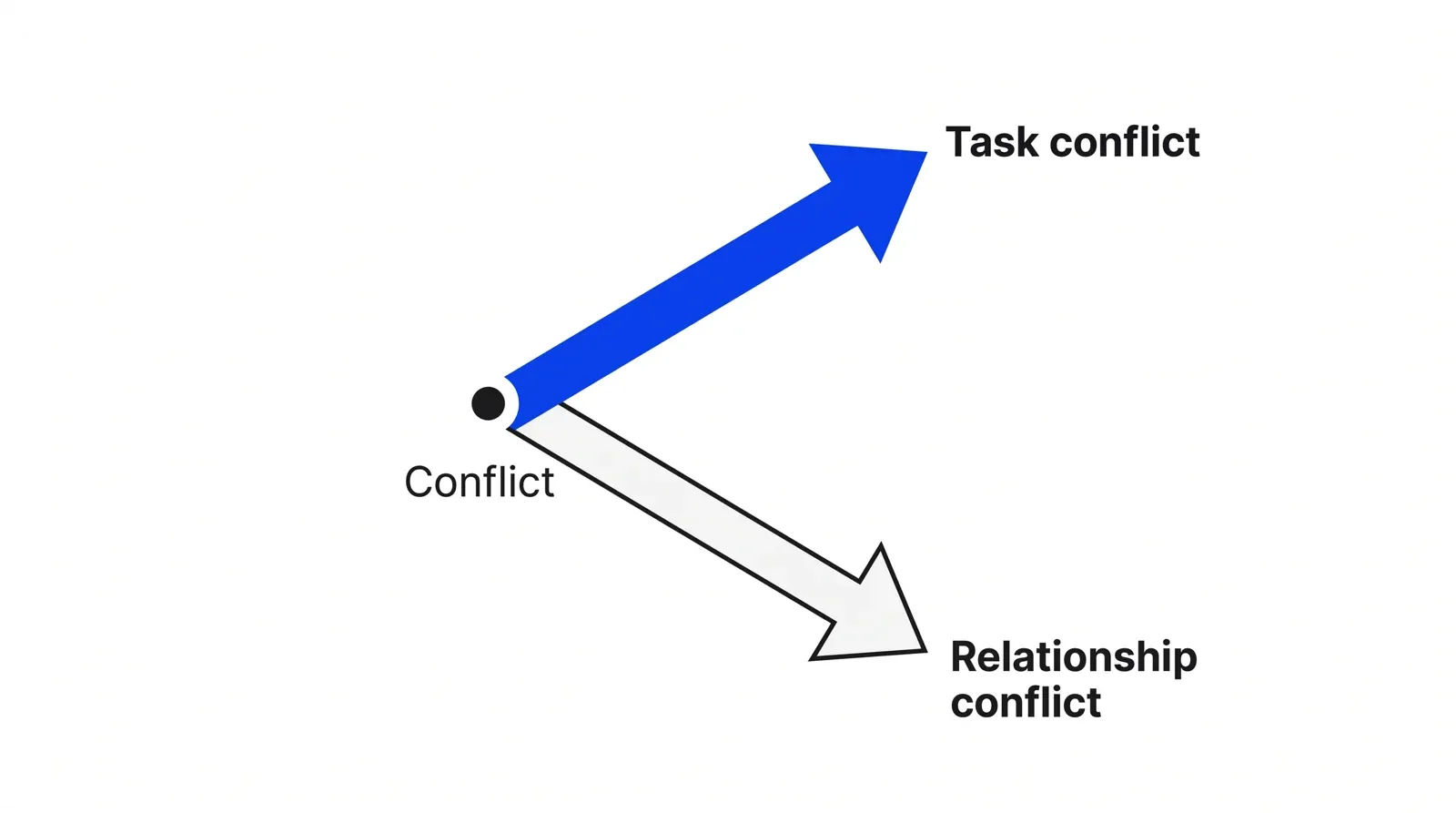
A later meta-analysis complicates the picture. Carsten De Dreu and Laurie Weingart pooled dozens of conflict studies in 2003 and found that, on average, both relationship and task conflict correlated negatively with team performance and satisfaction, not only the relationship kind. Open disagreement helps when a team separates the argument from the person and ties it to a decision, and it becomes a new source of dysfunction just as easily when it does not.
Commitment comes after the argument
Lack of commitment, in the model, means ambiguity survives a decision: a meeting ends with nods around the table, and afterward different people act as though different things were agreed. Commitment depends on the conflict stage happening first. People commit more easily to a decision they got to argue against than to one that arrived without debate, even when the outcome ends up the same.
Jon Katzenbach and Douglas Smith’s 1993 Harvard Business Review study of dozens of teams made a related point independently. What separates a real team from a working group, they found, is shared commitment to a common approach and mutual accountability for the result. Their research predates Lencioni’s book by a decade and reaches the pyramid’s third and fourth levels from team-performance research rather than a fable.
Accountability between peers
Avoidance of accountability, in Lencioni’s model, means team members tolerate weak performance from each other because holding a peer to a standard feels confrontational, so accountability quietly becomes the manager’s job alone.
This has a known mechanism outside the book. Steven Karau and Kipling Williams’ 1993 meta-analysis of 78 studies on social loafing found individuals reliably put in less effort inside a group than working alone, especially when their own contribution was hard to identify. A team with no peer accountability, only a manager checking in occasionally, gives that effect room to operate. A 2021 study in the Journal of Business Ethics by Virginia Stewart, Deirdre Snyder and Chia-Yu Kou found team accountability mostly forms through peer relationships, and predicted effort and commitment, though not performance on its own, a reminder that accountability fixes drift without guaranteeing the destination. Gallup’s own workplace research found accountability the lowest-rated of seven leadership competencies it tracks, and that teams whose leader holds the standard well are three times as likely to be engaged.
Accountability only works once it is clear who owns what, a role-clarity problem as much as a courage problem. A RACI matrix solves the role-clarity half, giving each task one accountable name. Lencioni’s model addresses the harder half: whether the team enforces it once the name is on the row.
Results stay first only if something keeps them visible
Inattention to results sits at the top of the pyramid: individual goals, department status or personal standing quietly outrank the team’s shared result, often once the lower levels are already working and the team stops watching for it.
J. Richard Hackman’s decades of research on teams, summarized in a 2009 Harvard Business Review interview, found teams often fail for a more basic reason than any single dysfunction: members do not agree on what the team is there to do. Lencioni’s fifth level assumes that question is settled and the risk is losing sight of the answer under daily pressure. Hackman found that for many teams, the answer was never agreed on in the first place, a prior problem the pyramid does not name directly.
Five dysfunctions against Google’s five dynamics
Both models name five factors and both put psychological safety or trust first, which is where the confusion starts, but they come from different places and answer different questions.
| Five Dysfunctions | Project Aristotle’s five dynamics | |
|---|---|---|
| Origin | Lencioni’s 2002 leadership fable | Google’s internal study of 180 teams |
| Basis | A consultant’s model built from client observation | Statistical analysis of interview and survey data |
| Starting point | Trust, built through the team’s own behavior over time | Psychological safety, alongside dependability, structure, meaning and impact |
| Best fit | Diagnosing why an existing team is stuck | Measuring where a team stands across several factors at once |
Use the Five Dysfunctions to diagnose a team that already feels stuck. Use Google’s five dynamics for a survey, checking a team’s standing before deciding where to intervene.
Naming which level blocks a team, instead of treating whichever symptom is easiest to see, is the same discipline behind Pushers’ work building operational systems: a named owner and a meeting rhythm only hold up once the team underneath them can commit to what gets decided in the room.
How to apply Five Dysfunctions of a Team, step by step
- Name the level the team is stuck on. Read the five levels from the bottom up and name where the pattern breaks first. Most teams assume the problem is accountability or results, since those are what hurt this quarter, when the real block sits lower, usually trust or conflict. Naming the true level, out loud, is the step teams skip most and the one the rest depends on.
- Build trust before asking for candor. Trust here means a team member can admit a mistake or ask for help without it being used against them later. A short structured round, everyone naming one thing they are not good at, moves this faster than a retreat with generic trust exercises, because it is specific and it is done in front of the whole team.
- Make room for one real disagreement per meeting. Pick one decision on the agenda and require at least one stated objection before it closes. A team that leaves every meeting agreeing on everything is usually agreeing in the room and disagreeing afterward, in side conversations that never reach the people who could act on them.
- Close every decision with a stated commitment. End the meeting by restating what was decided and who does what by when, out loud, including the people who argued against it. Ambiguity here is what lets a team quietly reopen the same decision three meetings later, as if it had never been made.
- Let peers hold each other accountable, not only the manager. Agree on a standard before the work starts, then make it normal for a peer, not only the manager, to point out when someone misses it. A team where only the manager enforces standards stops enforcing them the moment the manager is not in the room.
- Put one shared result above individual goals. Pick the single collective result that matters most this quarter and put it somewhere the team sees it more often than each person's own targets. A team chasing five individual goals rarely notices it has stopped chasing the one that was supposed to matter most.
Examples
A clinic's leadership team
Illustrative. A multi-location clinic's leadership team has flagged scheduling as a problem for months: overbooked mornings, a rising no-show rate, one location short-staffed while another sits idle. It comes up in every weekly meeting, gets a nod, and drops. Two directors who disagree about the fix, block scheduling versus flexible slots, each explain their preferred version to the practice owner separately afterward instead of to each other in the room. The same complaint reopens at the same meeting six months later, because the team never had the argument that would have closed it.
A fintech ops and compliance team
Illustrative. A payments company's operations and compliance leads agree, in every planning meeting, to cut average KYC review time from six days to three. Both nod. Back at their desks, compliance leaves its existing sign-off queue untouched because no one was named to change it, and operations assumes compliance is already moving. Two sprints later, review time has not shifted, and neither lead can say why, because the meeting produced agreement without producing one named commitment.
When to use it
Use it when a team has the resources, talent and a clear enough mandate, but still slips deadlines, avoids hard conversations, or lets the same disagreement resurface every few weeks. It fits one intact team that meets regularly, a leadership team, a department, a squad, not a whole company's culture in a single pass.
When not to use it
Skip it as a first move when the team's real problem is structural: the wrong people are on the team, the mandate from above is unclear, or the team has been asked to discuss a decision it has no authority to make. No amount of trust-building fixes a team empowered to talk but not to act. It is also not a substitute for a conflict-resolution process when the friction looks more like harassment or a personal clash than ordinary disagreement.
Common mistakes
- Trying to fix accountability or results first, since they are the visible pain, without checking whether the team ever built trust or had a real argument underneath.
- Treating one offsite or trust exercise as finished work, instead of the ongoing practice each level needs.
- Mistaking harmony for trust, when a team that never disagrees usually has not gotten honest yet.
- Leaving accountability to the manager alone, so peers stay quiet and standards slide the moment the manager is not watching.
- Running the model as a poster on the wall instead of an honest diagnosis of which specific level is broken this quarter.
FAQ
What are the five dysfunctions of a team?
Patrick Lencioni's model names five stacked problems: absence of trust, fear of conflict, lack of commitment, avoidance of accountability and inattention to results. Each rests on the one below it, so a team addresses trust before conflict, conflict before commitment, and so on up the pyramid he set out in his 2002 book.
Is the five dysfunctions model backed by research?
It is a practitioner model from a leadership fable, not a peer-reviewed study. Some parts map onto real research, Amy Edmondson's work on psychological safety supports the trust level, but other parts, like whether more conflict reliably helps performance, are contested in the academic literature on teams.
What is the difference between task conflict and relationship conflict?
Task conflict is disagreement about the work itself, which approach, which numbers. Relationship conflict is friction between people. Karen Jehn's research found task conflict can help decisions under the right conditions, while relationship conflict consistently hurts them, though a later meta-analysis found even task conflict often correlates with worse outcomes on average.
Which dysfunction should a team fix first?
The lowest one it is stuck on, not the one that feels most urgent this week. Teams often try to fix accountability or results directly, but if trust or conflict underneath is still broken, the fix does not hold. Lencioni built the pyramid specifically to stop teams from skipping levels.
How long does it take to fix a dysfunctional team?
Diagnosing which level is broken can take one direct conversation. Moving up a level, from tolerating disagreement to having it, takes weeks of repeated practice, not a single workshop. Teams that treat it as a one-time offsite usually slide back within a few months.
Sources
- The Table Group, The Five Dysfunctions of a Team model
- Jossey-Bass (Wiley), The Five Dysfunctions of a Team: A Leadership Fable, 20th Anniversary Edition
- Wiley, Overcoming the Five Dysfunctions of a Team: A Field Guide
- The Table Group, Five Dysfunctions Online Team Assessment
- Amy C. Edmondson, Psychological Safety and Learning Behavior in Work Teams, Administrative Science Quarterly, 1999
- Amy C. Edmondson, The Fearless Organization, Wiley, 2019
- Amy C. Edmondson, official site, Psychological Safety
- Harvard Business School Working Knowledge, In Tough Times, Psychological Safety Is an Asset, Not a Luxury
- Google re:Work, Guide: Understand team effectiveness
- Karen A. Jehn, A Multimethod Examination of the Benefits and Detriments of Intragroup Conflict, Administrative Science Quarterly, 1995
- Karen A. Jehn, Elizabeth A. Mannix, The Dynamic Nature of Conflict, Academy of Management Journal, 2001
- Carsten K. W. De Dreu, Laurie R. Weingart, Task Versus Relationship Conflict, Team Performance, and Team Member Satisfaction: A Meta-Analysis, Journal of Applied Psychology, 2003
- Diane Coutu, Why Teams Don't Work, an interview with J. Richard Hackman, Harvard Business Review, 2009
- J. Richard Hackman, Ruth Wageman, A Theory of Team Coaching, Academy of Management Review, 2005
- Jon R. Katzenbach, Douglas K. Smith, The Discipline of Teams, Harvard Business Review, 1993
- Steven J. Karau, Kipling D. Williams, Social Loafing: A Meta-Analytic Review and Theoretical Integration, Journal of Personality and Social Psychology, 1993
- Virginia R. Stewart, Deirdre G. Snyder, Chia-Yu Kou, We Hold Ourselves Accountable: A Relational View of Team Accountability, Journal of Business Ethics, 2021
- Frances X. Frei, Anne Morriss, Begin with Trust, Harvard Business Review, 2020
- Gallup, Accountability Is Leadership's Greatest Weakness
- MindTools, Lencioni's Five Dysfunctions of a Team
Last updated Sep 25, 2026


Fractional COO or embedded operations team? How to choose at Series A
The two models solve different problems. Here is how to tell which one your company has, and what each costs you in time and control.

What a revenue operations manager actually owns
Pipeline definitions, CRM hygiene, forecasting and the handoffs between marketing, sales and success. What the role covers, and how it differs from sales ops.

What is a fractional executive? Models, pricing and failure points
Fractional, interim, advisory or embedded team: four different models get lumped under one word. Here is how they differ and when each one fails.