Customer success
Customer success is a proactive discipline for making sure a customer reaches the result they bought a product to get, tracked through onboarding, health scores and renewal so a team can act before churn instead of after it.
Customer success is a proactive function that helps a customer reach the outcome they bought a product for, so they renew and expand instead of leaving. It runs on onboarding to a first value moment, a health score built from usage and support signals, and a success plan tied to that score. Salesforce built one of the first dedicated teams around it in 2005; Gainsight later named the discipline.
- Origin
- Salesforce (Customers For Life team, David Dempsey); Gainsight, Nick Mehta, Dan Steinman and Lincoln Murphy named and popularized the discipline, 2005; 2016
- Level
- 201 · Tool
- Fits
- Small and mid-size, Scale-up, Enterprise
- Time to apply
- A quarter to stand up a first onboarding milestone and health score; ongoing after that
- What you need
- product usage data connected to individual customer accounts, not just aggregate traffic · one defined 'first value' moment every new customer needs to reach · one person accountable for each account's renewal, not a shared queue
Customer success is the practice of proactively helping a customer reach the outcome they bought a product to get, watched closely enough that a team can act before a renewal is at risk instead of after. It grew up inside subscription and SaaS businesses, where a signed contract starts a relationship the customer can leave at the next renewal date. Salesforce is widely credited with building one of the first dedicated teams around the idea, in 2005. Gainsight’s founders later gave the discipline its name and its playbook.
Where the idea came from
No academic paper started customer success. The fullest account of its origin sits inside the book that later popularized the term: Nick Mehta, Dan Steinman and Lincoln Murphy’s Customer Success, published by Wiley in 2016. The authors describe a 2005 company offsite in Half Moon Bay, California, where Salesforce’s renewals lead, David Dempsey, told CEO Marc Benioff and the rest of the leadership that the company’s churn rate stood at 8 percent every month. Salesforce responded by building a team focused on keeping the customers it already had. That account, told by the people who went on to build an entire software category around it, is the closest thing customer success has to a founding story. It comes from the industry’s own foundational text, so it is best read as a single-source account from the category’s founders.
The economic case behind it is older. Frederick Reichheld and W. Earl Sasser Jr.’s 1990 Harvard Business Review article “Zero Defections” showed that a small cut in customer defections could raise profits by a large margin. Their example was MBNA America’s card business, which brought its defection rate down to roughly 5 percent a year, about half the industry average, and grew from 38th to 4th place among US card issuers. The often-repeated claim that a 5 percent gain in retention lifts profits by 25 to 95 percent traces back to the same research, reported by Harvard Business Review in 2014. Reichheld’s own later work for Bain puts the lower end of that range, just over 25 percent, specifically in financial services, so the exact number moves with the industry rather than being one fixed law.
Customer success versus customer support
The two get confused because both sit close to the customer after the sale.
| Customer support | Customer success | |
|---|---|---|
| Trigger | A ticket, call or complaint | A usage signal or a milestone on the calendar |
| Timing | Reactive, after the problem appears | Proactive, before it does |
| Goal | Resolve the immediate issue | Get the customer to the outcome they bought |
| Main metric | Resolution time, satisfaction score | Health score, renewal, net revenue retention |
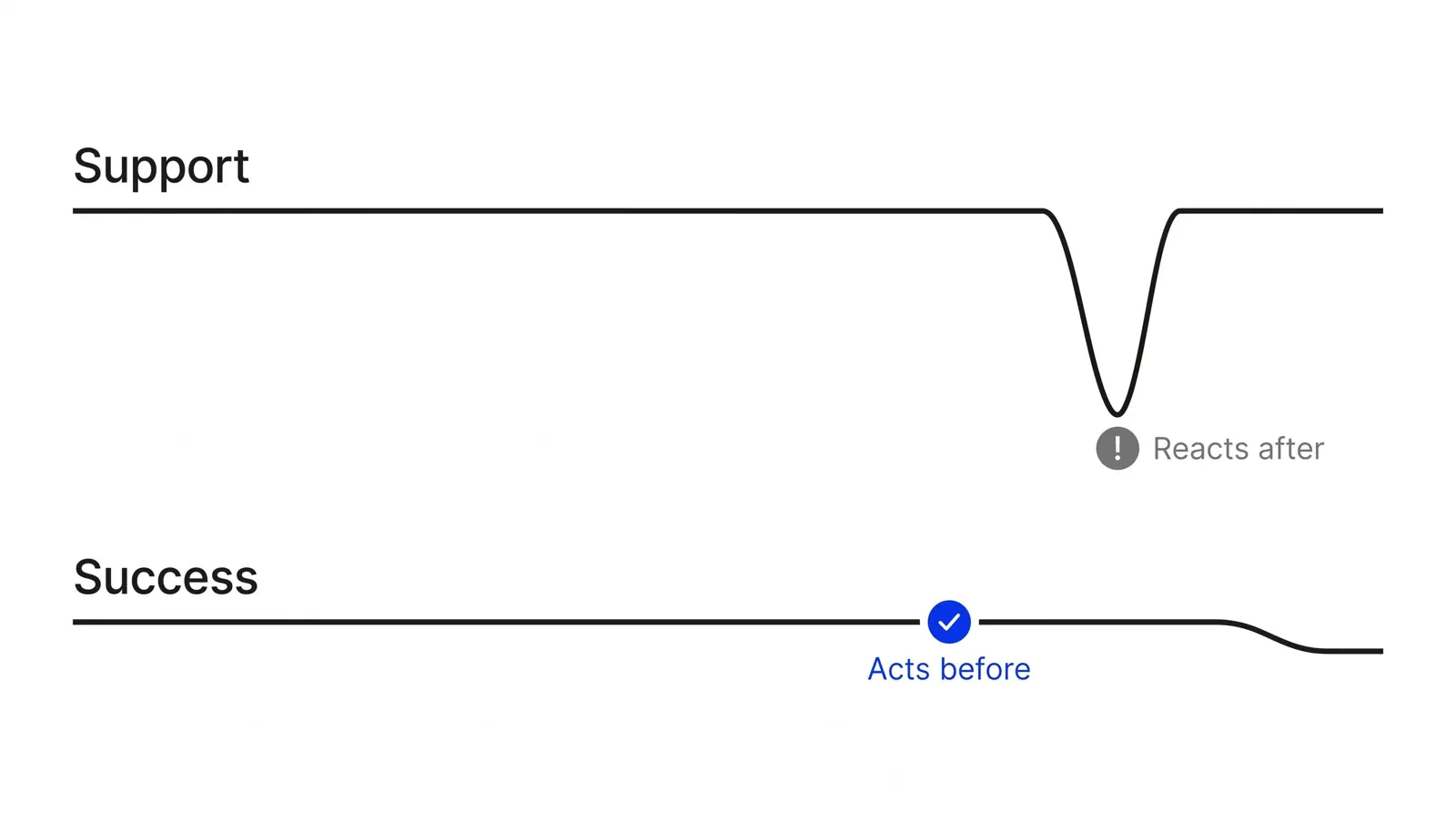
Salesforce’s own definition draws the same line: support is a reactive function that resolves problems as they occur, success is a proactive function that guides customers toward the outcome they wanted before those problems surface. TSIA, the research body for technology and software companies, defines it the same way, as proactively helping a customer realize the value they already bought rather than fixing what broke. Peer-reviewed marketing research treats customer success management as a distinct successor practice in a line that runs from customer relationship management through customer experience and customer engagement, rather than a rebrand of either one.
From signup to first value
Onboarding is defined by what it produces. Gainsight’s own definition ties the term directly to time to value: a customer counts as onboarded once they reach a specific result, past the point of finishing a setup checklist. A customer journey map is often the tool that finds where that first-value moment sits, since it traces what a real customer does rather than what an onboarding flowchart assumes.
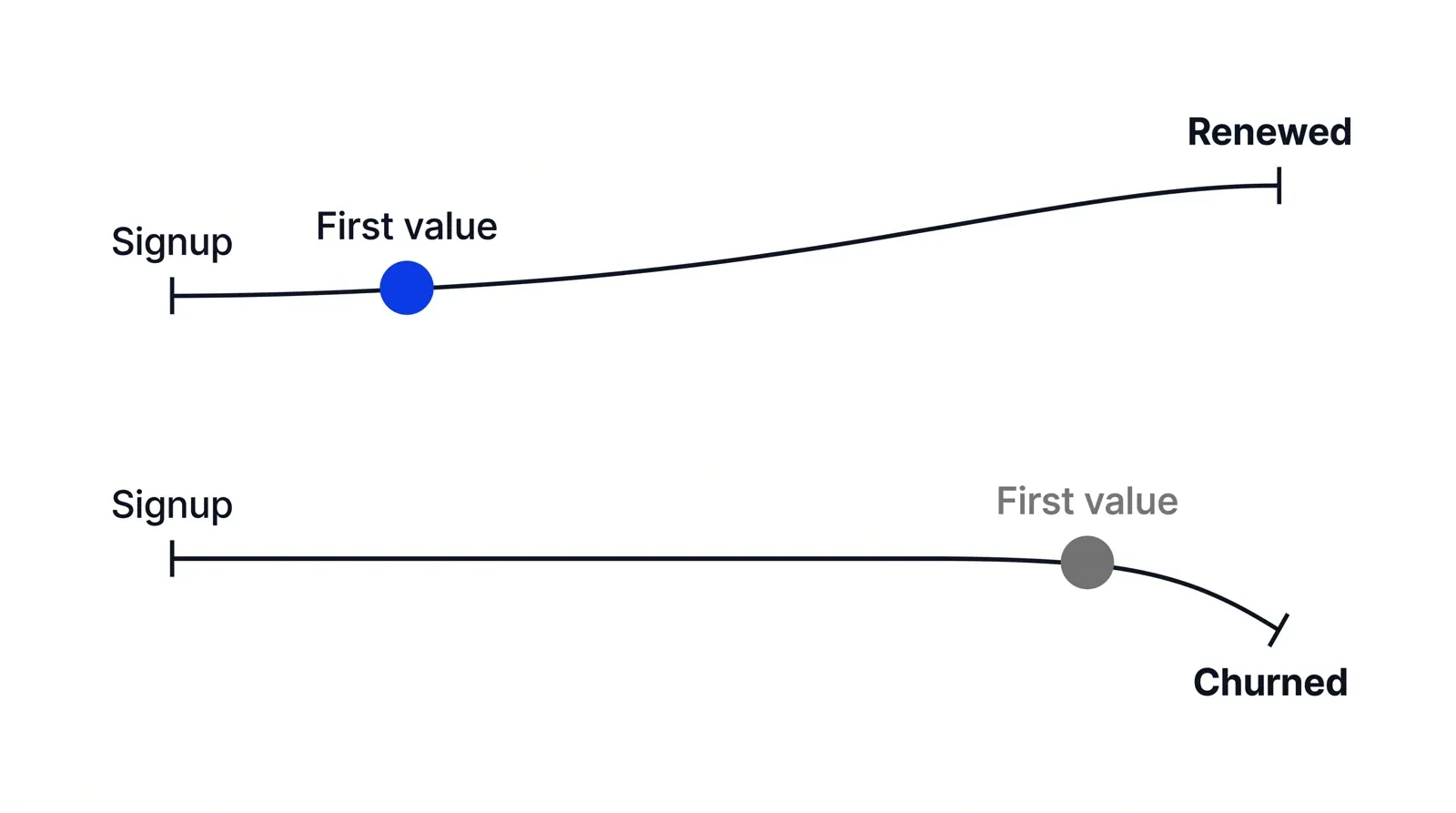
The moment matters more than the checklist around it. A customer who reaches a result in the first week behaves differently for the rest of the relationship than one who takes two months to get there, even if both eventually finish the same setup steps. That’s why a success team tracks the date of first value as its own number instead of folding it into a generic “onboarding complete” flag.
The health score and the plan it drives
A health score consolidates several signals into one number so a team can act on the accounts most at risk before any of them complain. Gainsight’s own guidance on building one lists five categories worth weighing: behavioral signals like feature adoption and login frequency, support signals like ticket volume, relationship signals like executive engagement, financial signals like renewal and upsell history, and feedback signals like NPS or CSAT. Most teams score on a 0 to 100 scale or a red, yellow, green band, and Gainsight’s own example splits a 100-point score into healthy from 71 to 100, at risk from 31 to 70, and critical from 0 to 30.
A score only earns its keep once it drives a specific plan. For every account below the threshold, a success plan names an owner, a next action and a date, tied to the exact reason the score dropped rather than a generic check-in.
Renewal, expansion and the number that reports both
Gross renewal rate tells a team whether it kept the customers it already had. Net revenue retention (NRR) tells it more: the share of recurring revenue kept and grown from that same base, including expansion from upsells and excluding any revenue from new customers. Stripe’s own formula for it is starting recurring revenue, minus revenue lost to churn and downgrades, plus revenue gained from upgrades, divided by that starting figure. Bessemer Venture Partners’ widely used benchmark treats 100 percent NRR as good, 110 percent as better and 120 percent or higher as best for growth-stage SaaS companies.
Take a project-management software vendor, illustrative, round numbers. It starts the quarter with $6,000,000 in recurring revenue. Churn and downgrades across the quarter cost $200,000. Upsells and plan upgrades on renewed accounts add $350,000. Net revenue retention for the quarter is (6,000,000 minus 200,000 plus 350,000) divided by 6,000,000, which is 6,150,000 divided by 6,000,000, or 102.5 percent. The vendor grew its existing base without signing a single new customer that quarter, the exact outcome customer success is built to produce.
When proactive outreach backfires
A field experiment published in the Journal of Marketing Research tested a proactive retention campaign that recommended cost-saving plan changes to at-risk customers, and found it raised the churn rate from 6 percent in the control group to 10 percent in the group that received the outreach. The intervention itself, not the customer’s underlying risk, drove the difference. A health score earns its purpose only when the action it triggers is tested against what keeps a specific segment of customers, instead of assumed to work because it looks proactive on a dashboard.
Run this way, customer success stops being a renewals afterthought and becomes a standing part of how a business keeps what it already sold, the same discipline Pushers builds into a client’s operating system through Growth Lab, where a health score and a renewal number sit next to the rest of the operational metrics instead of surfacing only when a contract is about to lapse.
How to apply Customer success, step by step
- Define what success means for one segment. Pick one customer segment and write down the specific, measurable outcome that segment bought the product to reach, not a vague goal like 'happy customers'. Result: a definition a health score and an onboarding plan can both point at.
- Map the path from signup to first value. Lay out the shortest real sequence from signup to the moment a customer gets that first outcome, and mark where most new customers currently stall. Result: a repeatable onboarding sequence with a named first-value moment.
- Build a health score from real signals. Combine usage, support history and a relationship signal like NPS into one weighted score, tested against accounts that already renewed or already churned. Result: an early-warning number instead of a hunch.
- Write a success plan for every at-risk account. For each account below the health-score threshold, assign an owner, a specific action and a date, tied to the exact reason the score dropped. Result: a plan a manager can check, not a poster.
- Route a falling score to outreach, not a ticket queue. Set the score drop to trigger a call from the success team before the customer files a complaint, separate from however support handles inbound tickets. Result: intervention before the customer asks for help, not after.
- Report renewal and net revenue retention every quarter. Track gross renewal rate and net revenue retention as the function's own scoreboard, reviewed on a fixed schedule, not only when a renewal is already at risk. Result: a number that shows whether the whole program is working, not just one account.
Examples
A fintech platform onboarding a merchant to first payout
Illustrative: a B2B payments platform doesn't count a signed merchant contract as a win. It tracks time to first payout, the day a new merchant's own customer completes a real transaction and the money lands in the merchant's account. A merchant still waiting after two weeks gets a call from the success team, not a support ticket, because a stalled integration this early predicts churn months before any renewal date.
A clinic-scheduling vendor's three-signal health score
Illustrative: a clinic-scheduling vendor with small-practice customers builds its health score from three signals only, weekly staff logins, the no-show rate inside the tool, and support tickets open longer than five days. A practice paying for a whole front desk's worth of seats but logging in twice a week drops into the amber band long before anyone calls to cancel.
When to use it
Use it once a business runs on subscriptions, contracts or repeat purchases, and a customer's decision to renew or expand depends on reaching a real result, not just getting help when something breaks. It fits SaaS, membership models and any B2B contract with a renewal date.
When not to use it
Skip it for one-time transactions with no renewal or expansion to protect. Skip building a dedicated function, too, before there is enough usage data or enough accounts for a health score to mean anything; a shared inbox and a spreadsheet cover a handful of early customers better than a formal program does.
Common mistakes
- Renaming the support team 'customer success' without changing what it does, reactive ticket handling under a new title.
- Building a health score from whatever data is easiest to pull instead of the signals that predict churn, so the score looks precise and still misses the accounts that leave.
- Running proactive outreach as one blanket campaign instead of targeting it: a published field experiment on plan-recommendation outreach found it raised churn instead of lowering it when the message didn't fit the customer.
- Measuring the function on tickets closed or calls made instead of renewal and net revenue retention, the numbers that show whether customers are succeeding.
- Waiting for the health score to turn red before assigning an owner, when the score's whole purpose is to trigger action before it gets there.
FAQ
What is customer success?
Customer success is a proactive function that helps a customer reach the outcome they bought a product for, tracked through onboarding, a health score and a success plan tied to renewal and expansion. It exists to act before a customer is at risk of leaving, not to respond once they complain.
What is the difference between customer success and customer support?
Customer support is reactive: it resolves a ticket, call or complaint after a customer raises it. Customer success is proactive: it uses usage data and a health score to reach out before a problem surfaces, aimed at the customer's outcome rather than one incident.
Who invented customer success?
No single person did. Salesforce built one of the first dedicated teams in 2005 after an internal presentation showed 8% monthly churn. Gainsight's founders, Nick Mehta, Dan Steinman and Lincoln Murphy, named and popularized the discipline in their 2016 book, though that origin story is documented mainly inside their own account.
What is a customer health score?
A customer health score is a single number, often 0 to 100 or a red, yellow, green band, built from weighted signals like product usage, support ticket volume, NPS and renewal history. It predicts the likelihood of renewal, expansion or churn so a team can act on the accounts most at risk first.
How is customer success measured?
The core metrics are gross renewal rate and net revenue retention, the share of recurring revenue kept and grown from existing accounts, including expansion and excluding new sales. A net revenue retention above 100% means a business can grow from its existing base alone.
Sources
- Frederick F. Reichheld, W. Earl Sasser Jr., Zero Defections: Quality Comes to Services, Harvard Business Review, September-October 1990
- Bain & Company, Zero defections: Quality comes to services (Harvard Business Review, HBR)
- Fred Reichheld, Bain & Company, Prescription for Cutting Costs
- Amy Gallo, The Value of Keeping the Right Customers, Harvard Business Review, October 2014
- Bryan Hochstein, Deva Rangarajan, Nick Mehta, David Kocher, An Industry/Academic Perspective on Customer Success Management, Journal of Service Research 23(1), 2020
- Bryson Hilton, Bita Hajihashemi, Conor M. Henderson, Robert W. Palmatier, Customer Success Management: The Next Evolution in Customer Management Practice?, Industrial Marketing Management 90, 2020
- Eva Ascarza, Raghuram Iyengar, Martin Schleicher, The Perils of Proactive Churn Prevention Using Plan Recommendations: Evidence from a Field Experiment, Journal of Marketing Research 53(1), 2016
- Nick Mehta, Dan Steinman, Lincoln Murphy, Customer Success: How Innovative Companies Are Reducing Churn and Growing Recurring Revenue, Wiley, 2016
- Nick Mehta, Dan Steinman, Lincoln Murphy, Customer Success, Wiley, 2016, excerpt: In the Beginning
- Salesforce, What Is Customer Success: The Ultimate Guide
- Gainsight, Customer Success, glossary
- Gainsight, Customer Health Score Explained: Metrics, Models & Tools
- Gainsight, Customer Onboarding, glossary
- TSIA, What Is Customer Success? Definition, Importance, and Value
- Stripe, Net revenue retention (NRR) for SaaS businesses
- Stripe, Payouts Explained: How Stripe Payouts Work
- ClientSuccess, Reactive vs. Proactive Customer Success Teams
- Zendesk, Customer success: What it is, why it matters, and how to achieve it
- Bessemer Venture Partners, State of the Cloud 2023
- Deloitte, Customer Success Strategy
- Gainsight, Customer Success Terms: The Complete A-Z Glossary
Last updated Sep 25, 2026


Fractional COO or embedded operations team? How to choose at Series A
The two models solve different problems. Here is how to tell which one your company has, and what each costs you in time and control.

What a revenue operations manager actually owns
Pipeline definitions, CRM hygiene, forecasting and the handoffs between marketing, sales and success. What the role covers, and how it differs from sales ops.

What is a fractional executive? Models, pricing and failure points
Fractional, interim, advisory or embedded team: four different models get lumped under one word. Here is how they differ and when each one fails.