Solution selling
Solution selling is a sales method in which the rep diagnoses a buyer's problem before proposing a product. Mike Bosworth built it at Xerox and published it in 1995.
Solution selling is a sales method in which a rep diagnoses a buyer's specific problem before proposing any product, then builds a shared picture of the fix and justifies its cost in the buyer's own numbers. Mike Bosworth developed it while training Xerox's sales force in the late 1970s and 1980s and published Solution Selling: Creating Buyers in Difficult Selling Markets in 1995.
- Origin
- Mike Bosworth (method and 1995 book); Keith M. Eades (2003 revision), late 1970s-1980s; 1995; 2003
- Level
- 201 · Tool
- Fits
- Small and mid-size, Scale-up
- Time to apply
- one call to try the diagnosis step; a full sales cycle to see it change what closes
- What you need
- a buyer with a problem they can already describe in their own words · enough time on the first call to ask questions before presenting anything · a way to find out who else signs off before the deal is far along
Solution selling is a sales method in which the rep diagnoses a buyer’s specific problem before proposing any product, builds a shared picture of the fix with the buyer, and only then justifies its cost in the buyer’s own numbers. Mike Bosworth developed the approach while running sales training at Xerox in the late 1970s and into the 1980s, and formalized it in his 1995 book Solution Selling: Creating Buyers in Difficult Selling Markets. Keith Eades, who led the training firm Sales Performance International, updated the method in The New Solution Selling in 2003. Both books describe the same order of operations: find where it hurts, understand why, and talk about the fix last.
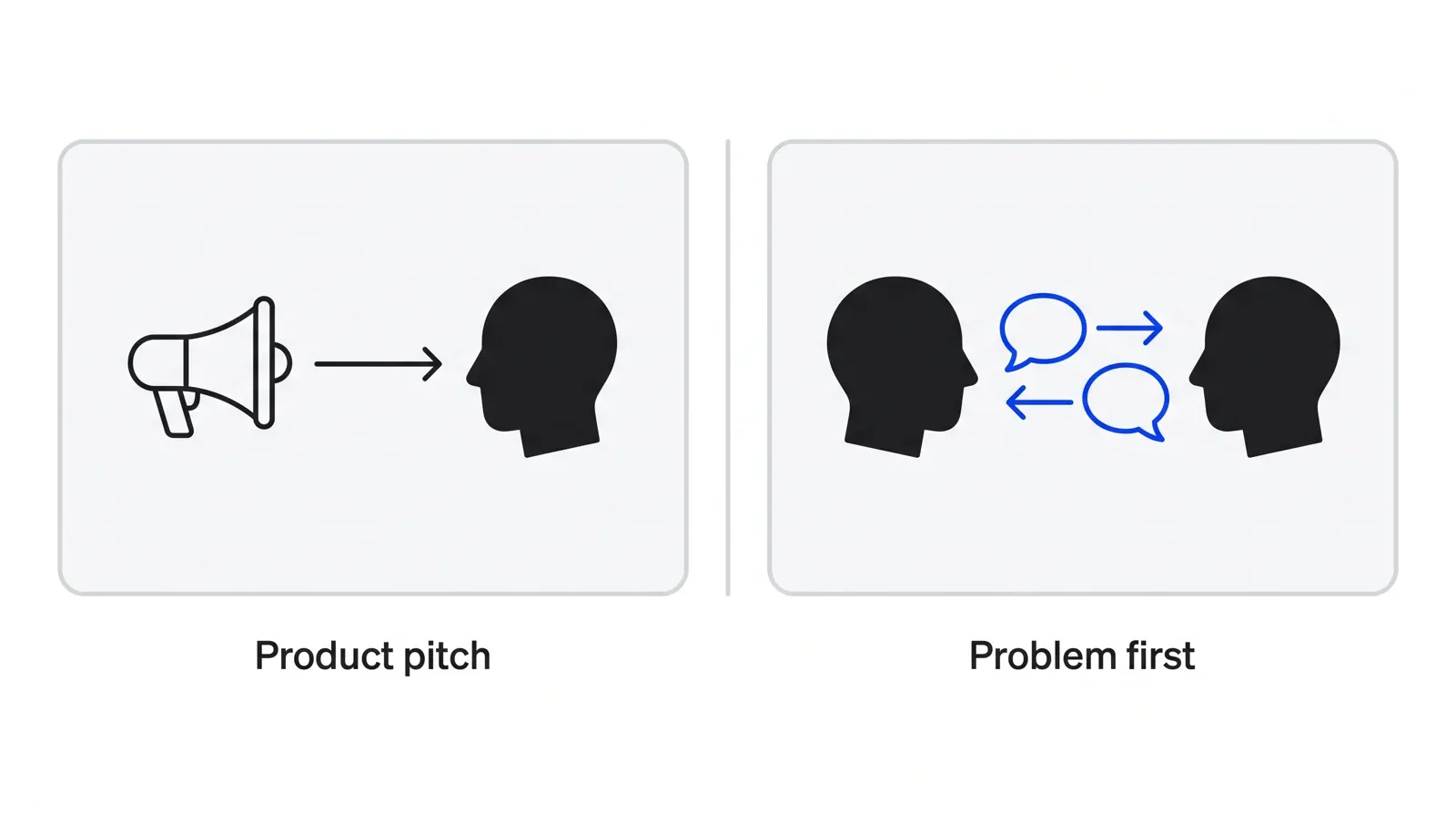
Where it came from
At Xerox, Bosworth kept running into the same pattern: roughly a fifth of the sales force closed most of the business, and the rest struggled with the same product, territory and training. Looking at what the top group did on a call, he found they spent the early minutes finding a problem the buyer already felt and asking why it existed, before they said a word about what Xerox sold. He left Xerox, built a training practice around that observation, and published it as Solution Selling in 1995.
Another researcher was working the same ground at Xerox around the same time. Neil Rackham, running the UK consulting firm Huthwaite, studied more than 35,000 sales calls at companies including Xerox, IBM and Motorola, and published SPIN Selling in 1988, seven years before Bosworth’s book. Both methods put questions before a pitch. Where they part ways is what the questions are for.
The four moves inside a solution sale
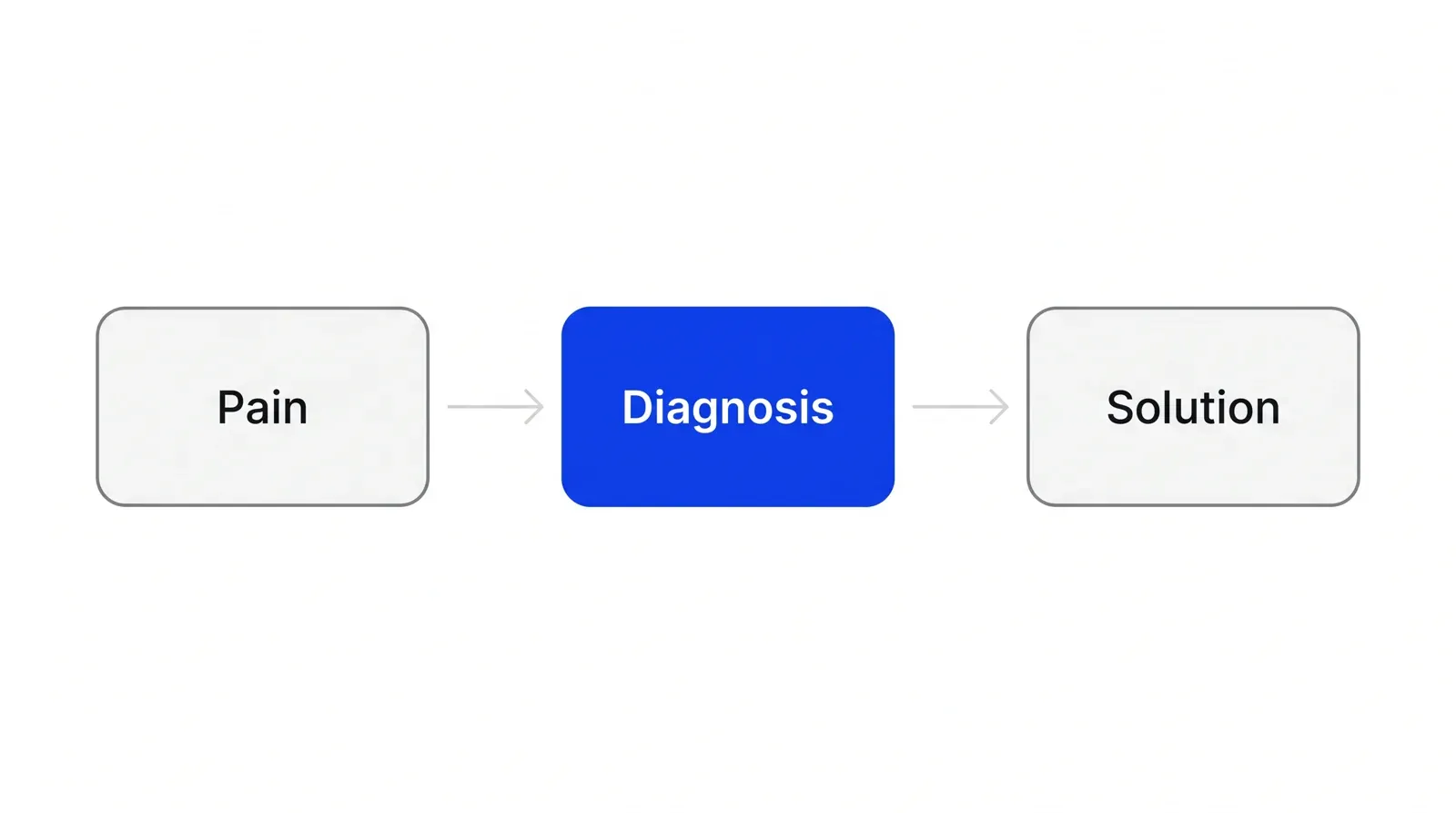
A solution sale runs through four moves, in order: pain, diagnosis, vision and value.
Pain is a problem the buyer already feels before the rep ever shows up. An operations manager who retypes the same order into two systems every day, and finds a mismatch most weeks, has pain. A manager who says the current setup is “fine” has none worth building a call around, no matter how outdated the setup looks from outside.
Diagnosis asks why the pain exists before anyone proposes a fix. The rep’s questions carry the weight here: what causes the delay, who touches the process, what it costs when it goes wrong. A demo can wait until the answers are on the table. Skip this step and a solution sale collapses into a product pitch with extra steps.
Vision is a picture of the fix that the buyer helps build, rather than one the rep hands over finished. The point is for the buyer to own the idea instead of just receiving it.
Value justification puts a number on the vision, in the buyer’s own terms: hours saved, errors avoided, a deadline no longer missed. A vision with no number attached is easy for a buyer to defer.
How it compares to SPIN and Challenger
Solution selling, SPIN and Challenger all argue a rep should stop leading with product. They disagree about what should come first instead.
| Solution selling | SPIN selling | Challenger sale | |
|---|---|---|---|
| Core move | Diagnose the buyer’s felt problem, then co-build a fix | Ask a fixed sequence of questions to build the case for change | Teach the buyer something they did not know, then push |
| Rep’s role | Consultant surfacing a pain the buyer already has | Researcher structuring what the buyer says out loud | Teacher reframing a problem the buyer thinks is settled |
| Assumes | The buyer already feels the pain | The buyer needs help seeing the size of the pain | The buyer’s current view of the problem is wrong |
| Source | Michael Bosworth, Solution Selling, 1995 | Neil Rackham, SPIN Selling, 1988 | Matthew Dixon, Brent Adamson, The Challenger Sale, 2011 |
Matthew Dixon, Brent Adamson and Nick Toman argued in a 2012 Harvard Business Review article, “The End of Solution Sales,” that solution selling built its whole approach around a buyer who did not yet know what was wrong or what fixed it, and that buyers with modern procurement teams increasingly diagnose their own problem before a rep ever gets on the call. Their answer was the Challenger sale: instead of asking the buyer to define the problem, the rep brings an insight the buyer had not considered.
That claim has not gone unchallenged. Adam Rapp and colleagues reviewed the Challenger model in a 2014 Journal of Personal Selling & Sales Management paper and found the evidence for pushing back on customers thinner than the book’s popularity suggested. Scott Inks, Ramon Avila and George Talbert, writing in 2019, placed Challenger alongside SPIN and solution selling as one more entry in a long line of sales methods each claiming to replace the last. None of the three has settled the question: a 2025 review of four decades of adaptive selling research still finds that reading the specific buyer separates strong performers from weak ones more reliably than any fixed script.
Selling into a regulated buying committee
In fintech and healthcare, the person who feels the pain is rarely the only person who signs off on the fix. Frederick Webster and Yoram Wind’s 1972 Journal of Marketing model of the buying center described this decades before software made it more visible: a purchase runs through users, buyers, influencers, deciders and gatekeepers, and a rep who diagnoses only the user’s pain has diagnosed half the deal. Forrester’s State of Business Buying 2026 report puts the current scale of that group at an average of 13 internal stakeholders and 9 external ones on a typical B2B purchase.
Take a bank evaluating a fraud-detection tool. The operations lead who requested it feels the pain directly: too many false positives, too many hours spent clearing them by hand. A bank’s third-party vendor rules, restated in the Office of the Comptroller of the Currency’s 2023 guidance on third-party risk management, require due diligence on that vendor before signing, covering security, data handling and the vendor’s own financial stability. A rep who never diagnoses the compliance team’s concerns, and pitches only to the operations lead, finds the deal stuck in a review queue nobody warned them about. The same pattern holds in healthcare software: whoever raised the request rarely owns the sign-off on how a vendor stores and protects patient records, and that approval usually sits with someone the rep does not meet until deep into the deal.
Kapil Tuli, Ajay Kohli and Sundar Bharadwaj’s 2007 Journal of Marketing research reframed a “solution” itself as a relational process. It gets worked out jointly with the customer over time and keeps changing as the diagnosis deepens, unlike a fixed bundle handed across the table once. That framing fits a regulated deal especially well: the diagnosis, the vision and the value case each have to satisfy a different stakeholder, and the rep’s job is running that process to a close, adjusting the case for each one along the way.
Run this alongside an experiment cycle in Pushers’ Growth Lab practice, where a sales motion this specific gets tested against its own numbers instead of adopted on faith because a book said so.
How to apply Solution selling, step by step
- Confirm the buyer feels the pain. Before booking a second call, check that the buyer can describe the problem without your prompting: what breaks, how often, and what it costs when it does. If the buyer calls the current process fine, there is no pain to build a deal on yet. Result: a pain worth diagnosing, or a clear signal to spend the next call somewhere else.
- Ask why before you propose anything. Spend the discovery call finding the cause: what triggers the problem, who touches the process, what breaks downstream when it happens. Hold the product back until the buyer has named the cause out loud. Result: a specific, shared description of the root cause, in the buyer's own words.
- Build the vision together. Sketch the fix as a conversation: ask what a working version of this process would look like, then connect pieces of what you sell to the picture the buyer just described. Result: a vision the buyer describes as their own idea when they repeat it to a colleague.
- Put a number on the vision. Translate the vision into terms the buyer already tracks: hours saved each week, errors avoided, a deadline that stops slipping. Use figures the buyer supplies or can check, instead of a generic industry benchmark. Result: a value case the buyer can defend to their own boss without you in the room.
- Map who else has to approve it. Ask directly who signs off, who reviews vendors, and whether compliance, security or finance weigh in before a contract moves. In a regulated market this list is usually longer than the person on the call expects. Result: a named list of every approval the deal still needs, found before it stalls in one of them.
- Trace the deal back to the pain. Before closing, check the agreement still fixes the cause named in step one, for the person who felt it first. Result: an agreement the buyer still defends a month after signing it, once the newness wears off.
Examples
A payments reconciliation tool sold to a finance director
Illustrative. A payments platform's rep opens the call assuming the finance director wants faster reporting. Ten minutes of questions surface a different pain: two people spend three days each month matching bank statements against invoices by hand, and March's close ran two days late because of it. The vision they build together centers on a match rate high enough that the manual pass takes an afternoon. The rep prices the deal against those three days a month, using the finance director's own numbers.
A patient-scheduling system sold to a clinic group
Illustrative. A scheduling vendor's rep hears the office manager's stated problem: patients getting a busy signal at peak hours. Diagnosis turns up a different cause: no-shows run high because reminder calls go out only a day ahead, too late for anyone to fill a cancelled slot. The vision they build is a reminder sent early enough to rebook that slot, aimed at the no-show pattern behind the busy signal. Before the deal closes, whoever owns patient records at the clinic group has to confirm how the vendor stores and protects that data, an approval the office manager did not know was coming.
When to use it
Use solution selling for a complex B2B deal where the buyer already feels a problem but has not settled on how to fix it, especially where more than one person has to approve the purchase and a generic pitch will not survive the diagnosis stage.
When not to use it
Skip it for a transactional or self-serve purchase where the buyer already knows exactly what they want to buy, or for a market where procurement has already defined the solution in detail before a rep is contacted; a diagnosis nobody asked for reads as a stalling tactic in either case.
Common mistakes
- Pitching the product before the buyer has named the cause of the pain, which turns a diagnosis into a demo with extra questions attached.
- Treating whoever answers the first call as the only stakeholder, and finding the real approval chain after the deal has already stalled.
- Presenting a finished vision instead of building it with the buyer, leaving them nothing to do but say yes or no.
- Quoting a value case in generic industry terms instead of the buyer's own numbers, which a skeptical buyer can dismiss in one sentence.
- Running a fixed script on every call, when the method's own research finds reading the specific buyer matters more than the script.
FAQ
What is solution selling?
Solution selling is a sales method where the rep diagnoses a buyer's specific problem before proposing a product, then builds a shared vision of the fix and prices it in the buyer's own numbers. Mike Bosworth developed it at Xerox and published it in 1995; Keith Eades updated the method in 2003.
Who invented solution selling?
Mike Bosworth developed the method while training Xerox's sales force in the late 1970s and 1980s, then published Solution Selling: Creating Buyers in Difficult Selling Markets in 1995. Neil Rackham worked similar ground around the same time with SPIN Selling, published in 1988, based on Huthwaite's research into more than 35,000 sales calls.
Is solution selling dead?
No single method has replaced it. A 2012 Harvard Business Review article argued buyers increasingly diagnose their own problem before calling a rep, and proposed the Challenger sale instead. A 2014 peer-reviewed review found the evidence behind that claim thinner than its popularity suggested, and a 2019 study placed Challenger in the same recurring cycle as solution selling and SPIN.
How is solution selling different from SPIN selling?
SPIN selling gives the rep a fixed sequence of question types (situation, problem, implication, need-payoff) to build the size of a problem the buyer may not have quantified yet. Solution selling assumes the buyer already feels the pain and focuses the rep's questions on diagnosing its cause and co-building a fix.
How is solution selling different from the Challenger sale?
Solution selling assumes the buyer's stated problem is close to correct and works with them to fix it. The Challenger sale, introduced by Matthew Dixon and Brent Adamson in 2011, assumes the buyer's view of the problem is wrong and has the rep teach them a different one before selling anything.
Sources
- Internet Archive, Solution Selling: Creating Buyers in Difficult Selling Markets by Michael T. Bosworth
- WorldCat, Solution selling: creating buyers in difficult selling markets
- Internet Archive, The New Solution Selling by Keith M. Eades
- Open Library, The New Solution Selling by Keith M. Eades
- Internet Archive, SPIN Selling by Neil Rackham
- Open Library, SPIN Selling by Neil Rackham
- McGraw Hill Education, Solution Selling (PB), product page
- McGraw Hill Education, SPIN Selling, product page
- Penguin Random House, The Challenger Sale by Matthew Dixon and Brent Adamson
- Brent Adamson, Matthew Dixon, Nicholas Toman, The End of Solution Sales, Harvard Business Review, July-August 2012
- Huthwaite International, The SPIN Methodology
- Huthwaite International, Neil Rackham explains the extensive research behind SPIN
- CBS News, Michael Bosworth: How Storytelling Helps You Sell
- Frederick E. Webster Jr., Yoram Wind, A General Model for Understanding Organizational Buying Behavior, Journal of Marketing 36(2), 1972
- Kapil R. Tuli, Ajay K. Kohli, Sundar G. Bharadwaj, Rethinking Customer Solutions: From Product Bundles to Relational Processes, Journal of Marketing 71(3), 2007
- Adam Rapp, Daniel G. Bachrach, Nikolaos G. Panagopoulos, Jason Ogilvie, Salespeople as Knowledge Brokers: A Review and Critique of the Challenger Sales Model, Journal of Personal Selling & Sales Management 34(4), 2014
- Scott A. Inks, Ramon A. Avila, George Talbert, The Evolution of the Sales Process: Relationship Selling versus the Challenger Sale, Journal of Global Scholars of Marketing Science 29(1), 2019
- Nawar N. Chaker and colleagues, The Past, Present, and Future of Adaptive Selling: Toward an Integrative Framework, Journal of the Academy of Marketing Science, 2025
- Forrester, Forrester 2026: The State of Business Buying
- Office of the Comptroller of the Currency, Bulletin 2023-17, Third-Party Relationships: Interagency Guidance on Risk Management
- Salesforce, What Is Solution Selling? A Complete Guide
- HubSpot, Solution selling: what it is and how I do it effectively
Last updated Sep 25, 2026