RACI matrix
The RACI matrix is a table that gives every task in a process exactly one owner, plus a clear answer for who does the work, who is asked and who is told.
A RACI matrix is a table that assigns one of four roles, responsible, accountable, consulted or informed, to each person for every task in a process. It exists to answer one question before work starts: who does it, who owns it, who has to be asked, and who only needs to hear about it. Each row gets exactly one accountable name.
- Origin
- No single inventor; DuPont, Ernst & Young and consultant Edmond F. Sheehan are all cited, 1950s to 1970s, disputed
- Level
- 201 · Tool
- Fits
- Small and mid-size, Scale-up, Enterprise
- Time to apply
- An afternoon to map one process; a short review each time the process or the team changes
- What you need
- a written list of the process's tasks or decisions · the actual names of who does each task today, not job titles · one person willing to own each row
A RACI matrix is a table that assigns one of four roles, Responsible, Accountable, Consulted or Informed, to every person involved in a task, deliverable or decision. It turns a vague line like “marketing handles onboarding” into a specific answer: who does the work, who owns the result, who has to be asked before it happens, and who only needs to hear about it once it is done.
Nobody can say with confidence who built the first one. What sources agree on is roughly when: the matrix took shape somewhere in management practice between the 1950s and the 1970s, not from one paper or one named author. Perfony’s history of the tool puts it plainly: it is hard to name an inventor, “because it has evolved a lot” over decades of use. Different write-ups point to different candidates, DuPont’s early responsibility charts, Ernst & Young’s RASCI variant from the 1970s, and a consultant named Edmond F. Sheehan, but no source settles which came first, and this page will not pretend otherwise.
What is documented, rather than disputed, is where the model landed. The Project Management Institute’s PMBOK Guide, Sixth Edition, defines a “RACI chart” directly in its glossary as “a common type of responsibility assignment matrix that uses responsible, accountable, consult, and inform statuses to define the involvement of stakeholders in project activities.” The Seventh Edition changes the emphasis: it folds RACI into the wider idea of a responsibility assignment matrix rather than naming RACI itself as the headline term. Both editions agree on the mechanics. Only the label on the box moved.
What each letter actually means
Responsible is whoever does the work. This can be one person or several, as long as they are the ones with hands on the task, not a manager who checks in on it. Accountable is different: it is the single name who owns the result and answers for it if the task fails or slips. Consulted is anyone whose input the Responsible person actually needs before finishing the work, a two-way conversation. Informed is anyone who needs the outcome but has no say in producing it, a one-way update after the fact.
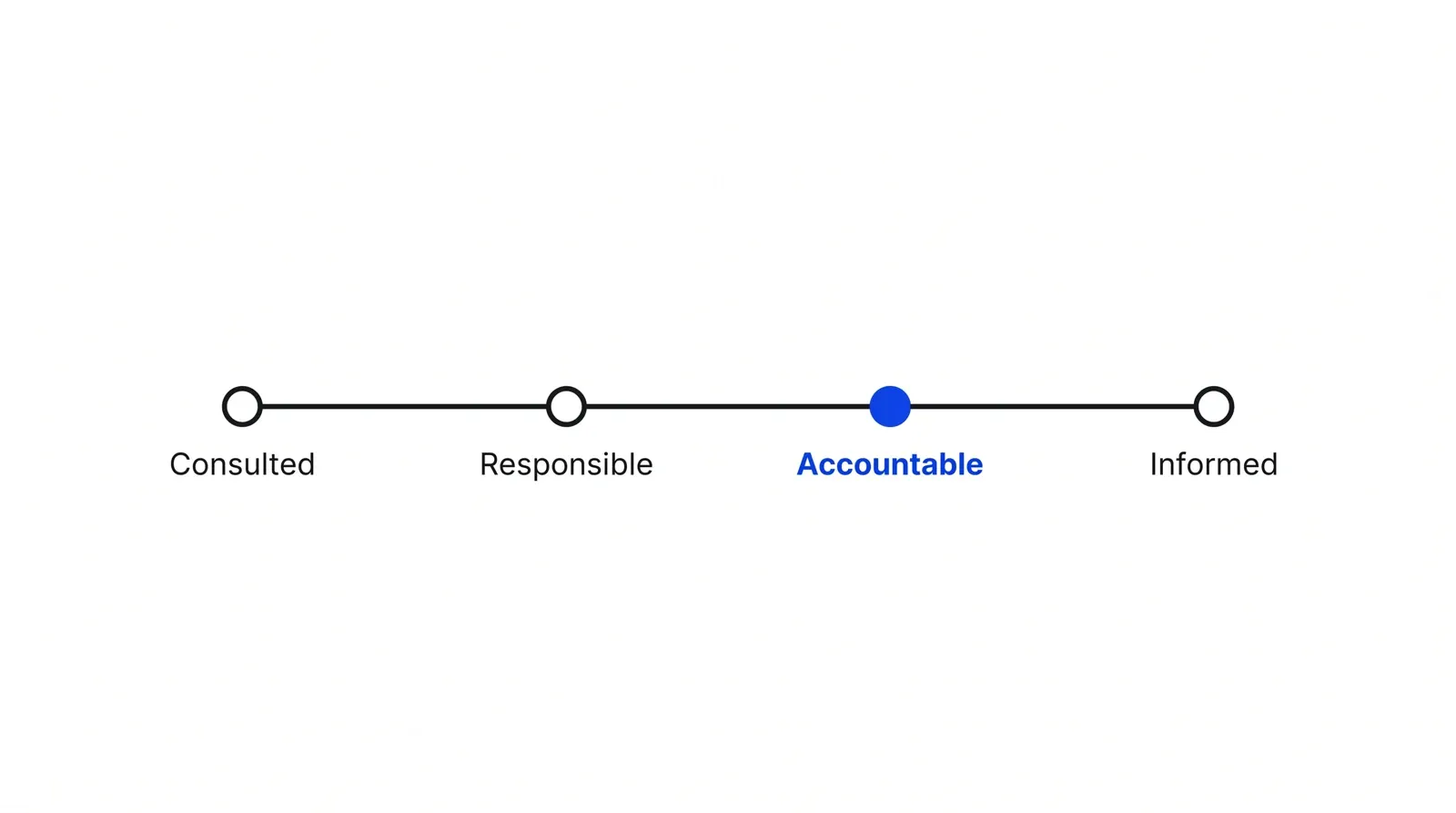
The distinction that trips people up most is Responsible versus Accountable. A software developer can be Responsible for writing a feature while their engineering manager is Accountable for it shipping on time. The developer does the work; the manager owns whether it landed. Confuse the two and the manager either micromanages the code or disappears entirely, neither of which the matrix was meant to cause.
A matrix is read one row at a time, not as a single block. Each row is one task or one decision, and the columns across it are the people or roles touching the process. A cell can hold more than one letter only in the sense that a person can carry more than one role on different rows, the compliance manager who is Accountable for onboarding might be only Consulted on a marketing task in the same organization. What never changes, row by row, is the single Accountable cell.
Why the matrix depends on exactly one Accountable name
The rule that makes RACI work, and the one most teams break, is that each row gets exactly one Accountable person. Sources across project management and organizational design converge on this from different angles. A common phrasing calls it the golden rule: assign only one person as accountable per task. Another framing states the failure mode directly: multiple Accountables per task dilute ownership and breed finger-pointing, since when something goes wrong, two people who were both technically in charge can each point at the other.

The opposite failure is quieter but just as damaging: a row with zero Accountable names. Nobody notices until the task is late, and by then there is no one to ask why. A RACI matrix with either problem, two Accountables or none, is not really a RACI matrix. It is a list of names with no decision attached to it.
The same logic applies to Consulted, in reverse. The matrix breaks just as easily when a task lists eight or ten Consulted names as a courtesy. Every name added to that column is a person whose input has to be sought and weighed before the work can move, so a long Consulted list quietly turns a same-day decision into a multi-week one. Consulted should mean the task cannot proceed without this person’s input, not that it would be nice to hear their view.
Variants: when plain RACI is not enough
A handful of variants extend RACI for cases the four base letters do not cover cleanly.
| Variant | Adds | Fits |
|---|---|---|
| RACI | Responsible, Accountable, Consulted, Informed | Most processes and projects |
| RASCI | Support, between Accountable and Consulted | Larger teams with people who actively help without owning the result |
| RACI-VS | Verify and Sign-off | Regulated work needing an independent check and formal authorization |
| DACI | Driver, Approver, Contributors, Informed, built to structure one decision rather than a task | A single decision that needs a clear final call, not a whole process |
DACI deserves a separate note because people reach for it in the wrong situations. It was built at Intuit to speed up decisions rather than track task execution, and it answers a different question: not who does the work, but who has the authority to say yes. If the real problem on a team is a task nobody is doing, RACI is the right tool. If the real problem is a decision nobody is allowed to make, DACI usually fits better.
Mapping and assigning roles this cleanly is the same discipline behind Pushers’ work building operational systems: a process is only as reliable as the ownership behind each step in it.
How to apply RACI matrix, step by step
- List the tasks, not the department. Write down every task, deliverable or decision the process actually contains, in the order they happen. A row like 'marketing handles it' is not a task; 'draft the welcome email' is.
- Name who is Responsible. For each row, write the name of whoever does the work. More than one Responsible name is fine when two people actually do the task together.
- Pick one Accountable name per row. Choose the single person who owns the result and can be asked why it did or did not happen. If two names feel right, the task is really two tasks.
- Mark who is Consulted before the work starts. Add the names whose input the Responsible person needs before finishing the task. If a name would not change the outcome, it does not belong here.
- Mark who is Informed after the work is done. Add the names who need the result but have no say in producing it. This list is usually longer than Consulted and that is normal.
- Check the counts before you publish it. Flag any row with zero or two Accountable names, and any row with more than three or four Consulted names. Both patterns predict a stalled task.
- Share it and revisit it. Publish the matrix where the team works and set a trigger to review it, a new hire, a reorg, a process change, rather than letting it go stale.
Examples
A fintech KYC onboarding queue
A payments company onboarding a new business customer sets Responsible on the compliance analyst who collects documents and runs the checks. The compliance manager is Accountable, the one name who signs off before the account opens. Legal and the risk lead are Consulted on edge cases, such as a politically exposed person on the ownership chart. Sales and the account manager are Informed once the account clears, so they can tell the customer it is live. This is a worked example, to show the shape of the matrix.
A clinic's new-patient intake
A small clinic redesigns how it takes new patients. The front-desk coordinator is Responsible for collecting paperwork and insurance details before the first visit. The practice manager is Accountable for the patient actually being ready when the appointment starts. The billing lead is Consulted before insurance is confirmed, since a wrong code delays payment for weeks. The treating clinician is Informed once the file is complete, so they walk into the visit with the chart ready. This one is illustrative too.
When to use it
Use a RACI matrix once a process crosses more than one team or more than a handful of people, and tasks are already falling through the gaps between them, missed handoffs, duplicated work, or a decision that took three weeks because nobody knew who could make the call. It fits recurring processes best: onboarding, incident response, a monthly close, a compliance review, anything that runs often enough to be worth mapping once.
When not to use it
Skip it for a team of three or four people who already know who does what, and for work that changes shape every week, since a matrix written for last month's process misleads more than it helps. RACI also assigns roles, not authority. If the real problem is that an accountable person has no power to enforce a deadline or reject bad work, redrawing the table will not fix it. That is a question of organizational design, and no table settles it.
Common mistakes
- Naming more than one Accountable person on a row, so nobody actually owns the outcome and a stalled task turns into an argument instead of a fix.
- Marking everyone Consulted just in case, which turns a two-day approval into a three-week committee nobody can synthesize.
- Treating Consulted and Informed as the same thing, so a person who only needed an update starts expecting a vote.
- Filling the matrix with job titles instead of the name of the person doing the job today, so the chart is out of date the moment someone changes roles.
- Building the matrix once for a kickoff meeting and never opening it again after the team or the process changes.
FAQ
What is a RACI matrix?
A RACI matrix is a table that lists a process's tasks against the people involved, marking each one Responsible, Accountable, Consulted or Informed. It makes ownership explicit before work starts, so a task never ends up with zero owners or several people who each assumed someone else had it.
What is the difference between RACI and RASCI?
RASCI adds one role, Support, between Accountable and Consulted, for people who help with the work without owning the outcome. Use RASCI on larger teams with real hands-on helpers that plain RACI would otherwise hide inside the single Responsible column, losing track of who actually pitched in.
Can a task have two Accountable people?
The rule behind RACI is one Accountable name per task. Two Accountable people usually means the task stalls the first time they disagree, since neither one is forced to make the final call, and when the task slips, each can point at the other instead of fixing it.
How is RACI different from DACI?
RACI assigns roles for finishing a piece of work. DACI, built at Intuit, assigns roles for making one decision: Driver, Approver, Contributors, Informed. Reach for DACI when the bottleneck is a decision nobody is empowered to make, not a task nobody is doing.
Who invented the RACI matrix?
No one knows for certain. It grew out of management practice from the 1950s through the 1970s, with DuPont's early responsibility charts, Ernst & Young's RASCI variant and a consultant named Edmond F. Sheehan all cited as possible origins. No source settles which came first.
Sources
- PMI, PMBOK Guide Sixth Edition errata and Q&A sheet (glossary definition of a RACI chart)
- Projects With Impact, What is a RACI chart and how do I use it on real projects?
- Rebel's Guide to PM, A Complete Guide to RACI/RASCI Charts
- Perfony, RACI matrix: history of a managerial invention
- 12manage, RACI method
- MIT Sloan Management Review, Effective Leaders Decide About Deciding
- Umbrex, RASCI and RASCI-VS Variants
- ProductPlan, DACI Decision-Making Framework
- LogRocket Blog, What is the DACI decision-making framework?
- Invensis Learning, RACI vs DACI
- Onplana, RASCI vs RACI vs DACI: Which Matrix Actually Helps
- Lemon Learning, RACI vs RASCI: Definitions, Meanings and Key Differences
- Institute of Project Management, What is the Responsibility Assignment Matrix?
- Decision Mastery, Why the RACI Matrix Fails Most Teams
- Connexxo, What RACI Gets Wrong About Accountability
- TeamGantt, RACI Chart: What It Is, How to Create One
- Asana, RACI Charts: The Ultimate Guide
- xMind, RACI Chart Analysis: Responsible vs. Accountable
- Management Study Guide, RACI Matrix
- GUIDEcx, How to Create a RACI Chart for Client Onboarding
- Identropy, Responsible Accountable Consulted Informed (RACI): An NHS Proposition
- National Collaborating Centre for Methods and Tools, RACI Matrix
- AIHR, RACI Template and Guide
Last updated Sep 25, 2026


Fractional COO or embedded operations team? How to choose at Series A
The two models solve different problems. Here is how to tell which one your company has, and what each costs you in time and control.

What a revenue operations manager actually owns
Pipeline definitions, CRM hygiene, forecasting and the handoffs between marketing, sales and success. What the role covers, and how it differs from sales ops.

What is a fractional executive? Models, pricing and failure points
Fractional, interim, advisory or embedded team: four different models get lumped under one word. Here is how they differ and when each one fails.