Freemium
Freemium is a pricing model that gives away a working product free and charges for a paid tier, and it only pays off when the free tier is cheap to serve and the paid tier solves a problem the free version leaves open.
Freemium is a pricing model where a business gives away a working version of its product free and charges for a paid tier with more capacity, features or seats. It exists to turn a low-cost acquisition channel into revenue, and it only works when the free tier costs little to serve and the paid tier solves a problem the free version does not.
- Origin
- Fred Wilson (described it); Jarid Lukin (named it); Chris Anderson (popularised it), 2006; 2009
- Level
- 201 · Tool
- Fits
- Startup, Scale-up
- Time to apply
- A day to sketch the free and paid split; a full quarter of usage data to know if the gate is right
- What you need
- the fully loaded cost of serving one free user: hosting, support, payment processing · a feature, usage limit or seat count that makes people want to pay · at least one paying customer's own account of why they upgraded
Freemium is a pricing model where a business gives away a working version of its product free and charges for a paid tier with more capacity, features or seats layered on top. The free version has to work well enough on its own that people use it, trust it and tell other people about it. The paid version has to solve a problem the free tier was built to leave open.
The word traces to a specific place. In March 2006, investor Fred Wilson described the pattern on his blog AVC: give the service away free, acquire customers cheaply through word of mouth and search, then sell premium features to the customers already using it. Wilson asked readers for a name for the pattern, and Jarid Lukin, an executive at the Flatiron portfolio company Alacra, proposed freemium in the comments. Wilson adopted the word and it stuck. Chris Anderson’s 2009 book Free: The Future of a Radical Price carried the idea to a much wider audience three years later. Wilson kept his narrower argument (acquire customers cheaply and sell some of them something more) apart from Anderson’s broader claim about computing costs falling toward zero across the board.
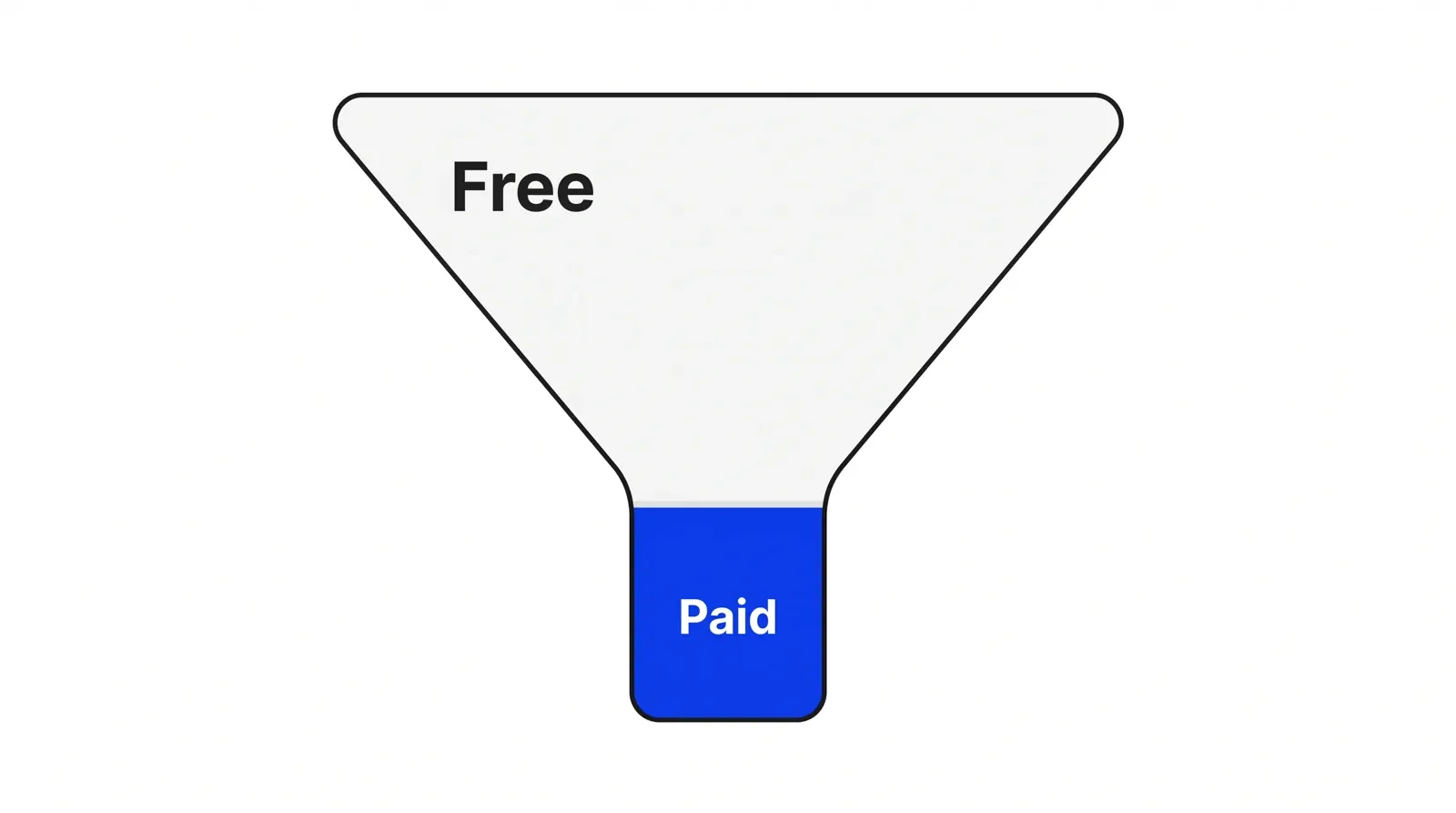
What to give away and what to charge for
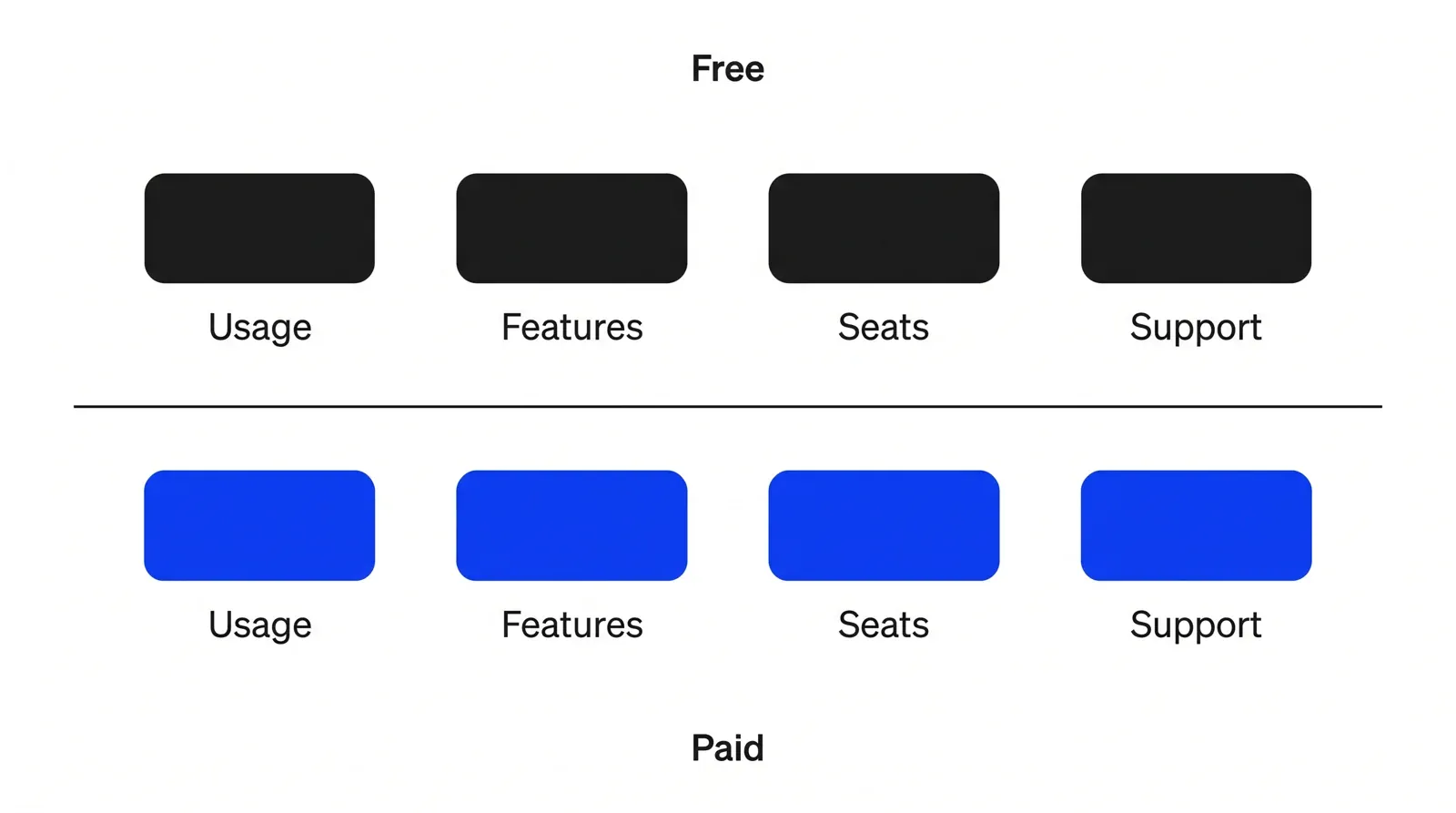
The split comes down to four levers, and a product usually gates on one or two of them.
Usage limits cap how much of the product a free account can consume: storage, projects, API calls, monthly active seats. Feature limits hold back a specific capability (advanced analytics, integrations, automation) while the core function stays open to everyone. Seat limits cap how many people on one team can use a free account, which ties conversion to the moment a second or third person joins. Support limits leave free users with community help only, while paying accounts get a guaranteed response time or an uptime commitment.
Economists Carl Shapiro and Hal Varian described the logic behind this in Harvard Business Review in 1998, years before freemium had a name: selling different versions of the same information good at different prices, what they called versioning, lets a business capture more of what different buyers are willing to pay without cutting the price for everyone. Freemium is versioning with the cheapest version priced at zero. A 2019 paper by economist Susumu Sato in the International Journal of Industrial Organization works out the same point mathematically: it models freemium as price discrimination and shows when a free version plus a paid one is the profit-maximizing menu.
The arithmetic a free tier has to clear
A free user is not free to the business serving it. Storage, bandwidth, support tickets and infrastructure all scale with every free signup, and a freemium plan that ignores this cost is a subsidy.
Researchers Clarence Lee, Vineet Kumar and Sunil Gupta, studying a cloud storage service, found that a large share of a freemium company’s user base, often 95% or more, never pays the firm anything directly. The free tier’s entire value has to come from what that majority does for the business indirectly: word of mouth, referrals, and the smaller share who do convert.
That conversion share varies widely, and no single number should stand in for a company’s own data. ChartMogul’s SaaS Conversion Report puts 3% to 5% free-to-paid conversion at good for a self-serve freemium product and 8% to 12% at great, while close to a quarter of the freemium products it tracked convert below 2.5%. Dropbox’s IPO filing put an exact figure on its own funnel: as of the end of 2017 the company served over 500 million registered users and 11 million paying ones, about 2.2%. Whether a freemium plan is working comes down to one comparison: expected paying revenue (users times conversion rate times price) against the cost of serving every free account it took to get there.
Cannibalization: when free eats the paying side of the business
The same free tier that pulls in cheap customers can also shrink the number who would have paid, because every feature added to the free plan removes one more reason to upgrade.
Wide free adoption and strong paid conversion pull against each other by design, and different products handle that trade-off differently. Joost Rietveld’s peer-reviewed study of digital PC games, published in Strategic Entrepreneurship Journal, found that freemium games were played less and earned less revenue than premium games competing in the same market, so freemium does not automatically beat charging upfront.
Two documented cases show the split holding rather than collapsing into itself. Slack’s IPO filing reported more than 500,000 organizations on its free plan against more than 88,000 paying customers, a wide free base funding a much smaller paying one. Spotify’s IPO filing described its ad-supported service as a funnel: it drove more than 60% of gross added Premium subscribers since Spotify began tracking this in February 2014. In both cases the free tier worked as an acquisition channel feeding a paying product built to stand on its own.
Freemium, free trial and reverse trial
The three get confused because all three hand something over before asking for money, and the difference is what happens once the free access runs out.
| Freemium | Free trial | Reverse trial | |
|---|---|---|---|
| Free access | Limited version, no expiry | Full version, time-limited | Full version, time-limited |
| After the limit | Stays free at reduced capability | Locked out entirely | Drops to a limited free tier |
| Fits best | Low cost per free user, word-of-mouth products | High-consideration purchases needing full evaluation | Products where losing a feature stings more than never having had it |
TechCrunch’s 2022 comparison, citing OpenView partner Kyle Poyar, lays out the trade-off: freemium drives more signups with a lower share converting, while free trials produce fewer signups with a higher conversion rate among the people who try. A reverse trial gives the paid experience first, then drops to a capped free tier if nobody pays, leaning on loss aversion (people dislike giving back a feature already in hand).
Deciding what a free tier gives away and what it holds back is part of the pricing and packaging work inside Pushers’ growth lab, where the free-to-paid arithmetic gets checked against real usage and support cost before a pricing page changes.
How to apply Freemium, step by step
- Decide what the free tier has to prove. Pick the one job the free product must do well enough that a stranger trusts the business enough for a second look. That job becomes the anchor for everything the free tier keeps. Result: one sentence saying what free users must be able to do.
- Sort every feature into free or gated. List everything the product does, then mark each item free, or gated by usage, feature, seats or support. A feature with no owner on that list ends up free by accident, and accidents are how free tiers give away the wrong things. Result: a complete list with every feature marked free or gated.
- Pick the metric that gates the free tier. Usage limits (storage, projects, API calls), feature limits (advanced tools, integrations), seat limits and support limits all work as gates. Choose the one tied to how a paying account grows (storage that fills up, a team that adds people) so the gate and the reason to upgrade are the same event. Result: one gating metric.
- Price the paid tier against what it delivers. Set the price against what a paying buyer gets for it: more seats, multi-currency support, a guaranteed response time. A price a buyer can defend to their own finance team is doing its job. Result: a paid-tier price tied to what it delivers.
- Run the free-user cost arithmetic before launch. Multiply the expected number of free users by what each one costs to serve (hosting, support tickets, payment processing on any free transactions) and weigh that against expected paying accounts times their price. Result: a number that shows whether growth in the free tier helps the business or drains it.
- Watch for cannibalization as the free tier grows. Check on a schedule whether people who would have paid are finding enough in the free tier to never convert. Result: an early warning before a generous free tier eats the paid one it was built to feed.
- Revisit the split when the inputs change. Review the free and paid boundary whenever usage patterns shift, a competitor changes what free means in the category, or the cost of serving a free user moves. Result: a boundary that still matches the product and its costs.
Examples
A cross-border invoicing app
Illustrative: an invoicing tool for freelancers is free for single-currency invoices to unlimited clients. Say 4,000 freelancers sign up free, and 3% add the paid multi-currency plan at $15 a month once they land an overseas client. That is 120 paying accounts and $1,800 a month, which has to cover the cost of serving the other 3,880 free accounts.
A small-team project tracker
Illustrative: a task tracker is free for one project and one person. A team needs the paid plan once it adds a second person or a second project board. Say 6,000 people sign up free and 4% eventually add a teammate and a second board at $9 a seat; that is 240 paying teams grown out of individual free accounts.
When to use it
Use freemium when the product's core value is obvious after a few minutes of unsupervised use, the cost of serving one more free user is small, and there is a natural point (more storage, more seats, a harder problem) where a free user's needs outgrow the free tier on their own.
When not to use it
Skip freemium when serving a free user is expensive: a service business, anything needing hands-on support or physical delivery. There the free tier turns into a subsidy with no funnel behind it. Skip it too when the buyer is a company and the blocker is a sales conversation that a free account cannot replace.
Common mistakes
- Gating a feature the product needs to prove its value, so free users never experience enough of it to trust the paid version.
- Skipping the cost arithmetic before launch, so growth in the free tier quietly outpaces the revenue it was meant to fund.
- Copying a competitor's free-to-paid split without checking that the cost of serving their free users, or how their buyers decide to pay, matches at all.
- Treating the split as permanent, leaving a boundary drawn at launch untouched while usage patterns and free-user costs both move.
- Adding paid features into the free tier one small update at a time until paying customers stop seeing a reason to keep paying.
FAQ
What is freemium in simple terms?
Freemium is a pricing model where a business gives away a working version of its product free and sells a paid tier with more capacity, features or seats. The free version has to work well enough that people use it and tell others, and the paid version solves a problem the free tier leaves open.
What is a good freemium conversion rate?
ChartMogul's SaaS Conversion Report puts 3% to 5% free-to-paid conversion at good for a self-serve freemium product and 8% to 12% at great, though close to a quarter of freemium products convert below 2.5%. Match the number against what a free user costs to serve before calling any given rate good or bad.
What is the difference between freemium and a free trial?
A free trial gives full access for a limited time and then locks the product until someone pays. Freemium gives a permanently free, limited version with no expiry, with only the extra capacity or features behind the paywall. A reverse trial mixes the two: full access first, then a drop to a limited free tier if nobody pays.
Does freemium work for every kind of business?
No. A peer-reviewed study of digital games by Joost Rietveld found freemium titles were played less and earned less revenue than premium ones in the same market. Freemium fits products where serving one more free user costs little and the value is obvious fast, and fits worse where support or onboarding costs scale with every signup.
Who invented freemium?
Investor Fred Wilson described the model on his blog AVC in March 2006, and reader Jarid Lukin proposed the word freemium in the comments. Chris Anderson's 2009 book Free: The Future of a Radical Price popularised the idea for a much wider audience three years later.
Sources
- Fred Wilson, AVC, The Freemium Business Model
- Fred Wilson, AVC, Freemium and Freeconomics
- Chris Anderson, Free: The Future of a Radical Price, Grand Central Publishing / Hachette, 2009
- Vineet Kumar, Harvard Business Review, Making 'Freemium' Work
- Carl Shapiro and Hal R. Varian, Harvard Business Review, Versioning: The Smart Way to Sell Information
- Xian Gu, P. K. Kannan, Liye Ma, Journal of Marketing, Selling the Premium in Freemium, 2018
- Robert H. Smith School of Business, Getting You to Pay in a Freemium World
- Clarence Lee, Vineet Kumar, Sunil Gupta, Designing Freemium: Strategic Balancing of Growth and Monetization, 2017
- Julian Wagner, Alexander Benlian, Thomas Hess, Electronic Markets, Converting freemium customers from free to premium, 2014
- Susumu Sato, International Journal of Industrial Organization, Freemium as Optimal Menu Pricing, 2019
- Joost Rietveld, Strategic Entrepreneurship Journal, Creating and Capturing Value from Freemium Business Models, 2018
- ChartMogul, The SaaS Conversion Report
- Umbrex, Freemium Pricing: Core Pricing Strategy Guide
- Bain & Company, How SaaS Providers Can Use Pricing to Achieve Their Ambitions
- Dropbox, Inc., Form S-1, U.S. Securities and Exchange Commission, 2018
- Slack Technologies, Inc., Form S-1, U.S. Securities and Exchange Commission, 2019
- Spotify Technology S.A., Form F-1, U.S. Securities and Exchange Commission, 2018
- First Round Review, From 0 to $1B: Slack's Founder Shares Their Epic Launch Strategy
- TechCrunch, Freemium or free trials: Why not both?
- LogRocket Blog, What is a reverse trial? Benefits and risks
Last updated Sep 25, 2026


How to calculate channel payback and unit economics
A CAC number that only marketing believes is not a finance number. Here is how to calculate channel payback so both teams work from the same model.

Fractional CFO vs finance operations: which gap do you actually have
A fractional CFO is a person. Finance operations is a system. Most companies searching for one are missing the other, or both.

Why channel tests stall after month three
Most paid channel tests do not end with a decision. They end when the budget runs out, the attribution model changes, or everyone quietly stops looking at the dashboard.