AIDA model
AIDA is a four-stage model, attention, interest, desire, action, that marketers have used since the early 1900s to plan what to say to a prospect at each point before a purchase, and it is the shape behind most marketing funnels today.
The AIDA model describes four stages a buyer moves through before a purchase: attention, interest, desire and action. Marketers have used it since the early 1900s to plan what a page, an ad or a salesperson says at each stage. The story that E. St. Elmo Lewis invented it in 1898 is widely repeated and poorly documented; the surviving record credits other salesmanship writers with the real formulation.
- Origin
- Credited to E. St. Elmo Lewis by Edward K. Strong (1925), without a citation; the documented record credits Frank H. Dukesmith and Arthur Frederick Sheldon, 1898 (claimed); 1904-1911 (documented)
- Level
- 201 · Tool
- Fits
- Startup, Small and mid-size, Scale-up
- Time to apply
- 20 minutes to map one page or campaign against the four stages
- What you need
- one page, ad or sales script to map against the four stages · a clear, specific idea of who is reading or hearing it
AIDA is a model of four stages a prospect moves through on the way to a purchase: attention, interest, desire and action. Salespeople and advertisers have used some version of it since the early 1900s to decide what a page, an ad or a sales call needs to say at each point, and it is the idea behind almost every marketing funnel drawn on a whiteboard today. The wider term, marketing funnel, just adds a shape around the same four stages.
Where the 1898 story comes from
Most marketing content repeats the same line: E. St. Elmo Lewis wrote the AIDA formula in 1898. The source of that claim is one sentence, with no citation, in Edward K. Strong’s 1925 paper “Theories of Selling” in the Journal of Applied Psychology. Lewis, Strong wrote, coined “attract attention, maintain interest, create desire” in 1898 and added “get action” later. Every popular account since, including Philip Kotler’s Marketing Management, traces back to that single uncited sentence.
A 2024 study in the Japan Marketing History Review went looking for the writing Strong described. Akinori Iwamoto searched Lewis’s published output from 1897 to 1910, digitized advertising trade magazines included, and found nothing matching Strong’s quoted slogan. What Lewis wrote in that period talks about catching a reader’s eye and making a customer of them, close to the idea but not the words later attributed to him. Iwamoto’s conclusion: “the dominant hypothesis that E. St. Elmo Lewis invented and formulated AIDA is unsupported or based on weak evidence.”
The documented record instead points to two other salesmanship writers. Frank H. Dukesmith described the effect of advertising as attention, interest, desire, then action, in a 1904 trade article. Arthur Frederick Sheldon, who ran a correspondence school for salesmen, laid out a near-identical four-step sequence in his 1911 book The Art of Selling: “favorable attention… interest… desire… decision and action.” By 1911 the complete four-word formula existed in print. Whether Lewis contributed anything to it earlier is, on the current evidence, an open question the industry has treated as settled for a century.
What the four stages mean in practice
Attention is whatever makes a stranger stop: a headline, an ad creative, an opening line. Interest is the reason to keep reading, a specific benefit rather than a list of features. Desire is proof a skeptical reader can check, a number, a name, a guarantee. Action is the one next step, and everything sitting between Desire and Action either helps someone take it or gets in the way.
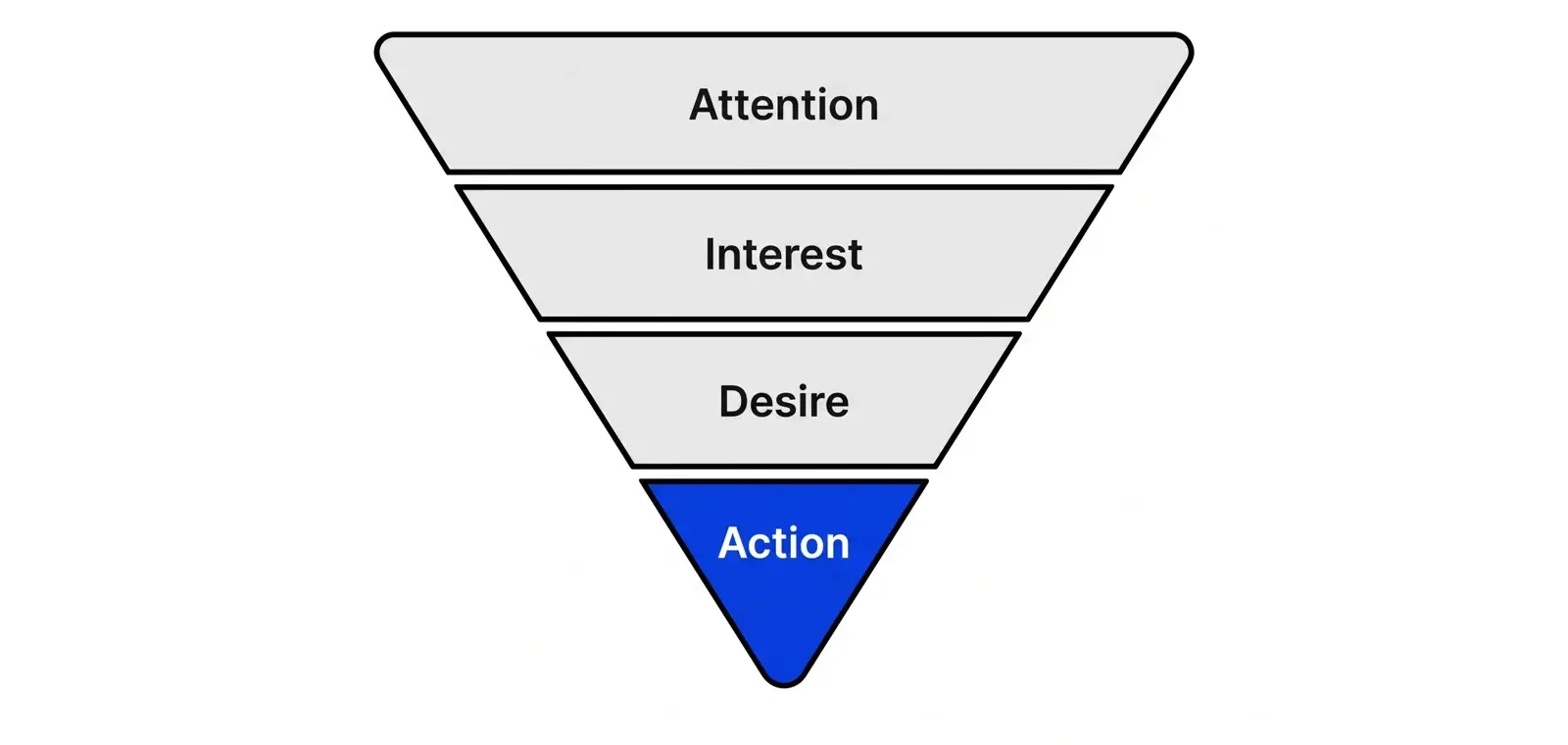
Writing to each stage on purpose catches a common failure: copy that is all Attention, a striking headline over generic body text, or all Interest, a feature list with no reason to believe any of it. A page strong at one stage and empty at the others usually gets traffic without action.
How the funnel got its shape
AIDA started as a list, not a picture. The funnel came in 1924, in William Townsend’s book Bond Salesmanship, written to train telephone salespeople selling bonds. Townsend drew the four stages narrowing from wide to thin, facts poured in at the top, a sale coming out the bottom. Marketing Week’s 2021 history of the shape found it stayed a minor idea for most of the 20th century and only became the default way to talk about marketing once digital ad platforms needed a simple frame for awareness and conversion spend, a shift that happened within the last fifteen years or so.
Does the sequence hold up?
Partly. In 1961, Robert Lavidge and Gary Steiner split AIDA’s four stages into six, awareness, knowledge, liking, preference, conviction, purchase, in a Journal of Marketing paper that became the standard academic version, often called the hierarchy of effects. Russell Colley’s DAGMAR model, published the same year for the Association of National Advertisers, used a similar four-step sequence, awareness, comprehension, conviction, action, to set measurable advertising goals. Two separate 1961 papers landing on the same shape looks like confirmation.
The stronger test came later. Demetrios Vakratsas and Tim Ambler reviewed more than 250 studies in a 1999 Journal of Marketing paper and found little support for any fixed order of effects, cognitive then affective then behavioral, holding up consistently across products, categories or people. A 2017 paper applying neuroscience to AIDA specifically went further, arguing conscious and unconscious processing happen in parallel rather than in sequence, and called the strict AIDA order “not applicable and substantially problematic.” Attention, interest, desire and action still matter. The order is a convenient simplification rather than a proven law, and a real prospect can feel desire before interest fully lands, or act before either one finishes.
From funnel to journey
The clearest challenge to the funnel’s shape, rather than the stages inside it, came from McKinsey in 2009. David Court and coauthors studied roughly 20,000 consumer purchase decisions across industries and continents and concluded that “the funnel concept fails to capture all the touch points and key buying factors” of real buying. Their consumer decision journey replaces the narrowing funnel with a loop: initial consideration, active evaluation, where buyers often add options rather than narrow them, the purchase, and a post-purchase stage that feeds directly into the next decision.
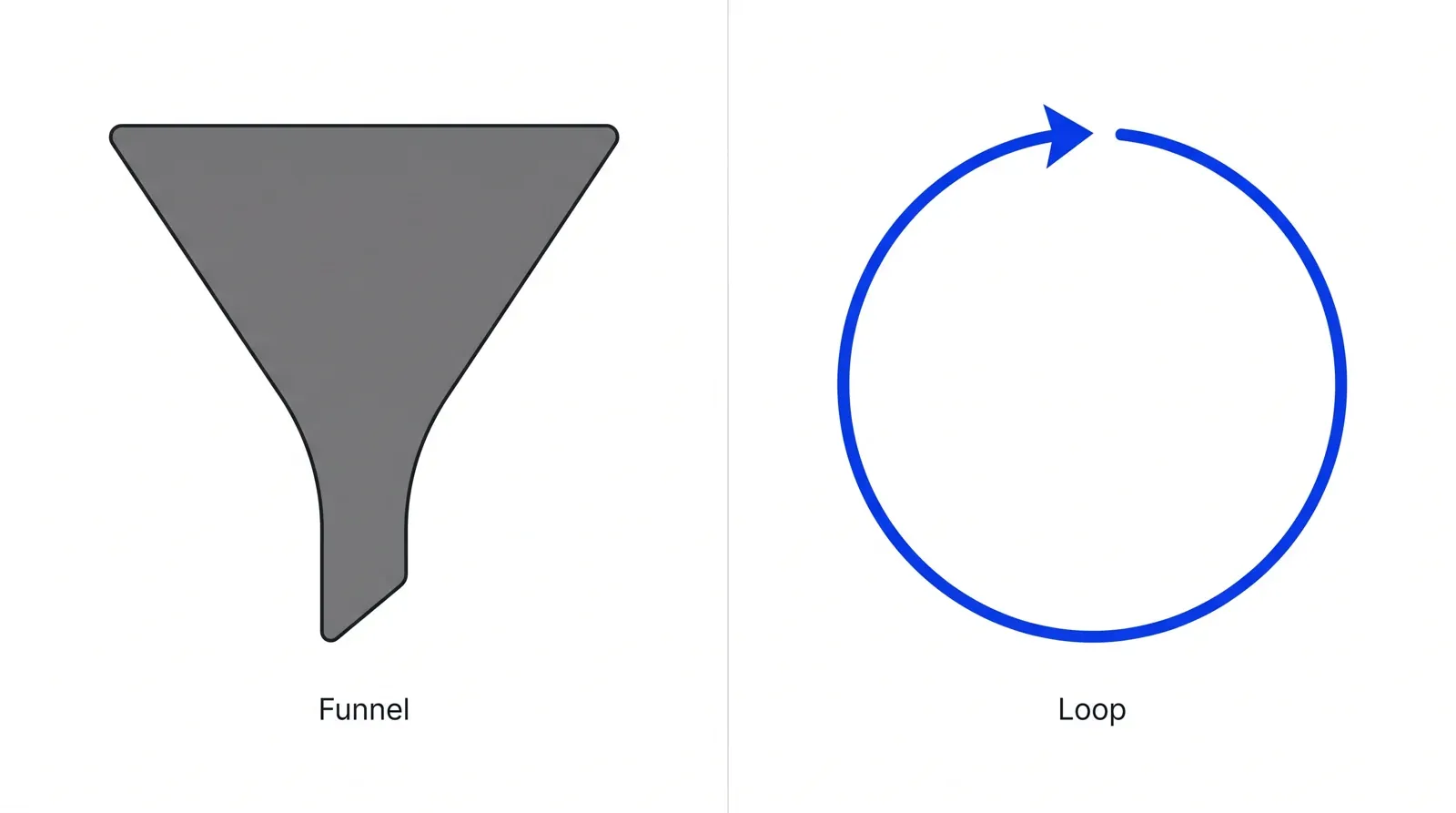
Harvard Business Review has returned to the same point twice since, in 2014 and again in 2023, when Frank Cespedes wrote that buying has long been “framed as a hierarchy of effects: moving a prospect from awareness to interest to desire to action,” and argued sales teams need a different picture entirely. The complexity is sharper in B2B: Forrester’s 2025 buyer survey found the typical purchase now involves an average of 13 people inside the buying company and 9 outside it, closer to a network than a line one person walks down alone.
| AIDA / the marketing funnel | Consumer decision journey | |
|---|---|---|
| Shape | A line, narrowing at each stage | A loop, including what happens after purchase |
| Assumes | One stage finishes before the next starts | Stages get revisited, skipped or run in parallel |
| Fits | Planning one page, ad or script | Mapping how a real purchase happens over time |
| Weak spot | Treats the order as fixed | Harder to turn into a single piece of copy |
For a single ad, landing page or sales script, AIDA still works as a fast checklist for what to say. For understanding how a real customer got there, especially once more than one decision-maker is involved, the loop matches the evidence better. Most teams need both: AIDA to write the thing, a journey view to know when and where to show it. That planning work sits inside Pushers’ Marketing-Operational System, where a campaign’s stages and its measurement live in one system instead of a slide redrawn every quarter.
How to apply AIDA model, step by step
- Write down the one thing to prove at each stage. For this one page, ad or call, write one line each for what has to happen at Attention, Interest, Desire and Action. Result: four short goals instead of one vague creative brief.
- Earn Attention with something this audience stops for. Lead with the fact, image or line that this specific audience cares about, not a generic opener that could sit on any competitor's page. Result: an opening line you can test against a real alternative.
- Build Interest with one concrete benefit. Answer why this reader should keep going in the first few seconds, with a specific benefit tied to the goal from step one, not a list of features. Result: copy a stranger could repeat back in one sentence.
- Create Desire with proof, not adjectives. Replace claims like best or trusted with a number, a name, a before-and-after or a guarantee a skeptical reader can check. Result: one proof point doing the work three adjectives used to do.
- Clear the path to Action. List every extra field, click or wait between Desire and the actual action, and cut whatever is not load-bearing. Result: one visible next step, with the friction that kills it named and removed.
- Check the sequence against what people do. Look at session recordings, call notes or a support inbox for where people skip a stage, loop back or act early, and adjust the plan instead of forcing them back into line. Result: a version of the four stages that matches this audience, not the textbook order.
Examples
A fintech app's signup
Illustrative. A budgeting app earns Attention with a screenshot of the one feature people are searching for, not a logo. Interest is a single sentence on the specific problem it solves. Desire is a real user quote naming a number people recognize, a fee, a rate, a time saved. Action is a signup form asking for an email address only, with identity checks and linking a bank account moved to after the account already exists.
A clinic's path from ad to booked appointment
Illustrative. Attention is a local search ad for the exact symptom or procedure someone is searching, not the clinic's name. Interest is a page that says what the visit involves and roughly what it costs before asking for anything. Desire is real reviews and a photo of the actual doctor, not a stock image. Action is a booking form with one required field, a phone number, and a promised callback, instead of an eight-field intake form up front.
A B2B software demo request
Illustrative. Attention names a specific pain point in the headline, not the product's category. Interest is two lines on what changes for the buyer's own team. Desire is a short case study naming the role of the person who benefited, not a logo wall. Action is one calendar link, not a form that routes into a queue a prospect never hears back from.
When to use it
Use it to plan or audit a single page, ad, email or sales script, anywhere a stranger needs to go from not knowing you exist to taking one specific action. It works as a checklist for that one piece of communication, not as a map of how a real buyer behaves over weeks or months.
When not to use it
Skip it for a purchase with several stakeholders, a long consideration period or heavy research before first contact, a B2B software deal or a large medical decision, where buyers loop back, compare options in parallel and revisit stages AIDA assumes are already finished. A journey map or a stakeholder map fits those better.
Common mistakes
- Treating Attention, Interest, Desire and Action as a strict order a buyer completes in sequence, when research on hierarchy-of-effects models finds little support for a fixed sequence at all.
- Spending most of the budget and creative effort on Attention while Desire and Action get whatever copy is left over, so traffic rises and the action rate does not.
- Writing an Interest section that lists features instead of answering why this specific reader should care, which reads like a spec sheet instead of a reason.
- Repeating the 1898, E. St. Elmo Lewis origin story as settled fact, when the documented record does not support it.
- Fixing friction at the Action step, a shorter form, fewer clicks, when the real problem is that Desire was never built, so a shorter path just gets people to no faster.
FAQ
What is the AIDA model?
AIDA is a model of four stages a prospect supposedly moves through before buying: attention, interest, desire and action. Marketers and salespeople have used it since the early 1900s to plan what a page, ad or sales conversation needs to say at each stage, and it is the shape behind most marketing funnels.
Who invented the AIDA model?
Edward K. Strong credited E. St. Elmo Lewis with a 1898 slogan in a 1925 paper, without citing a source, and it became the standard story. A 2024 historical study found no Lewis writing that matches the quote and credits Frank Dukesmith and Arthur Sheldon with formulating and completing the four-step version by 1911.
Is the AIDA model the same as a marketing funnel?
AIDA names the four stages; the funnel is the picture drawn around them, added in 1924 by William Townsend to train bond salespeople. Most funnels used today, awareness, consideration, conversion, are a relabeled version of the same four stages.
Does research support the AIDA model?
Only partly. A 1999 review of more than 250 studies in the Journal of Marketing found little support for any fixed sequence of advertising effects, and a 2017 neuroscience critique called the strict AIDA sequence not applicable. The four ideas stay useful as a checklist; the fixed order is the weak part.
How is AIDA different from the consumer decision journey?
AIDA assumes a straight line from attention to action. McKinsey's 2009 consumer decision journey, based on around 20,000 purchase interviews, found buyers add and drop options non-sequentially and loop back after purchase, and replaced the funnel with a circular model that includes a post-purchase loyalty loop.
Sources
- Akinori Iwamoto, The Origin of AIDA: Who Invented and Formulated the AIDA Model?, Japan Marketing History Review 3(2), 2024
- Edward K. Strong, Theories of Selling, Journal of Applied Psychology 9(1), 1925 (archived issue)
- Arthur Frederick Sheldon, The Art of Selling, 1911
- William W. Townsend, Bond Salesmanship, Henry Holt and Company, 1924
- Thomas E. Barry, Daniel J. Howard, A Review and Critique of the Hierarchy of Effects in Advertising, International Journal of Advertising 9(2), 1990
- Robert J. Lavidge, Gary A. Steiner, A Model for Predictive Measurements of Advertising Effectiveness, Journal of Marketing 25(6), 1961
- Demetrios Vakratsas, Tim Ambler, How Advertising Works: What Do We Really Know?, Journal of Marketing 63(1), 1999
- S. Montazeribarforoushi, A. Keshavarzsaleh, T.Z. Ramsey, On the Hierarchy of Choice: An Applied Neuroscience Perspective on the AIDA Model, Cogent Psychology, 2017
- Russell H. Colley, Defining Advertising Goals for Measured Advertising Results, Association of National Advertisers, 1961
- David Court, Dave Elzinga, Susan Mulder, Ole Jorgen Vetvik, The Consumer Decision Journey, McKinsey Quarterly, 2009 (Business Today reprint)
- Mark Bonchek, Cara France, Marketing Can No Longer Rely on the Funnel, Harvard Business Review, 2014
- Frank V. Cespedes, Sales Teams Need to Stop Focusing on the Customer Funnel, Harvard Business Review, 2023
- Ray Yu, Derek Rodenhausen, Yotam Ariav, Trevor Sponseller, Clementine Remy, It's Time for Marketers to Move Beyond a Linear Funnel, BCG, 2025
- Katie Fabiszak, Kaitlyn Bretagne, Three Realities About B2B Buying Networks, Forrester, 2026
- Tom Roach, Why the Sales Funnel Is the Cockroach of Marketing Concepts, Marketing Week, 2021
- James K. Elrod, John L. Fortenberry Jr, Response Hierarchy Models and Their Application in Health and Medicine, BMC Health Services Research 20(Suppl 1), 2020
- Baymard Institute, 50 Cart Abandonment Rate Statistics
- Google Analytics 360 Suite, Adding Data-Driven Attribution to the Purchase Funnel, 2016
- EBSCO Research Starters, AIDA Model
- Philip Kotler, Kevin Lane Keller, Marketing Management, 15th edition, Pearson, 2016
Last updated Sep 25, 2026


The compliance layer under fintech marketing operations
A fintech marketing agency can build campaigns. It cannot own the compliance review, the KYC drop-off or the multi-market licensing rules that decide whether a lead ever becomes a customer.

Fractional CMO: what you get, and what has to exist underneath
A fractional CMO brings strategy and judgment. Without reporting, CRM hygiene and a named owner per number, the engagement produces a slide deck instead of a system.

The operations layer behind healthcare patient acquisition
Ads and search bring the request in. What happens between the click and the booked, attended visit decides whether the spend paid off.