Inversion
Inversion is a decision-making move that asks what would guarantee failure before asking what would produce success, then turns each cause into a safeguard.
Inversion is a technique for solving a problem by asking what would guarantee it fails, instead of what would make it succeed, then working backward from that list to build safeguards into the plan. The line behind it is reported of mathematician Carl Gustav Jacob Jacobi and was popularized for business and investing by Charlie Munger. It catches risks a forward-only plan tends to miss.
- Origin
- Carl Jacobi (reported); Charlie Munger (popularizer), reported, 1800s; Munger from 1986
- Level
- 201 · Tool
- Fits
- Startup, Small and mid-size, Scale-up
- Time to apply
- 20 to 30 minutes alone for a first pass; an hour with a team for a full premortem session
- What you need
- one goal or decision written down in a single sentence · a blank list and the willingness to fill it with uncomfortable answers · for a group session, the people who know the plan
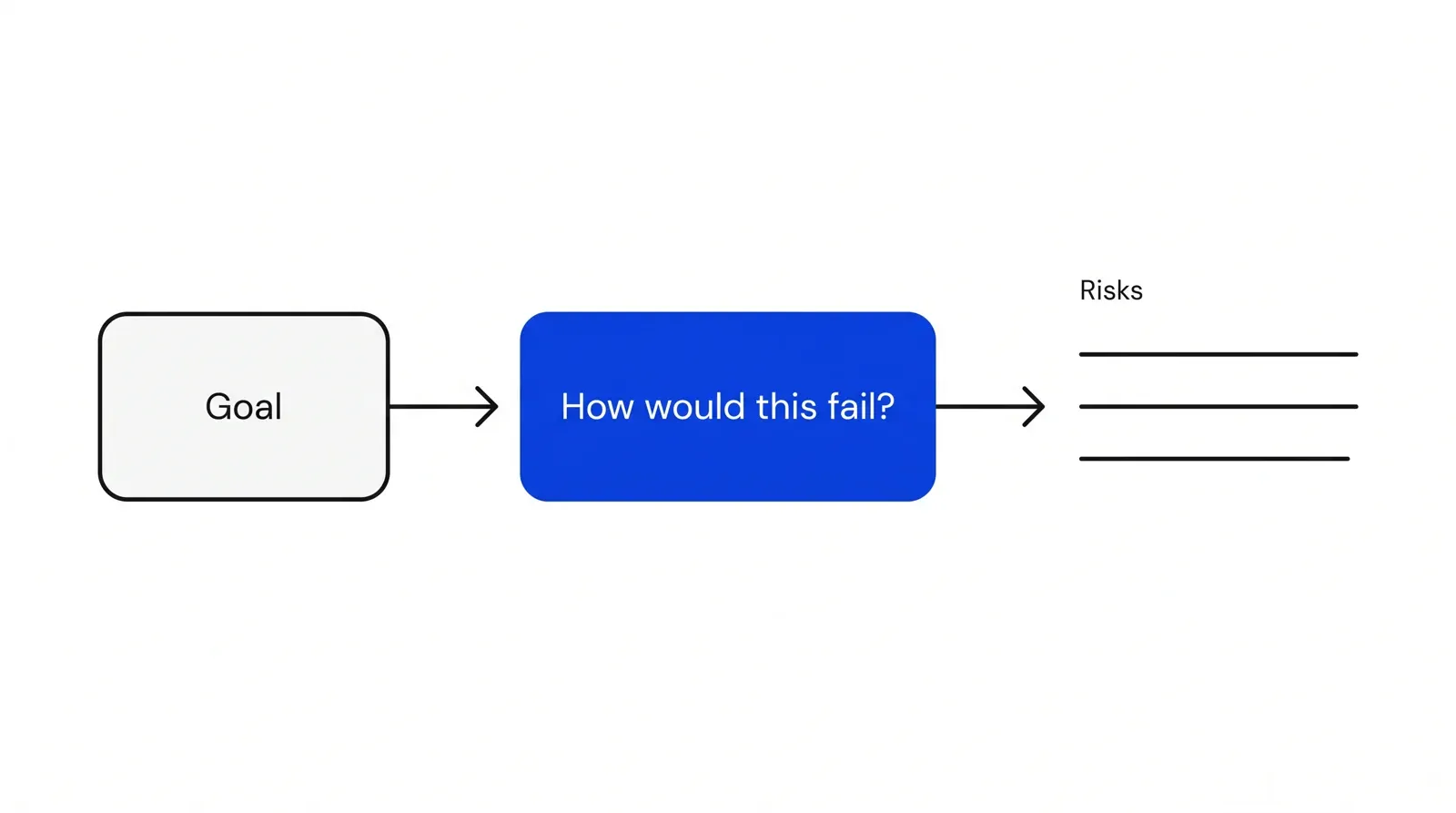
Inversion is a way of solving a problem by asking what would guarantee it fails, instead of asking what would make it succeed, then working backward from that list to build safeguards into the plan itself. A team facing a launch, a hire, a redesign or a budget decision can run the same move: state the goal in one sentence, flip the question, write down every way it could go wrong, and turn each cause into a rule the plan already contains.
Where the line comes from
The phrase behind inversion is reported of the German mathematician Carl Gustav Jacob Jacobi: “man muss immer umkehren,” one must always invert. In a 1986 commencement address at the Harvard School, Charlie Munger described Jacobi as “known for his constant repetition of one phrase: ‘Invert, always invert.’” Munger does not say Jacobi wrote the line down, and the MacTutor biography of Jacobi does not mention it. The attribution stays reported: it survives through later writers, with no document showing Jacobi wrote or published it.
Munger is the reason the phrase reached business and investing at all. He applied the move to investing: in a Wesco Financial shareholder letter, quoted in Janet Lowe’s Damn Right!, he credited long-term advantage to “trying to be consistently not stupid.” Munger returned to the theme across several talks, collected in the book Poor Charlie’s Almanack, which is why the phrase now shows up in investing and management writing far more often than in mathematics.
Why flipping the question works
Forward planning tends to describe a best case and call it a plan. Bent Flyvbjerg’s review of behavioral biases in project management describes optimism bias as the tendency for people, including experts, to be “overly bullish about the outcomes of planned actions,” largely without noticing they are doing it. A team asked “will this work” answers from inside the plan it already committed to, drawing on the same assumptions that built the plan in the first place. A team asked “how would this fail” has to step outside that plan and look for the parts that do not hold up, which produces a different and more specific kind of list, closer to an audit than a pep talk.
The premortem: inversion run as a process
A premortem gives inversion a repeatable shape: a deadline, a group and one shared prompt. Gary Klein described the method in Harvard Business Review in 2007: a team is told the project “has failed spectacularly,” and each person writes down every reason they can think of before anyone speaks aloud, including the reasons people usually keep to themselves out of politeness. Klein traced the mechanism to earlier research. In his summary, a 1989 study by Mitchell, Russo and Pennington found that imagining an outcome has already happened (what researchers call prospective hindsight) increases the ability to correctly identify its causes by 30%.
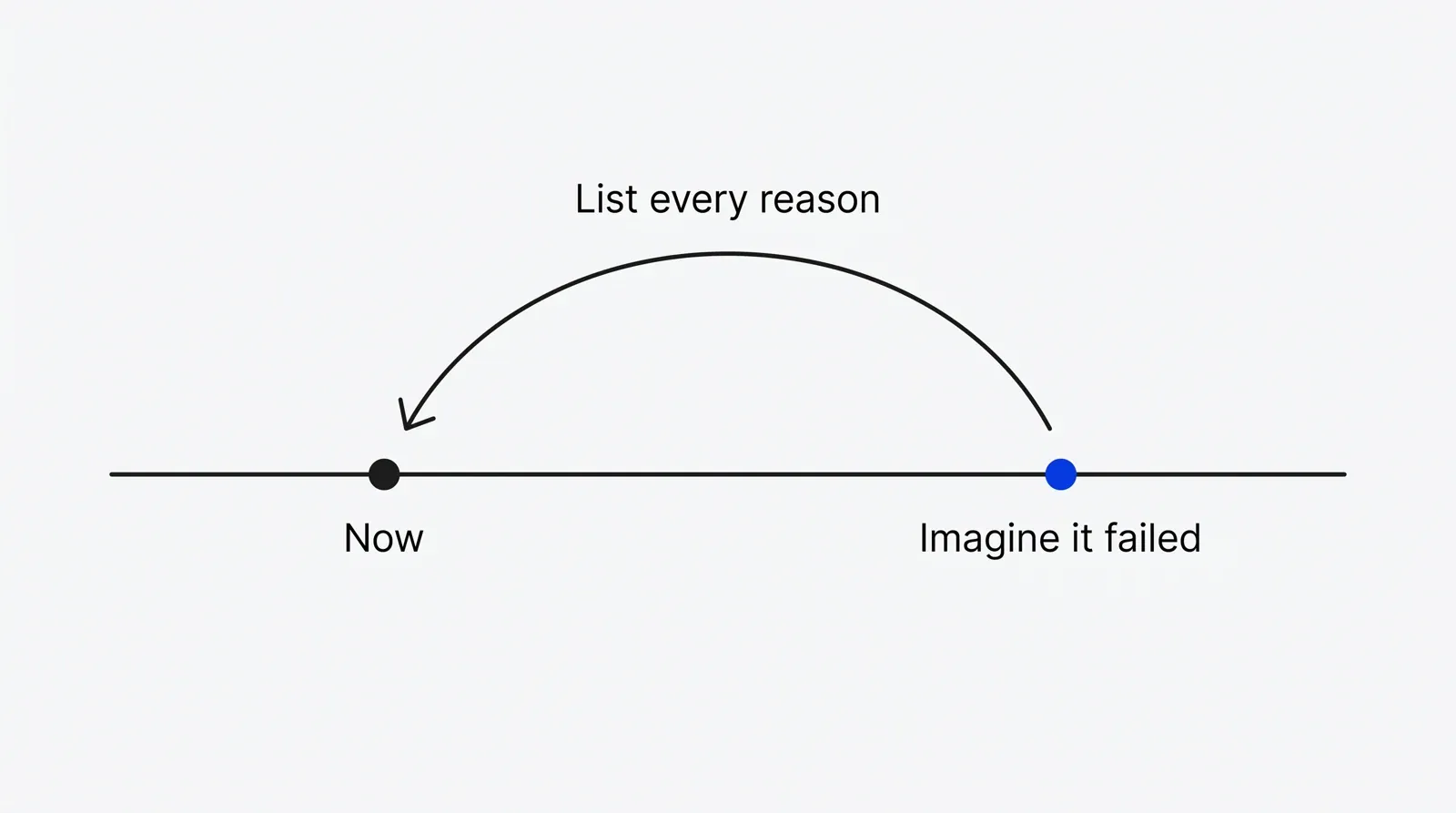
Daniel Kahneman later folded the method into Thinking, Fast and Slow, describing the same instruction Klein uses: imagine a year has passed, the plan was followed, and the outcome was a disaster, then write that history down in a few minutes. A 2020 study at Michigan Technological University compared a group premortem against a plain pro-and-con discussion and found the premortem produced more usable reasons for failure, evidence that the format itself does some of the work, beyond the general idea of thinking ahead.
A worked example: inverting a first sales hire
Take a 12-person agency about to hire its first head of sales (illustrative). The forward question, “what would make this hire succeed?”, produces a job description and a salary range. The inverted question, “what would make this hire fail within six months?”, produces a different list:
- there are no leads for the new person to work in their first month;
- nobody has agreed what counts as a qualified lead;
- the founder keeps closing the largest deals personally;
- commission is paid on signed deals that later cancel.
Each cause turns into a check before the offer goes out. The team builds a 90-day lead list, writes a one-line qualification rule, names the accounts the founder hands over, and pays commission on collected revenue. The hire itself stays the same. The plan around it changes.
Where the same move shows up
The premortem is now part of a wider set of debiasing tools. Dan Lovallo and Olivier Sibony list it in McKinsey Quarterly’s case for behavioral strategy as one way to counter overconfidence in big decisions, and Klein writes that a session can take as little as 20 to 30 minutes. Hospitals run a more formal cousin: the Institute for Healthcare Improvement describes Failure Modes and Effects Analysis as a proactive method to find “where and how it might fail,” applied step by step to a clinical process. Scenario planning, as Paul Schoemaker described it in MIT Sloan Management Review, sits further out: it explores a range of possible futures, while inversion interrogates one plan.
Inversion, premortem and backcasting
The three get confused because each one reasons from a point other than the present.
| Inversion | Premortem | Backcasting | |
|---|---|---|---|
| Starting point | A goal, written down | A goal, assumed to have already failed | A desired future state |
| Question asked | What would guarantee failure? | Why did this fail? | What steps reach this future? |
| Output | A list of causes to guard against | One project’s specific risk list | A path of milestones toward the goal |
Inversion is the general move: ask the opposite of whatever question you are trying to answer. A premortem is inversion applied to a single project’s risk, run as a timed session with a group. Backcasting inverts the direction of planning rather than the outcome. The planning literature defines it as picturing a desirable future and working back to the present to plan how to reach it, which is a different exercise from listing what could go wrong. Backcasting plans toward a future a team wants; inversion and the premortem plan around a future a team wants to avoid.
Pushers’ growth lab work runs on the same instinct behind all three: test a plan against its failure modes while the plan still costs nothing to change.
How to apply Inversion, step by step
- State the goal in one sentence. Write the specific outcome you want. 'Launch the payments feature by March without a compliance rejection' names a result you can test; 'work on the payments feature' only names an activity, too vague to fail against. Result: one sentence specific enough to test.
- Invert the question. Ask what would guarantee the goal fails, instead of what would make it succeed. The inverted question pulls out causes rather than intentions, which is the part a forward-only plan tends to skip. Result: a single question ready to answer in detail.
- List every cause of failure. Write down each specific way the goal could fail, one item per line, drawn from weak points in the plan. Skip vague entries like 'bad luck' and keep items specific enough to check, such as 'the compliance review flags the onboarding flow' rather than 'something goes wrong with compliance.' Result: a list of concrete, checkable causes.
- Turn each cause into a rule or a check. For every cause on the list, write the one action or check that would catch or prevent it, and add that action to the plan itself. A cause with nothing attached to it stays a worry sitting on a page. Result: the plan now contains a check for every cause you found.
- Decide which ones are worth acting on. Rank the causes by how likely they are and how much damage they would do, and spend effort on the ones that clear both bars. Treating every cause as equally worth fixing buries the two or three that matter under a long list of minor ones. Result: a short, prioritized set of changes instead of an unworkable checklist.
- Run it with the group before the decision is final. Gather the people who know the plan, tell them it already failed, and have each person write down a reason before anyone speaks aloud. A 2020 study at Michigan Technological University found a group premortem produced more usable failure causes than a plain pro-and-con discussion. Result: causes on the list that one person working alone would not have found.
Examples
A fintech launch
Illustrative: a cross-border payments company inverts its launch goal by asking what would make a regulator or a user reject the new onboarding flow. The list surfaces items such as a missing audit trail for identity checks and a form asking for data the licence does not require, and each one becomes a fix built into the plan before launch.
A clinic's patient experience
Illustrative: a physiotherapy clinic asks what would make a patient never book a second visit. The causes include a front desk that cannot explain the bill, a reminder call that never arrives, and a first session that ends with no next appointment on the calendar. Each cause gets a fix owned by a named person at the front desk.
When to use it
Reach for inversion before a decision is locked in and reversing it gets expensive: a product launch, a hire, a process redesign, a plan set at the start of a quarter. It works best on a decision specific enough to already have failure modes in it.
When not to use it
Skip it on decisions small enough that the cost of failing is lower than the time spent listing how it could happen. It is also not a substitute for expertise in the room: inverting a plan surfaces the risks the group already knows enough to name, and a session missing the right expertise produces a list that misses the risk that matters most.
Common mistakes
- Stopping at the list of failure causes and never turning any of them into a rule or a check, so the exercise produces worry instead of a better plan.
- Running inversion alone on a decision that affects a whole team, missing the causes only someone else in the room would think to name.
- Treating every failure cause as equally worth fixing, so effort goes to a rare, minor risk while a likely one ships unaddressed.
- Running the premortem after the decision is already public, when reversing course costs far more than making the right call the first time.
- Confusing inversion with pessimism, letting the session turn into complaints instead of a checklist anyone can act on.
FAQ
What is inversion in decision making?
Inversion is a technique that asks what would guarantee a plan fails, before asking what would make it succeed. Listing the causes of failure surfaces risks a forward-only plan tends to miss, and each cause can be turned into a rule or a check the plan already accounts for.
Who invented the inversion mental model?
No documented text credits an inventor. The line 'invert, always invert' is reported of mathematician Carl Gustav Jacob Jacobi by later writers, with no source showing it in his published work, and Charlie Munger popularized it for business and investing starting with a 1986 speech.
What is the difference between inversion and a premortem?
Inversion is the general move of asking how a goal could fail. A premortem is one structured way to run it: a team imagines a decision has already failed and writes down every reason before anyone speaks, a method Gary Klein described in Harvard Business Review in 2007.
Does inverting a decision improve it?
Research Gary Klein cites found that imagining an outcome has already happened increases the ability to correctly identify its causes by 30%, and a 2020 study found group premortems produced more usable reasons than a plain pro-and-con discussion. Neither guarantees a better decision, but both back the mechanism.
How is inversion different from backcasting?
Backcasting starts from a desired future and plans the steps to reach it. Inversion and its premortem variant start from a failed future and work backward to find what to avoid. Both move backward from an end state, but they plan toward opposite outcomes.
Sources
- Charlie Munger, How to Guarantee a Life of Misery, Harvard School commencement address, June 1986, transcript at James Clear
- MacTutor History of Mathematics, University of St Andrews, Carl Gustav Jacob Jacobi biography
- Gary Klein, Performing a Project Premortem, Harvard Business Review, September 2007
- Deborah J. Mitchell, J. Edward Russo, Nancy Pennington, Back to the future: Temporal perspective in the explanation of events, Journal of Behavioral Decision Making 2(1), 1989
- Daniel Kahneman, Thinking, Fast and Slow, Farrar, Straus and Giroux, 2011, Open Library record
- Dan Lovallo and Olivier Sibony, The Case for Behavioral Strategy, McKinsey Quarterly, March 2010
- Philip J. Vergragt and Jaco Quist, Backcasting for sustainability: Introduction to the special issue, Technological Forecasting and Social Change 78(5), 2011
- Farnam Street, Inversion: The Power of Avoiding Stupidity
- Institute for Healthcare Improvement, Failure Modes and Effects Analysis (FMEA) Tool
- Gary Klein, The Pre-mortem Method of Risk Assessment, gary-klein.com
- Gary Klein, The Pre-Mortem Method, Psychology Today, January 2021
- Olivier Serrat, The Premortem Technique, Knowledge Solutions, Asian Development Bank, March 2012
- Bent Flyvbjerg, Top Ten Behavioral Biases in Project Management: An Overview, Project Management Journal, 2021
- Charles T. Munger, Poor Charlie's Almanack: The Wit and Wisdom of Charles T. Munger, 2005, Open Library record
- Farnam Street, Avoiding Stupidity Is Easier Than Seeking Brilliance
- Janet Lowe, Damn Right!: Behind the Scenes with Berkshire Hathaway Billionaire Charlie Munger, John Wiley, 2000, Internet Archive record
- SHRM, Backcasting: Using Future-Back Thinking to Plan Tomorrow's Triumphs
- fintech.global, FinTech launches don't fail on compliance, they fail on data
- Elizabeth Keysor, Aliyah Wojtyna, Elizabeth S. Veinott, Premortem: Evaluating two structured analytic techniques for group brainstorming, Society for Judgment and Decision Making, 2020
- Paul J. H. Schoemaker, Scenario Planning: A Tool for Strategic Thinking, MIT Sloan Management Review, January 1995
Last updated Sep 25, 2026
