7 Powers
7 Powers is Hamilton Helmer's model of the seven conditions that let a business earn higher returns than its rivals for years, each one pairing a benefit for the company with a barrier that stops competitors from taking it away.
7 Powers is a strategy framework by Hamilton Helmer, published in 2016, that names seven sources of lasting advantage: scale economies, network economies, counter-positioning, switching costs, branding, cornered resource and process power. Each power needs a benefit that improves cash flow and a barrier that stops rivals from copying or competing that benefit away. Without both, a strength does not last.
- Origin
- Hamilton Helmer, 2016
- Level
- 301 · Advanced
- Fits
- Scale-up, Enterprise
- Time to apply
- two to three hours for a first pass with the leadership team
- What you need
- a clear view of one business unit and the market it competes in · the names of two or three rivals and what each would need to match you · margin data for your business and, if you can get it, for those rivals
7 Powers is a strategy framework that names the seven conditions under which a company can earn better returns than its rivals for a long time. Hamilton Helmer calls such a condition a power and defines it as the conditions that create the potential for persistent differential returns. The seven are scale economies, network economies, counter-positioning, switching costs, branding, cornered resource and process power.
Helmer published the book in October 2016 (book listing). He had worked at Bain & Company, run his own strategy consultancy with clients such as Adobe, Netflix and Spotify, and taught business strategy in Stanford’s economics department, according to his author page. Reed Hastings wrote the foreword and describes how, from 2009, Helmer taught a strategy program to Netflix’s key people. Founders and investors use the book to ask a single question: what will stop competitors from taking our margins?
Power needs a benefit and a barrier
A power exists only when two conditions hold together. In his Acquired interview, Helmer calls them the two necessary and sufficient conditions. The benefit is an improvement in cash flow: a higher price, a lower cost or less investment. The barrier is whatever stops a capable rival from copying that benefit or competing it away.
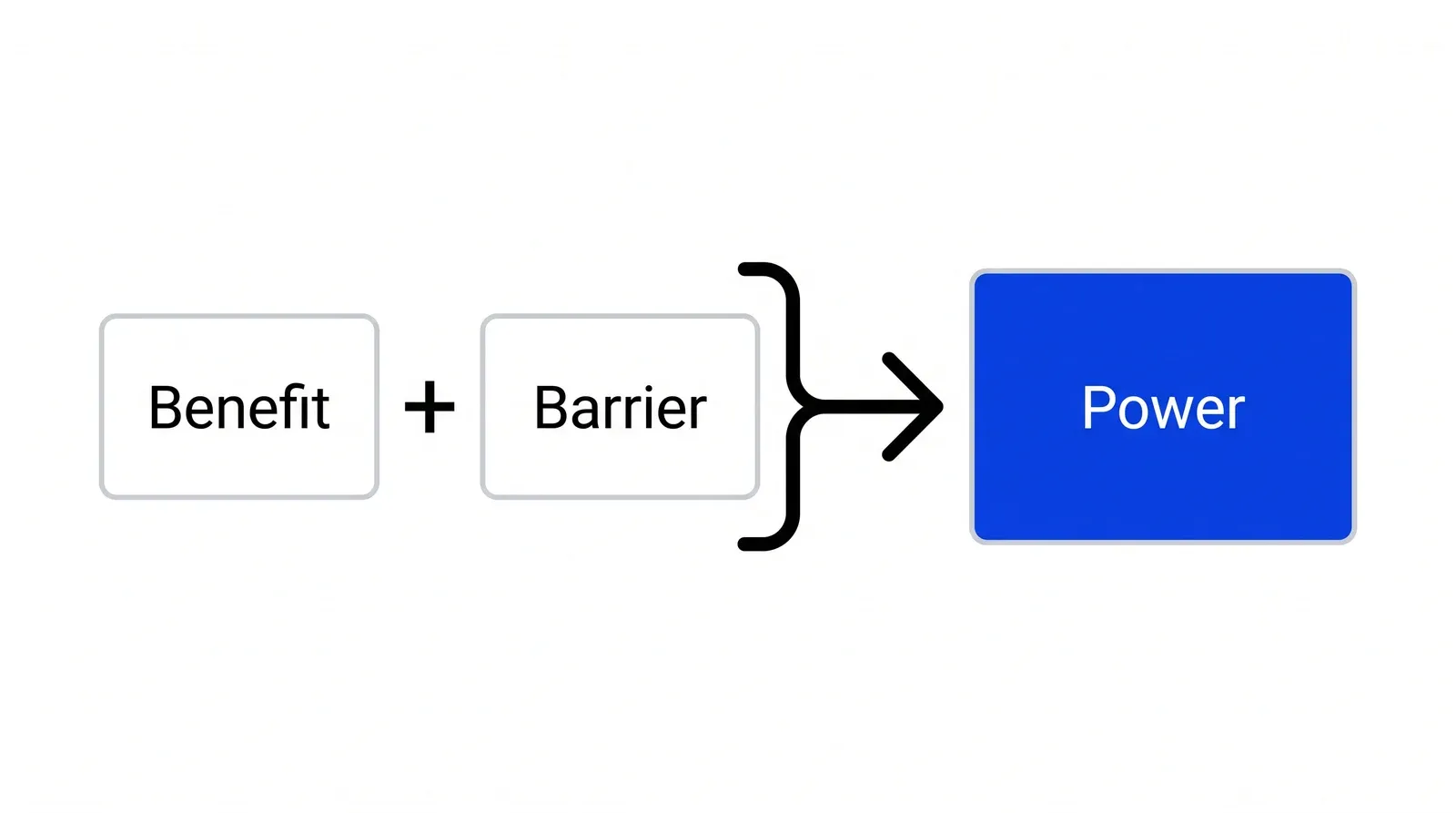
Benefits are common. A better checkout flow or a faster support team improves results this quarter, and a rival can match it next quarter. Barriers are rare, which is why most advantages fade. Michael Porter made a related point in 1996, arguing that operational effectiveness is not strategy because competitors imitate it quickly.
Helmer ties power to value with what Commoncog’s summary records as his Fundamental Equation: value equals current market size, times a discounted growth factor, times long-term market share, times long-term differential margin. Power is what keeps the last two terms above zero.
The seven powers, their benefits and barriers
The table follows the version of Helmer’s model laid out in a Nova School of Business and Economics work project that cites the book page by page. Only some examples come from Helmer himself: he discussed Netflix against Blockbuster and Pixar on Acquired, and his Vanguard case is described by Commoncog. The other examples are the Nova paper’s own choices.
| Power | Benefit | Barrier | Example |
|---|---|---|---|
| Scale economies | Lower unit cost | A rival’s cost of winning share is prohibitive | Walmart (Nova paper) |
| Network economies | Higher price, since value rises with users | Gaining share costs more than it returns | Instagram (Nova paper) |
| Counter-positioning | A better business model | Copying would damage the incumbent’s own business | Netflix against Blockbuster; Vanguard (Helmer) |
| Switching costs | Higher price to existing customers | Customers lose money or time by leaving | Apple (Nova paper) |
| Branding | Higher price for an identical offer | Time: a brand takes years to build | Coca-Cola (Nova paper) |
| Cornered resource | Varies: cost, price or product | Rivals cannot get the asset on the same terms | Pixar (Helmer) |
| Process power | Lower cost or better product | Time: the process took years to evolve | Toyota (Nova paper) |
Scale and network economies
Both use size as the barrier. With scale economies, a fixed cost such as a content library or a data centre is spread over more customers, so the leader’s unit cost is lower. With network economies, each new user makes the product worth more to the others. W. Brian Arthur described this shift toward increasing returns in knowledge industries in 1996. The platform strategy page covers network effects in depth.
Counter-positioning
A newcomer adopts a business model that the incumbent could copy but chooses not to, because copying would hurt its existing profits. Vanguard launched its first index fund in 1976 with lower costs for individual investors; active fund managers held back because index funds would cannibalize their fees, as Commoncog notes. Helmer told Acquired that late fees made up half of Blockbuster’s income, which made Netflix’s no-late-fee model expensive for Blockbuster to match. Hastings credits Helmer with inventing the concept.
Switching costs and branding
Both sit on the customer’s side. Switching costs are the losses a customer expects from moving to a rival: retraining, data migration, broken integrations. Paul Klemperer’s 1995 survey shows why they matter: with switching costs, current market share drives future profit. Branding is narrower than most teams think. It means customers pay more for an objectively identical offer because of what they know about the seller, close to Kevin Lane Keller’s idea of customer-based brand equity.
Cornered resource and process power
A cornered resource is preferential access to something valuable: a patent, a licence, a team. Helmer’s case is Pixar, whose leader Ed Catmull argued that good people matter more than good ideas. Process power is, in the words of the TIP727 episode notes, the rarest of the powers. It is a way of working that rivals can observe but cannot reproduce. Toyota’s production system was studied for decades, yet Spear and Bowen wrote that what happens inside the company remains a mystery.
When each power can be built: the Power Progression
The Power Progression says each power can only be established in a certain phase of a business: origination, takeoff or stability (book synopsis). Miss the window and the power is usually gone.
| Phase | What the business looks like | Powers built in this phase |
|---|---|---|
| Origination | Before the product sells | Counter-positioning, cornered resource |
| Takeoff | Fast growth, market still in flux | Scale economies, network economies, switching costs |
| Stability | Growth slows, market settles | Branding, process power |
The takeoff row comes from Helmer himself: on Acquired he called scale, network and switching costs the middle-phase powers and the most common ones in technology. The placement of the other four powers comes from secondary summaries of the book, not from a source we could read directly. It fits the barriers in the table above: branding and process power rest on time, so they cannot appear early. Hastings singles out the Progression in the foreword as one of the book’s two main advances.
7 Powers compared with VRIO and Porter’s five forces
| Framework | Unit of analysis | Question it answers |
|---|---|---|
| Porter’s five forces | An industry | Is this market attractive for everyone in it? |
| VRIO | A resource or capability | Can this resource give a lasting edge? |
| 7 Powers | A business against a named rival | What benefit do we have, and what stops this rival from taking it? |
VRIO grows out of Jay Barney’s 1991 resource-based paper and tests resources one by one. 7 Powers starts from the business and its rivals, and adds timing. The two fit together: VRIO is a good check on a claimed cornered resource.
Limits and open questions
The framework rests mainly on one book and its author’s consulting and investing practice. We found no peer-reviewed study that tests the seven powers as a whole. Parts of it have older roots. Charitou and Markides wrote in 2003 that incumbents facing a new business model risk damaging their existing business if they copy it, which is the counter-positioning mechanism. Readers often confuse counter-positioning with disruptive innovation. Christensen’s theory, revisited in HBR in 2015, is about entrants that start in segments incumbents ignore; counter-positioning is about why an incumbent declines to copy a model it can see.
Helmer also limits the scope himself: the analysis applies to one business unit, and power is relative to each competitor. In Pushers’ Growth Lab work, that makes the model most useful as a test of claims in a strategy memo: for every advantage listed, name the barrier and the rival it holds against.
How to apply 7 Powers, step by step
- Name the business and the rival. Pick one business unit and one market, then name the competitor you are testing against. Helmer treats power as relative, so a company can hold power over a small rival and none over a large one. Result: a single sentence such as 'our payroll product against the two largest local providers'.
- Find the benefit. Write down what makes your margin or price better than the rival's: lower unit cost, a higher price customers accept, or lower investment needs. If you cannot point to a number that moves, there is no benefit yet. Result: one or two benefits stated in money terms.
- Test the barrier. For each benefit ask what stops a well-funded rival from copying it next year. Match the answer to one of the seven barriers: their cost of winning share, damage to their own business, the customer's cost of leaving, time, or no access to the resource. Result: each benefit marked with a named barrier or with 'none'.
- Check the size. A power has to be material. Ask whether the benefit would move company value if it lasted ten years, and whether the barrier holds against every serious competitor or only one. Result: a short list of real powers and a longer list of advantages that will be competed away.
- Place the company on the Power Progression. Decide whether the business is in origination, takeoff or stability, and which powers can still be built in that phase. A company past takeoff without scale, network or switching-cost power has usually missed that window. Result: one or two powers the team will commit to building.
- Turn it into decisions. Assign an owner to each power you hold or plan to build, with a measure that would show the barrier weakening, such as churn, share gains by a rival, or price pressure. Result: three to five decisions with a review date.
Examples
A payments company serving online merchants
Illustrative. The team claims three powers. Fast onboarding is a benefit, but any rival with a good product team can match it within a year, so there is no barrier. A connected set of reconciliation reports that merchants have wired into their accounting systems gives switching costs: leaving means rebuilding finance processes, so churn stays low even when prices rise. A fraud model trained on years of the company's own transactions is a possible cornered resource, but only if a rival cannot buy similar data. The plan: invest in the integrations and track churn as the barrier's health check.
A dental clinic chain against a new low-price entrant
Illustrative. A chain of six clinics charges full price for check-ups and earns most of its margin on treatment plans. An entrant offers check-ups at half price with no upselling. For the chain, copying that model would cut revenue on its existing patients, so it hesitates: the entrant holds counter-positioning against this rival. The chain's answer is to look for a different power, such as process power in how it runs treatment planning, because matching the price directly costs more than it saves.
A B2B software firm checking its brand
Illustrative. The founders believe their brand is a power because customers like them. The test: would a buyer pay more for the same product under their name than under a rival's? Win-loss notes show deals are won on features and price, never on name. Branding fails the benefit test. The firm drops brand from its strategy memo and focuses on switching costs from data that customers store in the product.
When to use it
Use 7 Powers when you need to decide which advantage to build or defend: at an annual strategy review, before entering a new market, when choosing which product to fund, or when you invest in or acquire a company and want to know whether its margins will last. It suits growth-stage and enterprise teams that know their market and rivals, which is why the model asks about one business unit at a time.
When not to use it
Skip it before you have a product people buy. Helmer says invention comes first, so an idea-stage team gains more from customer discovery. Do not use it to judge whether a whole industry is attractive; Porter's five forces does that job. And do not treat it as a forecast: it says what conditions allow lasting returns, not whether you will execute well enough to reach them.
Common mistakes
- Listing a benefit with no barrier. Faster delivery, a better app or a strong team are benefits; if a rival can match them, they are not power.
- Calling a brand a power because customers like you. Branding means customers pay more for an objectively identical offer. Helmer warns that teams often overrate branding, data scale and operational excellence.
- Treating a founder or a great executive as a cornered resource. Helmer's test is sufficiency: would the same person guarantee success in a different business? Usually not.
- Ignoring the rival. Power is relative to a specific competitor, so a scale advantage over small players means nothing against a larger one.
- Missing the timing. Scale, network and switching-cost power are built during rapid growth. Waiting until the market settles usually leaves you behind a leader.
FAQ
What are the 7 Powers?
The seven powers in Hamilton Helmer's book are scale economies, network economies, counter-positioning, switching costs, branding, cornered resource and process power. Each describes a condition that lets a company earn returns above its rivals for a long time. Each one combines a benefit, such as lower cost or a higher price, with a barrier that stops competitors from copying it.
What is the difference between a power and a moat?
Helmer's power has two parts, a benefit and a barrier. A moat in the investor sense describes only the barrier. Lenny Rachitsky's episode with Helmer puts it this way: a moat around something worthless protects nothing. A power exists only when the company has something valuable and a reason rivals cannot take it.
Which power is best for startups?
Counter-positioning is usually the first power open to a startup, because it uses the incumbent's existing business against it. In his 2024 interview with Lenny Rachitsky, Helmer described tech startups moving from counter-positioning to scale, then switching costs, then network economies. Branding, process power and cornered resources are rare for young technology companies.
Who is Hamilton Helmer?
Hamilton Helmer is a strategy consultant and investor. He worked at Bain & Company, founded Helmer & Associates (later Deep Strategy), and is chief investment officer and co-founder of Strategy Capital. He holds a Yale PhD in economics and taught business strategy at Stanford for a decade until 2018. Netflix and Spotify are among his clients.
How is 7 Powers different from Porter's five forces?
Porter's five forces assesses how attractive an industry is for all companies in it. 7 Powers assesses whether one company in that industry has a lasting advantage over specific rivals. A team can use five forces to decide where to compete and 7 Powers to decide what advantage to build once inside.
Sources
- Hamilton Helmer, 7 Powers: The Foundations of Business Strategy, synopsis
- Hamilton Helmer, 7 Powers, About the Author
- Reed Hastings, Foreword to 7 Powers
- Amazon, 7 Powers: The Foundations of Business Strategy, book listing (ISBN 978-0998116310)
- Acquired, 7 Powers with Hamilton Helmer, episode page
- Acquired, 7 Powers with Hamilton Helmer, transcript (Podscripts)
- Lenny's Podcast, Business strategy with Hamilton Helmer (author of 7 Powers), 2024
- The Investor's Podcast, TIP727: 7 Powers by Hamilton Helmer, 2025
- The Investor's Podcast, TIP600: Business Durability and Strategy Masterclass with Hamilton Helmer, 2024
- Cedric Chin, Commoncog, Counter-Positioning
- Cedric Chin, Commoncog, A summary of 7 Powers
- Nova School of Business and Economics, Suffering from Success: Can Nvidia's Dominance Continue?, work project, 2024
- Michael E. Porter, What Is Strategy?, Harvard Business Review, 1996
- Steven Spear, H. Kent Bowen, Decoding the DNA of the Toyota Production System, Harvard Business Review, 1999
- Ed Catmull, How Pixar Fosters Collective Creativity, Harvard Business Review, 2008
- Constantinos Charitou, Constantinos Markides, Responses to Disruptive Strategic Innovation, MIT Sloan Management Review, 2003
- Clayton M. Christensen, Michael E. Raynor, Rory McDonald, What Is Disruptive Innovation?, Harvard Business Review, 2015
- W. Brian Arthur, Increasing Returns and the New World of Business, Harvard Business Review, 1996
- Vanguard, Our history
- Paul Klemperer, Competition when Consumers have Switching Costs, Review of Economic Studies 62(4), 1995
- Joseph Farrell, Paul Klemperer, Coordination and Lock-In: Competition with Switching Costs and Network Effects, Handbook of Industrial Organization vol. 3, 2007
- Kevin Lane Keller, Conceptualizing, Measuring, and Managing Customer-Based Brand Equity, Journal of Marketing 57(1), 1993
- Jay B. Barney, Firm Resources and Sustained Competitive Advantage, Journal of Management 17(1), 1991
Last updated Oct 9, 2026


Marketing agency or growth system: when a company outgrows its agency
An agency is the right call while the founder still runs most of the company. Once the business starts copying itself into new locations or markets, it needs a system that sets goals, tests hypotheses and owns the result.

Why healthcare marketing agencies stall: the short, mid and long wins model we use with clinics
Most agencies own the click and nobody owns the front desk. How we structure clinic work in three horizons, the research behind each one, and one year of results.

Why channel tests stall after month three
Most paid channel tests do not end with a decision. They end when the budget runs out, the attribution model changes, or everyone quietly stops looking at the dashboard.