Tuckman's stages
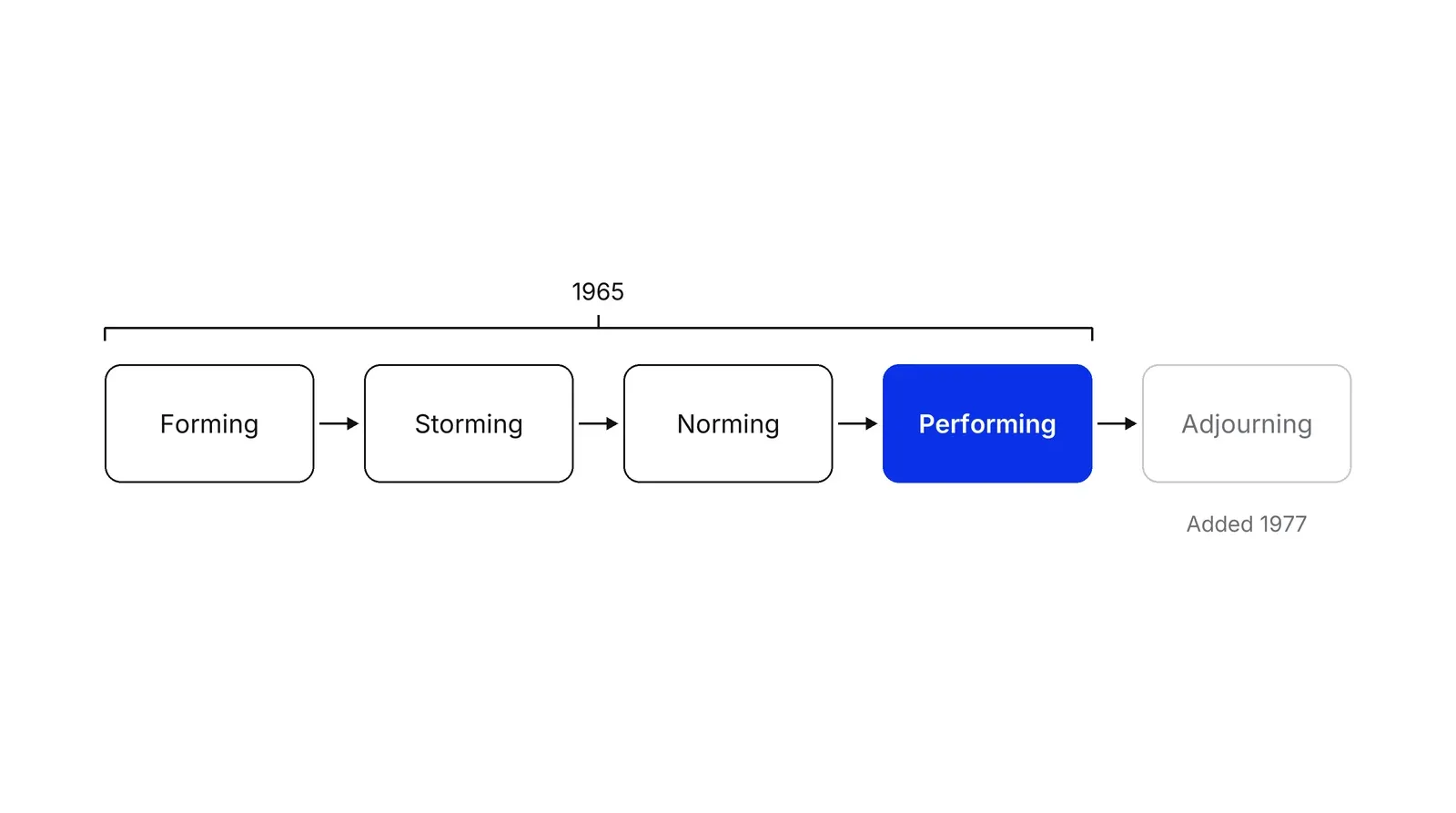
Tuckman's stages describe a team's development as forming, storming, norming, performing and, when the team ends, adjourning, so a leader can name what a new group is going through and respond to it.
Tuckman's stages are a model of team development in which a group passes through forming, storming, norming and performing, with adjourning added when the team ends. Bruce Tuckman proposed the first four in a 1965 review of 50 studies. Leaders use it to expect early friction, but later research shows many work teams change in bursts tied to their deadline, not in fixed steps.
- Origin
- Bruce W. Tuckman (1965); Bruce W. Tuckman and Mary Ann C. Jensen (1977), 1965; 1977
- Level
- 201 · Tool
- Fits
- Startup, Small and mid-size, Scale-up
- Time to apply
- 45 minutes to read a team, plus a 30-minute check at the halfway point
- What you need
- a team that has met for less than a few months, or a new project with a deadline · the start date and the deadline · two or three members willing to answer honestly how the team is going
Tuckman’s stages are a model of how a new team develops: forming, storming, norming and performing, with adjourning added for teams that come to an end. Psychologist Bruce Tuckman proposed the first four in a 1965 article in Psychological Bulletin, and added the fifth with Mary Ann Jensen in a 1977 update. Managers use the model to explain why a freshly assembled team argues before it works well. The evidence behind it is thinner than its fame suggests, and this page covers both.
What are the five stages?
The five stages are forming, storming, norming, performing and adjourning. Tuckman followed each on two tracks: how members relate to each other, and how they deal with the task, as set out in his 1965 paper.
| Stage | Between people | On the task |
|---|---|---|
| Forming | Testing the boundaries and depending on the leader | Orientation: what the task is and what the rules are |
| Storming | Conflict and resistance to the group’s influence | Emotional responses to what the task demands |
| Norming | Cohesion grows, new standards and roles emerge | Open exchange of views about the work |
| Performing | Roles become flexible and useful | Solutions emerge and the structure supports the work |
| Adjourning | Disengagement, anxiety about the team ending | Self-evaluation |
Tuckman said he coined the four names himself, and guessed in a 1984 note that their memorability explains the paper’s popularity.
Where did the stages come from?
They came from a literature review. At the US Navy’s Naval Medical Research Institute, Tuckman’s boss Irwin Altman had collected articles on group development and handed him 50 of them. The 1965 paper sorted them by setting and looked for a sequence that fit most findings.
The sample was narrow. Of the 50 articles, the paper reports 26 on therapy groups and 11 on training groups, the human-relations groups known as T-groups. Tuckman himself wrote that generalizing from this literature needed caution, because most studies watched a single group and were qualitative. Tuckman recalled that the editor of Psychological Bulletin first rejected the manuscript because the reviewed studies were not good enough, and that he answered that he was drawing inferences from them, not defending them.
In 1977 Tuckman and Jensen reviewed 22 studies published since. By Tuckman’s account, these tended to support the four stages and suggested a fifth. Denise Bonebright’s 2010 historical review adds that the model spread first among human resource development practitioners and only later became common in academic work.
Why do new teams storm?
New teams storm because members have to settle who has influence and how demanding the task is before they trust each other. In Tuckman’s 1965 review, 13 of 26 therapy-group studies reported a stage of conflict, and 10 of 11 training-group studies placed it second in the sequence.
Conflict is not automatically useful. Karen Jehn’s 1995 study of 105 work groups found that disagreement about the work could help groups doing nonroutine tasks, while it hurt groups doing routine ones. A 2003 meta-analysis by Carsten De Dreu and Laurie Weingart found that, on average, both relationship conflict and task conflict correlated negatively with team performance and satisfaction.
What decides whether a storm is survivable is safety. Amy Edmondson’s 1999 study of 51 work teams defined psychological safety as a shared belief that the team is safe for interpersonal risk taking, and linked it to team learning. Google’s team effectiveness research on 180 teams listed it first among five dynamics. Lencioni’s five dysfunctions treat the ability to argue about work as a level of its own.
Does every team follow the sequence?
No. Connie Gersick’s 1988 study followed eight work teams from first meeting to deadline, from seven days to six months in length. They did not move through stages in order. They alternated between long stretches of steady, inert effort and a sudden change of approach, a pattern she called punctuated equilibrium.
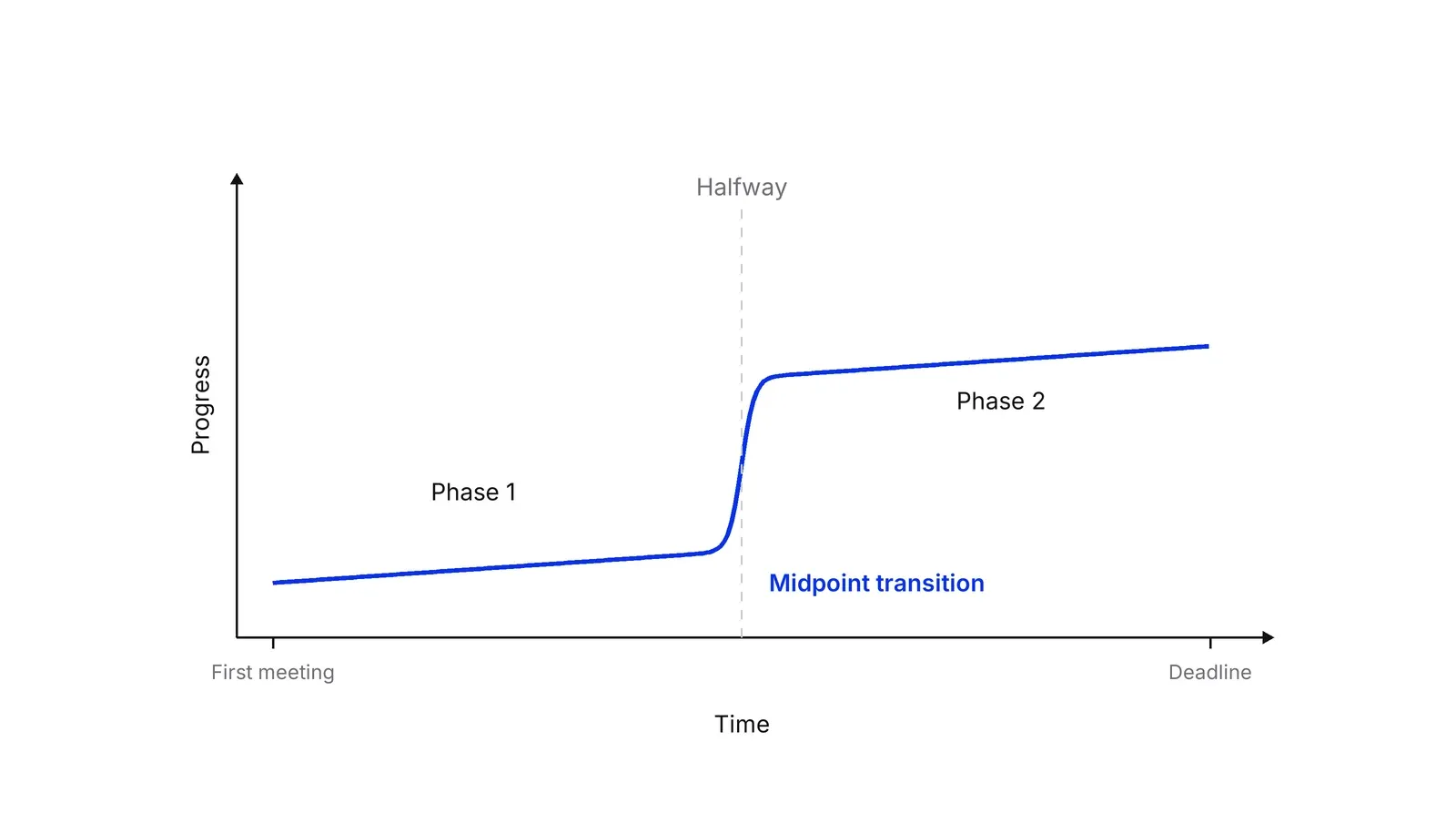
The change came at the midpoint of the time each team was given, whatever its length. Gersick concluded that awareness of time and deadlines, more than finishing a developmental stage, moved teams forward. One team in her sample showed no initial storming. A 1989 lab study of groups producing creative work found the same midpoint pattern.
The picture is mixed. A classroom study at the University of Oregon called the fit to Tuckman’s model very good. Susan Wheelan and colleagues found in 2003 that groups meeting longer made fewer dependency and fight statements and more work statements. A study of 25 simulated project teams found partial support for both views. The authors had predicted that time awareness and pacing would follow punctuated equilibrium, and that structure and process would follow a linear model. And Marshall Scott Poole and Jonelle Roth’s typology of 47 decisions found 11 different decision paths, not one sequence.
| Tuckman’s stages | Gersick’s punctuated equilibrium | |
|---|---|---|
| Built from | 50 published studies, mostly therapy and training groups | Direct observation of eight work teams from start to finish |
| What moves a team on | Working through issues in order | Awareness of the deadline, with a shift at the halfway point |
| Silent on | How long a stage lasts and what triggers the next | Detail on relationships inside the team |
| Best used for | Naming what a new team is dealing with | Timing reviews and interventions |
How to use it without treating it as a timetable
Use the stages as a list of questions a new team must answer: who decides, what is the task, which rules do we keep, who does what. Use the clock for timing: Gersick’s midpoint is a natural date for a review, and Hackman and Wageman’s theory of team coaching also ties coaching to the points in a task when it can help.
Pair the stages with a leadership style that shifts with the team. Situational leadership does this. The structure of a new growth team decides which issues storming will be about. At the end, an after-action review gives the adjourning stage a purpose. Katzenbach and Smith made a related point in Harvard Business Review: a group does not become a team just because it is called one.
A Growth Lab plan starts by naming who owns each experiment, the question a forming team has not yet answered; see Growth Lab.
How to apply Tuckman's stages, step by step
- Write down the start date and the deadline. The stages say nothing about how long each lasts, so anchor the team in real dates. Mark the halfway point of the time you have. Result: a timeline with one date that matters more than the others.
- Read the team on both tracks. Tuckman tracked two things at once: how members relate to each other, and how they handle the task. Ask each person two questions: who do I look to for decisions, and is the work clear to me? Result: a guess at the stage for people and a guess at the stage for the work, which often differ.
- Choose the move that fits the stage. Forming needs clear task, roles and rules. Storming needs disagreement kept on the work. Norming needs the new agreements written down. Performing needs the leader to step back. Result: one action for the next two weeks.
- Check how safe it is to disagree. Ask whether a member could admit a mistake or challenge the plan without being embarrassed or punished. Google's team research named this psychological safety. Result: a yes or no for each person, and a first name to talk to if it is no.
- Hold a review at the halfway point. Gersick found teams change their approach at the midpoint. Use it on purpose: stop for 30 minutes, compare progress with the deadline and decide what to drop or change. Result: a revised plan for the second half.
- Close the team deliberately. When the work ends, run a short review of what worked and what to keep, and thank people by name. Tuckman and Jensen added adjourning for this phase. Result: lessons written down and people released to their next team.
Examples
A growth pod built from three departments
Illustrative. A marketer, an analyst, a designer and two developers are pulled into one pod with a 12-week goal. In week 1 nobody knows who decides which test ships (forming). In week 3 the analyst and the marketer argue about which metric counts (storming). The lead writes the metric definition and a decision rule on one page (norming). Whether a test ships is then settled without the lead (performing). At week 6, the midpoint, the pod drops two of its planned tests.
A clinic front desk before a second site opens
Illustrative. Six new coordinators have eight weeks to be ready for opening day. In week 2 they defer to the one person who worked at the first site. In week 4, the midpoint, the manager runs a full patient day on paper and finds that nobody owns insurance checks. The team fixes that, and the second half goes to practice and speed. After opening, the manager holds a review so the next site starts with what this team learned.
A payments support team launching a new product
Illustrative. Eight agents, two compliance staff and a product owner have 12 weeks to support a new card product. Early on, agents and compliance disagree about what can be said to customers, which is storming over the task rather than over people. Once the owner records the answers in a shared playbook, those arguments stop. A check at week 6 tests the playbook against real tickets before the launch date forces the issue.
When to use it
Use it when a new team forms, when two teams merge, or when a leader needs a plain way to explain why early friction is normal. It is a good vocabulary for onboarding new managers and for planning the first weeks of a project team.
When not to use it
Do not use it as a schedule or a test that a team can fail. The model does not say how long a stage lasts or what moves a team on. For a stable team stuck in the same pattern, a diagnosis such as the five dysfunctions fits better than a stage label.
Common mistakes
- Treating the stages as a timetable. Tuckman's own review noted that the same sequence appeared in groups that met for hours and in groups that met for a year, so the stage names say nothing about calendar time.
- Trying to skip storming. The 1965 review found a conflict stage in many studies, but a later study of eight work teams found one that never had it. Forcing a fight, or suppressing one, are both mistakes.
- Assuming conflict is productive. A 2003 meta-analysis found that both task and relationship conflict correlated negatively with team performance on average.
- Reading one stage for the whole team. People and work can sit at different stages, and new members reset part of the picture.
- Applying a model built mostly from therapy and training groups to a software or sales team without checking. Tuckman warned that its evidence came mainly from therapy groups.
FAQ
What are the five stages of Tuckman's model?
Forming, storming, norming, performing and adjourning. Forming is orientation and dependence on the leader. Storming is conflict and resistance. Norming brings cohesion and new standards. Performing is when roles are flexible and the team produces results. Adjourning, the 1977 addition, covers disengagement as the team ends.
Who created Tuckman's stages and when?
Psychologist Bruce W. Tuckman published four stages in a 1965 Psychological Bulletin review, based on a review of 50 articles. With Mary Ann Jensen he added adjourning in a 1977 update after reviewing 22 later studies. He wrote that he coined the four names himself, and that their memorability probably explains the paper's popularity.
Does every team go through storming?
No. Many studies in Tuckman's 1965 review found a conflict stage, but Connie Gersick's 1988 study of eight work teams recorded one team with no initial storming. Whether a team storms depends on how much members disagree about who leads and what the task is, not on a fixed law.
How long does each Tuckman stage last?
The model gives no durations. Tuckman noted in his 1965 paper that laboratory groups meeting for a few hours followed essentially the same course as therapy groups meeting for a year. Gersick later argued that traditional models say little about what triggers change, and found it was awareness of the deadline.
Is Tuckman's model still valid?
Partly. Studies of classroom and work groups have found patterns that fit it, but Gersick's research and a 2003 study of 25 simulated teams show that time and deadlines also shape development. Treat the stages as a checklist of issues a new team must work through, not as a guaranteed sequence.
Sources
- Bruce W. Tuckman, Developmental sequence in small groups, Psychological Bulletin 63(6), 1965
- Bruce W. Tuckman, Mary Ann C. Jensen, Stages of small-group development revisited, Group & Organization Studies 2(4), 1977
- Bruce W. Tuckman, Citation Classic commentary on the 1965 paper, Current Contents, 1984
- Connie J. G. Gersick, Time and transition in work teams: toward a new model of group development, Academy of Management Journal 31(1), 1988
- Connie J. G. Gersick, Marking time: predictable transitions in task groups, Academy of Management Journal 32(2), 1989
- Artemis Chang, Prashant Bordia, Julie Duck, Punctuated equilibrium and linear progression: toward a new understanding of group development, Academy of Management Journal 46(1), 2003
- Philip J. Runkel and colleagues, Stages of group development: an empirical test of Tuckman's hypothesis, Journal of Applied Behavioral Science 7(2), 1971
- Denise A. Bonebright, 40 years of storming: a historical review of Tuckman's model of small group development, Human Resource Development International 13(1), 2010
- Diane L. Miller, The stages of group development: a retrospective study of dynamic team processes, Canadian Journal of Administrative Sciences 20(2), 2003
- Susan A. Wheelan, Barbara Davidson, Felice Tilin, Group development across time: reality or illusion?, Small Group Research 34(2), 2003
- Marshall Scott Poole, Jonelle Roth, Decision development in small groups IV: a typology of group decision paths, Human Communication Research 15(3), 1989
- Carsten K. W. De Dreu, Laurie R. Weingart, Task versus relationship conflict, team performance, and team member satisfaction: a meta-analysis, Journal of Applied Psychology 88(4), 2003
- Karen A. Jehn, A multimethod examination of the benefits and detriments of intragroup conflict, Administrative Science Quarterly 40(2), 1995
- Amy C. Edmondson, Psychological safety and learning behavior in work teams, Administrative Science Quarterly 44(2), 1999
- Google re:Work, Understand team effectiveness
- Steve W. J. Kozlowski, Daniel R. Ilgen, Enhancing the effectiveness of work groups and teams, Psychological Science in the Public Interest 7(3), 2006
- John Mathieu, M. Travis Maynard, Tammy Rapp, Lucy Gilson, Team effectiveness 1997-2007: a review of recent advancements and a glimpse into the future, Journal of Management 34(3), 2008
- J. Richard Hackman, Ruth Wageman, A theory of team coaching, Academy of Management Review 30(2), 2005
- Mary J. Waller, Gerardo A. Okhuysen, Marzieh Saghafian, Conceptualizing emergent states: a strategy to advance the study of group dynamics, Academy of Management Annals 10(1), 2016
- Jon R. Katzenbach, Douglas K. Smith, The discipline of teams, Harvard Business Review, March-April 1993
Last updated Oct 9, 2026


Fractional COO or embedded operations team? How to choose at Series A
The two models solve different problems: how to tell which one your company needs, and what each costs in time and control.

What operational systems successful fintech startups use: lessons from ten companies
Starling, Monzo, Qonto, bunq, Lunar, Pleo, Tide, Ramp, Mercury and Column scaled on four operating systems. Regulators' findings show what breaks when one of them lags behind growth.

What a revenue operations manager actually owns
Pipeline definitions, CRM hygiene, forecasting and the handoffs between marketing, sales and success. What the role covers, and how it differs from sales ops.