How Brands Grow
How Brands Grow is Byron Sharp's 2010 book arguing, from decades of purchase data, that brands grow mainly by winning more buyers, most of them light buyers, rather than by making existing buyers more loyal.
How Brands Grow is a 2010 book by Byron Sharp of the Ehrenberg-Bass Institute that turns decades of consumer panel research into a set of empirical laws, such as double jeopardy and duplication of purchase. Its central claim is that brands grow mainly by increasing penetration, reaching more category buyers, especially light ones, because loyalty differs little between competing brands.
- Origin
- Byron Sharp and the Ehrenberg-Bass Institute (book); Andrew Ehrenberg and Gerald Goodhardt (the underlying laws), 2010 (book); 1959 to 1990 (laws)
- Level
- 401 · Expert
- Fits
- Scale-up, Enterprise
- Time to apply
- one day to run the checks on a year of panel or CRM data; the strategy change takes a planning cycle
- What you need
- a year of purchase data by brand: penetration and average purchase frequency for your brand and main rivals · category data or a panel provider, if you sell through retailers · a marketing lead willing to compare the brand's numbers with a benchmark before setting loyalty targets
How Brands Grow is a book and a body of evidence about how buyers choose between competing brands. Byron Sharp, director of the Ehrenberg-Bass Institute for Marketing Science, published How Brands Grow: What Marketers Don’t Know with Oxford University Press in 2010. Its argument is simple to state: brands grow by getting more people to buy them, and most of those people buy the brand rarely.
The book is a summary more than a discovery. Most of the patterns it calls laws come from Andrew Ehrenberg, Gerald Goodhardt and their colleagues, who spent four decades fitting statistical models to consumer panel data. Sharp packaged that work for practitioners and drew strategic conclusions from it. Brand managers in packaged goods, retail and media planning use it to set targets and to challenge loyalty-first plans.
Where the laws come from
The laws come from fitting simple probability models to millions of recorded purchases. In 1959 Ehrenberg showed in The Pattern of Consumer Purchases that the negative binomial distribution (NBD), a standard way to describe how often people repeat an action, fits how often households buy products such as bread, coffee and soap.
In 1984 Goodhardt, Ehrenberg and Chatfield extended it into the NBD-Dirichlet model. It describes a stable market where brands show no special groupings. Given each brand’s sales and two parameters, it predicts penetration, purchase frequency, repeat buying and brand switching. The authors reported that it fit more than 40 product fields. Ehrenberg collected the findings in Repeat-Buying, first published in 1972 and revised in 1988.
Double jeopardy: small brands lose twice
Double jeopardy is the pattern where a smaller brand has far fewer buyers than a bigger one, and those buyers also buy it slightly less often. Ehrenberg, Goodhardt and Barwise reviewed the evidence in Double Jeopardy Revisited in 1990. The name goes back to sociologist William McPhee, whose 1963 book Formal Theories of Mass Behavior described a similar pattern outside marketing.
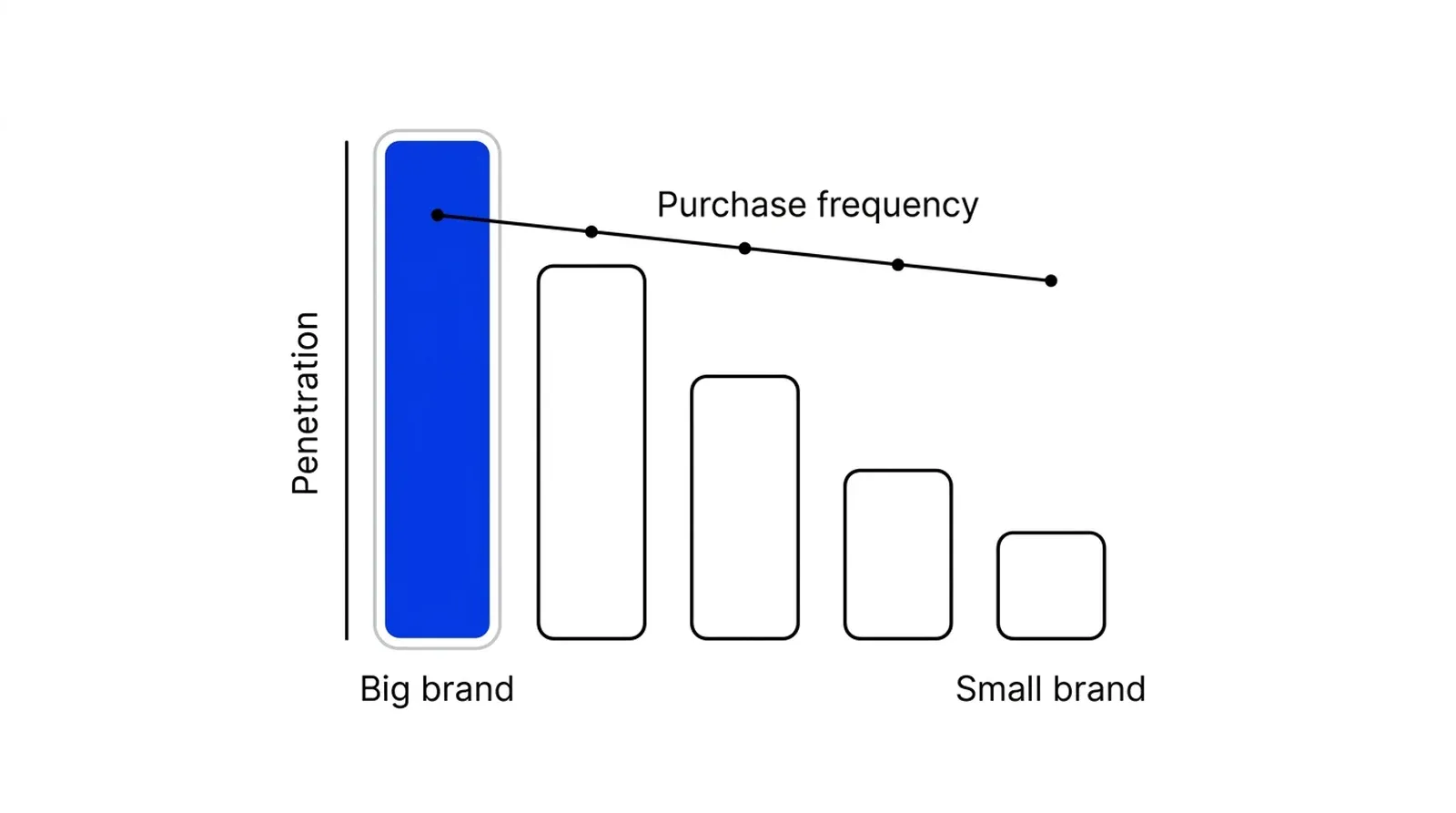
The practical reading is that loyalty is mostly a consequence of size. A small brand with low repeat rates usually has retention that is normal for its size. Graham and colleagues tested the pattern in 32 replications, including emerging markets and capital purchases, and found no boundary condition. They also validated a quick check: purchase frequency times one minus penetration comes out roughly the same for every brand in a category.
Duplication of purchase: who you really compete with
The duplication of purchase law says that brands share customers in line with their size. Ehrenberg and Goodhardt put it in a 1970 paper: the proportion of one brand’s buyers who also buy another brand is roughly proportional to that other brand’s total buyers. If the market leader is bought by half the category, about half of your buyers will buy it too.
The exceptions tell you the most. Two brands that share more buyers than size predicts compete more directly, often because of a shared format, price tier or channel. Magda Nenycz-Thiel of the Ehrenberg-Bass Institute describes the law as the tool that shows who a brand is really competing with.
A related finding cuts against narrow targeting. Hammond, Ehrenberg and Goodhardt found in more than 20 grocery categories that competing brands are bought by similar kinds of people, and a 2012 study across 50 categories confirmed it. Our STP page covers how defenders of targeting answer this.
Light buyers and the 60/20 Pareto law
Most of a brand’s buyers are light buyers, and together they bring a large share of its sales. Sharp, Romaniuk and Graham report in Marketing’s 60/20 Pareto Law that in a year the heaviest 20% of a brand’s buyers bring about 59% of sales on average, from 68% for dog food to 44% for hair conditioner.
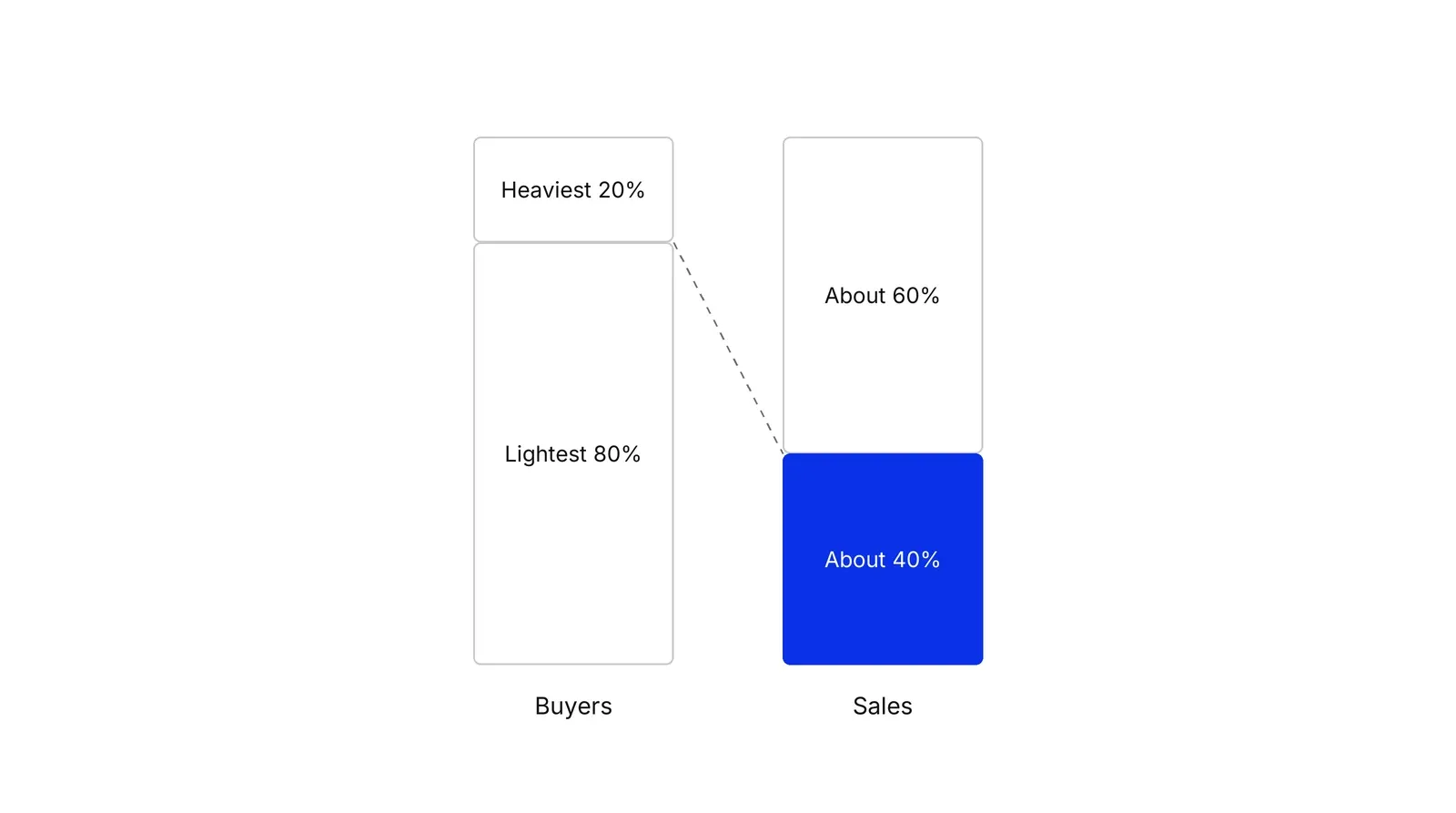
The exact figure depends on the time window. Kim, Singh and Winer used six years of Nielsen panel data and found a mean ratio of 0.73, closer to the classic 80/20. Sharp’s team answers that such long windows are unusual in brand management. Over five years, Dawes and colleagues found that 80% of buyers bought a brand once a year or less yet contributed 40% of sales. Heavy buyers also drift back toward the average next period, which the book calls the law of buyer moderation.
What it means for strategy
The strategic claim is that growth comes mainly from penetration. If loyalty is tied to size, a brand cannot raise it much in isolation, so the route to more sales is more buyers. Sharp argues this requires reaching all category buyers, not only heavy users, and being easy to recall and easy to buy. That second idea, mental and physical availability, has its own page in this library, together with distinctive brand assets.
| Common belief | What the Ehrenberg-Bass evidence shows |
|---|---|
| Our loyal customers drive growth | Share gains come mostly from penetration gains |
| The top fifth of buyers bring four fifths of sales | In a year it is usually closer to three fifths |
| Our buyers are a distinct segment | Rival brands’ buyer profiles seldom differ |
Where the evidence is contested
Most critics accept the data and question how far it reaches. Fader and Schmittlein showed in 1993 that high-share brands get more loyalty than the Dirichlet predicts in markets in Japan and the US. Pare and Dawes followed 300 UK brands and found persistent excess loyalty mostly among market leaders and private labels. The model assumes a stable market, and Graham, Scriven and Bound found across 62 categories that purchase propensities are never quite fixed, even though brands stay close to prediction.
Growth studies also give loyalty more credit. Baldinger, Blair and Echambadi compared 353 brands at two points five years apart and concluded that penetration is the key to share growth but that loyalty strongly amplifies it. David Cowan, reviewing the book for Market Leader in 2011, called its analysis static: it compares brands at one point in time instead of following how they grew. Mark Ritson, broadly a supporter, wrote in Marketing Week that the book is not original, and reported strategist Marie Oldham’s challenge to its advice against targeting.
Sharp’s reply is that he was misread. In an institute interview he said loyalty is everywhere, but “not the sort of loyalty that we thought.” For a team using the laws in Growth Lab work, the fair reading is to treat them as benchmarks. They tell you what to expect for a brand your size, and deviations are where the useful questions start.
How to apply How Brands Grow, step by step
- Pull penetration and purchase frequency for every brand. For the last 12 months, take each competing brand's penetration (share of category buyers who bought it at least once) and average purchase frequency among its buyers. Result: a table with one row per brand, sorted by market share.
- Check for double jeopardy. Compute purchase frequency times one minus penetration for each brand. If the numbers sit close together, your market follows the usual pattern and loyalty is mostly a function of size. A brand far above the line has excess loyalty that needs an explanation. Result: a short list of brands that deviate, with the size of the gap.
- Look at who else your buyers buy. Build a duplication table: for each brand, the share of its buyers who also bought each rival. Under the duplication of purchase law a rival's share of your buyers tracks that rival's overall penetration. Result: a list of rivals you share more or fewer buyers with than size alone predicts.
- Measure where sales come from. Rank your buyers by purchase volume and compute the share of sales from the heaviest 20%. Ehrenberg-Bass reports the figure is usually near 60 percent in a year, well short of the 80 the old rule promises. Result: the sales share of light buyers, which tells you how much of next year's revenue depends on people who buy you rarely.
- Set the growth goal as more buyers. Translate the sales target into a penetration target, since share gains in this research come mostly from more buyers. Plan reach across all category buyers and make the brand easy to find and buy. Result: a plan whose main KPI is penetration, with loyalty tracked against the benchmark, not as a separate goal.
Examples
A dental clinic chain reading its own double jeopardy
Illustrative, no real business implied. Three clinic brands share a city. Clinic A has a penetration of 0.40, meaning four in ten local dental patients visit it in a year, and its patients come back 3.0 times on average. Then 3.0 x (1 - 0.40) = 1.8. If the pattern holds, Clinic B, with a penetration of 0.10, should expect about 1.8 / 0.90 = 2.0 visits per patient. If Clinic B's data shows 2.0, its retention is normal for its size and a loyalty campaign will not close the gap. Reaching more patients will.
A payments app checking who its users also use
Illustrative. A small payments app learns from a survey that half of its users also use the market leader, which about half of all category users use. That is what the duplication of purchase law predicts. A second rival, used by one in five category users, turns out to share more than a third of the app's users. That over-duplication suggests the two apps compete for the same niche, for example freelancers paid from abroad, and should be checked before any segment-specific campaign.
When to use it
Use it when a brand in a repeat-purchase market is setting growth targets, when a team proposes a loyalty program or a narrow heavy-buyer strategy as the main growth lever, or when you need a benchmark to tell whether your retention numbers are good or typical for your size.
When not to use it
It helps less in markets that are clearly not stationary, such as a new category in its first years, or for one-off purchases where repeat-buying data does not exist. In subscription markets the patterns hold in a different form, so read loyalty through churn, not purchase frequency. Do not use it to argue that positioning or product quality do not matter.
Common mistakes
- Reading the book as saying loyalty does not exist. Sharp's own position is that loyalty is everywhere but weaker and more divided than marketers assume.
- Setting a loyalty target for a small brand without checking the double jeopardy benchmark first, then blaming the CRM team when frequency stays at the level size predicts.
- Quoting 80/20 for a brand's buyers. Annual data usually shows the heaviest fifth of buyers bring closer to three fifths of sales, and the figure shifts with the time window.
- Treating the laws as proof that targeting is useless. They describe who buys, not where the next euro of sales effort should go.
- Ignoring persistent deviations. Market leaders and store brands often show excess loyalty that the model does not explain.
FAQ
Who wrote How Brands Grow?
Byron Sharp, director of the Ehrenberg-Bass Institute for Marketing Science, wrote How Brands Grow: What Marketers Don't Know (Oxford University Press, 2010). The book is credited to Sharp and the institute's researchers, and rests on work by Andrew Ehrenberg and Gerald Goodhardt going back to 1959.
What are the main laws in How Brands Grow?
The best known are double jeopardy, where smaller brands have far fewer buyers who are also slightly less loyal; the duplication of purchase law, where brands share buyers in line with their size; the Pareto law, where the heaviest fifth of buyers bring closer to three fifths of sales than four fifths; and buyer moderation, where heavy buyers buy less next period.
What is the difference between How Brands Grow and How Brands Grow Part 2?
The first book (Byron Sharp, 2010) sets out the laws, mostly from packaged goods. Part 2 (Jenni Romaniuk and Byron Sharp, 2016) tests them in emerging markets, services, durables, new brands and luxury, and adds chapters on mental availability and distinctive assets.
Is How Brands Grow still relevant?
The core patterns keep replicating. A 2017 study of 32 replications found no boundary to double jeopardy. Critics accept much of it but dispute how far it goes: high-share brands often show excess loyalty, and penetration and loyalty tend to rise together when brands grow.
What is the Dirichlet model in marketing?
The NBD-Dirichlet is a statistical model published by Goodhardt, Ehrenberg and Chatfield (1984). From each brand's sales and two parameters it predicts penetration, purchase frequency, repeat buying and switching in a stable market. Marketers use it as a benchmark: deviations from it show where to investigate.
Sources
- Byron Sharp, How Brands Grow: What Marketers Don't Know, Oxford University Press, 2010, ESCP library record
- A. S. C. Ehrenberg, The Pattern of Consumer Purchases, Applied Statistics 8(1), 1959
- A. S. C. Ehrenberg, G. J. Goodhardt, A Model of Multi-Brand Buying, Journal of Marketing Research 7(1), 1970
- G. J. Goodhardt, A. S. C. Ehrenberg, C. Chatfield, The Dirichlet: A Comprehensive Model of Buying Behaviour, Journal of the Royal Statistical Society Series A 147(5), 1984
- A. S. C. Ehrenberg, Repeat-Buying: Facts, Theory and Applications, new edition, Griffin and Oxford University Press, 1988, Penn Libraries record
- A. S. C. Ehrenberg, G. J. Goodhardt, T. P. Barwise, Double Jeopardy Revisited, Journal of Marketing 54(3), 1990
- Center for Advanced Study in the Behavioral Sciences, Stanford, William McPhee, Formal Theories of Mass Behavior, 1963
- INFORMS Society for Marketing Science, In memoriam: Andrew Ehrenberg
- Mark Uncles, Andrew Ehrenberg, Kathy Hammond, Patterns of Buyer Behavior: Regularities, Models, and Extensions, Marketing Science 14(3), 1995
- Kathy Hammond, A. S. C. Ehrenberg, G. J. Goodhardt, Market Segmentation for Competitive Brands, European Journal of Marketing 30(12), 1996
- Mark Uncles, Rachel Kennedy, Magda Nenycz-Thiel and others, In 25 Years, Across 50 Categories, User Profiles for Directly Competing Brands Seldom Differ, Journal of Advertising Research 52(2), 2012
- Byron Sharp, Malcolm Wright, Gerald Goodhardt, Purchase Loyalty is Polarised into Either Repertoire or Subscription Patterns, Australasian Marketing Journal 10(3), 2002
- A. S. C. Ehrenberg, Mark Uncles, Gerald Goodhardt, Understanding Brand Performance Measures: Using Dirichlet Benchmarks, Journal of Business Research 57(12), 2004
- Peter S. Fader, David C. Schmittlein, Excess Behavioral Loyalty for High-Share Brands: Deviations from the Dirichlet Model for Repeat Purchasing, Journal of Marketing Research 30(4), 1993
- Vincent Pare, John Dawes, The Persistence of Excess Brand Loyalty over Multiple Years, Marketing Letters 23(1), 2012
- Charles Graham, John Scriven, John Bound, Making Sense of Common Dirichlet Deviations, Australasian Marketing Journal 25(4), 2017
- Charles Graham, Dag Bennett and others, Double Jeopardy, 50 Years On, Australasian Marketing Journal 25(4), 2017, LSBU Open Research
- Byron Sharp, Jenni Romaniuk, Charles Graham, Marketing's 60/20 Pareto Law, Ehrenberg-Bass Institute report, 2019
- Baek Jung Kim, Vishal Singh, Russell S. Winer, The Pareto Rule for Frequently Purchased Packaged Goods: An Empirical Generalization, Marketing Letters 28(4), 2017
- John Dawes, Charles Graham, Giang Trinh, Byron Sharp, The Unbearable Lightness of Buying, Journal of Marketing Management 38(7-8), 2021
- John Dawes, Charles Graham, Giang Trinh, The Long-Term Erosion of Repeat-Purchase Loyalty, European Journal of Marketing, 2020
- Allan L. Baldinger, Edward Blair, Raj Echambadi, Why Brands Grow, Journal of Advertising Research 42(1), 2002
- David Cowan, How Brands Grow: work in progress, Market Leader, 2011, via The Marketing Society
- Mark Ritson, We should thank Byron Sharp, not attack him, Marketing Week, January 2017
- Ehrenberg-Bass Institute, Byron Sharp bites back
- Ehrenberg-Bass Institute, 3 main laws of brand growth in these uncertain times (Magda Nenycz-Thiel)
- Alan Wilson, Book review: How Brands Grow Part 2 by Jenni Romaniuk and Byron Sharp, International Journal of Market Research, 2016
Last updated Oct 9, 2026


Marketing agency or growth system: when a company outgrows its agency
An agency is the right call while the founder still runs most of the company. Once the business starts copying itself into new locations or markets, it needs a system that sets goals, tests hypotheses and owns the result.

Why healthcare marketing agencies stall: the short, mid and long wins model we use with clinics
Most agencies own the click and nobody owns the front desk. How we structure clinic work in three horizons, the research behind each one, and one year of results.

Why channel tests stall after month three
Most paid channel tests do not end with a decision. They end when the budget runs out, the attribution model changes, or everyone quietly stops looking at the dashboard.