ADKAR model
ADKAR is Prosci's model of individual change: five elements a person needs in order, and a way to find the first one that is missing.
The ADKAR model is a framework for managing the people side of change, created by Jeff Hiatt of Prosci. It says one person must have Awareness, Desire, Knowledge, Ability and Reinforcement, in that order, for a change to stick. The first element that scores low is the barrier point, where a manager should act. Its supporting evidence is mostly from Prosci and from descriptive studies.
- Origin
- Jeff Hiatt (Prosci), 1996; book 2006
- Level
- 401 · Expert
- Fits
- Scale-up, Enterprise
- Time to apply
- About 45 minutes to score one group, then a few weeks of targeted work on the barrier point
- What you need
- one specific change that affects named people, such as a new system or a new process · five questions, one per element, scored 1 to 5 by each person or their manager · a manager or coach who can act on the answer in the following week
ADKAR is a model of individual change: five things one person needs, in order, before a change at work sticks. Jeff Hiatt, who founded the consultancy Prosci in 1994, developed it. According to Prosci, he built it in 1996, first published it in a 1999 white paper called “The Perfect Change,” and released the first book, “ADKAR: A Model for Change in Business, Government and Our Community,” in 2006. The Prosci pages we read describe no research method behind the model, so what follows separates what the model says from what has been tested.
What are the five elements?
The five elements are Awareness, Desire, Knowledge, Ability and Reinforcement. Prosci’s definitions are short, and each one turns into a question you can ask a person.
| Element | Prosci’s definition | The question to ask |
|---|---|---|
| Awareness | Understand why the change is needed | Can you tell me why we are doing this? |
| Desire | Choose to participate in and support the change | Do you want to take part? |
| Knowledge | Know how to change and what success requires | Do you know the steps? |
| Ability | Put new skills and behaviors into practice | Can you do it on a normal day? |
| Reinforcement | Sustain the new way and prevent backsliding | What would pull you back to the old way? |
Prosci states that ADKAR is a model for individual change, not a complete change methodology. Awareness and Desire are about motivation, Knowledge and Ability are about skill, and Reinforcement is about what happens after launch.
What is a barrier point?
A barrier point is the first ADKAR element where a person scores 3 or lower on a 1 to 5 scale. This is Prosci’s definition, and Prosci’s assessment tool highlights it after scoring. The rule that follows is to address the first weak element before any later one. Training on a new tool (Knowledge) does little for someone who does not yet see why it is needed (Awareness).
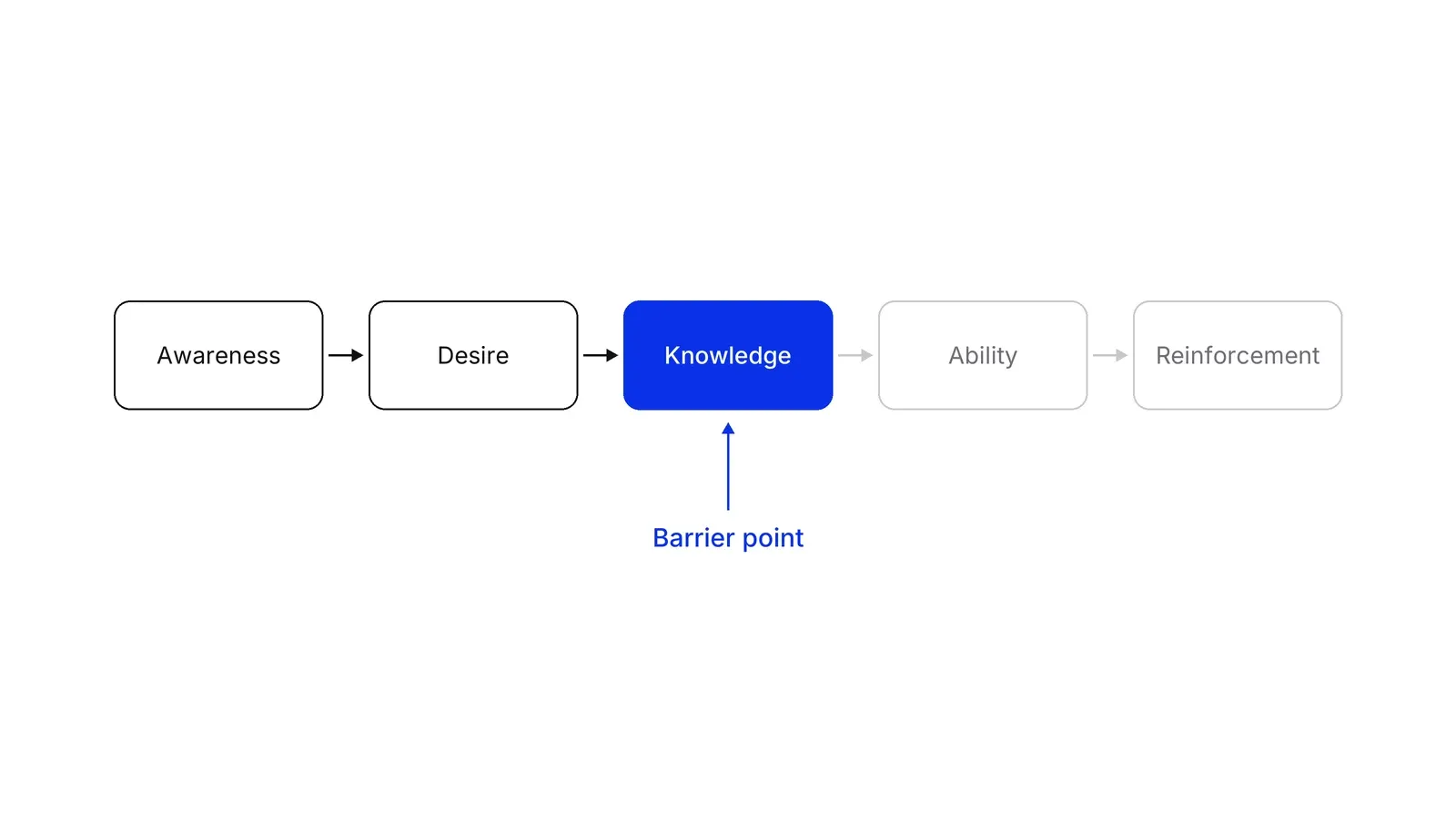
The same Prosci page says the elements are sequential but not always linear: a person can slip back to an earlier one. When many people share a barrier point, one group-level action can serve them all.
How does ADKAR relate to Lewin and Kotter?
ADKAR answers a different question from Lewin’s and Kotter’s models. They describe what an organization or its leaders do. ADKAR describes what one person goes through. Prosci’s own comparison pages are vendor positioning, since Prosci sells training built on its own models.
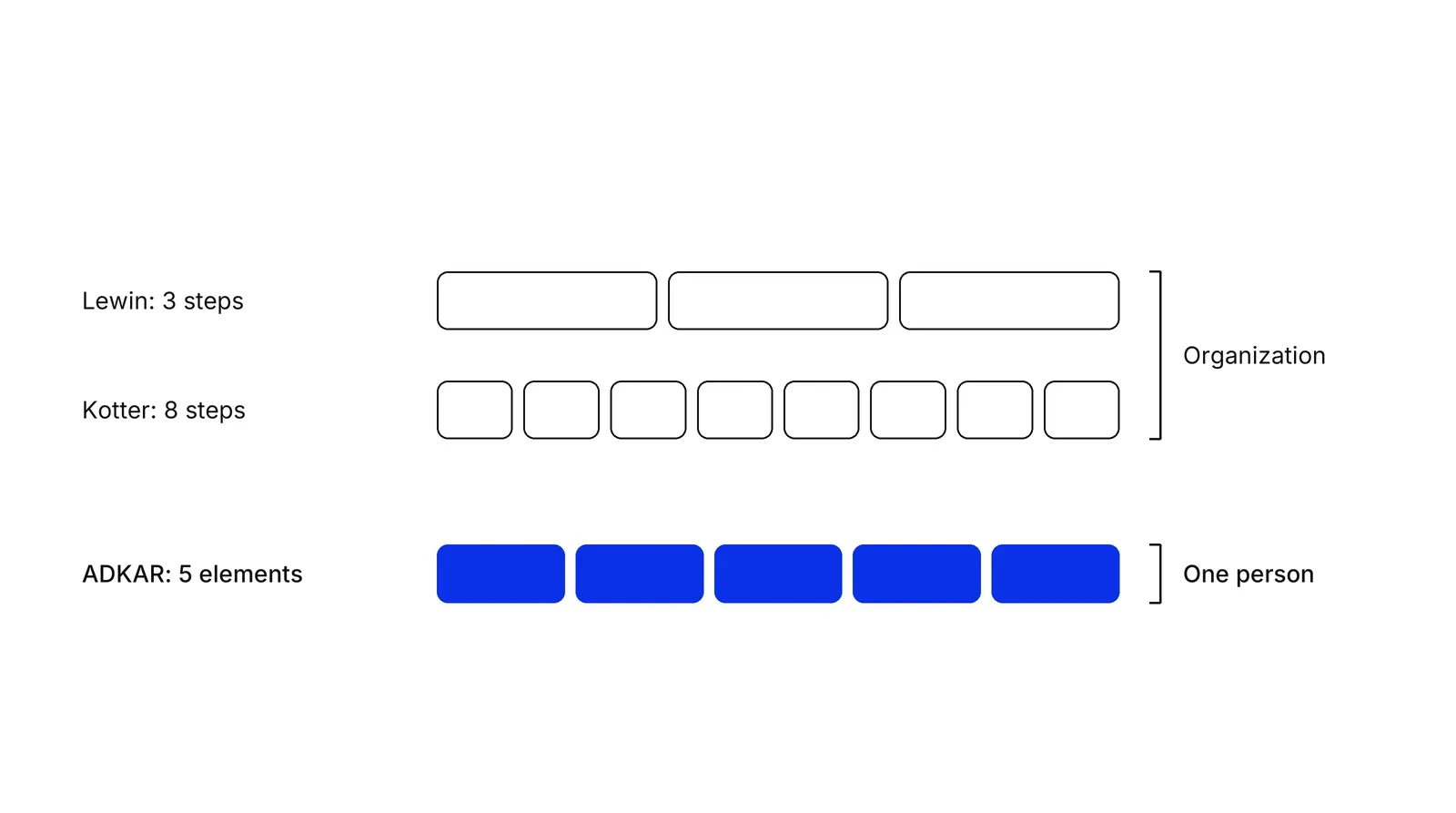
| Lewin | Kotter | ADKAR | |
|---|---|---|---|
| Unit | Group or organization | Organization, led from the top | One person |
| Shape | Unfreeze, change, refreeze | Eight steps, from urgency to institutionalizing | Five elements, in order |
| Source | 1947 article | 1995 HBR article and a book | Hiatt’s 2006 book |
The textbook version of Lewin is itself disputed. Cummings, Bridgman and Brown argue in Human Relations that Lewin never developed the three-step model and that it took form after his death. Burnes defends Lewin’s planned approach as still relevant, and a 2018 review of 13 planned-change models traces links from each back to the three steps. Seen that way, ADKAR’s order, from understanding to doing to sustaining, echoes the same unfreeze, move, hold pattern at the level of one person. That reading is ours, not Prosci’s.
Prosci says Kotter’s process focuses on a leader’s perspective and overlooks personal transitions. The practical use is to pair them: an organization-level plan for the sequence of the change, and ADKAR for the people it lands on. For the organization-level design, see operating model design.
What does the evidence say?
The evidence is thin and partly commercial. Prosci’s own benchmarking says that of participants with excellent change management, 88% met or exceeded objectives, against 13% with poor change management, from a survey of more than 2,600 practitioners. This is vendor data, and the page we read does not define “excellent”, so we treat it as an association reported by people who rated their own programs.
Independent studies exist, but most use ADKAR as a questionnaire rather than testing it.
| Study | Design | What it shows |
|---|---|---|
| Khachian et al., 2018 | 320 nurses in Tehran, cross-sectional | ADKAR scores used to measure readiness for a Kardex change |
| Goyal and Patwardhan, 2018 | Bank staff, correlation and t-tests | No difference between men and women on ADKAR scores |
| da Veiga, 2018 | Security-culture survey before and after | Acceptance of change improved significantly, combined with other tools |
| Jaaron et al., 2022 | Literature review and 8 interviews | A conceptual model for adopting building-information software |
| Mudjisusatyo et al., 2024 | 65 university program heads | All five elements correlated with a competency profile |
| Arbaein et al., 2024 | 76 clinic managers, Prosci questionnaire | Internal consistency reported; no outcome tested |
These are surveys and case studies. We found no study that tests whether the order of the elements holds, or whether fixing the barrier point raises adoption compared with a control group. The model is a reasonable diagnostic, but it is not proven to predict outcomes.
Do most change programs fail?
There is no reliable evidence that most do, and the number behind the belief is worth knowing. Beer and Nohria wrote in HBR in 2000 that about 70% of all change initiatives fail. In 2011 Mark Hughes reviewed five published instances of the 70 per cent claim in the Journal of Change Management and found no valid and reliable empirical evidence for any of them. He argued the idea of an inherent failure rate is questionable, given how change is defined and measured. In 2022 he wrote that the flawed assumption still stands unchallenged. Do not use a failure rate to justify an ADKAR program.
How do you make it stick?
Reinforcement is the element most teams skip. After launch, a PDCA check shows whether people still follow the new way, a kaizen routine lets them fix what annoys them, and an after-action review captures what the first weeks taught. When you decide how much help each person needs, situational leadership gives a way to match support to ability on the task. A Growth Lab plan, described on the practices page, can start from the same question: which element is stuck for the people who have to change.
How to apply ADKAR model, step by step
- Define the change in one sentence. Write what will be different and for whom: 'From 1 March, all merchant onboarding runs in the new case tool.' ADKAR works on one change at a time. Result: a sentence every person can be asked about.
- Score each person or group on five elements. Ask five questions on a 1 to 5 scale: do I understand why, do I want to, do I know how, can I do it, will it last. Use a short survey or a conversation. Result: five scores per person, or per group if you average them.
- Find the barrier point. Read the scores in order and stop at the first element at 3 or below. That is the barrier point, by Prosci's definition. Ignore later low scores for now. Result: one named element per person or group.
- Choose an action for that element only. Awareness needs a clearer reason, Desire needs a real answer to 'what is in it for me', Knowledge needs training, Ability needs practice with support, Reinforcement needs follow-up. Result: one action, one owner, one date.
- Re-score and move on. After two to four weeks, ask the same questions again. If the barrier moved to a later element, switch the action. If it did not move, change the action, not the question. Result: a score trend that shows where people are stuck.
Examples
A clinic moving to a new booking system
Illustrative, no real clinic implied. One receptionist scores 5, 5, 2, 3, 2 on the five elements: she understands the change and want it, but she does not know the steps. The barrier point is Knowledge, so a long email about benefits would miss it. A one-hour practice session on real appointments fits.
A payments team switching reconciliation tools
Illustrative. Analysts attend training and pass the test, so Knowledge scores 4. Two weeks later they still export to spreadsheets: Ability scores 2. The barrier point is Ability, and the fix is a shadowing week and a named person to ask. After that, Reinforcement means removing the old export from the monthly checklist.
A sales team and a new CRM field rule
Illustrative. Managers announce that every deal needs a loss reason. Reps score low on Desire because nobody reads the field. The barrier point is Desire, so a training day would be wasted. The fix is to show one report that uses the field and changes a pipeline decision.
When to use it
Use it when a change depends on many individuals changing what they do, such as a new tool, process or role, and you need to know why adoption is slow. It gives a manager one question per person and a clear order for the answers. It works well alongside a plan for the organization, because it covers the part those plans leave open.
When not to use it
Do not use it as a full change plan, because Prosci itself calls ADKAR a model for individual change, not a complete methodology. It also does not decide whether the change is a good idea, handle structure, or cover change that people have no say in. Do not quote its success statistics as independent research.
Common mistakes
- Treating ADKAR as a checklist for the project plan instead of a diagnosis for each person, so everyone gets the same communication.
- Fixing Knowledge with more training when the barrier is earlier, at Awareness or Desire.
- Scoring only once, then assuming the barrier stays the same, when people can move back to an earlier element.
- Quoting Prosci's benchmarking figures as proof that the model works.
- Skipping Reinforcement, so the old process quietly returns after the project team leaves.
FAQ
What does ADKAR stand for?
ADKAR stands for Awareness, Desire, Knowledge, Ability and Reinforcement. Prosci defines them as understanding why the change is needed, choosing to support it, knowing how to change, putting new skills into practice, and sustaining the new way. The model is for individual change, and the elements build in that order.
What is a barrier point in ADKAR?
A barrier point is the first ADKAR element a person scores 3 or below on a 1 to 5 scale, according to Prosci. You address that element before the later ones. Training someone on a new tool is wasted effort if they do not yet see why it is needed.
Who created the ADKAR model?
Jeff Hiatt, the founder of Prosci. Prosci says he developed the model in the 1990s, and its first book on ADKAR followed about a decade of research. The Prosci pages we read describe no research method behind it, so the model rests on the vendor's account.
Is it true that 70% of change programs fail?
No reliable evidence supports it. Mark Hughes reviewed five published statements of a 70 per cent failure rate in the Journal of Change Management in 2011 and found no valid and reliable empirical evidence behind any of them. The figure persists because it is repeated, not because it was measured.
How is ADKAR different from Kotter's 8 steps?
Kotter's 8 steps describe what leaders do to run a change across an organization, from urgency to anchoring it. ADKAR describes what one person needs to go through. Prosci presents ADKAR as the individual part of its larger methodology. The two answer different questions and can be used together.
Sources
- Prosci, ADKAR Model (vendor material)
- Prosci, ADKAR: Core to the People Side of Change (vendor material)
- Prosci, Individual Barriers to Change and What to Do About Them (vendor material)
- Prosci, ADKAR Assessments help page (vendor material)
- Prosci, The Correlation Between Change Management and Project Success (vendor data)
- Prosci, Change Management Models (vendor material)
- Prosci, ADKAR vs Kotter (vendor material)
- Prosci, About Prosci (vendor material)
- Mark Hughes, Do 70 per cent of all organizational change initiatives really fail?, Journal of Change Management 11(4), 2011
- Mark Hughes, Reflections: How Studying Organizational Change Lost Its Way, Journal of Change Management 22(1), 2022
- Michael Beer and Nitin Nohria, Cracking the Code of Change, Harvard Business Review, May-June 2000
- John P. Kotter, Leading Change: Why Transformation Efforts Fail, Harvard Business Review, March-April 1995
- Kotter Inc., The 8 Steps for Leading Change (vendor material)
- Kurt Lewin, Frontiers in Group Dynamics, Human Relations 1(1), 1947
- Cummings, Bridgman, Brown, Unfreezing change as three steps: Rethinking Kurt Lewin's legacy for change management, Human Relations 69(1), 2016
- Bernard Burnes, Kurt Lewin and the Planned Approach to Change: A Re-appraisal, Journal of Management Studies 41(6), 2004
- Rosenbaum, More, Steane, Planned organisational change management: forward to the past, Journal of Organizational Change Management 31(2), 2018
- Khachian, Elyasi, Haghani, ADKAR Model and Nurses' Readiness for Change, Journal of Client-centered Nursing Care 4(4), 2018
- Goyal, Patwardhan, Role of change management using ADKAR model: a study of the gender perspective in a leading bank organisation of India, International Journal of Human Resources Development and Management 18(3/4), 2018
- Jaaron, Hijazi, Musleh, A conceptual model for adoption of BIM in construction projects: ADKAR as an integrative model of change management, Technology Analysis and Strategic Management 34(6), 2022
- Adele da Veiga, An approach to information security culture change combining ADKAR and the ISCA questionnaire, Information and Computer Security 26(5), 2018
- Mudjisusatyo, Darwin, Kisno, Change management in Independent Campus program: application of the ADKAR model as a change management competency constructor, Cogent Education 11(1), 2024
- Arbaein et al., The assessment of readiness to change among head managers of primary healthcare centers in Makkah, Journal of Taibah University Medical Sciences 19(2), 2024
Last updated Oct 9, 2026


Fractional COO or embedded operations team? How to choose at Series A
The two models solve different problems: how to tell which one your company needs, and what each costs in time and control.

What operational systems successful fintech startups use: lessons from ten companies
Starling, Monzo, Qonto, bunq, Lunar, Pleo, Tide, Ramp, Mercury and Column scaled on four operating systems. Regulators' findings show what breaks when one of them lags behind growth.

What a revenue operations manager actually owns
Pipeline definitions, CRM hygiene, forecasting and the handoffs between marketing, sales and success. What the role covers, and how it differs from sales ops.