Revenue operations (RevOps)
Revenue operations is an operating model that joins the operations work of marketing, sales and customer success under one plan, one set of definitions and one data set, so the company manages the whole path from first touch to renewal as one process.
Revenue operations (RevOps) is an operating model that joins the operations work of marketing, sales and customer success under one plan, one set of definitions and one data set. The company then manages the path from first touch to renewal as a single process. It can run as a loose coalition, a virtual alignment or one centralized team.
- Origin
- Practitioner-led; formalized as a charter by SiriusDecisions (now part of Forrester); no single inventor documented, 2019 (charter)
- Level
- 301 · Advanced
- Fits
- Scale-up
- Time to apply
- 2 to 3 weeks for a first alignment pass, then a quarterly review
- What you need
- the heads of marketing, sales and customer success, plus whoever runs your CRM · read access to the CRM and the reports each team uses today · one executive who can settle disputes between the teams
Revenue operations (RevOps) is an operating model that puts the operations work of marketing, sales and customer success under one plan, one set of definitions and one data set. Forrester’s 2019 charter calls it an operating model that integrates the operational work of those three functions. Boston Consulting Group (BCG) describes the same idea as centralizing their operations teams. The point is simple. A customer passes from marketing to sales to customer success, and each team tracks that customer in its own system with its own rules. RevOps gives the whole path one owner.
Where does revenue operations come from?
Nobody owns the term. No source we could open credits an inventor, and the earliest formal framework we could verify is the Revenue Operations Charter that SiriusDecisions, a B2B research firm now part of Forrester, previewed in April 2019 and presented at its Summit that year. BCG published its own account in May 2020, written for B2B technology companies adapting to virtual selling.
The roots are older. Philip Kotler, Neil Rackham and Suj Krishnaswamy wrote in Harvard Business Review in 2006 that sales and marketing undervalue each other’s contributions and should work as partners. RevOps adds a third group, customer success, and gives the partnership a team and a shared set of rules.
What does it line up?
The SiriusDecisions charter names seven elements to align, called the Sirius7: vision, goals, planning, processes, infrastructure, data and measurement. In practice most of the work sits in three of them.
Definitions come first. If marketing’s qualified lead is not sales’ qualified lead, the handoff is a dispute, so the MQL and SQL rules and the exit criteria of your sales process stages have to be written once and used by everyone. Data comes second: one record per customer, with a named owner for each field. A customer data platform can match a person across systems, and RevOps decides which record wins when systems disagree. Measurement comes third: one forecast and one set of metrics instead of three.
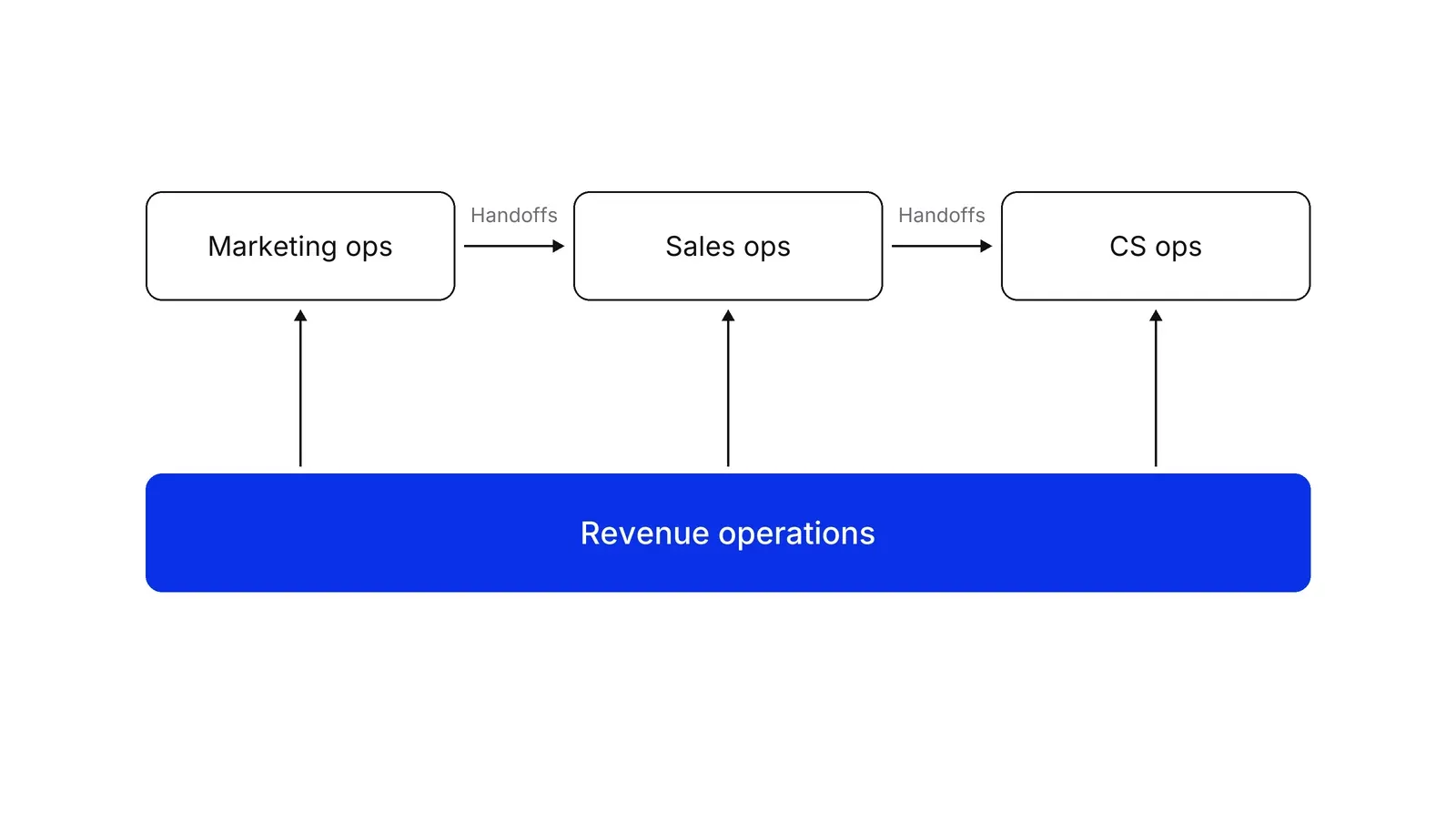
The handoffs matter because that is where leads are lost. A study of 461 sales reps in four firms, by Sabnis and colleagues, started from the observation that reps leave about 70% of marketing-generated leads unpursued, and found that follow-up depends on how leads are prequalified and how managers track them. Both are processes a RevOps team can own.
How is it different from sales operations?
Sales operations supports the sales team. RevOps spans the revenue path. The Revenue Operations Alliance puts the split this way: sales operations serves one team and focuses on closing, while RevOps covers the full lifecycle and focuses on growth and retention. Definitions of scope vary. Salesforce extends it to finance and to the path from product development to cash collection, while Forrester’s charter keeps to the three operations teams.
| Sales operations | Marketing operations | Sales enablement | Revenue operations | |
|---|---|---|---|---|
| Serves | The sales team | The marketing team | Sellers and managers | Marketing, sales and customer success |
| Typical work | Territories, quota, CRM, reports | Campaign systems, lead routing, reports | Onboarding, training, content | Shared definitions, data, plan and forecast |
| Sees | Pipeline and bookings | Leads and campaigns | Rep readiness | The whole path through renewal |
Sales enablement stays its own job. RevOps sets the shared rules that enablement trains people to follow. Forrester also names the expansion side: its 2021 revenue waterfall adds renewal, cross-sell and upsell to the demand plan, which is where net revenue retention is decided.
Three ways to organize it
Forrester’s Megan Heuer described models that range from loose coalitions to virtually aligned teams to centralized functions. The three labels are Forrester’s, and the descriptions that follow are ours. In a coalition, the three teams keep their own leaders and meet on shared problems. In virtual alignment, they share a charter, a plan and metrics, still under separate bosses. In a centralized model, one leader runs all three operations teams.
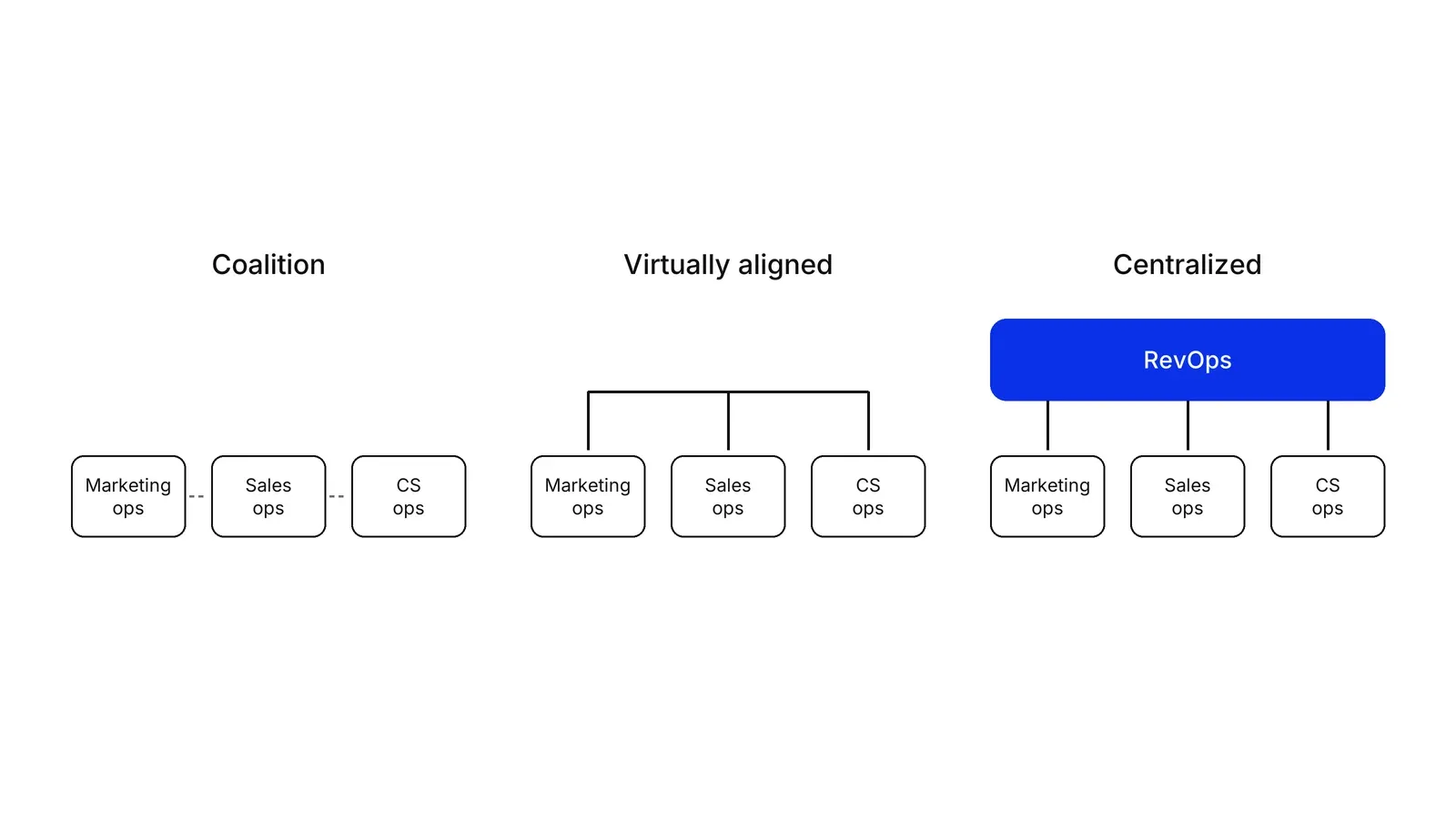
BCG’s advice is to choose by trust. Where trust between teams is high and alignment is low, centralize reporting lines first. Where trust is low, start with partial centralization or virtual alignment. Large companies can use a hub and spoke: a central team sets standards and tools, and regional teams adapt them. BCG also lists the objections honestly: the change can look too large for its benefit, centralized staff can drift from the front line, and a company without a chief revenue officer may have no clear reporting line for the function.
What does the evidence show?
The evidence for the model is thinner than the vendor literature suggests.
Surveys describe the problem and how widespread the function is. A Forrester Consulting survey for Clari in 2021, of 327 US software revenue operations decision-makers, found 55% missing their quarterly forecast by more than 10% on average, and only 18% within 5%. A Wakefield Research survey for Salesloft in 2025, of 400 US decision-makers, found 73% with a C-suite role dedicated to RevOps, yet 89% saying the function lacks clearly defined strategic goals. Both surveys were paid for by software vendors.
Claims about results are weaker. BCG reports gains in marketing return, sales productivity and lead acceptance at top B2B technology companies, but its article names no companies and discloses no sample, so we do not repeat the figures. SiriusDecisions’ growth claims for aligned companies also come without a published sample.
Academic work supports the mechanism more than the org chart. Le Meunier-FitzHugh and Piercy found a positive link between sales and marketing collaboration and performance in three case studies of large UK firms, and argued for collaboration rather than full integration. Rouziès and colleagues noted that integration has costs and drawbacks and matters more in some conditions than others.
Treat RevOps as a way to remove known leaks, not a guaranteed lift. Measure the leaks before you reorganize: forecast error, leads not followed up, and the days between signature and first use.
If you want to set up the shared stages, owners and metrics described above, the Marketing-Operational System practice is the place to start.
How to apply Revenue operations (RevOps), step by step
- Map the revenue path and its handoffs. Draw one line from first touch to renewal. Mark who owns each stage and every point where a record passes from one team to another. Result: a one-page map of handoffs, with the ones that lose or delay deals marked.
- Write shared definitions. Agree in writing what counts as a qualified lead, an opportunity, a won deal, a churned account and a renewal. Use the exit rules from your sales stages. Result: one glossary that marketing, sales and customer success all sign.
- Pick one record of truth. Choose the system that holds the customer record, name the fields each team must fill and the one person who may change a definition. Result: a field list and an owner for the data.
- Choose a degree of centralization. Pick coalition, virtual alignment or a central team. BCG suggests centralizing reporting lines first when trust between teams is high and alignment is low, and starting smaller when trust is low. Result: a decision with a named owner.
- Set one plan and one forecast. Run a single planning cycle and one forecast review that all three functions attend, using the shared metrics. Track forecast error each month. Result: one forecast number and a running error figure.
- Fix the process, then the tools. Review the software stack only after the definitions and handoffs work, so you are not automating a broken process. Result: a short list of tools to keep, merge or drop.
Examples
A B2B software company with three ops people
Illustrative. Marketing counts a lead as qualified when a form is filled. Sales counts it only after a discovery call. Customer success has no view of what was promised in the sale. Of 400 leads a month marketing reports as qualified, sales accepts 120. The RevOps lead writes one definition with exit rules, adds a field for promises made in the sale, and puts all three teams in one weekly pipeline review. The argument moves from whose number is right to what the rule should be.
A cross-border payments company
Illustrative. Sales signs a merchant, compliance onboards it and account management owns activity. Nobody owns the gap between signature and the first live payment, where deals stall. A RevOps owner adds a shared stage called first live payment, with an owner and a target number of days, and reports it to all three teams. The leak becomes visible because one stage now has one definition and one owner.
A clinic group with a call centre
Illustrative. Marketing counts enquiries, the call centre counts bookings and the clinics count attended first visits. Each team reports success on its own number. A RevOps layer makes the attended first visit the shared stage and tracks the share of enquiries that reach it, so a booking that never turns up counts against every team that touched it.
When to use it
Use it when a company has separate marketing, sales and customer success teams, each with its own tools and reports, and revenue leaks at the handoffs: leads nobody follows up, deals that stall after signature, forecasts that miss. It fits growing B2B and subscription businesses with more than one team touching the customer.
When not to use it
Skip a full RevOps function when one person still runs sales, marketing and support. A shared glossary and one pipeline review are enough. Do not use it as a way to fold marketing operations into sales operations. Forrester's Megan Heuer lists that, along with shrinking the CMO's remit, as the wrong way to deploy it.
Common mistakes
- Buying software first. Forrester analyst Anthony McPartlin wrote that RevOps is an operating model, not a technology category, and BCG advises improving processes and tools along with the org chart.
- Moving everything under sales operations. It turns RevOps into a bigger sales support team and loses marketing and customer success, the groups it is meant to join.
- Appointing no owner. BCG lists a cross-functional leader among its six success factors, and a missing reporting line among the barriers.
- Defining the job as reporting. Salesloft's 2025 survey found 89% of 400 US respondents saying RevOps lacks clearly defined strategic goals.
- Skipping the shared definitions. Without one meaning for a qualified lead or a churned account, a central team only produces more dashboards that disagree.
FAQ
What is revenue operations?
Revenue operations is an operating model that puts marketing operations, sales operations and customer success operations under shared planning, processes, systems, data and measurement. Forrester describes it as an operating model that integrates their operational work. Salesforce draws the scope wider, to finance and the whole path from product development to cash collection.
What is the difference between RevOps and sales operations?
Sales operations supports the sales team: territories, quota, CRM and reporting. RevOps covers the full revenue path across marketing, sales and customer success, and in some definitions finance. The Revenue Operations Alliance puts it as sales ops serving one team while RevOps focuses on growth and retention across all of them.
Who invented revenue operations?
No source we could open credits one inventor. The earliest formal framework we could verify is the Revenue Operations Charter that SiriusDecisions, now part of Forrester, presented at its 2019 Summit. Boston Consulting Group published its own account in May 2020. Treat any single-person origin story as unverified.
Does revenue operations improve revenue?
The evidence is mixed in quality. BCG reports gains from top B2B tech companies but publishes no sample. Vendor-commissioned surveys describe the problem and the function's spread. Academic work, such as the Le Meunier-FitzHugh and Piercy study, links sales and marketing collaboration to better performance in three case studies, not a controlled test.
Where should the RevOps team report?
BCG notes that a company with no chief revenue officer may lack a clear reporting line, and treats that as a barrier. Whatever the line, the leader needs authority across marketing, sales and customer success, which is the cross-functional mandate BCG asks for.
Sources
- Boston Consulting Group, Revving Up Go-to-Market Operations in B2B, Fabbri, Mustaghni, Nekrasova, Matuszczyk and Ward, 13 May 2020
- Boston Consulting Group, AI Was Made for RevOps: From Prediction to Execution, September 2025
- Forrester, Change Is Coming: The Revenue Operations Charter Is Born, Kate Pierpont, 17 April 2019
- Forrester, Introducing the Sirius7: Seven Elements to Align in Your Revenue Engine, 18 June 2019
- Forrester, Revenue Operations and the CMO: Game Changer or Game Over?, Megan Heuer, 13 June 2019
- Forrester, Dare to Disrupt Yourself: The Revenue Operations Function Takes Off at Summit 2019, Kate Pierpont, 7 May 2019
- Forrester, Three Tips for Running a High-Performance B2B Revenue Engine, Julian Archer, 11 June 2019
- Forrester, Revenue Operations And Intelligence Is Now Core To A Go-To-Market Tech Stack, Anthony McPartlin, 20 October 2021
- Forrester, Why Revenue Operations (RevOps) Should Be On Your Radar, Jerry Zhao, 20 August 2024
- Forrester, The Revenue Process Alignment Series Part 1: The End Of MQLs, Terry Flaherty, 14 April 2022
- Forrester, Saying Goodbye To MQLs, Simon Daniels, 21 November 2023
- Forrester, Forrester debuts next-generation B2B revenue waterfall, press release, 4 May 2021
- Forrester Consulting for Clari, Revenue Operations And Intelligence Delivers Predictable Growth, August 2021, survey of 327 US software revenue operations decision-makers
- Wakefield Research for Salesloft, The Rise of RevOps to the C-Suite, July 2025, 400 US decision-makers
- Salesforce, What Is Revenue Operations (RevOps)? A Complete Guide
- Revenue Operations Alliance, What is revenue operations (RevOps)?
- Philip Kotler, Neil Rackham, Suj Krishnaswamy, Ending the War Between Sales and Marketing, Harvard Business Review, July-August 2006
- Ken Le Meunier-FitzHugh, Nigel F. Piercy, Exploring collaboration between sales and marketing, European Journal of Marketing 41(7/8), 2007, Warwick repository
- Dominique Rouziès, Erin Anderson, Ajay K. Kohli and colleagues, Sales and Marketing Integration: A Proposed Framework, Journal of Personal Selling and Sales Management 25(2), 2005
- Gaurav Sabnis, Sharmila Chatterjee, Rajdeep Grewal, Gary Lilien, The Sales Lead Black Hole, Journal of Marketing 77(1), 2013 (working paper, July 2012)
- Forrester, The State of Business Buying, 2026, press release, 21 January 2026
Last updated Oct 9, 2026


Marketing agency or growth system: when a company outgrows its agency
An agency is the right call while the founder still runs most of the company. Once the business starts copying itself into new locations or markets, it needs a system that sets goals, tests hypotheses and owns the result.

Why healthcare marketing agencies stall: the short, mid and long wins model we use with clinics
Most agencies own the click and nobody owns the front desk. How we structure clinic work in three horizons, the research behind each one, and one year of results.

The compliance layer under fintech marketing operations
A fintech marketing agency can build campaigns. It cannot own the compliance review, the KYC drop-off or the multi-market licensing rules that decide whether a lead ever becomes a customer.