Competency model
A competency model is a short list of the knowledge, skills and behaviours a role needs, each described at set proficiency levels, so a team can hire, train and promote against the same standard.
A competency model is a set of competencies, each a bundle of knowledge, skills, abilities and other traits that produce effective work, written as observable behaviour at defined proficiency levels. Managers use it to hire, develop and promote against one standard. Applied to a marketing team, it becomes a skills matrix that compares each person with the level the role needs.
- Origin
- David C. McClelland (1973); Richard Boyatzis (1982); Lyle and Signe Spencer (1993), 1973 to 1993
- Level
- 201 · Tool
- Fits
- Small and mid-size, Scale-up, Enterprise
- Time to apply
- 2 to 3 weeks for a first model of one team; the matrix itself takes an afternoon
- What you need
- a list of the roles on the team and one person who knows each role well · a sample of recent strong and average performers you can compare, with evidence of their work · a decision the model will feed: a hire, a promotion round or a training budget
A competency model is a set of competencies that together describe what effective work looks like in a job. Campion and colleagues define it in a 2011 Personnel Psychology paper as a collection of knowledge, skills, abilities and other characteristics that a job needs, and add that it is more than a list: it usually separates top performers from average ones, shows how each competency grows with level, and links to business goals. The idea is simple. Deciding what goes into it is the hard part, and so is proving it works.
Where did the competency model come from?
It starts with a 1973 paper by Harvard psychologist David McClelland in American Psychologist. He argued that the evidence for the validity of intelligence and aptitude tests was weaker than most people assumed, because they mostly predicted school grades. His alternative was criterion sampling: to pick a good police officer, find out what an officer does and test a sample of that work.
Two books turned the idea into a method. Richard Boyatzis studied managers and published The Competent Manager in 1982; the publisher describes the study as 2,000 managers in 41 jobs across 12 organizations. Lyle and Signe Spencer then wrote Competence at Work in 1993, drawing on 650 jobs and 20 years of McClelland and McBer research.
The word also means something else. In a 1990 Harvard Business Review article, Prahalad and Hamel used “core competence” for the collective capabilities of a whole company. This page is about people and roles, not corporate strategy.
What does a competency look like?
A competency has a label, a definition in behavioural terms, and a description of each proficiency level. Campion and colleagues note that ordinary job analysis often stops at a label and a short definition. They suggest five levels with levels 1, 3 and 5 described, and a full competency taking half a page to a page.
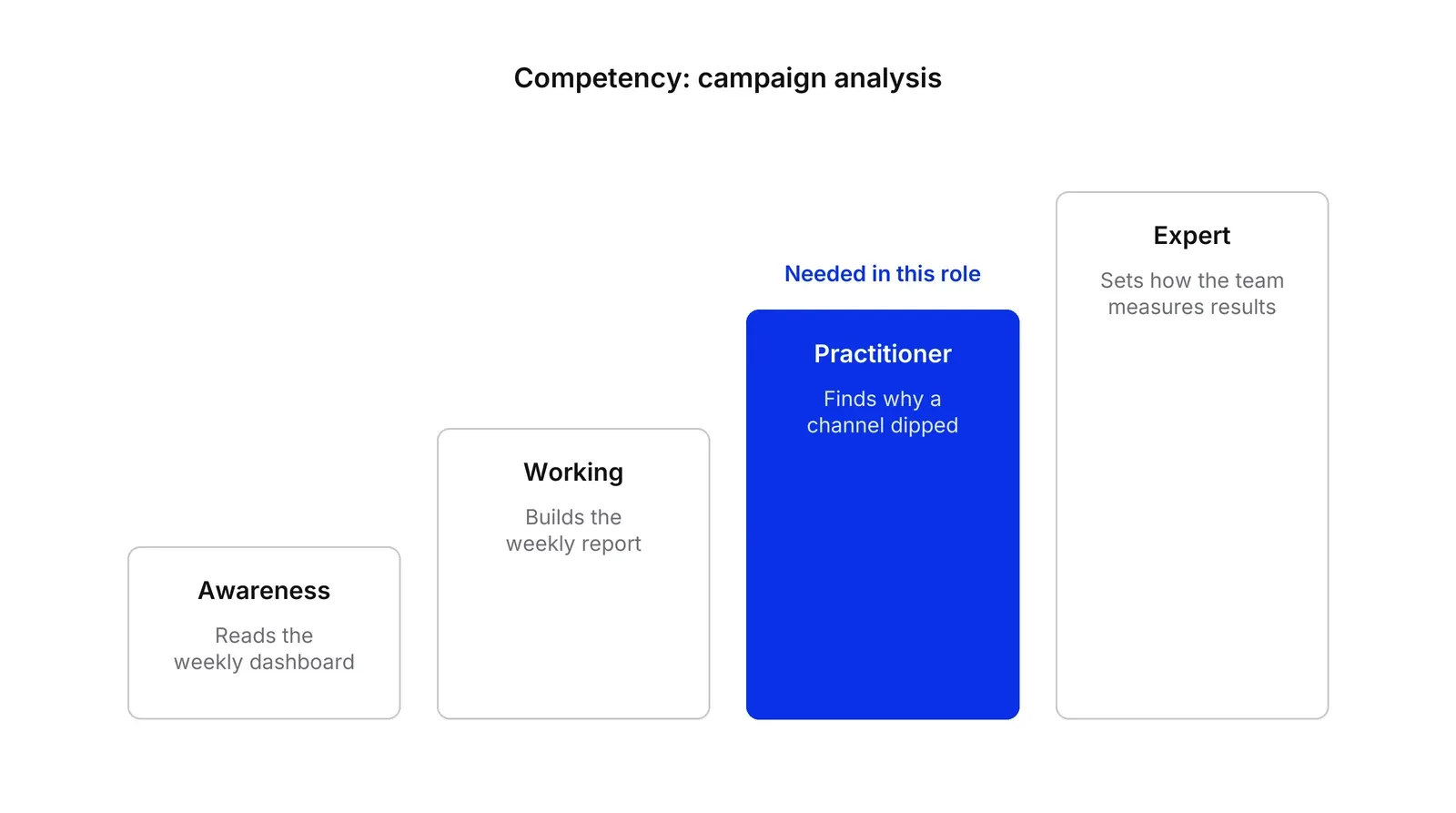
The level names are your choice. The UK government’s capability framework uses awareness, working, practitioner and expert, and each role profile lists the level required for each skill. The Chartered Institute of Marketing’s framework uses aware, knowledgeable, capable, skilled and expert. Both echo the five stages of skill that Stuart Dreyfus summarized in 2004: novice, advanced beginner, competent, proficient and expert.
Competency model, job analysis or skills matrix?
They answer different questions and are often mixed up.
| Tool | Question it answers | Typical shape |
|---|---|---|
| Job analysis | What does this job consist of today? | Tasks and required traits, built bottom up from people doing the work |
| Competency model | What does strong performance in this role need? | About a dozen competencies with levels, often built top down and tied to strategy |
| Skills matrix | Who on the team can do what, and where are the gaps? | A grid of people against competencies, rated at levels |
Campion and colleagues describe competency models as more future-facing and more tied to business goals than job analysis, which is traditionally inductive and built from tasks. Sanchez and Levine’s 2009 paper takes up the question of how far the two should differ.
Where can you borrow content?
Start from a public library and trim it. Four are worth knowing.
- The SHRM Body of Applied Skills and Knowledge describes HR work: nine behavioural competencies and one technical one, built from research that began in 2011 with thousands of HR professionals.
- O*NET, the US occupational database, rates skills, knowledge, abilities and work styles for each occupation. Its help pages explain that each skill gets an importance score from 1 to 5 and a level score from 0 to 7, with example tasks anchoring the levels.
- The CIM framework covers marketing, with eight content areas including data and insights, digital agility and brand and reputation.
- The UK framework shows how to attach levels to roles.
O*NET’s marketing manager page puts active listening, critical thinking and persuasion near the top of its lists. Its market research analyst page lists intellectual curiosity and attention to detail. These are general traits. Channel skills such as paid media or lifecycle email have to come from your own roles.
Applying it to a marketing team: the skills matrix
A skills matrix is the working form of a competency model: people down the side, competencies across the top, each cell a level. The model tells you what to measure, and the matrix shows where the team stands.
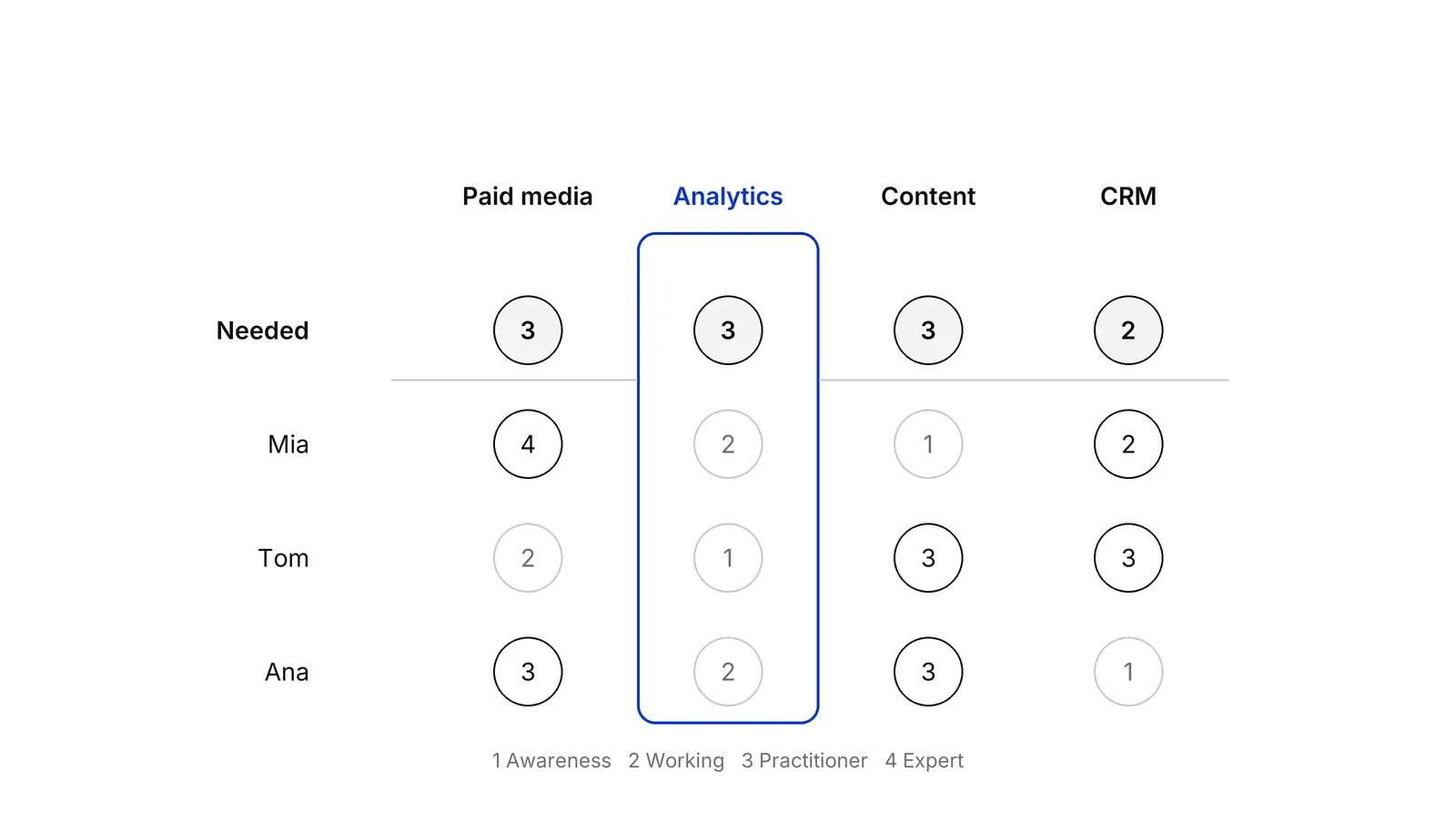
Read it in two directions. A row shows one person’s development needs. A column shows whether the team can deliver a skill at all. Here Mia has the top level in paid media but is weak in content, and the analytics column is the real finding: nobody reaches the needed level 3. Use the same levels for every competency so the grid stays readable.
Check the ratings. David Dunning’s research on self-assessment, covered by the Association for Psychological Science, cites a study in which surgical residents’ self-ratings showed virtually no correlation with test performance, while peer and supervisor ratings correlated strongly. Ask for evidence: a campaign, a report, a decision.
You can also derive competencies from performance data, as Google did in the study David Garvin described in HBR. Google compared its higher- and lower-rated managers using surveys, exit data and interviews, and found that higher-rated managers had lower turnover on their teams. The method fits any team: study what your strong people do differently, then write it down.
Does it work? What critics say
McClelland’s own argument was criticised early. Barrett and Depinet’s 1991 reconsideration found only limited support for his claims. They noted that he never defined “competency” and that a 1986 study by McClelland’s colleagues on senior managers covered no more than 27 people. They also quoted Boyatzis as saying his own validation studies did not give enough information to build a selection system without validation inside the organization.
Practice raised a second concern. The SIOP task force of 2000 compared competency modeling with job analysis and rated how rigorous each was. A SHRM-SIOP white paper later noted that poor documentation was a key reason competency models were seen as less rigorous. Campion and colleagues are candid that their 20 best practices come from experience, not controlled research.
On hiring, revised numbers favour resemblance to the job. Sackett and colleagues’ 2022 meta-analysis, as summarized by SIOP, put structured interviews first at .42, with job knowledge tests at .40 and work samples at .33, ahead of cognitive ability at .31. So the advice is to keep the model short, write levels as behaviours, record how you built it, and test whether people it rates highly perform better. A Growth Lab plan starts from the same step, by naming the skills each growth role needs.
To see where a competency model fits in team design, read growth team structure and the RACI matrix.
How to apply Competency model, step by step
- Pick one team and one decision. Choose a single team, such as marketing, and the decision the model must support: a hire, a promotion round, a training budget. A model built for everything gets used for nothing. Result: one sentence naming the team and the decision.
- Find what separates strong work from average work. List the roles. For each, collect examples of recent work from your best and from your typical people, then ask what the strong ones did differently. Interview people who do the job, not only their managers. Result: a raw list of behaviours tied to real examples.
- Group behaviours into about a dozen competencies. Cluster the behaviours under short labels such as paid media, analytics or writing for a regulated audience. Campion and colleagues suggest staying near 12 competencies in total. Result: 10 to 14 competencies, each with a one-line definition.
- Write four or five levels in observable terms. For each competency, describe what someone does at each level so two managers would rate the same person the same way. Describe the levels used by the roles you have, not an ideal ladder. Result: a half-page description per competency.
- Set the level each role needs. For every role, mark the level required for each competency. A junior may need level 2 in analytics, a channel lead level 3. Result: a role-by-competency target grid.
- Rate people against the grid and check the ratings. Have each person and their manager rate separately, then compare and settle differences with evidence. Result: a skills matrix with the gaps for each person and for the team as a whole.
- Turn gaps into actions and revisit. Pick the biggest team gap, decide whether to train, hire or reassign, and name an owner. Review the model every year or when the strategy changes. Result: a short development plan and a review date.
Examples
A four-person marketing team in a B2B payments company
Illustrative. The team needs paid media, analytics, content and CRM. The head of marketing sets the needed level at 3 for the first three and 2 for CRM, then rates Mia, Tom and Ana. Nobody reaches level 3 in analytics. Tom is the only person below level 3 in paid media, while Mia is weak in content. The matrix shows the real problem: one team-wide gap in analytics, not three personal ones. The fix is a hire or a course for the whole team, not a feedback conversation with each person.
A clinic marketing lead writing a competency for compliant advertising
Illustrative. Level 1: knows which claims the clinic's regulator restricts. Level 2: checks every ad against that list before publishing. Level 3: rewrites a weak ad so it keeps its appeal and stays within the rules. Level 4: trains the team and signs off the clinic's advertising policy. Writing the levels as actions makes it clear who can approve ads alone and who needs a reviewer.
When to use it
Use it when a team of about 8 people or more has several roles, you hire or promote often, and managers disagree about what good looks like. It also helps when strategy shifts, for example from outbound to lifecycle, and you need to know whether the team has the skills for the new plan.
When not to use it
Skip it for a team of two or three where everyone knows everyone's strengths, or when you only need to fill one vacancy; a hiring scorecard is lighter. Do not rely on an undocumented model for hiring, pay or dismissal decisions; the SHRM-SIOP white paper explains why documentation matters if a decision is challenged.
Common mistakes
- Copying a library of 40 generic competencies. Models people can remember hold about 12. Cut every item that does not separate strong from average performers.
- Writing levels as adjectives. 'Strong analytical thinking' cannot be rated. 'Explains why a channel dipped using two data sources' can.
- Letting people rate themselves with no check. Research on self-assessment found self-ratings of surgical residents had virtually no correlation with test performance, while peer and supervisor ratings correlated strongly.
- Building the model once and filing it. A model that is not used in hiring, reviews and promotion decisions stays a list of words.
- Mixing a skills matrix with a character profile. Rate learned, observable skills at levels; do not rank personality.
FAQ
What is a competency model?
It is a set of competencies that together define effective performance in a job, profession or organization. Each competency has a name, a definition and levels described as observable behaviour. Teams use the model to hire, assess, train and promote with the same standard instead of each manager's opinion.
What is the difference between a competency and a skill?
A skill is one learned ability. A competency is a cluster of related knowledge, skills, abilities and other traits that produce the behaviour a job needs. Analytics is a competency; building a pivot table is one skill inside it. A competency model usually lists competencies, and a skills matrix lists the skills.
How do you build a competency model?
Pick one team and decision, study what strong performers do differently, group those behaviours into about 12 competencies, write four or five observable levels for each, set the level each role needs, then rate people and review the gaps. Document how you did it, because a model that was never recorded is hard to defend.
How many competencies should a model have?
Campion and colleagues' practitioner team recommends around 12 per role. Boeing capped each job family at 10 to 12 general and 10 to 12 technical competencies, and Microsoft used 8 to 14 per role. Fewer, better described competencies are easier to remember and use than a long list.
Does competency modeling work?
Evidence is mixed. Barrett and Depinet's 1991 review found limited support for McClelland's claims, and the SIOP task force of 2000 found competency models often lacked the rigor and documentation of job analysis. Models built from real job data, with documented methods, are far easier to defend.
Sources
- David C. McClelland, Testing for competence rather than for intelligence, American Psychologist 28(1), 1973
- Gerald V. Barrett, Robert L. Depinet, A reconsideration of testing for competence rather than for intelligence, American Psychologist 46(10), 1991
- Lyle M. Spencer Jr., Signe M. Spencer, Competence at Work: Models for Superior Performance, Wiley, 1993
- Richard E. Boyatzis, The Competent Manager: A Model for Effective Performance, Wiley (1982; 1991 edition page)
- Michael A. Campion and colleagues, Doing competencies well: best practices in competency modeling, Personnel Psychology 64(1), 2011
- Jeffery S. Schippmann and the SIOP task force, The practice of competency modeling, Personnel Psychology 53(3), 2000
- Juan I. Sanchez, Edward L. Levine, What is (or should be) the difference between competency modeling and traditional job analysis?, Human Resource Management Review 19(2), 2009
- Thomas A. Stetz, Todd L. Chmielewski, Competency Modeling Documentation, SHRM-SIOP Science of HR white paper, 2015
- SHRM, Body of Applied Skills and Knowledge (BASK), 2022 edition
- SHRM, Competencies Are Key to HR's Professional Development, HR Magazine
- O*NET Resource Center, The O*NET Content Model
- O*NET OnLine, Help: scales, ratings and standardized scores
- O*NET OnLine, Summary report for Market Research Analysts and Marketing Specialists
- O*NET OnLine, Summary report for Marketing Managers
- National Academies, A Database for a Changing Economy: Review of the Occupational Information Network (O*NET), 2010, chapter on the content model and scales
- Chartered Institute of Marketing, Global Professional Marketing Framework
- UK Government Digital Service, Government Digital and Data Profession Capability Framework
- Stuart E. Dreyfus, The five-stage model of adult skill acquisition, Bulletin of Science, Technology and Society 24(3), 2004
- Association for Psychological Science, Know thy self (on David Dunning's research on self-assessment), Observer
- Paul R. Sackett, Charlene Zhang, Christopher M. Berry, Filip Lievens, Revisiting meta-analytic estimates of validity in personnel selection, Journal of Applied Psychology 107(11), 2022
- SIOP, Is cognitive ability the best predictor of job performance?, TIP
- C.K. Prahalad, Gary Hamel, The core competence of the corporation, Harvard Business Review, May-June 1990
- David A. Garvin, How Google sold its engineers on management, Harvard Business Review, December 2013
Last updated Oct 9, 2026


Marketing agency or growth system: when a company outgrows its agency
An agency is the right call while the founder still runs most of the company. Once the business starts copying itself into new locations or markets, it needs a system that sets goals, tests hypotheses and owns the result.

Why healthcare marketing agencies stall: the short, mid and long wins model we use with clinics
Most agencies own the click and nobody owns the front desk. How we structure clinic work in three horizons, the research behind each one, and one year of results.

Why channel tests stall after month three
Most paid channel tests do not end with a decision. They end when the budget runs out, the attribution model changes, or everyone quietly stops looking at the dashboard.