PDCA (Deming cycle)
PDCA is a four-step cycle, Plan, Do, Check, Act, for testing a change on a small scale and keeping it only if the results show it works.
PDCA is a four-step improvement cycle: Plan a change, Do it on a small scale, Check what happened, then Act by keeping the change or trying again. It grew out of Walter Shewhart's 1939 cycle and W. Edwards Deming's 1950 lectures in Japan. Deming preferred the name PDSA, with Study in place of Check, because he wanted teams to learn, not only to verify.
- Origin
- Walter A. Shewhart (cycle); W. Edwards Deming (1950 Japan lectures); Japanese quality leaders (PDCA), 1939; 1950; 1951
- Level
- 201 · Tool
- Fits
- Startup, Small and mid-size, Scale-up, Enterprise
- Time to apply
- one hour to plan a first test, then a cycle of days or weeks depending on the process
- What you need
- one process with a number you can already measure, such as errors per week or minutes per case · one person who owns the change and can stop the test · a place to write the prediction down before the test starts
PDCA is a four-step cycle for improving a process: Plan, Do, Check, Act. You plan a change and predict its effect, try it on a small scale, compare the result with the prediction, and then either standardise the change or adjust it and go round again. Its core idea is that a change is a hypothesis, and the only way to know whether it works is to test it.
Most people know it as the Deming cycle. That name is a simplification, and Deming himself pushed back on it, as the history below shows.
Where did PDCA come from?
PDCA grew over about 50 years, and no single person designed it. The path runs through four named versions.
In 1939 Walter Shewhart, a Bell Labs statistician, wrote in Statistical Method from the Viewpoint of Quality Control that specification, production and inspection must go “in a circle instead of in a straight line,” as Ronald Moen’s history of the cycle quotes him. He compared the three steps to forming a hypothesis, running an experiment and testing it.
In July 1950 the Union of Japanese Scientists and Engineers invited Deming to Tokyo, where he gave an eight-day course on quality control, according to JUSE’s account. Moen writes that Deming turned Shewhart’s straight line of design, produce and sell into a circle with a fourth step, redesign through market research. The Japanese called it the Deming wheel.
The Plan-Do-Check-Act wording came next. Moen and Norman, relying on Masaaki Imai, say Japanese executives recast the wheel as PDCA, and they date it 1951. Imai gave no details about who did it, and nobody has claimed it. The Lean Enterprise Institute credits JUSE with the change, so the sources differ on who. In 1985 Kaoru Ishikawa added goal setting to Plan and training to Do.
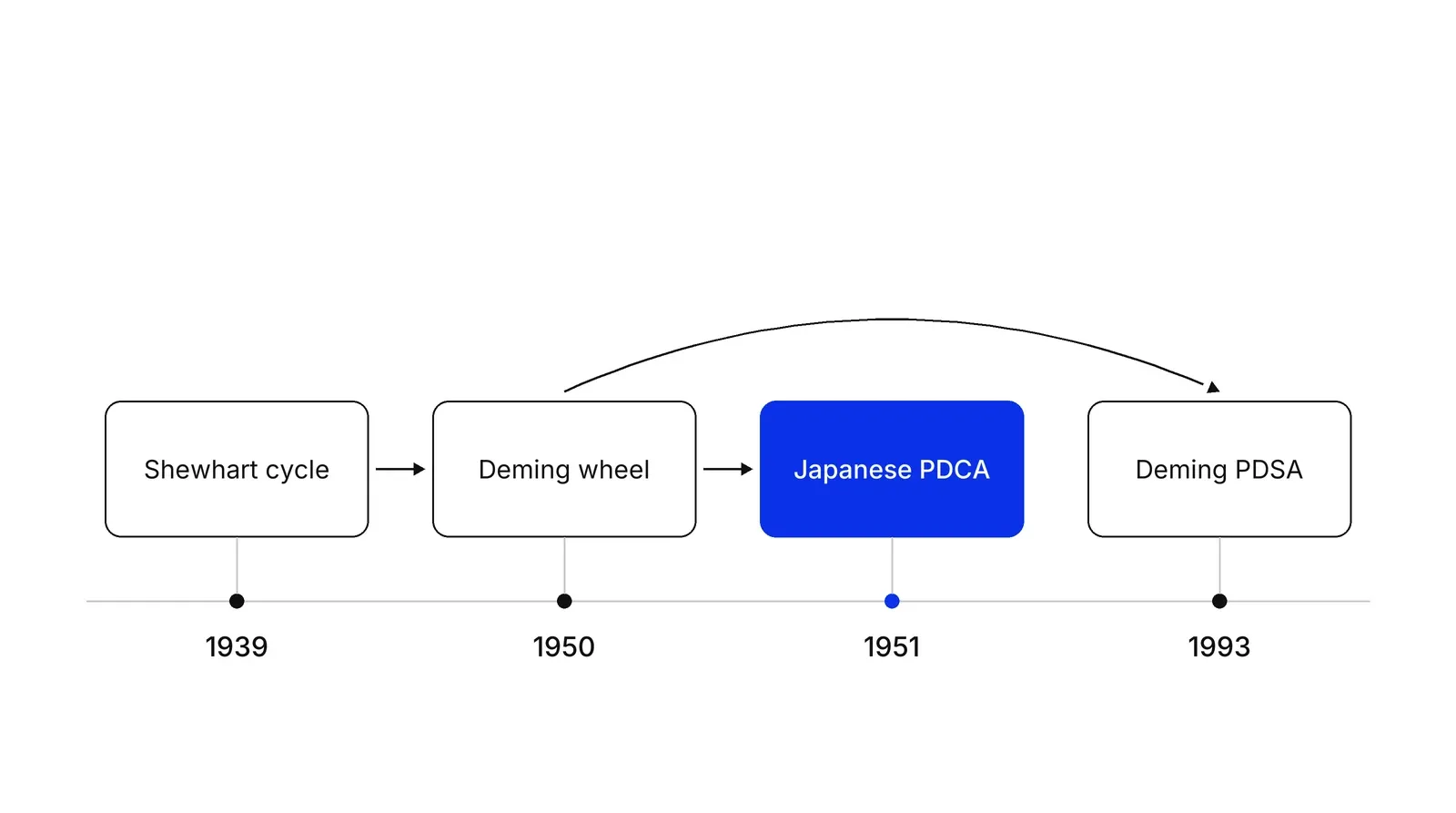
Deming reintroduced the cycle in his 1980s seminars, and Moen cites his book Out of the Crisis (1986) for that version. In 1993 he named it the Shewhart Cycle for Learning and Improvement, which is PDSA. In a Deming Institute podcast, Moen and Norman say Deming never spoke of PDCA, although it was connected to him in the early 1980s. Their Quality Progress article records that he told Moen in 1990 to call it PDSA, “not the corruption PDCA.”
What does each step ask you to do?
Each step has one job, and the cycle fails when one is skipped.
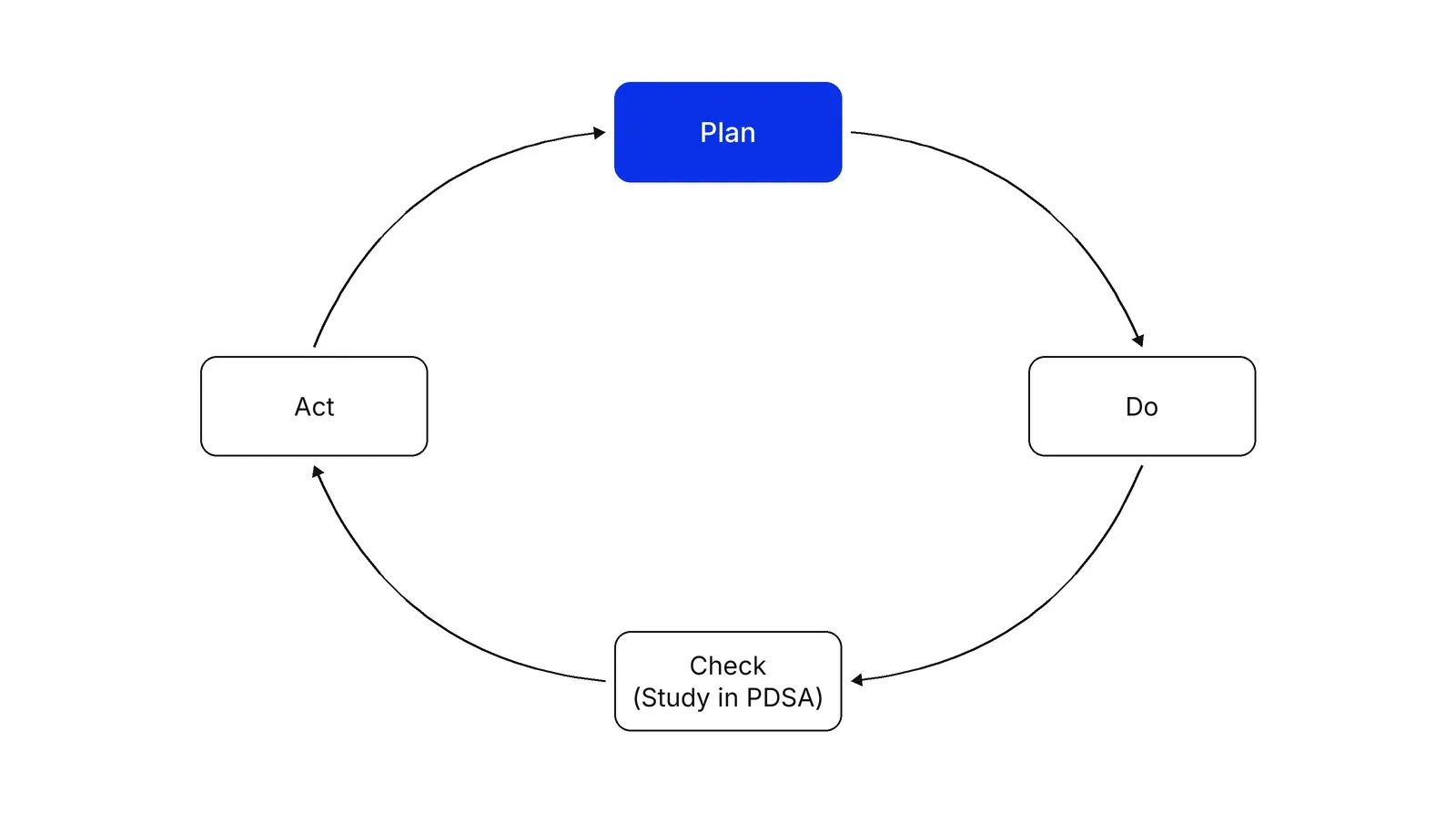
Plan. Define the objective, state the questions the test should answer and write down a prediction. The Institute for Healthcare Improvement adds that early cycles should be scoped as small as possible and that the plan names who, what, when and where.
Do. Carry out the plan, document problems and unexpected observations, and begin analysing the data.
Check. Compare the data with the prediction and summarise what was learned. Lean.org describes this step as evaluating performance against the target.
Act. Standardise the change if it worked, or return to Plan if it did not. In the IHI worksheet the choices are named adapt, adopt or abandon. Lean.org adds that a successful method goes into the standardised work, which is what keeps the gain from fading.
PDCA or PDSA?
The two differ in what the third step is for. The Deming Institute says Deming found that Check focuses on implementing a change and whether it succeeded, while his focus was on predicting results, studying them and revising the theory.
| PDCA | PDSA | |
|---|---|---|
| Third step | Check: did the plan succeed? | Study: what did we learn, and was the theory right? |
| Typical use | Standardising and holding gains in a process | Testing a new change under uncertainty |
| Main output | A corrected plan or a new standard | Revised knowledge, then a decision |
| Who named it | Japanese quality practice, 1950s | Deming, 1986 to 1993 |
David Garvin argued in Harvard Business Review that continuous improvement requires a commitment to learning, which is the point of Deming’s Study step. In practice the two overlap, and many teams use the words as synonyms. The useful lesson from Deming’s objection is the written prediction. The IHI’s Model for Improvement, built by the authors of The Improvement Guide, pairs PDSA with three questions: what are we trying to accomplish, how will we know a change is an improvement, and what change can we make.
One cycle is rarely enough
A single pass rarely settles a problem. The IHI says most changes need many cycles in sequence to develop the change, test it in varying conditions and then implement it.
The evidence says teams often fall short here. A 2014 systematic review in BMJ Quality & Safety found 73 qualifying hospital reports of PDSA out of 409 articles. Fewer than 20% (14 of 73) fully documented a sequence of iterative cycles, and only 15% (7 of 47) used quantitative data at monthly or more frequent intervals to decide how to proceed.
Reed and Card argue in the same journal that the problem is oversimplification. A well-run PDSA promises learning, they write, not that the desired outcome will be reached.
Where it fits with other methods
PDCA is the inner loop of several larger systems. It sits under kaizen, the habit of daily small improvements that Toyota says its employees practise. Eric Ries’s Build-Measure-Learn loop in The Lean Startup has the same shape, and the Lean Enterprise Institute calls it fundamentally similar to the Shewhart and Deming cycles.
Inside Pushers’ own toolkit, the HADI loop is the same cycle written for growth tests, and an experimentation program is what you build when many cycles run at once. To pick the process worth improving, a SIPOC map shows its scope first. For large data-heavy problems, Soković and Pavletić’s comparison calls PDCA simple to understand and DMAIC a systematic, fact-based project approach. A Growth Lab plan can start from a loop like this one.
How to apply PDCA (Deming cycle), step by step
- Name the problem and the number. Pick one process and one measure, such as the share of merchant applications that come back for missing documents. Write the current value. Result: a baseline you can compare against later.
- Predict, then plan a small test. State the change, say what you expect to happen to the number, and decide who tests it, where and for how long. Keep the first test as small as possible: one team, one day, ten cases. Result: a written prediction and a test plan.
- Do the test and note surprises. Run the plan as written. Record problems and anything unexpected, because those notes are often worth more than the result. Result: raw data and a log of what went off script.
- Check the result against the prediction. Compare what happened with what you predicted. A gap in either direction is information. Result: one paragraph on what you learned and whether the theory behind the change held.
- Act: adopt, adapt or abandon. If the change worked, adopt it and test it at larger scale. If it half worked, adapt it and run another cycle. If it failed, drop it. Result: one decision, written down, with an owner.
- Standardise what worked and restart. Write the new method into the standard procedure so the gain does not fade, then pick the next problem. Result: an updated procedure and the first line of the next plan.
Examples
A resident clinic and opioid renewals
A 2019 study in Pain Medicine describes two PDSA cycles in a university-affiliated internal medicine resident clinic. The first, electronic templates and routing renewals through a nurse, raised annual toxicology screening from 53% to 81% and signed opioid agreements from 13.8% to 53.5%. The second, nurse pre-visit planning and daily huddles, did not raise those numbers further but improved clinic utilization. The second cycle shows the value of the cycle: the team learned which change did the work.
A research team chasing survey responses
A 2019 report in Family Medicine describes three PDSA cycles over eight months to fix missing survey data in a resident-led study. A shared tracker with automatic due-date flags lifted overall survey completion from 57% (19 of 33 eligible) to 84% (16 of 19). The on-time rate did not improve. The authors report both results, which is how a Check step should read.
A payments onboarding queue
Illustrative, no real company implied. A payments company sees 8 of every 20 merchant applications sent back for missing documents. The team predicts that a document checklist on the form will cut that to 4 or fewer. It runs the checklist for the next 20 applications, and 5 come back. The prediction was close but missed, so the team keeps the checklist, adapts the wording of the two documents that cause most returns, and runs a second cycle.
When to use it
Use it when a process has a measurable problem and a plausible fix, but nobody is sure the fix works in your setting. It suits clinic workflows, support queues, onboarding steps, compliance checks and any routine where a small change can be tested within days. It is the default loop to run inside a larger improvement program.
When not to use it
Skip it when the cause of the problem is unknown and needs diagnosis first, since a test of the wrong change teaches little. It also fits badly for one-off irreversible decisions, such as signing a lease, where there is no second cycle to run. A structured diagnosis such as DMAIC suits large, data-heavy problems better.
Common mistakes
- Skipping the prediction. Without a written prediction the Check step becomes a vote on whether the result feels good, and nothing is learned from being wrong.
- Starting big. A first test across the whole company cannot be undone cheaply, and a failed pilot of that size teaches less than ten failed small ones.
- Treating one pass as the method. A 2014 review found fewer than 20% of hospital PDSA reports documented a sequence of iterative cycles.
- Dropping the Act step. Gains that are never written into the standard procedure fade, and the same problem returns a year later.
- Using Check as a pass or fail verdict on the plan, instead of asking what the result says about the theory behind it.
FAQ
What are the four stages of the PDCA cycle?
Plan means defining the problem, setting a goal and predicting the result of a change. Do means carrying out the change, ideally on a small scale. Check means comparing the results with the prediction. Act means standardising the change if it worked, or revising the plan and starting another cycle if it did not.
Did Deming invent PDCA?
No. Walter Shewhart described the underlying cycle in 1939, and Deming taught a four-step version in Japan in 1950. According to Masaaki Imai, Japanese executives recast it as Plan-Do-Check-Act. Ronald Moen and Clifford Norman note that Deming never spoke of PDCA, and in a 1990 letter called it a corruption.
What is the difference between PDCA and PDSA?
The third step differs. PDCA checks whether the plan succeeded and corrects it if not. PDSA, Deming's preferred form, studies the results against a prediction in order to revise the theory behind the change. The Deming Institute describes the Check emphasis as being on implementation, success or failure.
How many PDCA cycles does an improvement need?
Usually several. The Institute for Healthcare Improvement says most changes need many cycles run in sequence to develop a change, test it under varying conditions and then implement it. Early cycles should be scoped as small as possible, and each one ends with a decision to adopt, adapt or abandon the change.
Is PDCA the same as kaizen?
Not the same, but linked. Kaizen means continuous incremental improvement, and the Lean Enterprise Institute calls PDCA the foundation of it: the cycle is the method, and kaizen is the habit of running it every day. Toyota says all its employees implement daily incremental kaizen.
Sources
- The W. Edwards Deming Institute, The PDSA Cycle
- The W. Edwards Deming Institute, Deming on Management: PDSA Cycle
- Ronald D. Moen, Foundation and History of the PDSA Cycle, Associates in Process Improvement
- Ronald D. Moen, Clifford L. Norman, Circling Back: Clearing Up Myths About the Deming Cycle, Quality Progress, November 2010
- The Deming Institute Podcast, Cliff Norman and Ron Moen on the PDSA Cycle, 2016
- Walter A. Shewhart, Statistical Method from the Viewpoint of Quality Control, 1939, Internet Archive record
- W. Edwards Deming, Out of the Crisis, MIT Press, 1986, Internet Archive record
- Union of Japanese Scientists and Engineers (JUSE), How the Deming Prize Was Established
- Lean Enterprise Institute, Plan, Do, Check, Act (PDCA)
- Toyota Motor Corporation, Toyota Production System
- Institute for Healthcare Improvement, Model for Improvement
- Institute for Healthcare Improvement, Model for Improvement: Testing Changes
- Institute for Healthcare Improvement, Plan-Do-Study-Act (PDSA) Worksheet
- Gerald J. Langley and others, The Improvement Guide, 2nd edition, Jossey-Bass, 2009
- Michael J. Taylor and others, Systematic review of the application of the plan-do-study-act method to improve quality in healthcare, BMJ Quality & Safety 23(4), 2014
- Julie E. Reed, Alan J. Card, The problem with Plan-Do-Study-Act cycles, BMJ Quality & Safety 25(3), 2016
- Rachel Wong and others, Improving Opioid Management and Resource Utilization in an Internal Medicine Residency Clinic, Pain Medicine, 2019
- Kelsey Winnie, Carissa Broszko, Alexandra Whittle, Plan-Do-Study-Act Cycles Applied to a Longitudinal Research Protocol in a Family Medicine Residency, Family Medicine, 2019
- Mirko Soković, Duško Pavletić, Quality Improvement: PDCA Cycle vs. DMAIC and DFSS, Strojniški vestnik 53(6), 2007
- Eric Ries, The Lean Startup, methodology page
- David A. Garvin, Building a Learning Organization, Harvard Business Review, July-August 1993
Last updated Oct 9, 2026


Fractional COO or embedded operations team? How to choose at Series A
The two models solve different problems: how to tell which one your company needs, and what each costs in time and control.

What operational systems successful fintech startups use: lessons from ten companies
Starling, Monzo, Qonto, bunq, Lunar, Pleo, Tide, Ramp, Mercury and Column scaled on four operating systems. Regulators' findings show what breaks when one of them lags behind growth.

What a revenue operations manager actually owns
Pipeline definitions, CRM hygiene, forecasting and the handoffs between marketing, sales and success. What the role covers, and how it differs from sales ops.