Capital allocation
Capital allocation is the decision about where a company puts the cash it earns: back into the business, into acquisitions, out to owners, against debt or into its own shares.
Capital allocation is how a company decides where to put the cash its operations produce: reinvest it, buy another business, pay dividends, repay debt or buy back shares. William Thorndike's 2012 book The Outsiders argued that this choice separated eight unusually successful CEOs from their peers. For operators, a marketing budget is the same decision at smaller scale.
- Origin
- William N. Thorndike Jr., 2012
- Level
- 401 · Expert
- Fits
- Scale-up, Enterprise
- Time to apply
- one half-day session to rank the uses of cash, then a quarterly review
- What you need
- last twelve months of cash flow, and the cash buffer you refuse to go below · a list of every competing use for the next dollar, including repaying debt · a return estimate for each use, with the person who made it named
Capital allocation is the decision about where a company puts the cash its operations produce. William Thorndike’s 2012 book The Outsiders made it a management topic by arguing that this choice, more than operating skill, set eight unusual CEOs apart. According to Harvard Business Review Press, the publisher, their companies beat the S&P 500 by about twenty times on average, so that $10,000 invested with each CEO would have grown past $1.5 million over twenty-five years.
The idea is older than the book. Warren Buffett’s 1987 letter observes that most bosses rise through marketing, production or engineering and then face allocation decisions they have never made. The same letter adds that a CEO whose company retains earnings equal to 10% of net worth will, after ten years, have deployed more than 60% of all the capital at work in the business. Kept cash compounds into most of the company, which is why the decision deserves its own process.
What are the five uses of cash?
Thorndike’s frame is that a company raises capital from profits, new equity or debt, and spends it in five ways: reinvesting in operations, acquiring businesses, paying dividends, paying down debt or repurchasing shares, as he described in 2024. The allocator’s job is to rank them, because each dollar can go to only one.
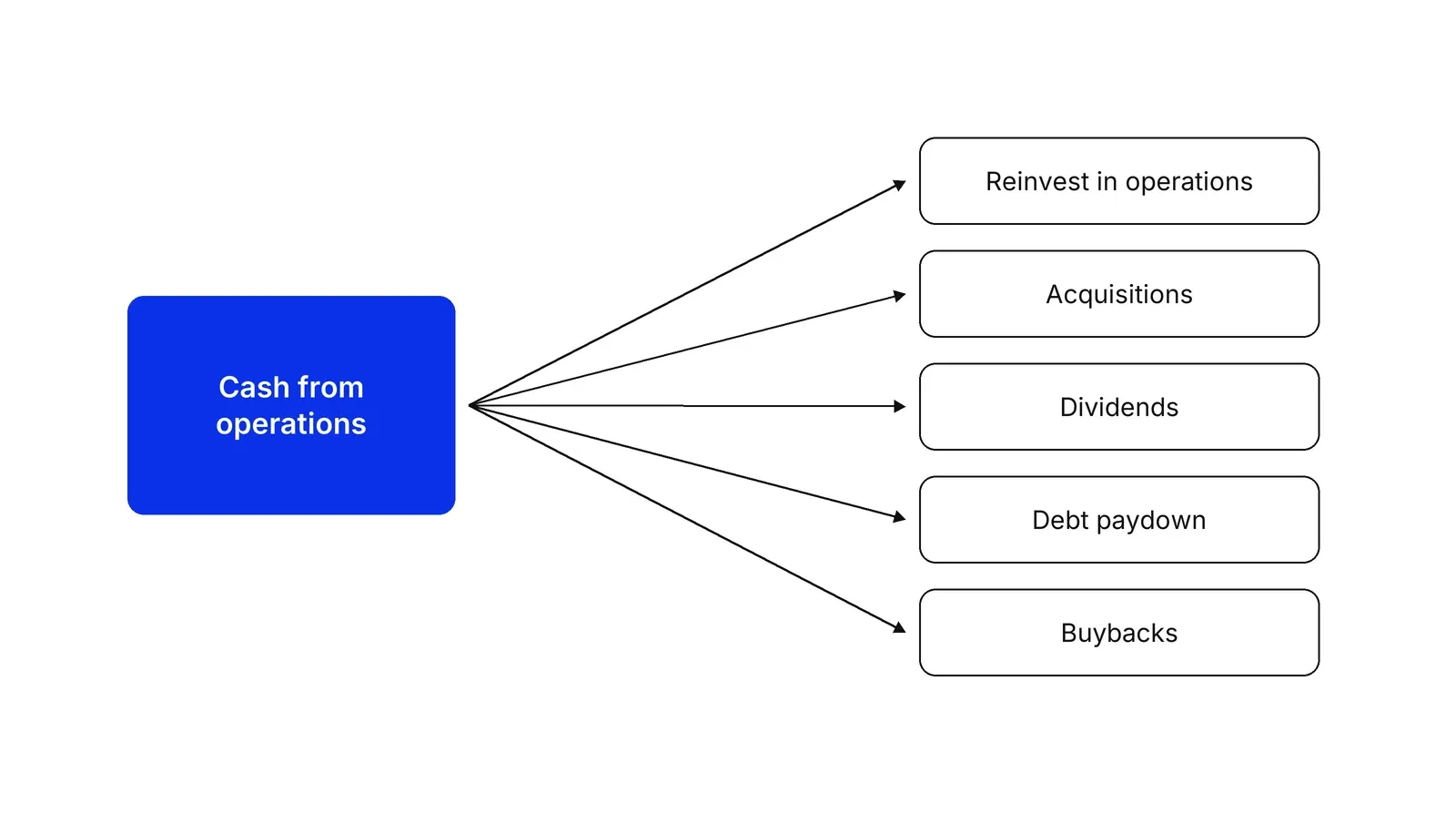
| Use | The test it must pass | Marketing budget equivalent |
|---|---|---|
| Reinvest in operations | Beats the return of the next-best use | Scaling a proven channel, funding a new one |
| Acquisitions | Priced below the cash flow it buys | Buying an audience, an agency or a partnership |
| Dividends | The business has no better home for the cash | Taking cash out instead of raising spend |
| Debt paydown | Earns the interest rate for certain | Repaying a credit line before adding spend |
| Buybacks | Bought below intrinsic value | Buying out an early investor at a fair price |
What did the outsiders do differently?
They were buyers when the price was low and patient otherwise. According to HBR’s 2014 interview with Thorndike, all but one of the eight repurchased at least 30% of their shares, most were first-time CEOs and about half took the job before forty. They also made occasional very large acquisitions, used debt selectively and generally avoided dividends. The publisher adds that they focused on per-share value rather than earnings or sales growth.
Treat the twentyfold figure as a description. The eight were chosen after the fact, and nothing in it forecasts what a similar policy would earn in your company.
How do you test a decision to keep cash?
Ask whether each dollar kept in the business is worth more than a dollar. Buffett’s Owner’s Manual tests retention by checking whether it delivers at least $1 of market value for each $1 retained, and he admits the original five-year wording of that test was flawed. Price matters as much as the use. His 2011 letter states the first law of capital allocation as “what is smart at one price is dumb at another.”
The buyback evidence follows the same logic. Ikenberry, Lakonishok and Vermaelen tracked repurchase announcements from 1980 to 1990 and found an average abnormal four-year return of 12.1%, 45.3% for value stocks and no positive drift for glamour stocks.
What does practice look like?
It is less rigorous than the textbooks. Graham and Harvey surveyed 392 CFOs: 74.9% always or almost always used net present value, 75.7% internal rate of return and 56.7% payback, which ignores the time value of money. Small firms leaned on payback almost as often as on the other two.
Inside large companies, Scharfstein and Stein describe a kind of socialism, where weaker divisions are subsidised by stronger ones. Stein shows the upside: headquarters can add value by picking winners among competing projects. Mauboussin and Callahan studied the 1,500 largest US companies over 30 years and built an assessment on five principles: zero-based allocation, funding strategies rather than projects, no capital rationing, zero tolerance for bad growth and continuous monitoring of asset values.
How does it apply to a marketing budget?
A marketing budget is a small capital allocation, and the same questions apply. The cash you can allocate comes from cash flow, not profit. The hurdle comes from unit economics: a channel that cannot beat your payback threshold does not get funded. A financial model for growth shows what each allocation does to the bank balance. Operators with high fixed costs should also read operating leverage, because a small revenue miss turns into a large profit miss and the cash buffer comes first.
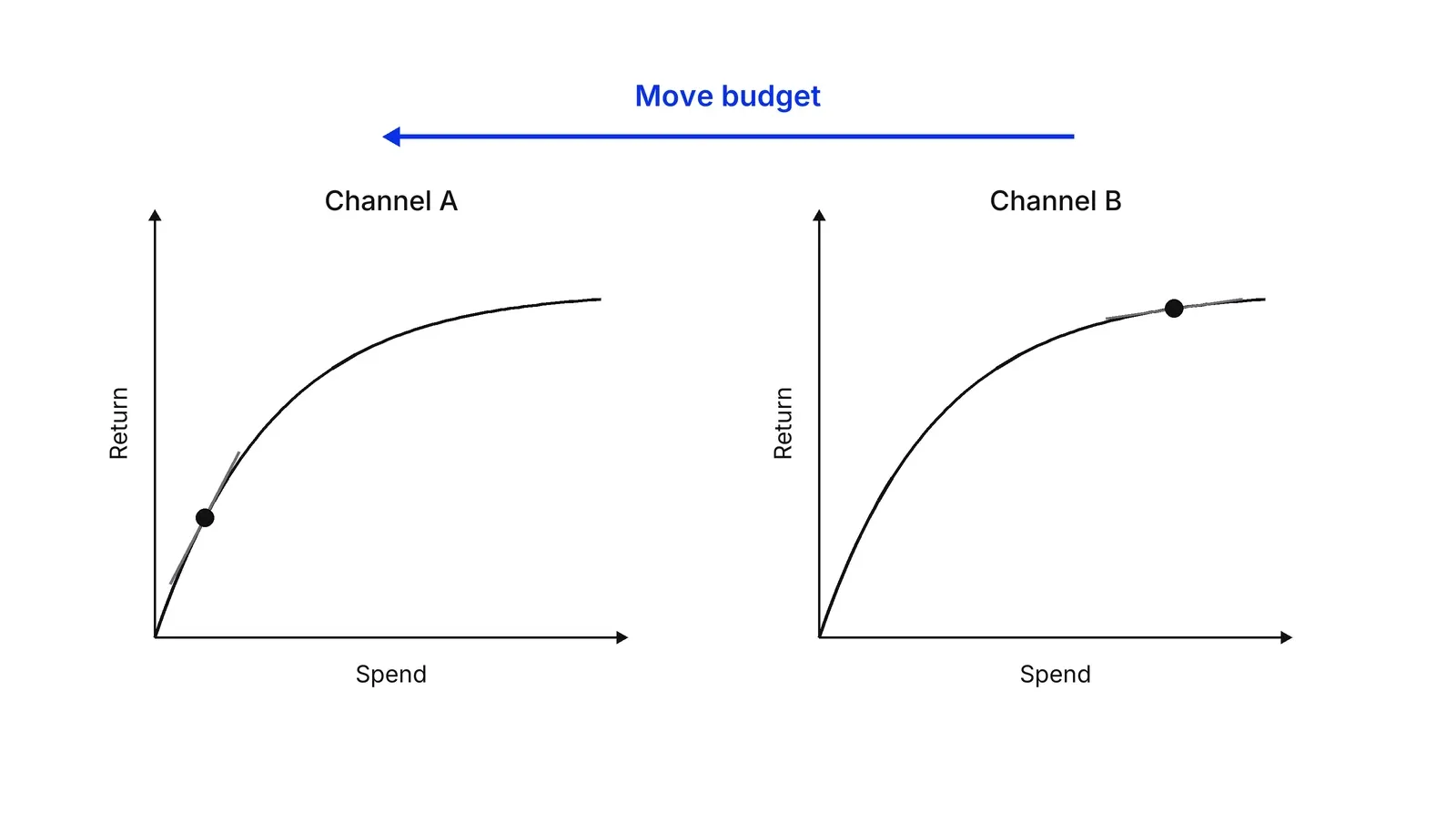
Compare channels by the return on the next dollar. Google’s Meridian documentation describes two modes: a fixed budget that finds the split with the highest return, and a flexible budget that stops spending where marginal return reaches a target. Meta’s Robyn works with saturation curves for the same purpose. Both are marketing mix modeling tools; see media mix for the basics.
Split the budget by horizon too. The three horizons of growth keep the core, emerging bets and long options from crowding each other out. On brand versus short-term spend, the IPA’s Long and the Short of It analysed 996 campaigns from 700 brands and found an optimum near 40% activation, and the IPA later reported 62:38 in its 2018 follow-up. Treat it as an average that varies by category.
Finally, review often. Bezos’s 1997 letter describes measuring each program, dropping those that fail and funding those that work. Teams building a Growth Lab plan can start from the same list of uses of cash.
How to apply Capital allocation, step by step
- Count the cash you can allocate. Start from operating cash flow, subtract the buffer you will not touch and any commitments already made. Profit is the wrong starting number, because a profitable company can still be short of cash. Result: one figure for the cash available this quarter.
- List every use, including the dull ones. Write down each place the cash could go: scaling a proven channel, a new bet, an acquisition, repaying debt, an owner payout, a larger reserve. Result: a list where repaying a loan sits next to a campaign.
- Put every use on one yardstick. Estimate the return on the next dollar in each use, over the same period, for example twelve months of gross margin per dollar spent. Cut optimistic forecasts before comparing, since Lovallo and Kahneman found most major initiatives fall short of their goals. Result: one comparable number per use.
- Set the hurdle and the price rule. Decide the minimum return a new use must beat, and never set it below the sure return of repaying debt. For anything bought at a price, such as an acquisition or a block of ad inventory, state the price above which you walk away. Result: a written hurdle and a written walk-away price.
- Split by horizon and fund in tranches. Cap how much goes to the core business, to emerging bets and to long options, then release money in tranches tied to results. Result: a budget with ceilings per horizon and a milestone attached to each tranche.
- Review, then run the retention test. Each quarter, move money from uses whose next dollar earns less to uses where it earns more. Once a year, ask whether the cash you kept in the business produced at least as much value as it would have in the owners' hands. Result: a dated allocation log and a yes or no on retention.
Examples
Amazon's 1997 rule for investment decisions
In his 1997 shareholder letter, reproduced on Amazon's site, Jeff Bezos wrote that the company weighs investments by their effect on long-term market leadership and prefers cash flow to the look of its accounts. He said Amazon measures each program, drops those that fail to earn acceptable returns and adds funding to those that work. It is a public example of allocation as a repeated ranking of uses of cash, not a one-off budget.
Berkshire Hathaway's buyback limit
According to Berkshire's own 2011 letter, the company announced it would repurchase shares at up to 110% of book value, and bought $67 million before the price rose past that limit. Buffett added that Berkshire would not buy if its cash equivalents were below $20 billion. A price ceiling and a cash floor, both written down in advance, are the two rules of this case.
A payments company ranking its free cash
Illustrative, no real company implied. A payments company has free cash after costs and its buffer, enough for three equal tranches. In Channel A the first tranche returns 70 cents of gross margin per dollar over twelve months, and the second only 4 cents. In Channel B the first tranche returns 20 cents. Repaying a loan that costs 12 cents a year per dollar returns a sure 12 cents. Ranked by the next dollar, the cash goes to the first tranche in A, the first in B and the loan, and the second tranche in A waits.
When to use it
Use it when cash is being generated and several people have a claim on it: a company moving from a handful of channels to a portfolio, a leadership team arguing over a bonus pool, a marketing budget that is split by last year's shares, or a business deciding between growth spend and repaying debt. It forces every use of cash onto one yardstick.
When not to use it
Skip it when the company is short of cash and survival, not ranking, is the problem; there the work is a cash flow forecast. It also adds little for a team that cannot yet measure the return on any single use of money, since a ranking built on guesses only looks precise.
Common mistakes
- Splitting the budget by last year's shares, so that each function gets about what it got before and nothing moves toward higher returns.
- Comparing uses by average return. A channel with a high average can already be saturated, and its next dollar can earn less than a new channel's first.
- Leaving out the return on repaying debt and holding cash, which means growth projects are never tested against a sure alternative.
- Funding a use because its sponsor has been in the business longest. Research on internal capital markets finds that weaker divisions are often subsidised by stronger ones.
- Taking forecasts at face value. Optimism inflates the return of the project being pitched, so the ranking favours whoever forecasts most boldly.
FAQ
What is capital allocation?
Capital allocation is the decision about where to put the cash a business generates. The options are reinvesting in operations, acquiring other businesses, paying dividends, repaying debt and buying back shares. Thorndike's 2012 book The Outsiders, from Harvard Business Review Press, argues that this decision matters more than operating skill for long-term shareholder returns.
What are the five ways to allocate capital?
Thorndike lists five uses of cash: invest in existing operations, acquire other businesses, pay dividends, pay down debt and repurchase stock. Capital itself comes from three sources: profits, new equity or borrowing. A private company has no traded shares, so a buyback becomes buying out an investor.
What did The Outsiders find about CEOs?
The publisher says the eight CEOs' companies beat the S&P 500 by about twenty times on average. They mostly bought back shares in large amounts when the price looked low, made a few very large acquisitions, used debt selectively and generally paid no dividends. The group is eight chosen CEOs, so the multiple describes them rather than predicting anything.
How do you allocate a marketing budget across channels?
Compare channels by the return on the next dollar, not the average dollar, and move money from channels where it earns less to channels where it earns more. Tools such as Google's Meridian and Meta's Robyn estimate response curves and recommend a split. Keep a share for brand building, since IPA data puts the average optimum near 60:40.
How do companies decide which projects to fund?
Graham and Harvey surveyed 392 CFOs and found that 74.9% always or almost always use net present value and 75.7% internal rate of return. Payback was used by 56.7%, and small firms leaned on it almost as often as the other two. Many firms also apply firm-wide risk to every project.
Sources
- Harvard Business Review Press, The Outsiders: Eight Unconventional CEOs and Their Radically Rational Blueprint for Success (William N. Thorndike Jr., 2012), publisher page
- Google Books, The Outsiders (Harvard Business Press, 2012), book record
- Harvard Business Review, How Unusual CEOs Drive Value, podcast, April 2014
- Harvard Business Review, How 8 Successful CEOs Allocated Capital to Build Durable Businesses, podcast, March 2024
- Warren E. Buffett, Berkshire Hathaway shareholder letter for 1987
- Warren E. Buffett, An Owner's Manual, Berkshire Hathaway
- Warren E. Buffett, Berkshire Hathaway shareholder letter for 2011
- John R. Graham, Campbell R. Harvey, How Do CFOs Make Capital Budgeting and Capital Structure Decisions?, Journal of Applied Corporate Finance 15(1), 2002
- John R. Graham, Campbell R. Harvey, The theory and practice of corporate finance: evidence from the field, Journal of Financial Economics 60, 2001, Duke Scholars record
- Michael J. Mauboussin, Dan Callahan, Capital Allocation: Evidence, Analytical Methods, and Assessment Guidance, Journal of Applied Corporate Finance 26(4), 2014
- Dan Lovallo, Daniel Kahneman, Delusions of Success: How Optimism Undermines Executives' Decisions, Harvard Business Review, July 2003
- Michael C. Jensen, Agency Costs of Free Cash Flow, Corporate Finance, and Takeovers, American Economic Review 76(2), 1986
- David S. Scharfstein, Jeremy C. Stein, The Dark Side of Internal Capital Markets: Divisional Rent-Seeking and Inefficient Investment, Journal of Finance 55(6), 2000
- Jeremy C. Stein, Internal Capital Markets and the Competition for Corporate Resources, Journal of Finance 52(1), 1997
- Alon Brav, John R. Graham, Campbell R. Harvey, Roni Michaely, Payout policy in the 21st century, Journal of Financial Economics 77(3), 2005
- David Ikenberry, Josef Lakonishok, Theo Vermaelen, Market underreaction to open market share repurchases, Journal of Financial Economics 39, 1995
- Google, Meridian documentation, Budget optimization scenarios
- Meta Marketing Science, Robyn open-source marketing mix modeling package, GitHub
- Jeff Bezos, Amazon 1997 letter to shareholders, appended to the 2020 letter page, Amazon
- Les Binet, Peter Field, The Long and the Short of It, IPA presentation
- Institute of Practitioners in Advertising, The next chapter for The Long and the Short of It
Last updated Oct 9, 2026


How to calculate channel payback and unit economics
A CAC number that only marketing believes will not survive a finance review. This guide calculates channel payback so both teams work from the same model.

Fractional CFO vs finance operations: which gap do you actually have
A fractional CFO is a person. Finance operations is a system. Companies searching for one are often missing the other, or both.