Paid media funnel (TOFU, MOFU, BOFU)
A way to plan paid advertising in three stages, top, middle and bottom of the funnel, so each campaign gets the objective, format, offer and metric that fit how close its audience is to buying.
The paid media funnel is a planning method that splits advertising into three stages: top of funnel (TOFU) for people who do not know you, middle of funnel (MOFU) for people who know you and are comparing, and bottom of funnel (BOFU) for people ready to act. Each stage gets its own objective, ad format, offer, metric and share of budget.
- Origin
- Practitioner shorthand with no documented author; descends from hierarchy-of-effects models such as Lavidge and Steiner, 1961 (hierarchy of effects); acronyms in common use since the 2000s
- Level
- 201 · Tool
- Fits
- Startup, Small and mid-size, Scale-up
- Time to apply
- half a day to sort current campaigns by stage; one quarter to read the results
- What you need
- a list of every live paid campaign with its objective, audience and monthly spend · the main conversion event tracked in each ad platform · one offer per stage: something to watch or read, something to compare, something to buy or book · agreement on which metric judges each stage
The paid media funnel is a way to plan advertising in three stages. Top of funnel (TOFU) reaches people who do not know you. Middle of funnel (MOFU) works on people who know you and are comparing options. Bottom of funnel (BOFU) converts people who are ready to act. For each stage you choose a platform objective, an ad format, an offer, a metric and a share of the budget.
Nobody owns the acronyms. They are practitioner shorthand, common in content and performance marketing since the 2000s, and they descend from the stage models of advertising, such as the 1961 hierarchy of effects by Lavidge and Steiner. The history of that idea, and the research on whether buyers really move in order, is covered in our page on the AIDA model and the marketing funnel. This page stays on the practical side: what to buy at each stage and how to judge it.
The ad platforms are already built this way
Most ad platforms ask you to pick a stage before anything else. LinkedIn Campaign Manager sorts its nine objectives into awareness, consideration and conversions. TikTok Ads Manager uses the same three groups: reach for awareness; traffic, video views and community interaction for consideration; app promotion, lead generation and sales for conversion. Meta’s Marketing API lists six outcome objectives: awareness, traffic, engagement, leads, app promotion and sales. Google Ads offers sales, leads, website traffic, app promotion, and YouTube reach, views and engagements.
The objective matters because it tells the platform’s bidding system whom to find. A campaign set to sales will look for people most likely to buy soon, which is right for BOFU and wrong for TOFU, where the job is to reach people who are not buying yet. Platforms rename objectives often, so check the current list before you build.
What changes from stage to stage
Everything about the campaign changes with the stage, not only the message.
| TOFU | MOFU | BOFU | |
|---|---|---|---|
| Audience | Cold: right profile, no contact yet | Engaged: watched, read, visited | Hot: priced, started checkout, searched your name |
| Platform objective | Reach, video views | Traffic, engagement, leads | Sales, conversions, leads with qualification |
| Typical formats | Short video, sponsored posts, connected TV, audio | Retargeting video, carousels, lead forms, webinar ads | Search ads, shopping ads, dynamic retargeting |
| Offer | Something useful with no ask | Proof and comparison | A reason to act now |
| Primary metric | Reach, frequency, CPM, ad recall lift | Engaged visits, cost per lead, lead quality | Cost per acquisition, return on ad spend |
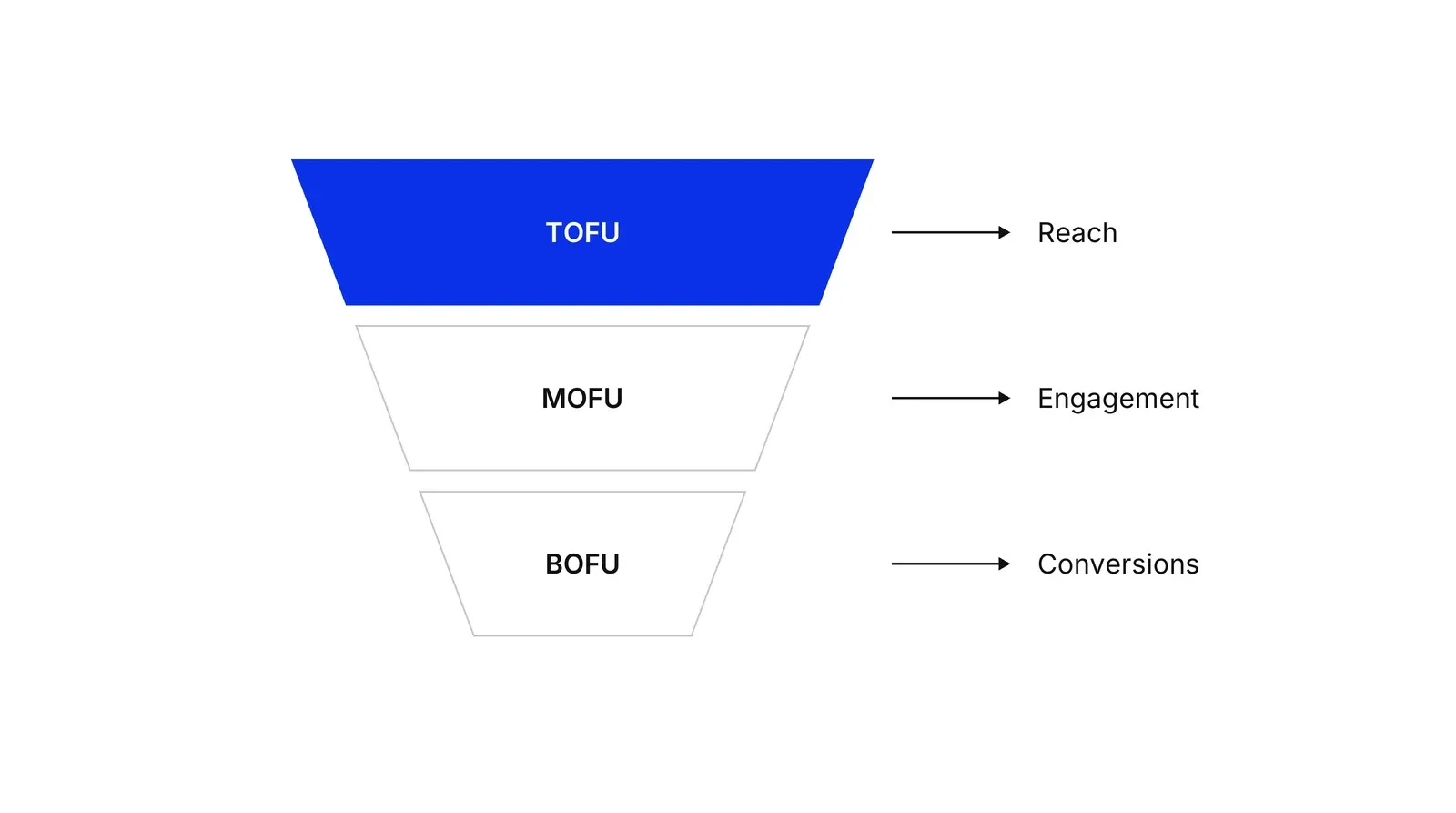
The metrics need their own definitions. Reach is the number of distinct people who saw an ad; Google counts people, not cookies, and reports average frequency per person. CPM is the cost of a thousand impressions. Ad recall comes from a Brand Lift study, which surveys people who saw the ad and a comparable group who did not. Return on ad spend is conversion value divided by spend: a target ROAS of 500% means five dollars of sales per dollar of ads.
Does the stage really change how ads work?
Yes, and field experiments show it. Paul Hoban and Randolph Bucklin ran a randomised display ad test at a financial tools provider and split users by stage: non-visitor, visitor, registered user, customer. According to their 2015 paper, the ads raised site visits at most stages but not among people who had visited without creating an account. Moving some impressions from non-visitors and visitors to registered users raised expected visits by almost 10%.
Ad content should change too. Anja Lambrecht and Catherine Tucker tested retargeting at an online travel firm and found that ads showing the exact products a person had viewed did worse, on average, than generic brand ads (MIT DSpace). Product-specific ads only caught up once browsing showed the person’s preferences had narrowed, for example after visiting review sites. In funnel terms, detail belongs at BOFU, and a MOFU audience still wants the broader story.
Formats also split by stage. Modelling a car launch campaign, Abhishek, Fader and Hosanagar found display ads mostly moved people from disengaged to engaged, while search ads worked at every stage.
Why BOFU looks better than it is
BOFU campaigns sit closest to the sale, so they collect most of the credit in click-based reports. Some of that credit is borrowed. In a large experiment at eBay, Blake, Nosko and Tadelis found brand-keyword search ads had no measurable short-term benefit, because people searching “eBay” arrived anyway through the free listing. Non-brand ads did help new and infrequent buyers.
Observational attribution struggles to correct for this. Across 15 advertising experiments at Facebook, Gordon and colleagues found that standard observational methods often failed to match the results of the randomised tests. The fix is a holdout. Google’s Conversion Lift and similar tools keep a control group from seeing the ads and count the difference. BOFU can pass that test: a retargeting campaign measured with ghost ads lifted purchases by 10.5%. The point is to measure the lift, not to assume it.
How to split the budget
No study has tested an ideal TOFU to MOFU to BOFU split, so treat any fixed ratio you see quoted as opinion. The closest evidence is Binet and Field’s work on brand building and sales activation, covered in our page on the long and the short of it. TOFU maps roughly to brand building, BOFU to activation, and MOFU sits between. Their B2B report puts the best balance at about 46% brand and 54% activation and warns it should not be followed too precisely; brands in their first one or two years do best nearer 35:65, per Effectiveness in Context.
The size of each audience argues against an all-BOFU plan. John Dawes of the Ehrenberg-Bass Institute estimates that only about 5% of B2B buyers are in market at any time. BOFU can only reach that slice. The other 95% will buy later, from whichever supplier they remember.
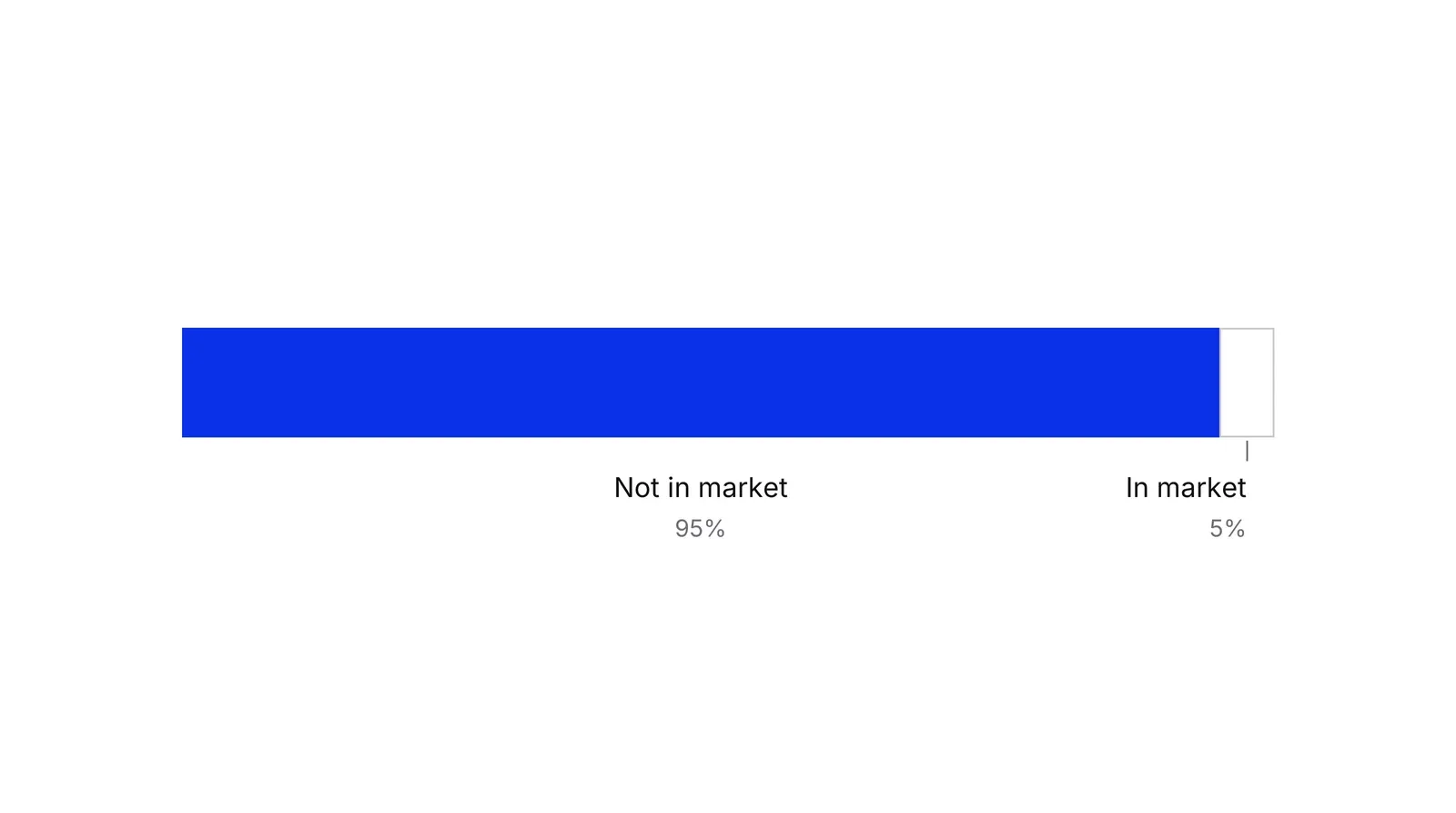
A practical order: fund BOFU to capture the demand that exists, fund TOFU from the start, even modestly, because its effect builds over months, and size MOFU to the number of people TOFU brings in. Then test the split with a regional or audience holdout. Buyers also loop: Google’s research on the messy middle describes people cycling between exploring and evaluating before they choose, so expect the same person to sit in MOFU and BOFU audiences more than once. Planning the stages, the metrics and the tests as one system is part of Pushers’ Growth Lab work.
How to apply Paid media funnel (TOFU, MOFU, BOFU), step by step
- Sort every campaign into a stage. Tag each live campaign TOFU, MOFU or BOFU by its audience, not its objective: cold audiences are TOFU, people who engaged or visited are MOFU, people who started a purchase, searched your brand or asked for a price are BOFU. Result: a table showing how much you spend per stage today.
- Match the platform objective to the stage. Use reach or video objectives for TOFU, traffic, engagement or lead objectives for MOFU, and sales or conversion objectives for BOFU. An awareness campaign optimised for purchases will hunt for people already buying. Result: each campaign's objective agrees with its stage.
- Give each stage its own offer. TOFU gets something useful with no ask: a short video, a guide, a calculator. MOFU gets proof and comparison: case studies, demos, webinars, reviews. BOFU gets the reason to act now: a trial, a quote, a first-visit price. Result: three offers, one per stage, written down.
- Set one primary metric per stage. Judge TOFU on cost per thousand people reached and ad recall lift, MOFU on engaged visits, cost per lead and lead quality, BOFU on cost per acquisition or return on ad spend. Result: a dashboard where no stage is judged by another stage's metric.
- Set the budget split and a test. Start from a written split, for example from the brand to activation benchmarks in Binet and Field's work, then hold out a region or audience for one stage and measure what changes. Result: a split you can defend with your own data after a quarter.
Examples
A B2B payments platform
Illustrative. A payments platform for online merchants spends 30k a month. It puts 12k, or 40%, into TOFU: short video and sponsored posts on LinkedIn aimed at finance leads at merchants of the right size. 7.5k, or 25%, goes to MOFU: retargeting video viewers with a fee comparison guide and a webinar. 10.5k, or 35%, goes to BOFU: search ads on payment-provider terms and demo-request ads for people who visited the pricing page. TOFU is judged on reach in the target accounts, BOFU on cost per qualified demo.
A dental clinic opening a second site
Illustrative. The clinic has no name in the new district. TOFU is local video and social ads about the new site, judged by reach within five kilometres. MOFU retargets viewers with a page showing the dentists, prices and reviews. BOFU runs search ads for 'dentist near me' and the procedure names, with a first-visit price, judged by cost per booked appointment. Because the site is new, most money goes to BOFU in the first months, with TOFU growing as bookings stabilise.
When to use it
Use it when paid campaigns have grown one at a time and nobody can say which audience each one serves, when all spend sits in conversion campaigns and cost per acquisition keeps rising, or when a team reports one blended ROAS that hides which stage does the work.
When not to use it
Skip the three-stage build when the budget is too small to fund more than one campaign well, or when demand already exceeds capacity and the job is to capture searches that exist. It also gives a poor picture of buying committees, where several people sit at different stages at once; account-based planning fits that better.
Common mistakes
- Running a TOFU campaign on a sales objective, so the platform spends the budget on people who were about to buy anyway.
- Judging TOFU by last-click conversions, cutting it, and watching BOFU volume fall a few months later.
- Showing the same hard offer, a demo or a discount, at every stage, including to people who have never heard of you.
- Counting brand-name search and retargeting results as new demand when experiments show a large share would have converted without the ad.
- Treating the stages as a one-way line when buyers loop between exploring and comparing before they decide.
FAQ
What do TOFU, MOFU and BOFU mean?
They stand for top, middle and bottom of the funnel. TOFU covers people who do not know you yet, MOFU people who know you and are comparing options, BOFU people ready to buy, book or sign up. Marketers use the labels to plan content and ads for each group.
What is TOFU, MOFU and BOFU content?
TOFU content teaches or entertains without asking for anything: short videos, articles, tools. MOFU content helps people compare: case studies, webinars, demos, reviews. BOFU content removes the last doubt: pricing pages, trials, quotes, guarantees. In paid media each piece becomes the offer in the ad for that stage.
How should I split the budget between TOFU, MOFU and BOFU?
No tested universal split exists. The closest evidence is Binet and Field's brand to activation work: about 60:40 on average and about 46:54 in B2B. TOFU is roughly brand building and BOFU activation. Start from a written split, then test it with a holdout.
Which metrics should I use at each stage?
For TOFU, reach, frequency, cost per thousand people reached and ad recall or brand lift. For MOFU, engaged visits, video completion, cost per lead and lead quality. For BOFU, conversions, cost per acquisition and return on ad spend, checked against a lift test where you can run one.
Is retargeting MOFU or BOFU?
Both, depending on the audience. Retargeting people who watched a video or read a guide is MOFU. Retargeting people who added to cart, saw pricing or started a form is BOFU. Lambrecht and Tucker found product-specific retargeting works best once a buyer's preferences have narrowed.
Sources
- Google Ads Help, About campaign objectives
- TikTok Ads Manager Help, How to choose the right objective
- LinkedIn Help, Campaign objectives in Campaign Manager
- Meta for Developers, Marketing API, Ad Campaign reference (objectives)
- Google Ads Help, About Brand Lift
- Google Ads Help, About Conversion Lift
- Google Ads Help, Measuring reach and frequency
- Google Ads Help, Cost-per-thousand impressions (CPM)
- Google Ads Help, About Target ROAS bidding
- Paul R. Hoban, Randolph E. Bucklin, Effects of Internet Display Advertising in the Purchase Funnel, Journal of Marketing Research 52(3), 2015
- Wisconsin School of Business, A research-based method for improving the effectiveness of online ads
- Anja Lambrecht, Catherine Tucker, When Does Retargeting Work? Information Specificity in Online Advertising, Journal of Marketing Research 50(5), 2013 (MIT DSpace)
- Vibhanshu Abhishek, Peter Fader, Kartik Hosanagar, Media Exposure through the Funnel: A Model of Multi-Stage Attribution, SSRN, 2012
- Hongshuang Li, P.K. Kannan, Attributing Conversions in a Multichannel Online Marketing Environment, Journal of Marketing Research 51(1), 2014
- Thomas Blake, Chris Nosko, Steven Tadelis, Consumer Heterogeneity and Paid Search Effectiveness: A Large-Scale Field Experiment, Econometrica 83(1), 2015 (NBER working paper)
- Brett R. Gordon, Florian Zettelmeyer, Neha Bhargava, Dan Chapsky, A Comparison of Approaches to Advertising Measurement: Evidence from Big Field Experiments at Facebook, Marketing Science, 2019
- Garrett A. Johnson, Randall A. Lewis, Elmar I. Nubbemeyer, Ghost Ads: Improving the Economics of Measuring Online Ad Effectiveness, Journal of Marketing Research 54(6), 2017
- Alistair Rennie, Jonny Protheroe, Google, How people decide what to buy lies in the messy middle of the purchase journey, 2020
- Ty Heath, LinkedIn B2B Institute, The 95-5 rule
- Ehrenberg-Bass Institute, The 95:5 rule is the new 60:40 rule (John Dawes)
- IPA, The long and the short of it presentation, Les Binet and Peter Field, 2013
- Les Binet, Peter Field, The 5 Principles of Growth in B2B Marketing, LinkedIn B2B Institute, 2019 (PDF)
- Les Binet, Peter Field, Effectiveness in Context: A Manual for Brand Building, IPA (PDF)
- Robert J. Lavidge, Gary A. Steiner, A Model for Predictive Measurements of Advertising Effectiveness, Journal of Marketing 25(6), 1961
Last updated Oct 9, 2026


Marketing agency or growth system: when a company outgrows its agency
An agency is the right call while the founder still runs most of the company. Once the business starts copying itself into new locations or markets, it needs a system that sets goals, tests hypotheses and owns the result.

Why healthcare marketing agencies stall: the short, mid and long wins model we use with clinics
Most agencies own the click and nobody owns the front desk. How we structure clinic work in three horizons, the research behind each one, and one year of results.

The compliance layer under fintech marketing operations
A fintech marketing agency can build campaigns. It cannot own the compliance review, the KYC drop-off or the multi-market licensing rules that decide whether a lead ever becomes a customer.