Social proof
Social proof is the tendency to treat what other people do and say as evidence of what is right, which is why ratings, reviews and honest usage numbers can lower the doubt a buyer feels.
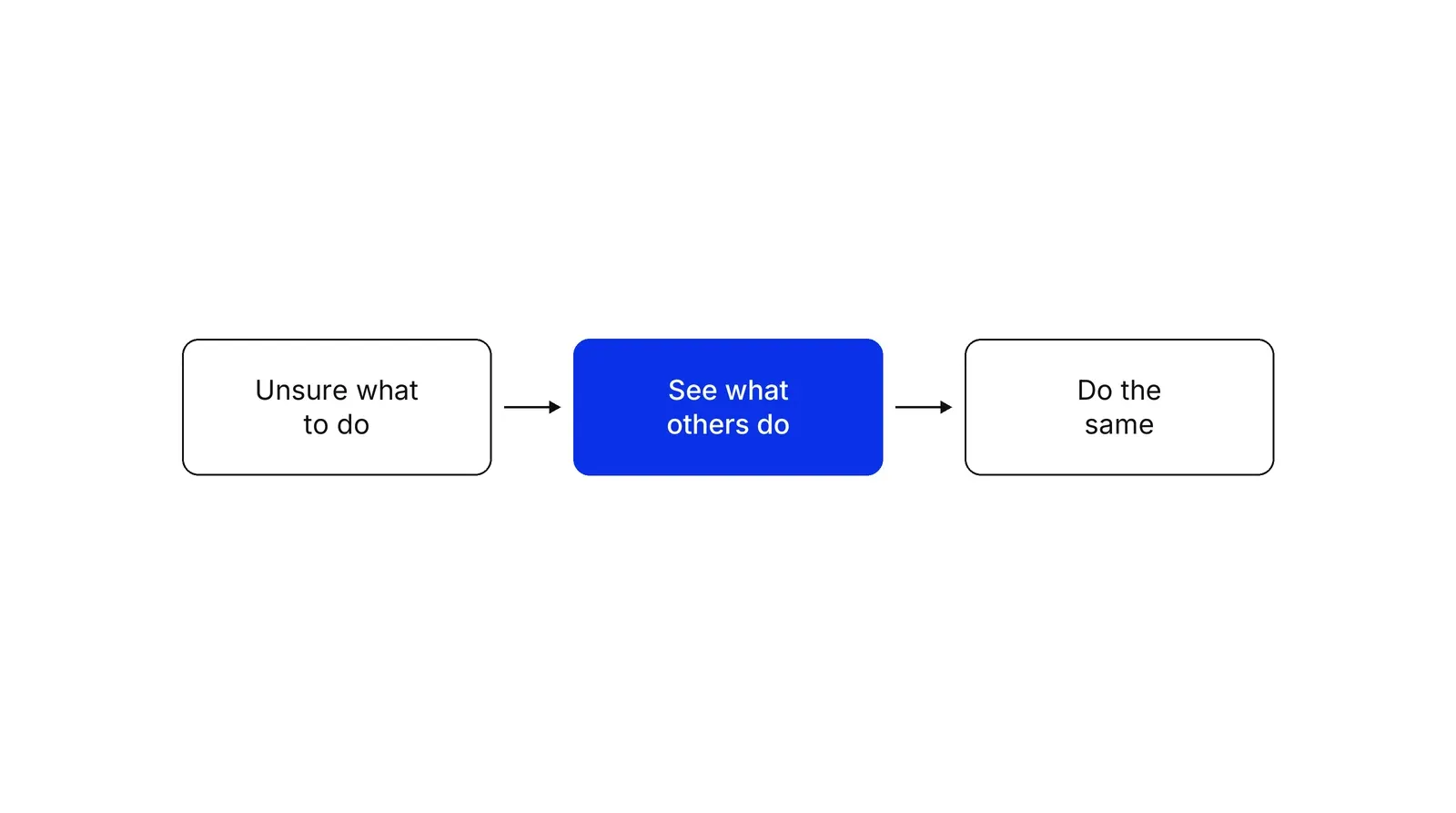
Social proof is the tendency to treat other people's behavior as evidence of what to do, especially when we are unsure. Robert Cialdini made the term famous in his book Influence. In marketing it means ratings, reviews, usage numbers and peer examples that lower doubt. It works best when the numbers are true, the group resembles the buyer, and the message does not normalize the wrong behavior.
- Origin
- Robert B. Cialdini (term popularised in Influence), 1984
- Level
- 201 · Tool
- Fits
- Startup, Small and mid-size, Scale-up
- Time to apply
- half a day to map doubts and proof, then a two-week test per placement
- What you need
- the three or four moments in your funnel where buyers hesitate (pricing page, checkout, sign-up) · real data you may publish: customer counts, ratings, repeat rates, with a date · a way to ask every customer for a review, not only the happy ones
Social proof is the habit of using other people’s behavior as evidence of what to do. Robert Cialdini gave the idea its popular name in his book Influence, first published in 1984. His own site sums it up in one line: when people are uncertain, they look to the actions of others to decide their own. This page covers social proof alone. The full set of Cialdini’s levers sits in Cialdini’s principles of persuasion.
How does social proof work?
Social proof works because uncertainty is uncomfortable and other people are a cheap source of information. If a buyer cannot judge a product directly, the choices of earlier buyers stand in for a test. The more unsure the buyer, the more weight the crowd gets.
An early field demonstration is the street study by Stanley Milgram and colleagues (1969), which measured how the drawing power of a staring crowd changes with its size. A lab version of the same logic is the music market of Salganik, Dodds and Watts (2006). They gave 14,341 participants a list of unknown songs, and some saw how often each song had been downloaded. Those who saw download counts produced more unequal and less predictable outcomes across eight separate worlds. The best songs rarely did badly and the worst rarely did well, but nearly anything in between could take off.
What do the field studies show?
The strongest evidence comes from experiments that changed one message and counted real behavior. Goldstein, Cialdini and Griskevicius (2008) put signs in hotel rooms. In the first experiment 35.1% of guests reused towels after the standard environmental appeal and 44.1% after a sign saying most guests reuse them. In the second, a sign naming guests in the same room reached 49.3%, against 37.2% for the standard sign. The authors call this closeness a provincial norm.
| Study | Setting | Result |
|---|---|---|
| Goldstein et al., 2008 | US hotel towels | Most-guests sign beat the standard appeal, 44.1% to 35.1% |
| Cai et al., 2009 | Restaurant menu | Listing the five most popular dishes raised demand for them by 13 to 20% |
| Allcott, 2011 | About 600,000 households | Neighbor comparison cut electricity use 2.0% on average |
| Bond et al., 2012 | 61 million Facebook users | Political mobilization messages moved real voting, and also the voting of recipients’ friends |
Does it always replicate?
No. Bohner and Schlüter (2014) ran the towel test again in two German hotels. Any message raised reuse over no message in their second study, but norm messages did not beat the standard environmental message. In the first study the standard message scored 83.7% and the combined norm messages 81.9%. The same-room advantage reversed in the first study and was not significant in the second. The authors suggest culture and already high reuse rates as reasons. Treat the original effect as real in its setting and as untested in yours until you run your own test.
How can social proof backfire?
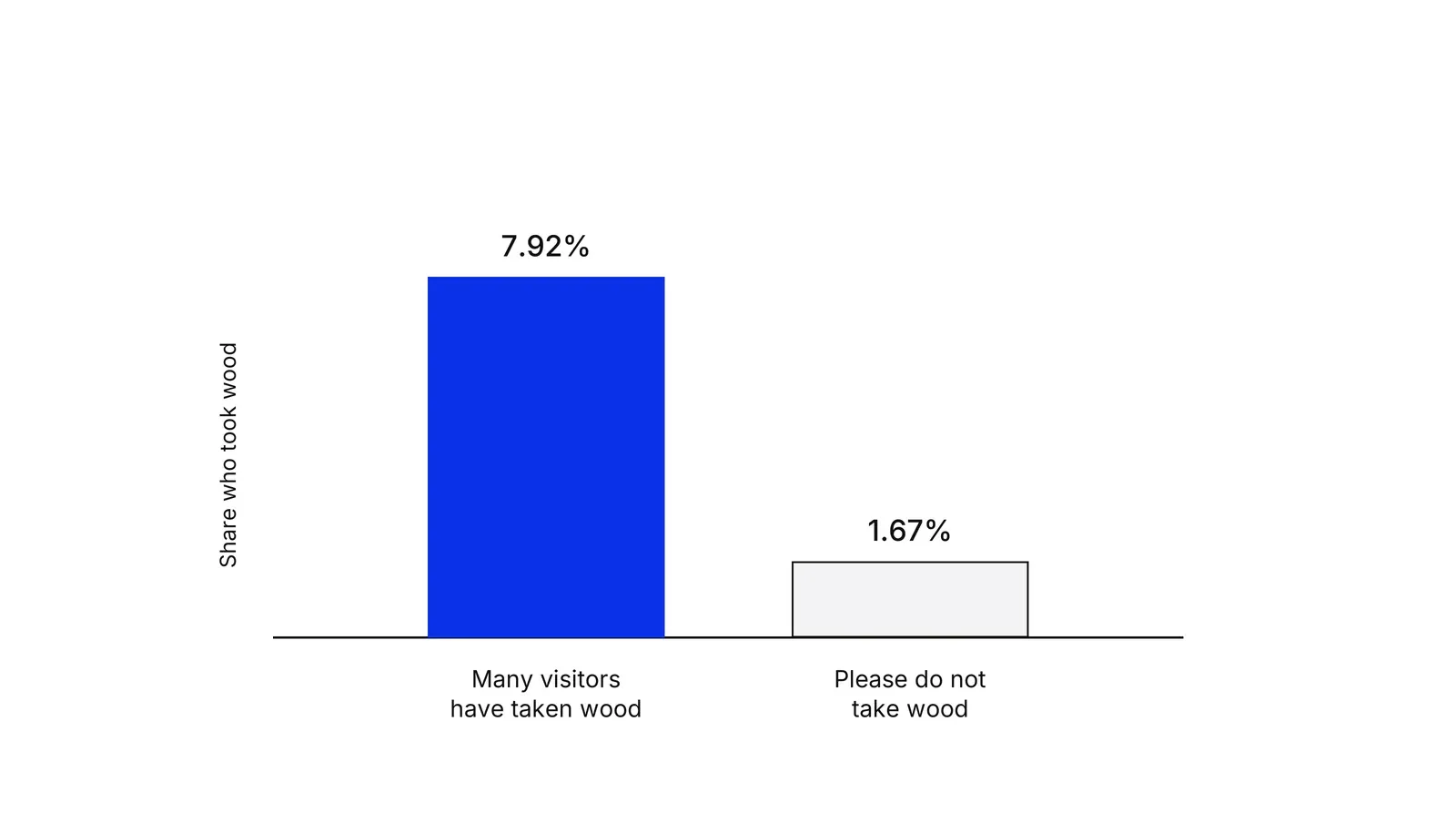
Social proof backfires when the message describes a crowd doing the wrong thing. Cialdini, Reno and Kallgren (1990) found that 41% of people littered into a littered area against 11% in a clean one. The Petrified Forest study (Cialdini and colleagues, 2006) tested signs against stealing petrified wood. A message stressing that many visitors had taken wood was followed by theft of 7.92% of marked pieces. A plain request not to take wood, worded to focus on disapproval, brought it down to 1.67%.
Schultz and colleagues (2007) saw the same pattern in household energy use. A descriptive message about the neighborhood average cut use among heavy users but raised it among households already below the average. Adding an approval message removed that boomerang effect. The practical rule: describe common behavior only when it is the behavior you want, and add approval when it is not.
What do reviews and ratings add?
Reviews turn social proof into a number that buyers can compare, and the effect on sales can be measured. Michael Luca (2011) estimated that a one-star rise in Yelp rating lifts restaurant revenue by 5 to 9%, with the effect found for independent restaurants and not for chains. Chevalier and Mayzlin found that one-star reviews of books had more impact than five-star ones. The Spiegel Research Center reports that a product with five reviews was 270% more likely to be bought than one with none, with a larger effect for higher-priced items, and that purchase likelihood peaks at ratings of 4.0 to 4.7 rather than 5.0.
Two cautions come with that. Ratings are not independent opinions: Muchnik, Aral and Taylor (2013), on a news-sharing site, randomly gave comments an early up-vote, which raised the chance of further positive ratings by 32% and final ratings by 25% on average. And ratings can be gamed. Mayzlin, Dover and Chevalier (2014) found that independent hotels with a strong incentive had more positive reviews on an open site than on one limited to actual customers.
What are the legal limits on reviews?
In the US, the FTC announced a final rule against fake reviews and testimonials on August 14, 2024, by a 5-0 vote, and it took effect on October 21, 2024. It bans fake or AI-generated reviews, paying for reviews that state a particular sentiment, undisclosed insider reviews, and threats or groundless legal action to suppress reviews, and it lets courts impose civil penalties for knowing violations. According to the FTC’s questions and answers, asking all purchasers for reviews is allowed, and incentives are not banned as long as they are not tied to a particular sentiment. The agency also updated its Endorsement Guides in 2023.
In the UK, the DMCC Act bans fake reviews and concealed incentivised reviews. The CMA guidance is dated 4 April 2025, and the CMA can fine up to 10% of worldwide turnover. A Growth Lab plan starts from the moments of doubt in the funnel and picks proof for each one, and it keeps the claims you publish within these rules.
How to apply Social proof, step by step
- Find the moment of doubt. Look at funnel drop-off and at what prospects ask sales or support before they commit. Social proof helps where people are unsure, so place it at those points, not on every page. Result: a short list of two to four screens or conversations where doubt is highest.
- Name the doubt in one sentence. Write what the buyer is afraid of: that nobody else uses this, that the product is not safe, that it will not work for a business like theirs. Each fear needs a different kind of proof. Result: one sentence per fear, such as 'a small clinic worries that tools like this are built for hospitals'.
- Match the proof to the fear. Use counts for the 'does anyone use this' fear, ratings with real review text for quality, and named peers or a segment such as 'dental clinics' for the 'is this for me' fear. The closer the reference group, the better, which is the finding of the hotel-room study below. Result: one proof item chosen for each fear.
- Publish only numbers you can defend. State the count, the period and what was counted, for example 'rated 4.6 from 212 verified reviews since January'. Keep the underlying data. Fake or inflated figures now carry legal risk in the US and UK. Result: every proof item has a date, a definition and a source file.
- Check what the message normalizes. Read each message as if it described a crowd doing something. 'Most people skip onboarding' tells new users that skipping is normal. Pair any description of common behavior with a statement of what is approved. Result: a reviewed set of messages with no accidental invitation to do the wrong thing.
- Ask every customer for a review on a schedule. Send a generic review request to all customers after a fixed event, such as day 14 or the first completed payout. Do not pick only the happy ones, and do not condition any reward on the rating. Result: a steady flow of reviews that shows the real spread of opinions.
- Test each placement. Change one proof item at a time and measure the step it sits on, not the whole funnel. Keep a no-proof variant for comparison. Result: a short table of which placements moved the metric and which did nothing.
Examples
Opower home energy reports
Opower mailed households a letter comparing their electricity use with that of neighbors. Hunt Allcott analyzed randomized experiments covering about 600,000 households and found an average cut of 2.0% in consumption, comparable to a short-run price rise of 11 to 20%. The heaviest users cut by 6.3% and the lightest by 0.3%. Allcott attributes part of the gap to the neighbor comparison the letters contained.
Hospital ratings on Yelp
Bardach and colleagues compared Yelp ratings of US hospitals with the official patient-experience survey. Only 962 of 3,796 hospitals had Yelp scores, but among those with more than five ratings the correlation with the survey's percent of high ratings was 0.49. Patients reading stars are reading something related to care quality, which is the case for showing them.
A cross-border payments landing page
Illustrative, no real company implied. A payments company sells to importers who fear that a new provider will hold their money. The headline claim 'trusted by businesses worldwide' answers no fear. A line such as 'about 1,200 importers settled payments with us in the last 90 days, median settlement time 6 hours', with the method linked, names a count, a period and a measure the buyer can check.
When to use it
Use it where buyers are unsure and cannot judge quality before buying: new brands, high-priced or high-risk purchases, sign-up pages, marketplaces, and products with many look-alike rivals. It also helps behavior change, as in energy saving or on-time payment, when a majority really does behave the way you want.
When not to use it
Skip descriptive numbers when most people do the wrong thing, because 'many customers pay late' can raise late payment. Skip it when you cannot support the figure, since fake or misleading reviews are illegal in the US and UK. It also adds little when buyers already know the product well from direct experience.
Common mistakes
- Showing a vague claim such as 'trusted by thousands' with no count, date or definition, which reads as marketing and gives the buyer nothing to check.
- Describing a bad habit as common ('most users never finish setup'), which tells readers that skipping is normal.
- Collecting reviews only from happy customers or deleting bad ones. Ratings of a perfect 5.0 can look less believable than 4.5, and review suppression is regulated.
- Using a reference group the buyer does not identify with, such as enterprise logos on a page aimed at small clinics.
- Treating a single study as a law. The hotel towel result did not hold in a German replication.
FAQ
What is social proof in marketing?
It is evidence that other people have chosen or approved something, shown to someone who is deciding. Examples are star ratings, review text, customer counts, 'most popular' labels and named peers. The idea comes from psychology research on how people copy others when unsure, popularized by Robert Cialdini in his book Influence.
Who coined the principle of social proof?
Robert Cialdini named and popularized it in Influence, first published in 1984. The underlying ideas come earlier from social psychology, including conformity and norm studies. Cialdini's own site describes it as people looking to others' actions when they are uncertain.
Does social proof really work, or is it hype?
Field experiments support it in several settings: restaurant dish rankings raised orders of the listed dishes by 13 to 20 percent, and neighbor comparisons cut household energy use by about 2 percent. Results are not universal, since a German hotel replication found no advantage for norm messages over a standard appeal.
Can social proof backfire?
Yes. Messages that describe a common bad behavior can increase it. In the Petrified Forest study, a sign saying many visitors took wood was followed by theft of 7.92 percent of marked pieces, against 1.67 percent for a plain 'do not take' message. Neighbor-comparison letters also pushed low users up until an approval message was added.
Is it legal to buy reviews or hide bad ones?
In the US, the FTC rule effective October 21, 2024 bans fake reviews, paying for a particular sentiment, undisclosed insider reviews and intimidating reviewers into removal. In the UK, fake reviews and concealed incentivised reviews are banned under the DMCC Act, with fines of up to 10% of global turnover.
Sources
- Robert B. Cialdini, Influence: The Psychology of Persuasion, Open Library record
- Influence at Work, The 7 principles of persuasion
- Noah J. Goldstein, Robert B. Cialdini, Vladas Griskevicius, A Room with a Viewpoint: Using Social Norms to Motivate Environmental Conservation in Hotels, Journal of Consumer Research 35(3), 2008
- Gerd Bohner, Lena E. Schlüter, A Room with a Viewpoint Revisited: Descriptive Norms and Hotel Guests' Towel Reuse Behavior, PLoS ONE 9(8), 2014
- Robert B. Cialdini, Raymond R. Reno, Carl A. Kallgren, A Focus Theory of Normative Conduct, Journal of Personality and Social Psychology 58(6), 1990
- Robert B. Cialdini and others, Managing Social Norms for Persuasive Impact, Social Influence 1(1), 2006
- P. Wesley Schultz and others, The Constructive, Destructive, and Reconstructive Power of Social Norms, Psychological Science 18(5), 2007
- Hunt Allcott, Social Norms and Energy Conservation, Journal of Public Economics 95(9-10), 2011
- Matthew J. Salganik, Peter Sheridan Dodds, Duncan J. Watts, Experimental Study of Inequality and Unpredictability in an Artificial Cultural Market, Science 311, 2006
- Robert M. Bond and others, A 61-Million-Person Experiment in Social Influence and Political Mobilization, Nature 489, 2012
- Lev Muchnik, Sinan Aral, Sean J. Taylor, Social Influence Bias: A Randomized Experiment, Science 341, 2013
- Stanley Milgram, Leonard Bickman, Lawrence Berkowitz, Note on the Drawing Power of Crowds of Different Size, Journal of Personality and Social Psychology 13(2), 1969
- Hongbin Cai, Yuyu Chen, Hanming Fang, Observational Learning: Evidence from a Randomized Natural Field Experiment, American Economic Review 99(3), 2009
- Judith A. Chevalier, Dina Mayzlin, The Effect of Word of Mouth on Sales: Online Book Reviews, NBER Working Paper 10148
- Michael Luca, Reviews, Reputation, and Revenue: The Case of Yelp.com, Harvard Business School Working Paper 12-016
- Dina Mayzlin, Yaniv Dover, Judith Chevalier, Promotional Reviews: An Empirical Investigation of Online Review Manipulation, American Economic Review 104(8), 2014
- Northwestern Medill Spiegel Research Center, How Online Reviews Influence Sales
- Naomi S. Bardach and others, The Relationship Between Commercial Website Ratings and Traditional Hospital Performance Measures in the USA, BMJ Quality & Safety 22(3), 2013
- Federal Trade Commission, Federal Trade Commission Announces Final Rule Banning Fake Reviews and Testimonials, August 14, 2024
- Federal Trade Commission, Consumer Reviews and Testimonials Rule: Questions and Answers
- Federal Trade Commission, Federal Trade Commission Announces Updated Advertising Guides to Combat Deceptive Reviews and Endorsements, June 29, 2023
- Competition and Markets Authority, Fake reviews: guidance on the prohibition under paragraph 13 of Schedule 20 to the DMCC Act 2024 (CMA208), 4 April 2025
- GOV.UK, CMA to boost consumer and business confidence as new consumer protection regime comes into force
Last updated Oct 9, 2026


Marketing agency or growth system: when a company outgrows its agency
An agency is the right call while the founder still runs most of the company. Once the business starts copying itself into new locations or markets, it needs a system that sets goals, tests hypotheses and owns the result.

Why healthcare marketing agencies stall: the short, mid and long wins model we use with clinics
Most agencies own the click and nobody owns the front desk. How we structure clinic work in three horizons, the research behind each one, and one year of results.

Why channel tests stall after month three
Most paid channel tests do not end with a decision. They end when the budget runs out, the attribution model changes, or everyone quietly stops looking at the dashboard.