Dark social
Dark social is the sharing of links through private channels such as messaging apps and email, which reaches your site without a referrer and so hides inside Direct traffic; this page shows how to estimate it.
Dark social is the sharing of links through private channels such as messaging apps, email and text messages, which analytics tools cannot trace because the visit arrives without a referrer. Alexis Madrigal of The Atlantic named it in an October 2012 article. Such visits are counted as Direct traffic, so teams estimate them by analysing Direct landings and by asking customers how they heard about the company.
- Origin
- Alexis C. Madrigal, The Atlantic, with data from Chartbeat, 2012
- Level
- 301 · Advanced
- Fits
- Small and mid-size, Scale-up
- Time to apply
- one afternoon to segment Direct traffic and add the question to a form; four to eight weeks before the answers are worth reading
- What you need
- access to your web analytics with landing page and new-versus-returning reports · one required free-text field on a sign-up, booking or checkout form · a person who reads and codes the answers every week
Dark social is the sharing of links through private channels, such as messaging apps, email and text messages, that web analytics cannot trace back to its source. Alexis Madrigal, then a senior editor at The Atlantic, coined the term in an October 2012 article. His argument was that social networks did not invent sharing on the web. People had been passing links by email and instant messenger since the 1990s; Facebook and Twitter made that sharing public and countable.
Today the idea matters to anyone whose customers recommend them in a WhatsApp group, a Slack channel or a forwarded email. That traffic is real, and in most reports it is invisible.
Why private shares look like Direct traffic
A browser normally tells your site which page a visitor came from, in a header called Referer. When that information is missing, analytics has nowhere to put the visit except Direct. Google Analytics 4 defines the Direct channel as source “(direct)” with medium “(none)” or “(not set)”, and describes it as a saved link or a typed URL.
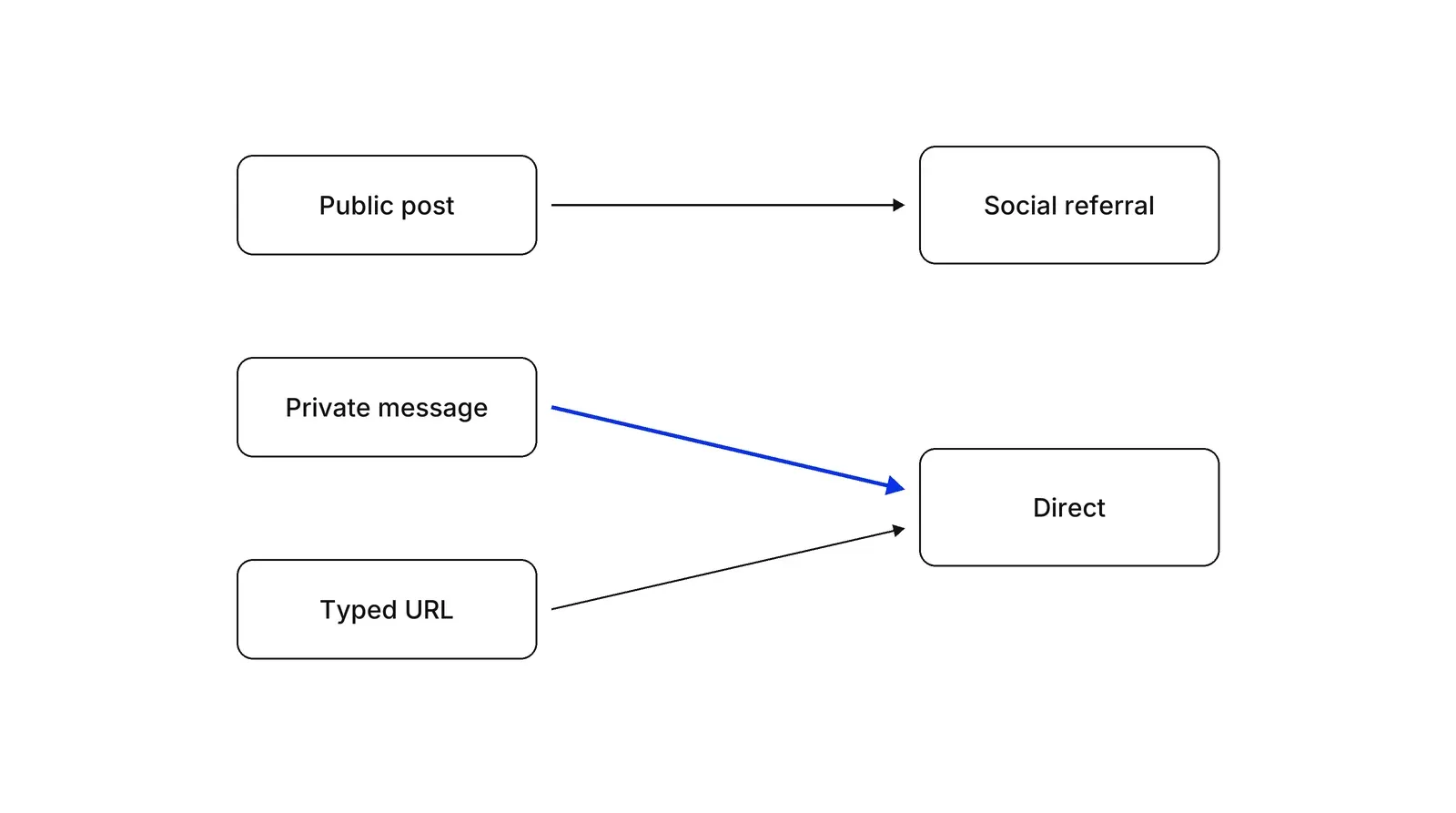
The referrer goes missing for several documented reasons:
- Apps: links opened from email programs, messengers and some mobile apps often carry no referrer, which Madrigal listed in 2012.
- Protocol rules: the HTTP standard, RFC 9110, says a browser must not send a referrer from a secure HTTPS page to an unsecured HTTP page.
- Browser defaults: since Chrome 85 in 2020, Chrome’s default referrer policy sends only the origin across sites and nothing on an HTTPS to HTTP move. Pages can also opt out entirely with the no-referrer policy.
- Privacy features: Apple’s Link Tracking Protection, announced in 2023, strips some tracking parameters from links shared in Messages and Mail.
Platforms can reverse this. Chartbeat reported that after Yahoo added a referrer tag to its homepage, attributable Yahoo traffic rose about six times, and a LinkedIn change tripled measured LinkedIn referrals across its network. Both show how much social traffic had been sitting in the dark bucket.
How Chartbeat first separated it
The method behind Madrigal’s article is simple enough to copy. Chartbeat took visits with no referrer and split them by landing page. Visits to the homepage or a section page could plausibly be typed or bookmarked. Visits to any deeper page, such as a long article URL, were almost certainly someone following a link, so Chartbeat counted them as a separate source.
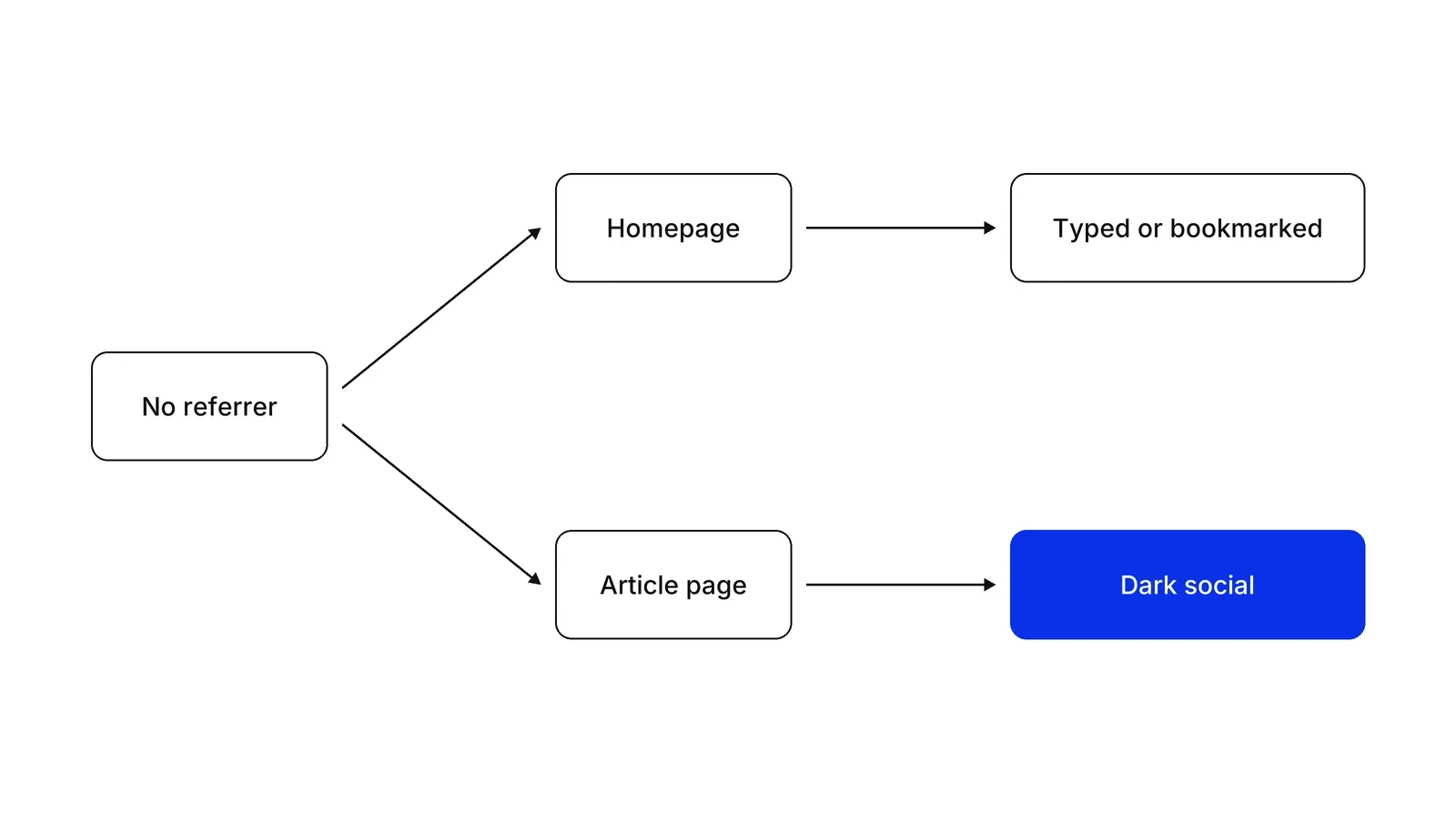
On the first day Madrigal saw the split, according to his article, dark social was 56.5% of The Atlantic’s social traffic. Across Chartbeat’s media clients it was almost 69% of social referrals, with Facebook at 20% and Twitter at 6%. Per Chartbeat’s aggregate, direct and dark social made up 17.5% of all referrals, second only to search at 21.5%.
How big is dark social now?
Nobody has a current benchmark that applies to your site, and the numbers people quote come from very different samples. Madrigal’s figures came from media sites in 2012, when Chartbeat’s Josh Schwartz estimated only about 4% of traffic was mobile.
The most useful recent test is SparkToro’s 2023 experiment: 1,113 visits from about 100 panelists, through 11 networks and 5 private messaging systems, tracked in Google Analytics.
| Source in the SparkToro test | Share recorded as Direct |
|---|---|
| WhatsApp, Slack, Discord, Mastodon, TikTok | 100% |
| Facebook Messenger | 75% |
| Instagram direct messages | 30% |
| LinkedIn public posts | 14% |
| Pinterest public posts | 12% |
The panel was mostly in the US and Canada, and the author calls it a snapshot. Private messaging is common elsewhere too: the Reuters Institute’s 2017 Digital News Report found 23% of respondents across 36 markets used messaging apps to find, share or discuss news each week, with WhatsApp news use at 51% in Malaysia and 3% in the US.
Direct is not the same as dark social
Direct is a bucket; dark social is one thing inside it. Groupon’s director of search de-indexed the site from Google and found that for every 10 search visits lost, about 6 Direct visits disappeared too, according to BrightEdge’s case study. Some Direct traffic is organic search without a referrer. Some is genuinely typed: when Facebook went down for 45 minutes in 2018, Chartbeat saw direct traffic to publishers rise 11%.
| Term | What it covers | Can analytics see it? |
|---|---|---|
| Direct traffic | Every visit without a referrer or campaign tags | Yes, as one bucket |
| Dark social | Links shared privately, arriving as Direct | Only by inference |
| Offline word of mouth | Recommendations in conversation, no link at all | No |
Offline talk is larger than many marketers assume. Ed Keller and Brad Fay argued in the Journal of Advertising Research that most consumer recommendations happen face to face. Only a self-reported question catches those.
Measuring with self-reported attribution
Self-reported attribution means asking customers how they heard about you and treating the answers as data. It is the only method that can name a WhatsApp group or a colleague. It is also biased. Markus Prior’s 2009 study found people overstated their network news viewing by a factor of three on average compared with Nielsen ratings, and Pew Research Center says such surveys tend to inflate estimates. Closed answer lists add a primacy effect, documented by Krosnick and Alwin, where people pick early options.
That is why the steps below use a required free-text field and read trends, not single months.
Why the effort pays off
Recommendations persuade. Nielsen’s 2015 Global Trust in Advertising survey found 83% of respondents completely or somewhat trusted recommendations from friends and family. Trusov, Bucklin and Pauwels found in a 2009 Journal of Marketing study that word-of-mouth referrals had longer carryover and higher response elasticities than traditional marketing at a social networking site. If you cannot see that channel, you will underfund whatever feeds it.
For budget questions, combine these signals with causal methods such as marketing mix modeling or geo experiments, which Vaver and Koehler describe as randomly assigning regions to treatment and control. In Pushers’ Growth Lab work, dark social sits next to the viral coefficient as an input to the growth model rather than a channel to buy.
How to apply Dark social, step by step
- Find the Direct traffic that cannot be typed. In your analytics, filter Direct sessions and group them by landing page. Separate the homepage and short section pages from deep pages with long URLs, such as articles, product pages or a pricing page with parameters. Result: a weekly count of Direct sessions that start on pages nobody types from memory.
- Tag the links you share yourself. Put UTM parameters on every link in your newsletters, sales emails, share buttons and messenger broadcasts, and use a separate value for each channel. Google Analytics says utm_source, utm_medium and utm_campaign should always be set. Result: your own sends leave Direct, so what remains there is closer to sharing by other people.
- Ask new customers how they heard about you. Add a required free-text question at the moment of conversion, not a dropdown. Free text avoids the primacy effect of answer lists and lets people write 'a friend sent it on WhatsApp'. Result: a column of raw answers attached to each new customer record.
- Code the answers into a short list of channels. Once a week, map each answer to one channel, keeping 'friend or colleague', 'messenger group', 'email forward' and 'community' as separate codes. Leave unclear answers as 'unknown' instead of guessing. Result: a monthly share of new customers who came through private recommendation.
- Compare the two signals and act on the gap. Put the dark Direct trend from step 1 next to the self-reported share from step 4. If both rise when you change something, such as a referral offer or a more shareable report, treat the change as working. Result: a monthly note on whether private sharing is growing and which changes moved it.
- Check big decisions with a test. Before cutting or doubling a budget on the strength of survey answers, run a holdout or geo experiment. Result: a causal estimate that does not depend on referrers or on what customers remember.
Examples
The Atlantic, 2012
Madrigal reported that Chartbeat had begun counting no-referrer visits to article pages, as opposed to the homepage, as a separate source. According to Madrigal, on the first day he looked these visits made up 56.5% of The Atlantic's social traffic against 43.5% from all social networks combined, more than two and a half times Facebook's contribution. According to Chartbeat's aggregate for its media clients, almost 69% of social referrals were dark, Facebook 20% and Twitter 6%. The lesson he drew was that the only way to optimize for this kind of sharing is the content itself.
A payments app for freelancers
Illustrative, no real company implied. A small payments app for freelancers gets 900 Direct sessions a week. 300 land on the homepage and 600 on deep pages such as a fee calculator for one currency corridor. After the team tags its own emails, Direct deep-page sessions fall to 400, so about 200 had been the company's own sends. Of 80 new accounts that week, 20 write answers coded as 'a friend or a freelancer group', one in four. The team builds a shareable fee comparison link and tracks both numbers.
A dental clinic's booking form
Illustrative, no real clinic implied. A clinic adds 'How did you hear about us?' as a required free-text field to online booking. Over eight weeks, 320 new patients answer; 96 mention a relative, a colleague or a parents' chat, which is 30%, while analytics showed only Direct and search for those bookings. The clinic adds a referral card at checkout and keeps the question to see whether the 30% moves.
When to use it
Use it when Direct traffic is large or growing and nobody can explain it, when customers say they heard about you from friends but your attribution shows search and Direct, or when your product is the kind people forward in messengers: articles, price comparisons, health advice, financial tools. It is also the right lens before you judge a content or community program on last-click numbers alone.
When not to use it
Skip it when nearly all of your growth comes from paid channels with click IDs and server-side conversion tracking, since private sharing is then a small share of new customers. It also does not answer how much revenue a channel causes; for that you need incrementality tests or marketing mix modeling.
Common mistakes
- Treating all Direct traffic as dark social. Groupon's experiment showed that a large part of Direct can be organic search that lost its referrer.
- Using a dropdown with your favorite channels at the top, which invites people to pick the first plausible option.
- Making the how-did-you-hear question optional, so the people who answer are not the people who bought.
- Copying a benchmark such as the 69% from Chartbeat's 2012 media sample and applying it to your own site.
- Leaving your own newsletters and sales emails untagged, then counting their clicks as private sharing by customers.
FAQ
What is dark social?
Dark social is link sharing through private channels such as WhatsApp, Slack, text messages and email, where the visit reaches your site without information about where it came from. Alexis Madrigal of The Atlantic coined the term in October 2012 after Chartbeat data showed most social traffic to the site arrived this way.
Is dark social the same as direct traffic?
No. Direct is the bucket analytics uses for any visit without a referrer or campaign tags, including typed addresses, bookmarks, some search visits and private shares. Dark social is the part of Direct that came from someone sending a link. Deep landing pages are the usual clue, because people rarely type long URLs.
Why does traffic from WhatsApp show as direct?
Messaging apps open links in a way that does not pass a referrer to your site. In SparkToro's 2023 test, every recorded visit from WhatsApp, Slack, Discord, Mastodon and TikTok showed up in Google Analytics as Direct, along with three quarters of visits from Facebook Messenger.
How do you measure dark social?
Combine three signals. Count Direct sessions that land on deep pages, tag every link you send yourself with UTM parameters so it leaves Direct, and ask new customers a required free-text question about how they heard of you. For budget decisions, confirm with a holdout or geo test.
Is a how did you hear about us survey reliable?
It is useful but biased. People remember recent and memorable touchpoints, and research on media exposure, such as Markus Prior's 2009 study, found self-reports can exaggerate exposure several times over. Use free text, make the question required, and read trends over months instead of trusting one month's shares.
Sources
- Alexis C. Madrigal, Dark Social: We Have the Whole History of the Web Wrong, The Atlantic, 12 October 2012
- Internet Archive, snapshot of Madrigal's Dark Social article, 20 October 2012
- Chartbeat, Yahoo Jumps to 6th Largest Web Referrer, Attributes Dark Social Traffic
- Chartbeat, Fighting Dark Social: LinkedIn Comes into the Light
- Chartbeat, Google Chrome Suggestions, in more detail than you could possibly want
- Chartbeat, What happens when Facebook goes down? People read the news, 2018
- Rand Fishkin, SparkToro, New Research: Dark Social Falsely Attributes Significant Percentages of Web Traffic as Direct, April 2023
- BrightEdge, case study on Groupon's de-indexing test of direct and search traffic
- IETF, RFC 9110 HTTP Semantics, section 10.1.3 Referer, 2022
- Chrome for Developers, A new default Referrer-Policy for Chrome: strict-origin-when-cross-origin
- MDN Web Docs, Referrer-Policy
- W3C, Referrer Policy, Candidate Recommendation, 26 January 2017
- Apple Newsroom, Apple announces powerful new privacy and security features, 5 June 2023
- Google Analytics Help, [GA4] Default channel group
- Google Analytics Help, URL builders: Collect campaign data with custom URLs
- Reuters Institute, Digital News Report 2017, Overview and key findings
- Reuters Institute and Kantar Media, News in social media and messaging apps, 2018
- Nielsen, Global Trust in Advertising, September 2015
- Michael Trusov, Randolph E. Bucklin, Koen Pauwels, Effects of Word-of-Mouth versus Traditional Marketing, Journal of Marketing 73(5), 2009
- Ed Keller, Brad Fay, Word-of-Mouth Advocacy, Journal of Advertising Research 52(4), 2012
- Jonah Berger, Word of mouth and interpersonal communication: A review and directions for future research, Journal of Consumer Psychology 24(4), 2014
- Jonah Berger, Eric M. Schwartz, What Drives Immediate and Ongoing Word of Mouth?, Journal of Marketing Research 48(5), 2011
- Markus Prior, The Immensely Inflated News Audience: Assessing Bias in Self-Reported News Exposure, Public Opinion Quarterly 73(1), 2009
- Pew Research Center, Assessing different survey measurement approaches for news consumption, December 2020
- Jon A. Krosnick, Duane F. Alwin, An Evaluation of a Cognitive Theory of Response-Order Effects in Survey Measurement, Public Opinion Quarterly 51(2), 1987
- Recast, How did you hear about us? survey and the limitations of current measurement techniques, May 2023
- Randall A. Lewis, Justin M. Rao, The Unfavorable Economics of Measuring the Returns to Advertising, Quarterly Journal of Economics 130(4), 2015
- Jon Vaver, Jim Koehler, Measuring Ad Effectiveness Using Geo Experiments, Google, 2011
Last updated Oct 9, 2026


Marketing agency or growth system: when a company outgrows its agency
An agency is the right call while the founder still runs most of the company. Once the business starts copying itself into new locations or markets, it needs a system that sets goals, tests hypotheses and owns the result.

Why healthcare marketing agencies stall: the short, mid and long wins model we use with clinics
Most agencies own the click and nobody owns the front desk. How we structure clinic work in three horizons, the research behind each one, and one year of results.

The compliance layer under fintech marketing operations
A fintech marketing agency can build campaigns. It cannot own the compliance review, the KYC drop-off or the multi-market licensing rules that decide whether a lead ever becomes a customer.