Distinctive brand assets
Distinctive brand assets are the colours, shapes, logos, characters, sounds and taglines that buyers link to one brand, measured by fame and uniqueness so you know which ones to use, build or drop.
Distinctive brand assets are non-name elements, such as a colour, a logo, a pack shape, a character or a sound, that buyers link to one brand and use to recognise it. Jenni Romaniuk of the Ehrenberg-Bass Institute set out how to build and measure them in Building Distinctive Brand Assets (2018), rating each asset on fame and uniqueness.
- Origin
- Jenni Romaniuk, Ehrenberg-Bass Institute, 2018 (book); the grid appeared in earlier Institute articles
- Level
- 301 · Advanced
- Fits
- Scale-up, Enterprise
- Time to apply
- two to four weeks for a first asset survey, then a re-measure every one to two years
- What you need
- a list of every element the brand uses: colours, logo, symbol, fonts, pack shapes, characters, sounds, taglines · versions of each element with the brand name removed · a survey panel of category buyers, including people who do not buy your brand
Distinctive brand assets are the elements other than the brand name that buyers use to recognise a brand: a colour, a logo, a pack shape, a character, a sound, a tagline. Jenni Romaniuk, a research professor at the Ehrenberg-Bass Institute in Adelaide, described an asset as something that “uniquely signal[s] the brand” in an Institute article, and set out how to build and measure them in her 2018 book Building Distinctive Brand Assets. Her Institute profile calls her the key architect of its asset measurement.
Brand managers use the method before a redesign, when writing brand guidelines and when briefing ads. It answers a narrow question: which of our cues still work if the name is hidden?
Why distinctiveness gets its own budget
An asset matters because buyers rarely read ads or packs closely. If a cue tells them which brand they are looking at in a glance, the ad or the shelf does its job even when the name is missed.
The Institute’s case starts with differentiation. In a 2007 paper Romaniuk, Byron Sharp and Andrew Ehrenberg reported that buyers see little difference between competing brands and still buy them, and argued for putting distinctiveness at the centre of brand strategy. Assets feed what Sharp and Romaniuk call mental and physical availability: they help buyers think of the brand and spot it.
Branding inside ads is part of the same argument. Romaniuk’s 2009 review found that showing the brand early and often, with at least one spoken mention, helps people recall which brand an ad was for. Assets give an ad more ways to show the brand without repeating the logo.
The idea also fits older theory. Kevin Lane Keller’s 1993 brand equity model treats brand knowledge as a network of memory links, and holds that equity needs associations that are strong and unique.
Fame and uniqueness: the two measures
Romaniuk rates every asset on two scores. Fame is how many category buyers link the asset to your brand. Uniqueness is how exclusively it points to you rather than to competitors. Of the two, “uniqueness is most important,” she wrote in the same article, because a shared cue can sell for a rival.
The measurement starts from the asset, not the brand. Romaniuk and Magda Nenycz-Thiel tested four approaches with 880 consumers in banking, chocolate and hair care. They recommended showing the asset with the brand name removed and asking, without a list of brands, which brand it brings to mind.
Take a worked example. Of 100 category buyers shown your de-branded symbol, 30 name your brand, 10 name rivals and 60 name nobody. Fame is 30%. Of the 40 who named any brand, 30 named you, so uniqueness is 75%.
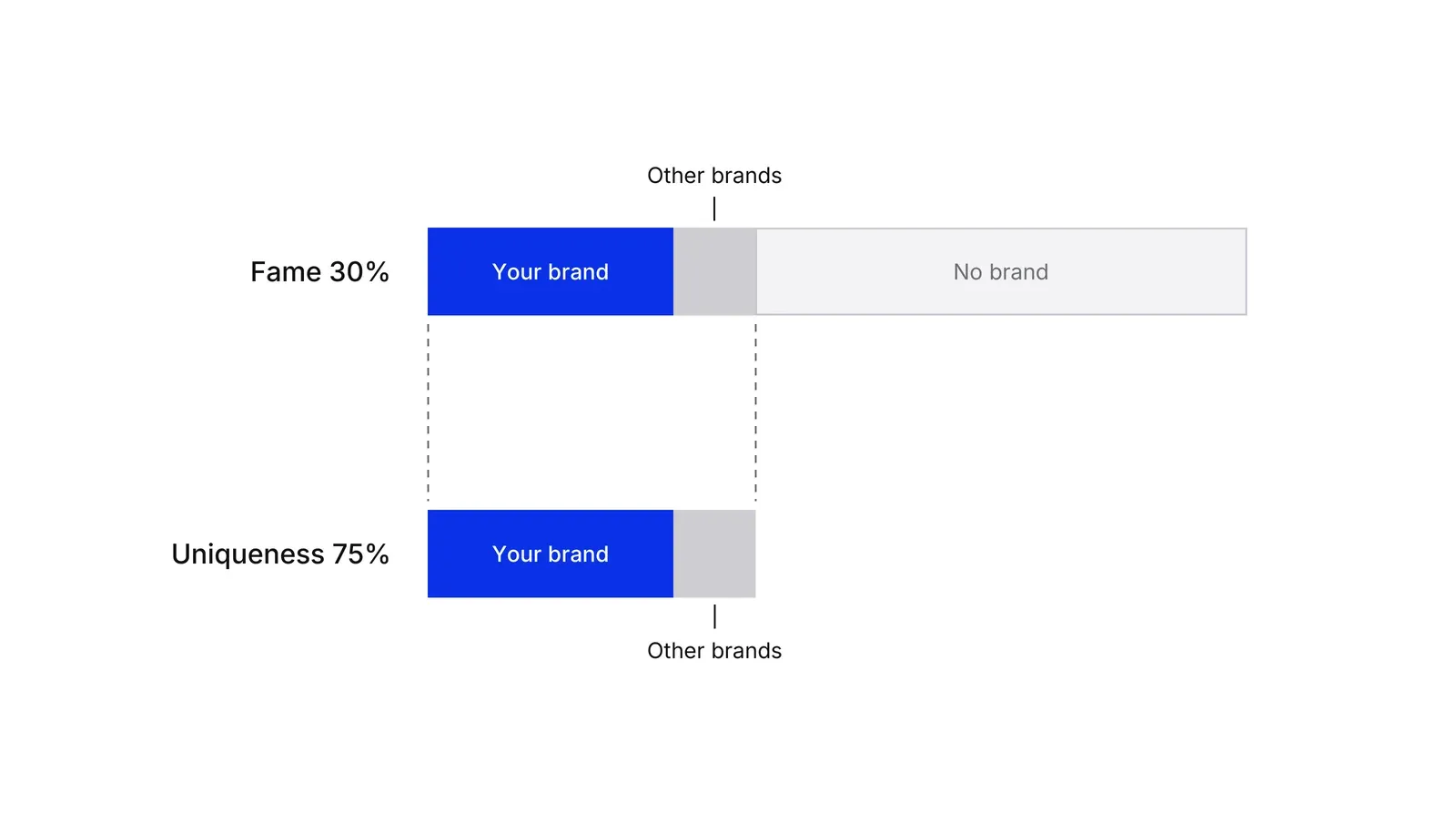
The fame and uniqueness grid
The grid crosses the two scores and gives each box an instruction. The labels below are the ones that Phua and colleagues and Mark Ritson’s course cite from the 2018 book.
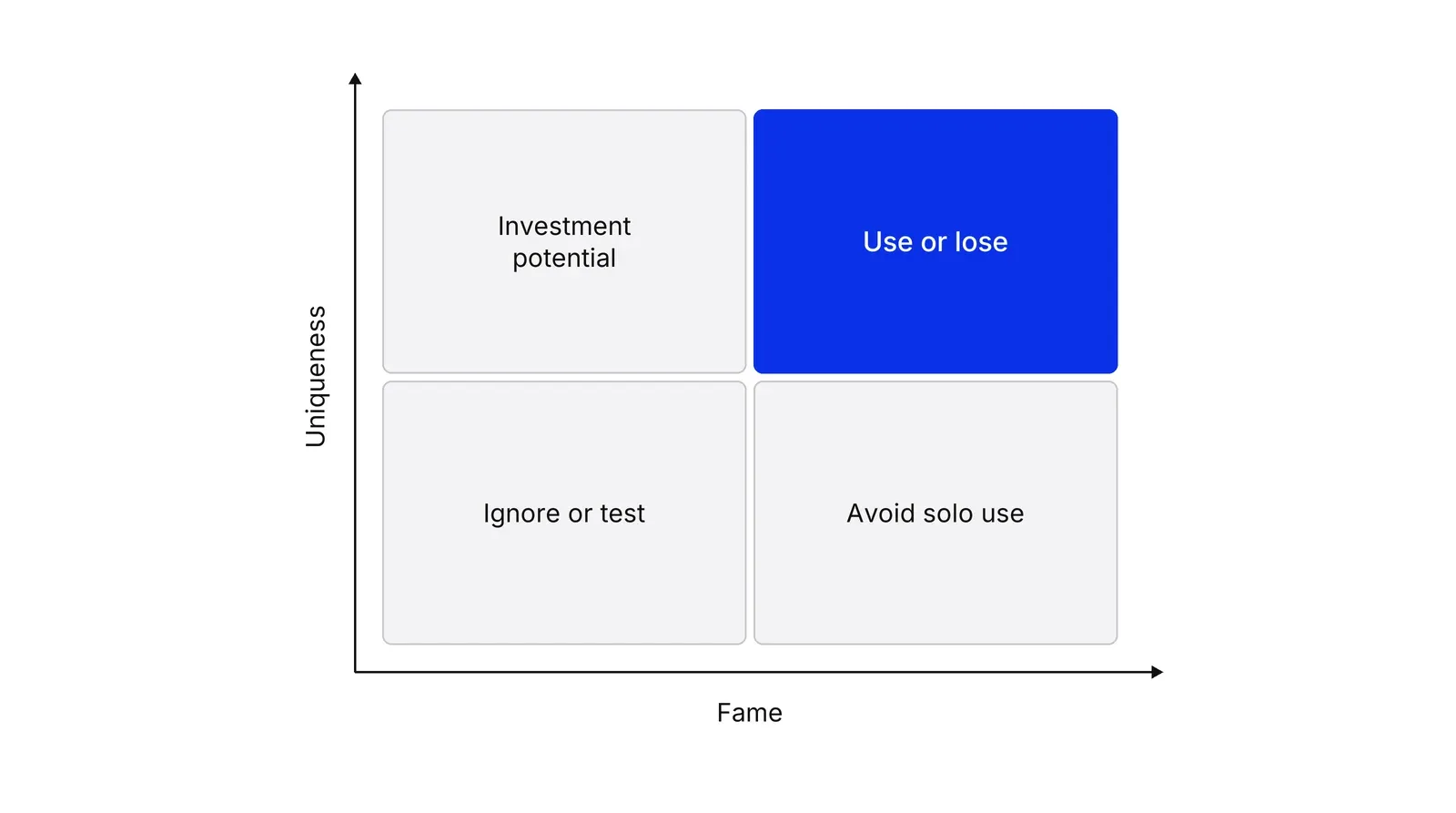
| Box | Fame | Uniqueness | What to do |
|---|---|---|---|
| Use or lose | High | High | Use it everywhere; it can replace or extend the name |
| Investment potential | Low | High | Keep using it consistently so more buyers learn it |
| Avoid solo use | High | Low | Show it only next to the brand name, since it also triggers rivals |
| Ignore or test | Low | Low | Test new assets over time; drop old ones that stay here |
An earlier Institute article used shorter labels: invest, avoid, and test or ignore. It also noted that every new asset starts in the bottom left. Where to draw the cut-off lines is a choice. Public summaries of the book do not agree on one figure, so fix your lines before you see the data and keep them between surveys.
Which asset types score best?
Shapes and characters tend to score highest; colour tends to score lowest. Three studies point the same way.
| Study | Sample | Finding |
|---|---|---|
| Ward, Yang, Romaniuk and Beal, 2020 | 1,281 elements, 13 packaged goods categories, 19 countries | Characters, logos and logotypes have the most potential for unique ownership; colour is often shared |
| Phua, Bali, Anesbury and Sharp, 2026 | 1,162 assets, 21 categories, 4 countries, 9 years | Shapes average 40% fame and 71% uniqueness; colours 12% and 39% |
| Fiocchi and Esfahani, 2024 | 44 UK car brand assets | Logos were the most ownable; fonts, slogans and colours were not |
Phua and colleagues also found narrative assets did relatively better for service brands. Ipsos reports a similar spread from its own database of more than 12,000 assets from over 900 brands: only 15% reach its top grade, and about one brand in five has a strong set.
For a fintech or a clinic, this means a colour alone is a weak bet. Banks, pharmacies and payment apps share a narrow band of blues and greens. A symbol, a character or a sound has a better chance of belonging to one brand.
Why teams misjudge their own assets
Marketers see their brand all day, so their sense of what buyers know is skewed. Ruby Brus and colleagues compared marketers’ judgements with consumer data for 405 brand elements from 50 brands in five categories. Marketers’ judgements were rarely accurate. They usually overestimated fame and underestimated uniqueness. The authors advise relying on consumer research, or at least judging as a group.
Dropping an asset has a cost
The cost of retiring a strong asset shows up fast. Tropicana removed the orange with a straw from its cartons in 2009; Romaniuk writes the image was back within a month and puts the lost sales at an estimated $26.3 million.
Going the other way, Mastercard dropped its name from its circles in some uses in 2019, citing 80% recognition of the symbol alone.
Ownership in memory and ownership in law are separate. The UK Court of Appeal refused Cadbury’s purple as a registered mark in 2013 because the wording of the application was too vague, even though distinctiveness was not in dispute.
From grid to palette
Most brands end up with a small set of assets used together. Romaniuk describes assets as “part of a larger palette or menu of branding options,” and Ritson’s course puts the practical limit at three to five codes. Design research helps with new candidates: Henderson and Cote’s study of 195 logos found that logos recognised accurately after investment tend to be natural, harmonious and moderately elaborate.
In Pushers’ marketing operational system work, the asset survey sits next to brand health tracking, so creative teams brief from data rather than taste.
How to apply Distinctive brand assets, step by step
- List every candidate asset. Go through packaging, ads, the app, the website and the store and write down each element that could signal the brand on its own, old ones included. Result: a long list of 10 to 30 candidates with a de-branded image or audio clip for each.
- Survey category buyers with the name removed. Show each de-branded asset to a sample of category buyers and ask, without a list, which brand it brings to mind. Include rivals' buyers and people who never bought from you. Result: for each asset, the share of buyers naming your brand, naming rivals and naming nobody.
- Score fame and uniqueness. Fame is the share of all category buyers who name your brand. Uniqueness is how much of the asset's brand linkage goes to you rather than to competitors. Result: two scores per asset, the same way every time.
- Place each asset on the grid. Set the cut-off lines before you look at the results, then put each asset in one of four boxes. Result: a short list of strong assets, a list to invest in and a list to stop funding.
- Write usage rules. Decide which assets appear in every execution, which may only appear next to the brand name, and which nobody may change without a new survey. Result: a one-page asset guide for agencies and in-house designers.
- Re-measure and protect. Repeat the survey every one to two years and before any redesign. Check whether rivals have started to copy your colours or shapes. Result: a trend for each asset and an early warning when one weakens.
Examples
Mastercard drops its name from the logo
In January 2019 Mastercard said its red and yellow interlocking circles would appear without the word Mastercard in some places, including at retail and online, the Associated Press reported. The company said 80 percent of people recognise the symbol when the name is absent. That figure is Mastercard's own and its method was not published, but the decision follows the grid's logic: a symbol that is both famous and unique can stand in for the name.
Tropicana's 2009 carton
Tropicana replaced the orange with a straw on its Pure Premium cartons with a plainer design. Jenni Romaniuk writes that the old image was back on the pack less than a month after the launch, and that the change was estimated to have cost $26.3 million in sales. Other published estimates of the loss differ, but every account agrees the brand reversed the redesign quickly.
A dental clinic chain before a rebrand
Illustrative, no real clinic implied. A chain of eight dental clinics plans a new identity. It surveys 300 local adults who have seen a dentist in the past year, showing its teal colour, its tooth symbol and its radio jingle with the name removed. The jingle is named correctly by 90 people and nobody names a rival: fame 30%, uniqueness 100%. The teal is named by 30 people for the chain and 60 for a pharmacy brand: fame 10%, uniqueness 33%. The chain keeps the jingle in every radio and video ad, and drops teal as a stand-alone cue.
When to use it
Use it before any rebrand, pack redesign or logo refresh, when agencies keep proposing new looks, when ads are remembered but the brand is not, and when you want a short list of cues to use the same way across every channel. It suits established brands with enough buyers that a survey can find real links.
When not to use it
A brand that is a few months old has no assets yet, so a survey will put everything in the low-fame corner; pick candidates and use them consistently first. It is also the wrong tool for deciding what the brand should stand for or say, which is a positioning question, and for choosing a legal trade mark strategy, which needs a lawyer.
Common mistakes
- Judging assets by team opinion. Marketers in a 2025 study overestimated fame and underestimated uniqueness compared with what buyers reported.
- Measuring with the brand name visible, which tests recognition of the name, not of the asset.
- Surveying only current customers, which inflates fame because these people already know the brand well.
- Treating a famous but shared asset, such as a category colour, as yours and using it without the brand name.
- Retiring a strong asset because the team is bored with it, long before buyers are.
FAQ
What are distinctive brand assets?
They are elements other than the brand name, such as colours, logos, pack shapes, characters, sounds and taglines, that buyers link to one brand. Jenni Romaniuk of the Ehrenberg-Bass Institute defines a true asset as both famous, known by many category buyers, and unique, linked to your brand and not to rivals.
What is the difference between fame and uniqueness?
Fame is how many category buyers link the asset to your brand when they see or hear it without the name. Uniqueness is how exclusively it points to you: an asset that also brings rivals to mind has low uniqueness. Romaniuk says uniqueness matters more, because a shared asset can help competitors.
How do you measure distinctive brand assets?
Remove the brand name from each asset, show it to a sample of category buyers and ask which brand it brings to mind, without offering a list. Romaniuk and Nenycz-Thiel tested four approaches with 880 consumers and recommended this asset-cued, unprompted question. Fame and uniqueness are calculated from the answers.
What are the four boxes of the distinctive asset grid?
In the version cited from Romaniuk's 2018 book: use or lose (famous and unique), investment potential (unique, not yet famous), avoid solo use (famous but shared with rivals) and ignore or test (neither). An earlier Institute article used the shorter labels invest, avoid and test or ignore for the same boxes.
What is the difference between distinctiveness and differentiation?
Differentiation is about giving buyers a reason to prefer the brand. Distinctiveness is about making the brand easy to identify. Romaniuk, Sharp and Ehrenberg reported in 2007 that buyers perceive little difference between competing brands yet still buy them, and argued that distinctiveness deserves more attention than it gets.
Sources
- Jenni Romaniuk, Building Distinctive Brand Assets, Oxford University Press Australia and New Zealand, 2018, Open Library record
- Ehrenberg-Bass Institute, Professor Jenni Romaniuk profile and books
- Ehrenberg-Bass Institute, Distinctive Asset Measurement
- Jenni Romaniuk, Brands of distinction, unisabusiness, republished by the Ehrenberg-Bass Institute
- Jenni Romaniuk, Brands need distinctive assets, Admap, republished by the Ehrenberg-Bass Institute
- Jenni Romaniuk and Magda Nenycz-Thiel, Measuring the strength of color brand-name links, Journal of Advertising Research 54(3), 2014
- Ella Ward, Song Hee Yang, Jenni Romaniuk and Virginia Beal, Building a unique brand identity: measuring the relative ownership potential of brand identity element types, Journal of Brand Management 27(4), 2020
- RePEc IDEAS, abstract of Ward, Yang, Romaniuk and Beal, Journal of Brand Management, 2020
- Stephen Whiteside, WARC, Characters and logos are the assets with greatest potential for unique brand ownership, April 2021
- Peilin Phua, Larissa Bali, Zachary Anesbury and Byron Sharp, Shape-based assets are strongest: benchmarking distinctive brand asset performance across industries, International Journal of Advertising, 2026
- Gianluca Fiocchi and Mona Seyed Esfahani, Exploring the uniqueness of distinctive brand assets within the UK automotive industry, Journal of Brand Management 31(1), RePEc IDEAS abstract
- Ruby Brus, Nicole Hartnett, Margaret Faulkner and Carl Driesener, Assessing branding strength: comparing marketer judgement and consumer data for brand identity elements, Journal of Brand Management 33(1), 2025
- Jenni Romaniuk, The efficacy of brand-execution tactics in TV advertising, brand placements, and internet advertising, Journal of Advertising Research 49(2), 2009
- Jenni Romaniuk, Byron Sharp and Andrew Ehrenberg, Evidence concerning the importance of perceived brand differentiation, Australasian Marketing Journal 15(2), 2007
- Jenni Romaniuk and Byron Sharp, Conceptualizing and measuring brand salience, Marketing Theory 4(4), 2004
- Kevin Lane Keller, Conceptualizing, measuring, and managing customer-based brand equity, Journal of Marketing 57(1), 1993
- Pamela W. Henderson and Joseph A. Cote, Guidelines for selecting or modifying logos, Journal of Marketing 62(2), 1998
- Rachel Morris, MiniMBA, Distinctive brands paint with a palette of codes, says Mark Ritson, September 2025
- Gillian Drewett, Ipsos, Recognisably you, September 2026
- Association of National Advertisers, How to manage distinct brand assets, October 2020
- The Associated Press, No words: Mastercard to drop its name from logo, January 2019
- Court of Appeal of England and Wales, Société des Produits Nestlé SA v Cadbury UK Ltd [2013] EWCA Civ 1174
Last updated Oct 9, 2026


Marketing agency or growth system: when a company outgrows its agency
An agency is the right call while the founder still runs most of the company. Once the business starts copying itself into new locations or markets, it needs a system that sets goals, tests hypotheses and owns the result.

Why healthcare marketing agencies stall: the short, mid and long wins model we use with clinics
Most agencies own the click and nobody owns the front desk. How we structure clinic work in three horizons, the research behind each one, and one year of results.

Why channel tests stall after month three
Most paid channel tests do not end with a decision. They end when the budget runs out, the attribution model changes, or everyone quietly stops looking at the dashboard.