Marketing team structure
Marketing team structure is the way a company divides marketing work among people and suppliers: what each group owns, who it reports to and which work stays in-house.
Marketing team structure is how a company splits marketing work across people, teams and outside suppliers. Four cuts are common: by skill (functional), by channel, by customer segment and by goal (pods). Each can be staffed in-house, by agencies or both. The right mix depends on company stage, the number of segments and how fast decisions must be made.
- Origin
- No single originator; research by John Workman, Christian Homburg and Kjell Gruner, and practitioner writing, 1998 onwards
- Level
- 301 · Advanced
- Fits
- Startup, Small and mid-size, Scale-up
- Time to apply
- a half-day workshop to choose a structure, then a review every two quarters
- What you need
- a list of the outcomes marketing is judged on (pipeline, activation, retention, brand reach) with a current number for each · the current org chart, including freelancers and agencies, with what each person or supplier owns · the budget split between salaries, agency fees and paid media
Marketing team structure is the way a company divides marketing work among its people and its outside suppliers. It answers three questions: how the work is grouped, who each group reports to, and which work stays inside the company.
There is no single originator. The academic base is a 1998 paper in the Journal of Marketing by Workman, Homburg and Gruner, who interviewed firms in the US and Germany and framed marketing organization along three dimensions: where marketing and sales groups sit, how far marketing tasks are spread across other functions, and how much power the marketing unit has. Everything since is practitioner writing and survey work, which this page draws on. Growth pods inside product companies are covered in growth team structure, so this page stays on the whole marketing function.
Four ways to cut the work
A marketing team can be grouped by skill, by channel, by customer segment or by goal, and most real teams mix two of these. The choice decides where handoffs happen and who can be held to a number.
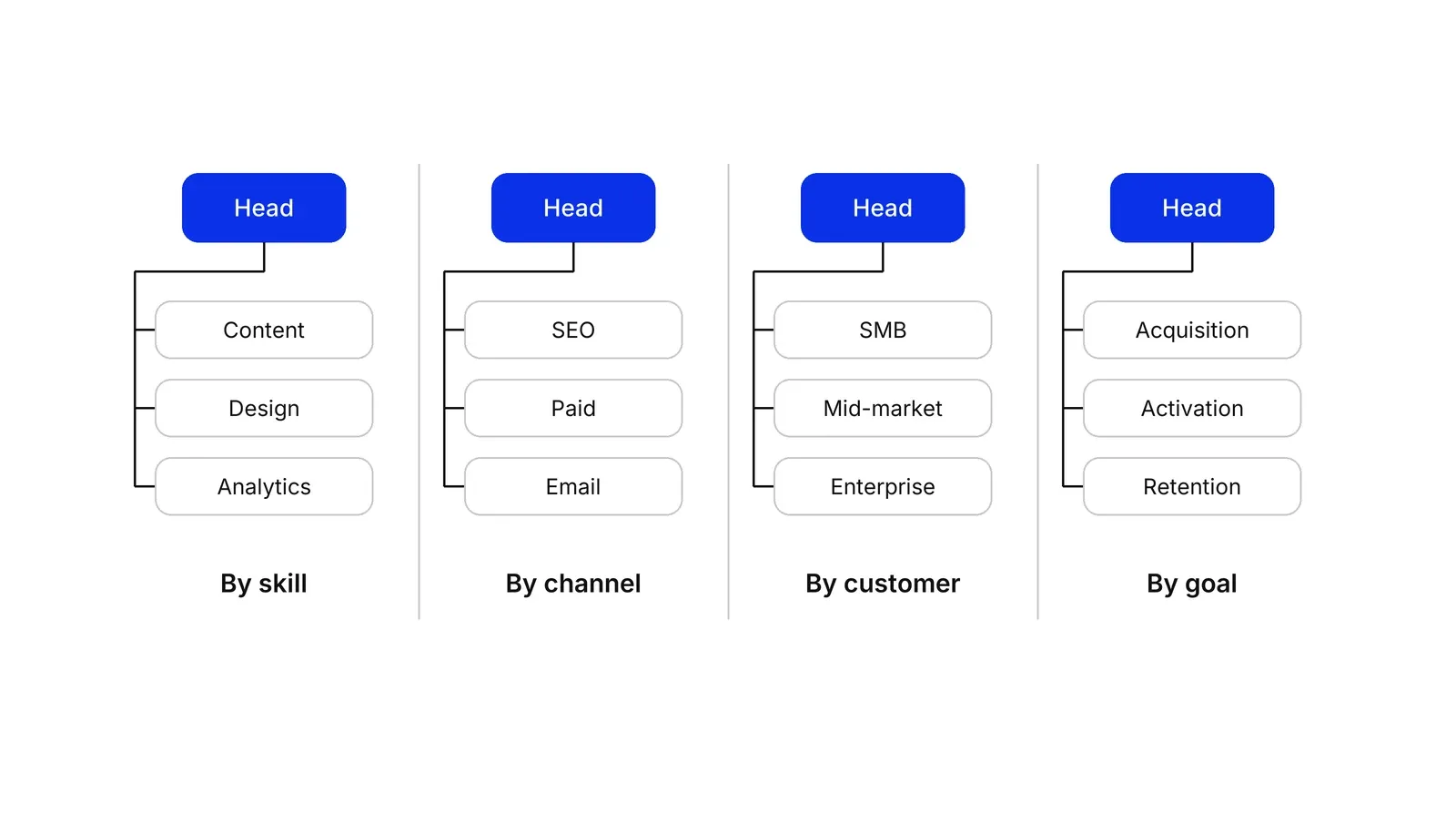
| Cut | Groups people by | Works when | Breaks when |
|---|---|---|---|
| Functional | Skill: content, design, performance, analytics | Craft quality matters and the team is small | Nobody below the head owns a result end to end |
| Channel | SEO, paid, email, events | Channels have their own budget and target | Customers see five uncoordinated messages |
| Segment | SMB, mid-market, enterprise, or service line | Segments buy differently and are big enough to staff | Teams duplicate tools and report different numbers |
| Pod (goal) | A goal such as acquisition or retention, with every skill needed | A goal needs design, data and copy together | Skills thin out, and pod leads compete for specialists |
The pod idea comes from software. In their 2012 paper, Kniberg and Ivarsson describe Spotify squads as small teams with all the skills needed to ship, built to feel like a mini-startup, grouped into tribes of under about 100 people. That paper is about product development, so its numbers do not transfer to marketing. The Agile Marketing Manifesto borrows the spirit: collaborate across functions instead of working in silos. A pod crossing functional lines is a matrix, and Galbraith’s 1971 paper on combining functional and project forms is the classic account of what that costs in dual reporting.
What research says about structure
Evidence for one best structure is thin, and the studies that exist point to conditions, not winners. Lee, Sridhar, Henderson and Palmatier followed Fortune 500 firms from 1998 to 2010 and found in Marketing Science that a customer-centric structure raised customer satisfaction and also raised coordination costs. The satisfaction gain shrank when competitors had already adopted similar structures and when markets were fragmented.
Gartner’s survey of marketing leaders, reported in March 2022, found that about 60% had centralized at least part of their function and 37% had centralized all of it. B2B organizations favored balanced or hybrid structures and B2C organizations were mostly centralized. Gartner put the main reasons at prioritization, workflows and collaboration.
Influence inside the firm is a separate question. Verhoef and Leeflang surveyed 213 usable respondents at Dutch firms with at least 250 employees and found in the Journal of Marketing that accountability and innovativeness were the two main drivers of a marketing department’s influence. A structure that gives each group a number to answer for supports that.
In-house, agency or hybrid
Most companies do both: they build capability themselves and rent some of it. The Spring 2026 CMO Survey, run by Duke, Deloitte and the AMA, invited 2,111 US marketing leaders and received 308 answers, a 14.6% response rate. Respondents allocated 100 points across ways to develop new marketing capabilities: 59.5 to building them by training or hiring, 38.5 to partnering, and 1.9 to buying companies. Of the partner points, 15.5 went to agencies. The same report says external agencies, partners and services perform 33.6% of digital marketing activities, up from 31.6% in the survey’s 2022 edition.
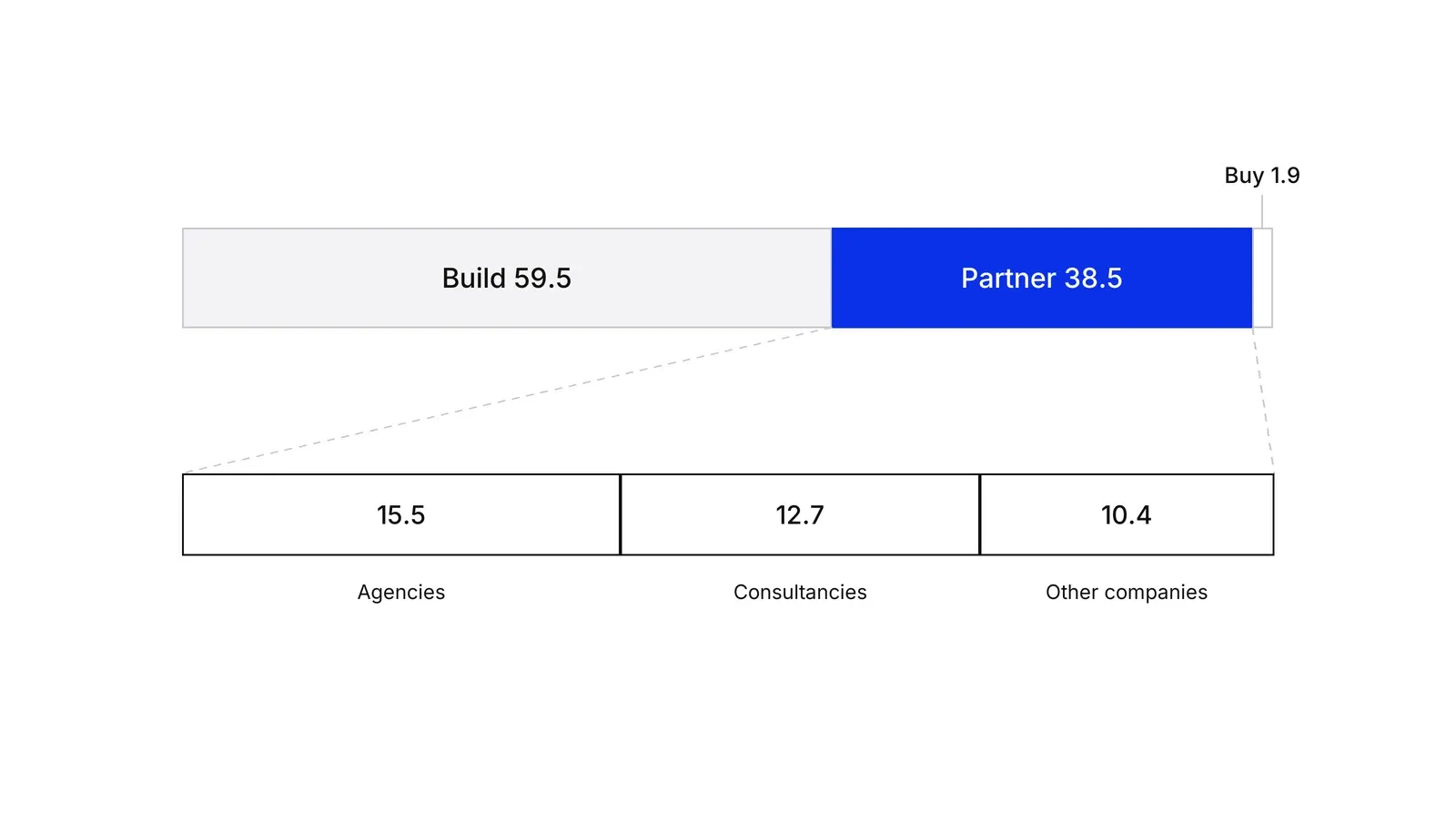
Size changes the picture. In that survey, firms with fewer than 50 employees gave partnering 40.4 points, while firms with 50 to 99 employees gave it 23.0, so no straight line runs from small to large. Treat any single “ideal split” with suspicion.
Large advertisers show the trend toward in-house work. The ANA’s 2023 study, with 162 respondents surveyed in February and March 2023 according to MediaPost, found 82% of members had an in-house agency, up from 42% in 2008. Yet 92% still used external agencies, and 65% had moved some agency work in-house over three years. Cost efficiency was the top benefit and first-party data a major driver.
Budgets push the same way. The Gartner 2025 CMO Spend Survey put marketing budgets at 7.7% of company revenue. In it, 39% of CMOs planned to cut agency budgets. Another 22% said generative AI had reduced their reliance on agencies. The 402 respondents worked in North America, the UK and Europe, mostly at firms with revenue above one billion dollars. Both this and the ANA sample are large enterprises, so read them as a direction, not a rule for a 20-person company.
What changes by company stage
Early on, the founders are the marketing team; structure arrives when a channel works and needs an owner. First Round’s Arielle Jackson says the timing depends on how customers buy: a consumer brand may want a marketer around the 10-person mark, while enterprise software usually builds a repeatable sales model first. She puts a first marketer search at three to six months, and says freelancers or agencies can cover project work meanwhile. Matt Lerner adds in First Round Review that founders should not delegate growth early.
| Stage | Typical shape | Outside help |
|---|---|---|
| Startup | Founder plus one generalist | Freelancers and agencies for projects; a fractional lead if no one can set direction |
| SMB | Head of marketing with specialists, mostly by skill or channel | Agency for a high-volume channel, with an internal owner |
| Scale-up | Segment teams or pods, plus a shared operations group | Agencies for peaks and rare skills, in-house for data |
Fractional leaders fit the first two rows. A 2026 Marketing Week report on a Slice Network and Robert Half survey of 113 fractional marketing leaders, a supply-side sample, found 33.9% saw demand rising because firms want senior expertise without a long commitment, and 9.2% because the long-term team structure was unclear. The fractional leadership model page covers scoping. IMD’s Tomoko Yokoi advises defining the work first, not the role.
As the team grows, watch the manager’s load with span of control, name owners for shared channels in a RACI matrix, and place the structure inside your wider operating model.
A Marketing-Operational System plan starts from the outcome list in step one, not from the org chart (practice).
How to apply Marketing team structure, step by step
- Write down the outcomes marketing owns. List three to five outcomes with a number each, such as qualified leads a month or share of customers still active after 90 days. Structure follows outcomes, so skip job titles for now. Result: a one-page list of outcomes with an owner's name next to each.
- Choose how to cut the work. Compare the four cuts below against your outcomes. If one skill is the bottleneck, cut by skill. If channels have separate budgets and targets, cut by channel. If segments buy differently, cut by segment. If one goal needs several skills, form a pod. Result: one sentence that says 'we group marketing by X because Y'.
- Sort the work into in-house, agency and hybrid. Keep in-house what depends on your customer data and needs fast decisions. Send out project work and rare skills. Share the rest with a named owner on each side. Result: a table of work areas with one of three labels.
- Write a RACI for every shared area. Where an agency and an employee touch the same channel, name who does the work, who approves and who is only told. Result: a RACI table with exactly one approver per row.
- Order the next three hires by trigger. For each hire, write the event that justifies it, for example a channel that has worked for two quarters and now needs a full-time owner. Result: an ordered hiring list with a trigger beside each name.
- Review the structure every two quarters. Check whether the outcomes moved, how many handoffs slowed work, and whether any manager now has more reports than they can coach. Result: a short note that keeps or changes the structure.
Examples
A 12-person B2B software startup
Illustrative, no real company implied. The founders still write positioning. They hire one generalist with channel experience as the first marketer, and buy design and one-off events from freelancers. When outbound meetings from content reach a steady level, the generalist becomes head of marketing and the first channel owner is hired. There is no segment or pod layer, because there is one buyer type.
A clinic network with six locations
Illustrative, no real company implied. About 400 patient enquiries arrive each month. Marketing is grouped by service line (implants, orthodontics, general dentistry), each with an owner for enquiries to booked visits. Paid media runs through an agency. Patient lists, reminders and review replies stay in-house because they depend on the clinic's own patient data.
A payments company at 250 staff
Illustrative, no real company implied. Small merchants sign up themselves and enterprise merchants come through sales. Marketing splits into an SMB team and an enterprise team, each with its own pipeline number. Analytics, tooling and budget planning sit in one shared operations group so the two teams report on the same definitions.
When to use it
Use it when marketing work keeps stalling at handoffs, when two people argue about who owns a channel, when you are about to make a second or third marketing hire, or when you are deciding whether to move work between employees and an agency.
When not to use it
Skip it while a founder is still running marketing alone and no channel has produced repeat results. A chart then describes a team that does not exist yet. A growth team inside a product company is better designed with the growth team structure model.
Common mistakes
- Copying the org chart of a company ten times larger. Segment teams and pods need enough volume per team to keep each one busy.
- Choosing a structure by the people you have. Choose it by the outcomes first, then place people.
- Handing an agency a channel with no internal owner. Someone employed has to hold the goal, the data and the budget.
- Splitting by segment and forgetting shared work. Without one shared owner for data and tools, each team builds its own numbers.
- Hiring the next specialist before the foundations exist. Messaging and positioning come before PR or events.
FAQ
What is a functional marketing department structure?
A functional structure groups people by skill, for example content, design, performance and analytics, each under a lead. It builds depth in each craft and keeps tools and standards consistent. Its weak point is that no one below the head of marketing owns an outcome end to end.
Who should a startup hire first in marketing?
First Round's marketing expert in residence advises ranking priorities and hiring for the one that matters most, usually someone with five to eight years of experience who can set positioning and messaging first. Timing depends on how customers buy: consumer brands may hire around ten people, enterprise software after a repeatable sales model.
Should marketing and sales sit in one department?
Research does not give one answer. Homburg, Jensen and Krohmer built a taxonomy of marketing and sales configurations from a cross-industry study of 337 European firms, which means firms combine them in several ways. Decide by who owns pipeline and how handoffs work.
Is a marketing team structure the same as a growth team structure?
No. Marketing team structure covers the whole function, including brand, content and operations. A growth team is a narrower group that owns one funnel metric, often across product and marketing. The two can coexist, and the growth team structure page covers that case.
Sources
- The CMO Survey (Duke Fuqua, Deloitte, AMA), Highlights and Insights Report, Spring 2026
- The CMO Survey, Topline Report, 2026
- Christine Moorman, Duke Fuqua, Who outsources marketing? (CMO Survey data), 2012
- Gartner, 2025 CMO Spend Survey press release, 12 May 2025
- Marketing Dive, Gartner 2024 CMO Spend Survey coverage, May 2024
- Gartner, survey on centralized marketing functions, press release, 21 March 2022
- FutureCIO, Centralising marketing function to attain operational efficiency (reporting the Gartner survey), 2022
- ANA, The Continued Rise of the In-House Agency: 2023 Edition
- ANA Magazine, Can in-house agencies do it all?, 2023
- MediaPost, ANA study on in-house agencies among its members, 2023
- Ju-Yeon Lee, Shrihari Sridhar, Conor Henderson, Robert Palmatier, Effect of Customer-Centric Structure on Long-Term Financial Performance, Marketing Science, 2015
- John Workman, Christian Homburg, Kjell Gruner, Marketing Organization: An Integrative Framework of Dimensions and Determinants, Journal of Marketing, 1998
- Peter Verhoef, Peter Leeflang, Understanding the Marketing Department's Influence Within the Firm, Journal of Marketing, 2009
- Christian Homburg, Ove Jensen, Harley Krohmer, Configurations of Marketing and Sales: A Taxonomy, Journal of Marketing, 2008
- Roland Rust, Christine Moorman, Gaurav Bhalla, Rethinking Marketing, Harvard Business Review, January-February 2010
- Jay Galbraith, Matrix Organization Designs: How to Combine Functional and Project Forms, 1971
- Henrik Kniberg, Anders Ivarsson, Scaling Agile @ Spotify, 2012
- Agile Marketing Manifesto, 2020
- First Round Review, So you think you're ready to hire a marketer? (Arielle Jackson), 2019, updated 2024
- First Round Review, You're not ready for a head of growth (Matt Lerner), 2025
- Marketing Week, Demand for fractional CMOs driven by expertise over cost (Slice Network and Robert Half survey), 2026
- IMD, Tomoko Yokoi, The fractional gains of senior leaders: fact or fallacy, 2024
Last updated Oct 9, 2026


The compliance layer under fintech marketing operations
A fintech marketing agency can build campaigns. It cannot own the compliance review, the KYC drop-off or the multi-market licensing rules that decide whether a lead ever becomes a customer.

Fractional CMO: what you get, and what has to exist underneath
A fractional CMO brings strategy and judgment. Without reporting, CRM hygiene and a named owner per number, the engagement produces a slide deck instead of a system.

The operations layer behind healthcare patient acquisition
Ads and search bring the request in. What happens between the click and the booked, attended visit decides whether the spend paid off.