Golden Circle (Start With Why)
The Golden Circle is Simon Sinek's model of three nested rings, why, how and what, that tells a company to explain its purpose before its methods and products.
The Golden Circle is a communication model from Simon Sinek's 2009 TEDx talk and his book Start With Why. It has three rings: why (the purpose or belief), how (the way you work) and what (the products). Sinek says inspiring companies talk from the centre outward. His claim that this mirrors the brain's limbic system is rejected by neuroscientists.
- Origin
- Simon Sinek, 2009 (TEDxPuget Sound talk, September; book Start With Why)
- Level
- 201 · Tool
- Fits
- Startup, Small and mid-size, Scale-up
- Time to apply
- a half-day workshop for a first draft, then two weeks of testing the why line in real copy
- What you need
- the founding story and three or four decisions the company made that cost it money but it made anyway · five to ten customer interviews or reviews, in the customers' own words · one live asset to rewrite, such as a homepage hero, a sales deck opener or a job ad
The Golden Circle is a model for explaining a business from the inside out: first why it exists, then how it works, then what it sells. Simon Sinek, a former advertising executive, presented it at TEDxPuget Sound in September 2009 and in his book Start With Why, published by Portfolio the same year. The talk, How great leaders inspire action, showed more than 71 million plays on TED’s page in October 2026. In 2017 Sinek and two co-authors added a workbook, Find Your Why.
Founders use it to write mission lines and pitch openers. Marketing teams use it to reorder homepages and sales decks, and HR teams use it in employer branding. The model is simple, and that is most of its appeal. The science Sinek attached to it is a different matter, covered below.
The three rings: why, how and what
Each ring answers one question about the company. Sinek’s own site defines them this way:
- Why is the purpose, cause or belief behind the company. In the talk transcript he rules out profit, calling it a result.
- How is the set of actions a company takes when it works at its best, the methods that make it different.
- What covers the products, services or job functions. Every company can name its what.
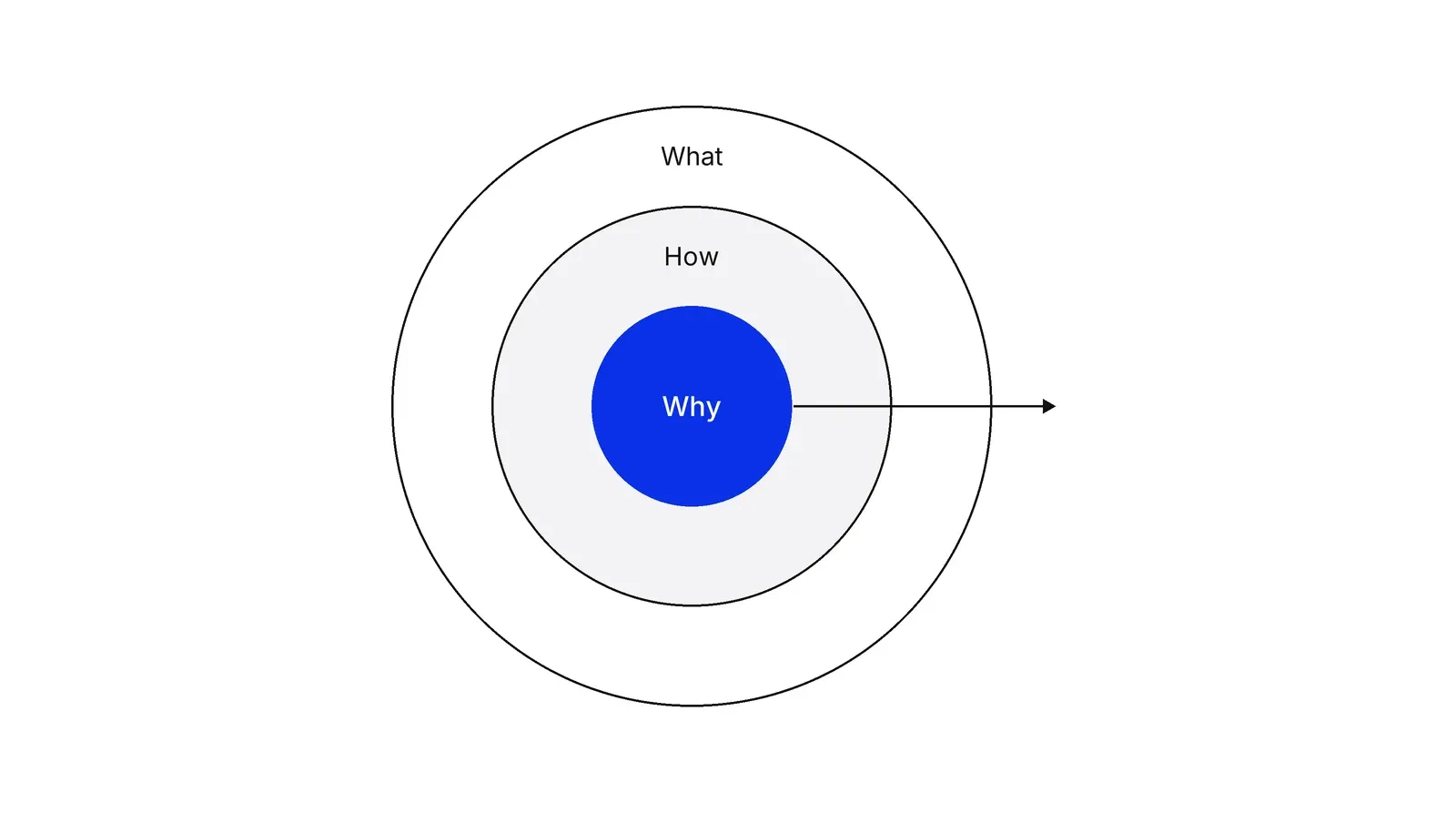
Sinek’s claim is about order. Most companies talk from the outside in: here is our product, here is why it is good, buy it. The companies he admires reverse the sequence. In his talk, a typical computer maker lists features, while his version of Apple’s message opens with a belief in challenging the status quo and ends with the computers. The wording is Sinek’s reconstruction, not an Apple advert. His summary line is that people buy why you do it, not what you do.
The stories behind the model
Sinek supports the rule with stories, not data. Two of them are worth checking.
The first is aviation. Sinek contrasts the Wright brothers with Samuel Pierpont Langley, who had money and official backing. The Linda Hall Library confirms Langley received $50,000 from the US War Department in 1898 and that his piloted Aerodrome A failed on 3 October and 9 December 1903. Sinek’s explanation, that the Wrights’ team believed in a cause while Langley chased fame, is his reading of motives, not a documented finding.
The second is Martin Luther King Jr. Sinek says 250,000 people came to Washington in August 1963 with no invitations sent. The King Institute at Stanford gives “more than 200,000” and describes months of organising by A. Philip Randolph, Bayard Rustin and a coalition of unions and civil rights groups. Belief mattered, and so did logistics.
Sinek also ties the model to the adopter curve. The shares he quotes for innovators and early adopters match the standard categories from Everett Rogers’ Diffusion of Innovations. The “tipping point between 15 and 18 percent” he adds is his own figure. For the full theory, see diffusion of innovations.
What Sinek says about the brain
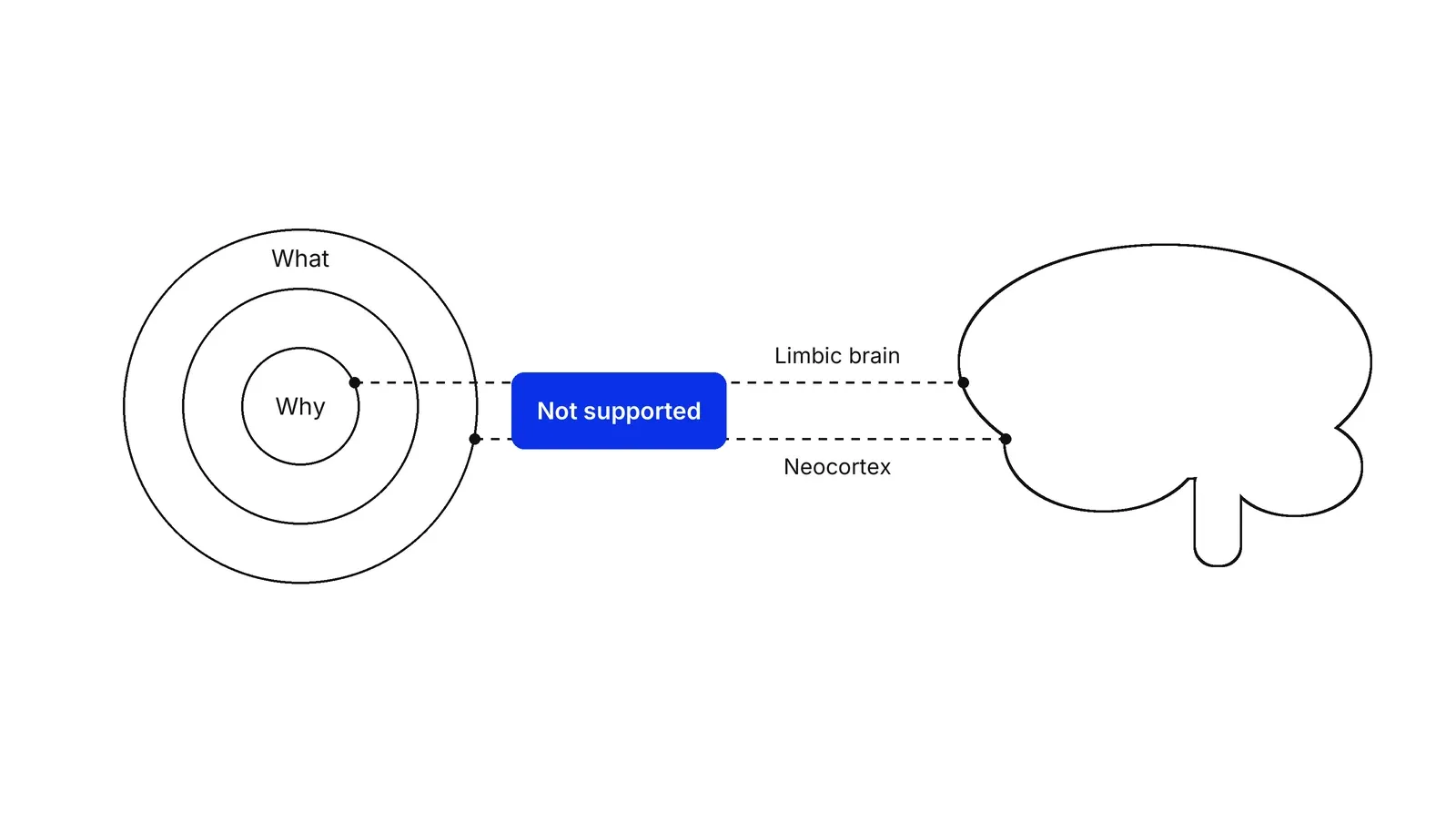
Sinek presents the Golden Circle as biology. In the talk he says none of it is his opinion and that it is “all grounded in the tenets of biology”. He maps the what ring to the neocortex, which he describes as the seat of rational thought and language. He maps the why and how rings to the “limbic brain”, which he says is responsible for “all human behavior, all decision-making” and has no capacity for language. That, in his account, is why gut decisions are hard to put into words.
The three-part brain he describes comes from Paul MacLean’s triune brain model, set out in A Triune Concept of the Brain and Behaviour in 1973. The writer Nick Asbury, citing a 2010 interview with Sinek, says the brain link came after the rings existed, from a dinner conversation, and that a scientist Sinek consulted suggested swapping how and what to make the fit work.
Why neuroscientists reject the limbic brain claim
The brain claim fails on three counts.
First, the limbic system is a weak concept. Rolf Kötter and Niels Meyer reviewed its empirical basis in Behavioural Brain Research in 1992 and concluded that it “lacks an adequate empirical definition” and “cannot be accepted on empirical grounds”. Joseph LeDoux, one of the best known researchers on fear, argued in 2000 that emotion research advanced by studying specific circuits such as the amygdala. In 2012 he proposed “survival circuits” in place of a general emotional brain.
Second, the layered brain is wrong. Joseph Cesario, David Johnson and Heather Eisthen write in Current Directions in Psychological Science (2020) that the idea of newer layers stacked on older ones “has long been discredited among neurobiologists”. Lisa Feldman Barrett calls the triune story “fundamentally not true”.
Third, feeling and reasoning do not live in separate parts. Luiz Pessoa argues in Nature Reviews Neuroscience (2008) that no brain region should be treated as purely emotional or purely cognitive. The best known evidence that feelings steer choices, the gambling studies by Bechara and colleagues (1997), points at the prefrontal cortex: patients with damage there kept choosing badly even after they knew the right strategy. That is part of the neocortex Sinek assigns to rational thought.
| Sinek’s claim | What research says |
|---|---|
| The brain has three layers that match the rings | The layered model is discredited among neurobiologists (Cesario et al., 2020) |
| The limbic brain is a distinct unit | The limbic system lacks an empirical definition (Kötter and Meyer, 1992) |
| The limbic brain makes all decisions | Decisions draw on networks that include prefrontal cortex (Bechara et al., 1997; Pessoa, 2008) |
| Feelings guide choices before words do | Partly supported: people act on nonconscious signals before they can explain them (Bechara et al., 1997) |
The last row is the part that holds up. Antonio Damasio’s Descartes’ Error made the broader case in 1994 that emotion is part of good reasoning. That supports opening with something people care about. It does not support the brain map.
What survives the criticism
The communication rule works without the biology, as a writing discipline. Saying what a company believes before listing features gives buyers a reason to read the features. Evidence on purpose in general is mixed. A study by Claudine Gartenberg, Andrea Prat and George Serafeim, summarised by Harvard Kennedy School, found better future financial performance where middle managers and professionals had both a strong sense of purpose and clarity about their work, and no such link for senior executives or hourly staff. Thomas Malnight and colleagues reported in Harvard Business Review in 2019 that purpose emerged as a growth driver they had not looked for.
The backlash is real too. In Fundsmith’s 2021 letter to shareholders, Terry Smith wrote that a company which feels it must define the purpose of Hellmann’s mayonnaise “has in our view clearly lost the plot”. A why only helps when it explains real decisions.
Golden Circle, positioning statement and value proposition
These tools are often mixed up because all three produce a short sentence about the company.
| Tool | Question it answers | Output |
|---|---|---|
| Golden Circle | Why does the company exist, and how does that show? | A belief, a short how list, a plain what |
| Positioning statement | For whom are we the best choice, against which alternative? | One internal sentence naming target, category and difference |
| Value proposition | What does the customer gain from this offer? | Gains and pain relief for one segment |
Teams usually start with positioning, because it forces a choice of customer, then use the Golden Circle to write the story around it. In Pushers’ marketing operational system work, the why line gets tested in live copy like any other claim.
How to apply Golden Circle (Start With Why), step by step
- Write down the what, plainly. List what you sell and to whom, in words a customer would use. A payments company writes 'cross-border transfers for small importers', not 'financial empowerment'. Result: one sentence of what, with no adjectives.
- Describe the how from evidence. Name two or three ways you work that rivals do not, and point to proof for each: a process, a policy, a number. Result: a short how list where every line could be checked by an outsider.
- Draft the why from decisions, not adjectives. Look at the choices the company made that cost money, such as refusing a client type or publishing prices, and ask what belief explains them. Profit is a result, Sinek says, so it cannot be the why. Result: one sentence that starts with 'We believe' and that a competitor could not sign without changing how it works.
- Test the why against customers' words. Compare the draft with what customers say they value in interviews or reviews. If nobody mentions anything close to it, the why is either untrue or not yet visible in the product. Result: a why that matches at least some customer language, or a list of gaps to close first.
- Rewrite one asset in why, how, what order. Take one live page or pitch and reorder it so it opens with the belief, then the method, then the offer. Keep the old version running for comparison. Result: two versions you can compare on clicks, replies or booked calls.
- Check every new campaign against the how. Before a campaign ships, check that it shows at least one line from the how list, because a belief with no visible proof reads as a slogan. Result: a one-line pass or fail note attached to each brief.
Examples
Wise and the mission line in its results
Wise, the UK money transfer company, puts its why into its investor reporting. In its FY22 results, co-founder Kristo Käärmann writes that the company is driven by a mission to build money without borders. The how follows in the same text: moving money instantly, conveniently, transparently and closer to free. The what is the transfer product, and the proof is a number, an average cross-border price of 0.61% in the fourth quarter of FY22. All three rings sit in one document, and the how can be checked against the price.
Mayo Clinic and a why written in 1910
Mayo Clinic traces its primary value, the needs of the patient come first, to a commencement speech William J. Mayo gave at Rush Medical College in Chicago in 1910, according to the clinic's own history site. The sentence works as a why because it decides cases: when a schedule, a referral or a billing rule conflicts with what the patient needs, the stated value says which side wins. It predates Sinek's model by a century, which shows the model describes a pattern rather than inventing one.
A dental clinic rewriting its homepage
Illustrative, no real clinic implied. A clinic's homepage opens with 'Modern dentistry, 12 chairs, open until 9 pm', which is all what. The team notices that its costliest habit is spending 40 minutes on first visits when competitors spend 15. The why becomes 'We believe nobody should agree to treatment they do not understand'. The how is the long first visit and a written plan with prices. The what, 12 chairs and late hours, moves to the bottom of the page. The clinic then compares booked first visits between the old and new versions.
When to use it
Use it when a company describes itself only by features and price and loses deals to rivals that look identical on paper, when a founder needs to explain to new hires why the company makes the choices it does, or when brand, product and sales teams tell different stories about the same business. It is a writing and alignment tool, so it fits best when you already know what you sell and how you work.
When not to use it
Skip it when the product has not found buyers yet, because a purpose statement cannot fix a product nobody wants. It is also a weak guide for low-involvement categories where buyers choose on price, availability and habit, and it is the wrong tool for picking a market or a target segment, which positioning and segmentation methods handle.
Common mistakes
- Writing a why that any company in the category could sign, such as 'we believe in quality', which tells customers nothing and changes no decision.
- Treating the why as a replacement for the what. Customers still need to know what you sell and what it costs, and Sinek describes the what as the proof of the belief.
- Repeating the limbic brain explanation in decks and training as if it were settled science. Neuroscientists reject the three-layer brain it relies on.
- Publishing a purpose the company does not act on. Investors and customers notice the gap, as Fundsmith's 2021 criticism of Unilever's purpose language showed.
- Reading Sinek's success stories as proof. Apple, the Wright brothers and Martin Luther King Jr. were chosen after the fact, and the model has no controlled test behind it.
FAQ
What is the Golden Circle by Simon Sinek?
It is a model of three nested rings, why, how and what, that Simon Sinek presented at TEDxPuget Sound in September 2009 and in his book Start With Why. The why is the purpose or belief, the how is the way the company works, and the what is the product. Sinek argues inspiring organisations communicate from the centre outward.
Is the Golden Circle based on real neuroscience?
No. Sinek says the rings match the brain, with why and how in the limbic brain and what in the neocortex. That mapping comes from Paul MacLean's triune brain model. Neurobiologists have rejected the layered model, and a 1992 review found the limbic system cannot be accepted as a concept on empirical grounds.
What is the difference between why, how and what?
What is the product or service you sell. How is the set of methods or values that make your way of delivering it different. Why is the belief or purpose behind the company, which Sinek says is never making money, because profit is a result. Most companies can state the what and the how; few state a why.
What is the Apple example in Start With Why?
Sinek contrasts a typical computer advert, which lists features, with his version of Apple's message, which opens with a belief in challenging the status quo and ends with 'we just happen to make great computers'. The wording is Sinek's own reconstruction, not an Apple advert, and it illustrates his rule rather than proving it.
Does starting with why actually improve business results?
The evidence is indirect. A study by Gartenberg, Prat and Serafeim linked a strong sense of purpose plus clear management among middle managers and professionals to better future financial performance. No published controlled test shows that ordering a message why, how, what beats other orders in sales or conversion.
Sources
- TED, Simon Sinek, How great leaders inspire action, TEDxPuget Sound, September 2009
- TED, Simon Sinek, How great leaders inspire action, transcript
- Simon Sinek, The Golden Circle (official site)
- Simon Sinek, Start With Why: How Great Leaders Inspire Everyone to Take Action, Portfolio, 2009, Internet Archive record
- Simon Sinek, David Mead, Peter Docker, Find Your Why, Portfolio/Penguin, 2017, Internet Archive record
- Paul D. MacLean, A Triune Concept of the Brain and Behaviour, University of Toronto Press, 1973, Internet Archive record
- Joseph Cesario, David J. Johnson, Heather L. Eisthen, Your Brain Is Not an Onion With a Tiny Reptile Inside, Current Directions in Psychological Science 29(3), 2020
- Rolf Kötter, Niels Meyer, The limbic system: a review of its empirical foundation, Behavioural Brain Research 52(1), 1992
- Joseph E. LeDoux, Emotion circuits in the brain, Annual Review of Neuroscience 23, 2000, Europe PMC record
- Joseph E. LeDoux, Rethinking the emotional brain, Neuron 73(4), 2012
- Luiz Pessoa, On the relationship between emotion and cognition, Nature Reviews Neuroscience 9, 2008
- Antoine Bechara, Hanna Damasio, Daniel Tranel, Antonio R. Damasio, Deciding advantageously before knowing the advantageous strategy, Science 275, 1997, Europe PMC record
- Antonio R. Damasio, Descartes' Error: Emotion, Reason, and the Human Brain, Putnam, 1994, Internet Archive record
- Northeastern Global News, Lisa Feldman Barrett's new book corrects pervasive neuroscience myths, April 2019
- Nick Asbury, The story of why, July 2024
- Everett M. Rogers, Diffusion of Innovations, 5th edition, Free Press, 2003, Internet Archive record
- Commonwealth of Learning, Fundamentals of Agricultural Extension, Diffusion and adoption of innovations: adopter categories
- Linda Hall Library, Flying Machines, Langley's Aerodrome
- Martin Luther King, Jr. Research and Education Institute, Stanford University, March on Washington for Jobs and Freedom
- Harvard Kennedy School, Mossavar-Rahmani Center, Corporate Purpose and Financial Performance (Gartenberg, Prat, Serafeim)
- Thomas W. Malnight, Ivy Buche, Charles Dhanaraj, Put Purpose at the Core of Your Strategy, Harvard Business Review, September-October 2019
- Fundsmith, 2021 Annual Letter to Shareholders
- Wise plc, FY22 results for the year ended 31 March 2022
- Mayo Clinic History, In the Words of Dr. Will: The Primary Value of Mayo Clinic
Last updated Oct 9, 2026


The compliance layer under fintech marketing operations
A fintech marketing agency can build campaigns. It cannot own the compliance review, the KYC drop-off or the multi-market licensing rules that decide whether a lead ever becomes a customer.

Fractional CMO: what you get, and what has to exist underneath
A fractional CMO brings strategy and judgment. Without reporting, CRM hygiene and a named owner per number, the engagement produces a slide deck instead of a system.

The operations layer behind healthcare patient acquisition
Ads and search bring the request in. What happens between the click and the booked, attended visit decides whether the spend paid off.