First principles thinking
First principles thinking breaks a problem into the basic facts you can verify and rebuilds the answer from them, instead of copying what others already do.
First principles thinking is a way of solving problems by breaking them into the basic facts you can verify and building a new answer from those facts, instead of copying what others do. The idea goes back to Aristotle and Descartes, and Elon Musk brought it to business as the alternative to reasoning by analogy.
- Origin
- Aristotle (starting points of a science); René Descartes (doubt down to certainties); Elon Musk (business use), 4th century BCE; 1644; 2012
- Level
- 201 · Tool
- Fits
- Startup, Small and mid-size, Scale-up
- Time to apply
- 2 hours for a first rebuild of one number
- What you need
- one decision that depends on a number or a belief everyone takes for granted · the raw inputs behind it: prices, rates, volumes, time · someone willing to ask why each assumption holds
First principles thinking is a way of solving problems by splitting them into the basic facts you can verify and building a new answer from those facts. The other way is to copy a similar case and adjust it. The phrase is old philosophy, and its business meaning is recent. Three different things sit under one name, so it helps to separate them.
Aristotle: the starting points of a science
For Aristotle, first principles (in Greek, archai, meaning starting points) are the premises a body of knowledge is built on. In the first chapter of the Physics, in the Hardie and Gaye translation, he says we only think we know a thing once we know its primary conditions, causes or elements. He adds that inquiry starts from what is plain to us, which is at first a confused whole, and moves toward the elements by analysis.
In the Posterior Analytics (I.2), scientific knowledge comes from demonstration. A demonstration is a deduction whose premises are true, primary, immediate and causes of the conclusion. The Stanford Encyclopedia describes the problem this creates (sections 6.2 to 6.4): if every premise needed proof, the chain would never end, so Aristotle holds that it stops at starting points known in another way. That other way is nous (named in II.19), usually translated as intuition or insight, which grows out of perception, memory and experience. The Nicomachean Ethics (VI.6) says the same: intuitive reason grasps the first principles, because they cannot be demonstrated. Commentators disagree about how that works.
The Metaphysics (Book I, in W. D. Ross’s translation) ties wisdom to knowledge of principles and causes. So Aristotle’s first principle is a starting point of a field, such as a definition or axiom. It is not a general instruction to simplify.
Descartes: doubt until something holds
Descartes wanted a foundation that could not be shaken. His Principles (1644) was meant as a school textbook to replace Aristotelian physics, according to the Stanford Encyclopedia. In the opening article of his Principles of Philosophy he says a seeker of truth must once in a lifetime doubt everything that can be doubted. What survives is the certainty that we exist while we doubt, which he calls the first and most certain thing for anyone who philosophizes in an orderly way (I.7).
The doubt is a tool, not a verdict. The Stanford Encyclopedia notes that Descartes doubts in order to find firm ground, unlike the sceptics. His Discourse on Method gives four rules in the Veitch translation: accept only what is clearly known, divide each difficulty into parts, proceed from the simplest to the most complex, and review the whole so nothing is missed. These are close to what business teams now do when they decompose a problem. The structure is the one the Stanford entry on epistemology calls foundationalism: basic beliefs at the bottom, everything else built on them.
Musk and the business version
The modern business use comes from a September 2012 interview on Kevin Rose’s show Foundation. Musk says it is important “to reason from first principles rather than by analogy.” He explains that most of life runs on analogy, because it is mentally easier. First principles, which he calls a physics way of looking at the world, means boiling things down to the most fundamental truths and reasoning up from there, and he says that takes more mental energy. He does not mention Aristotle in the interview.
His example is battery cost. People said packs had historically cost about $600 per kilowatt hour and would not get much cheaper. He asked what batteries are made of and what those materials cost on the London Metal Exchange, and arrived at about $80 per kilowatt hour. That number is a floor for materials. BloombergNEF reported an average pack price of $139 per kilowatt hour in 2023, a record low. The useful part of the example is the question it forces: how much of today’s price is physics, and how much is habit?
First principles versus reasoning by analogy
Reasoning by analogy takes a source case, finds the ways it resembles yours and carries its answer across. The Stanford entry on analogical reasoning says such arguments support a conclusion to varying degrees and do not prove it. The two methods fit different situations.
| Reasoning by analogy | First principles | |
|---|---|---|
| Starting point | A similar case | Facts you can verify |
| Main question | What did they do? | What is true here? |
| Cost in effort | Low | High |
| Typical output | A benchmark or a copied plan | A number or design built from parts |
| Main risk | Hidden differences between the cases | Guessed inputs that look rigorous |
Analogy has real support. Gavetti, Levinthal and Rivkin (Strategic Management Journal, 2005) model managers who match a new industry to a familiar one and borrow its policies, and find this works best when they focus on the traits that truly distinguish industries. Their simulation also finds that breadth of experience keeps improving results while depth of experience pays off less and less, and that following an analogy too rigidly can backfire. Kahneman and Lovallo (Management Science, 1993) argued that forecasts anchored on a team’s own plan, the inside view, run optimistic. Flyvbjerg’s reference class forecasting corrects this by using the outcomes of comparable past projects; its first application was cost forecasts for UK transport schemes, including the Edinburgh Tram and the roughly £15 billion Crossrail in London. Analogy done as statistics is a good check on a first principles number.
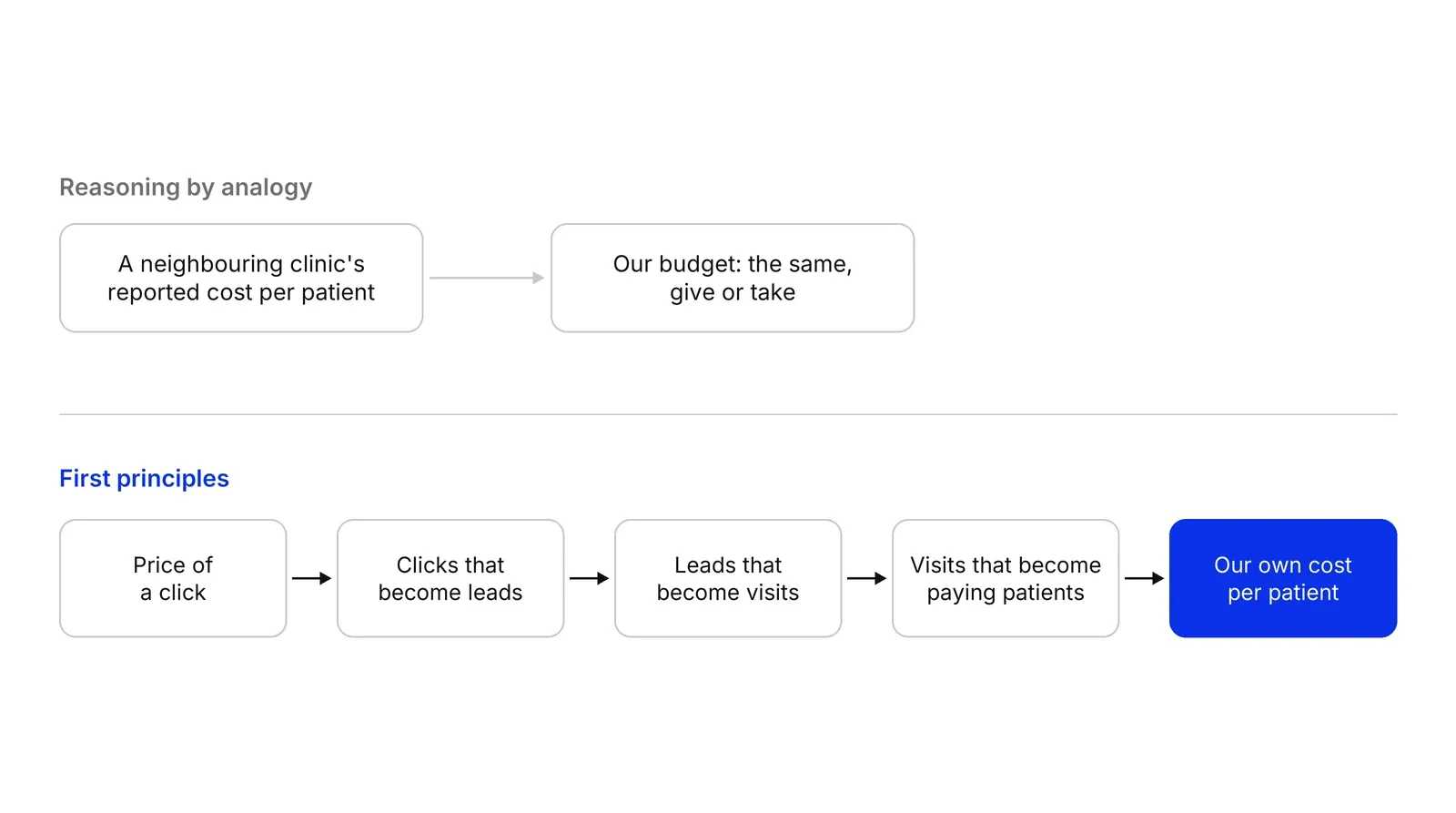
A marketing example: rebuild the CAC estimate
Customer acquisition cost (CAC) is the sales and marketing spend needed to win one new customer; David Skok quotes HubSpot’s Brad Coffey describing it as all marketing and sales expense in a period divided by the customers won. A team hears that a similar business pays 300 per new patient and budgets 300. That is an analogy.
The rebuild starts from the funnel. These numbers are illustrative arithmetic, not a real clinic. A click costs 2. Of clicks, 5% leave a phone number, so a lead costs 40. Of leads, 40% book, so a booking costs 100. Of bookings, 70% arrive, so a visit costs about 143. Of visits, 50% start treatment, so a paying patient costs about 286 in ads. Front-desk and call-handling time of 4,000 a month, spread over 20 new patients, adds 200. The fully loaded figure is about 486.
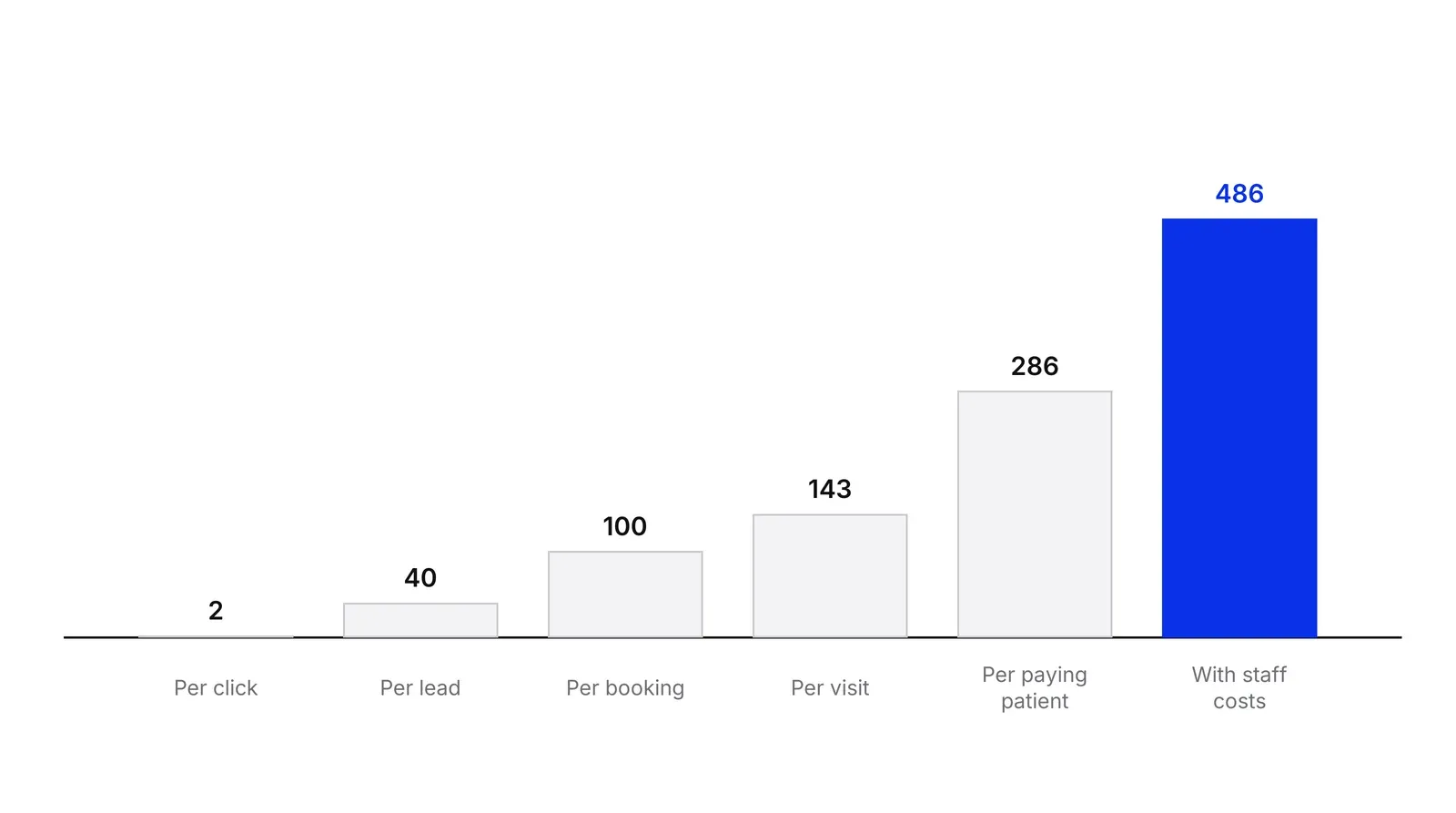
The rebuild gives a different number and shows where to work. Raising arrivals from 70% to 85% takes the ad cost to about 235. Halving the click price takes the loaded figure to about 343. The unit economics of the clinic follow from these parts, and the LTV to CAC ratio is only as reliable as the CAC inside it.
Where it fails and what to pair it with
A rebuild is only as good as its inputs. Every conversion rate above is an assumption until someone measures it, so run a pre-mortem on the rebuilt number and ask how it could be wrong. The 5 whys go backward from a failure to its cause, while first principles go down from a claim to its components. Working backwards also rebuilds a plan from a clean sheet, starting from the desired end result. The aim is always the same: find the part of the answer that is fact, and the part that is habit.
A Growth Lab plan can start by rebuilding acquisition cost from its parts before any budget is set.
How to apply First principles thinking, step by step
- State the decision, not the topic. Write the choice the number feeds: whether to raise the ad budget, enter a market, build or buy. Result: one sentence that tells you which facts matter.
- List what you currently believe and label each item. Write every assumption behind the answer, then mark it as a fact you measured, a convention ('that is how it is done'), or an analogy ('a competitor does it'). Result: a list where the unmeasured items are visible.
- Break the answer into parts you can measure. Split the number into components that multiply or add up: price times rate, cost per unit times units. Stop when each part is a quantity you can look up, count or test. Result: a formula with no black boxes.
- Find the floor for each part. Ask what the smallest possible value is, given prices, physics or arithmetic. Result: a lower bound that shows how much of today's number is real cost and how much is habit.
- Rebuild the answer and compare it with the analogy. Combine the parts into your own estimate and set it beside the number you were given. Result: a gap, and a list of the parts that explain it.
- Test the weakest part first. Pick the part you know least that moves the result most, and test it with the cheapest experiment you can run. Result: one assumption confirmed or replaced before any money is committed.
Examples
Batteries, as Elon Musk told it in 2012
Musk said people claimed battery packs cost about $600 per kilowatt hour and would not get much cheaper. He asked what a battery is made of, priced those materials on the London Metal Exchange, and got about $80 per kilowatt hour. His conclusion was that the work lay in assembling cheap materials cleverly. The $80 is a floor for materials, not a pack price: BloombergNEF's 2023 average pack price was $139 per kilowatt hour.
A dental clinic's cost of a new patient
Illustrative. A neighbouring clinic is said to pay 300 per new patient, so the clinic budgets 300. Rebuilt from parts, with a click costing 2, 5% of clicks leaving a phone number, 40% of leads booking, 70% of bookings arriving and 50% of visits starting treatment, the ad cost alone is about 286 per paying patient. Adding 4,000 a month of front-desk time spread over 20 new patients brings it to about 486. The analogy came in about 40% too low, and the rebuild shows which rates to work on.
A payments startup pricing cross-border payouts
Illustrative. The team assumes payouts must cost what banks charge. It lists the real components: the fee of the local payment rail, the currency conversion cost, minutes of manual review at an analyst's hourly cost, and the cost of funding prefunded accounts. Each component is checked against a statement or a timesheet. Result: a price built from the team's own costs, with the review minutes as the first thing to automate.
When to use it
Use it when a decision rests on a number or a rule that nobody has checked: an inherited budget, a 'standard' price, a cost everyone calls fixed. It also fits a new category with no good comparison, and a problem that has resisted the usual fixes.
When not to use it
Skip it for small, reversible choices, where copying a proven practice is faster and cheap to undo. Skip it when you have many close comparable cases and little time: a statistical reference class will serve you better. A rebuild also fails when its inputs are guesses nobody tests.
Common mistakes
- Stopping at the first breakdown. 'Customers' and 'cost' are still labels. Keep splitting until each part is something you can measure.
- Treating a floor as a forecast. Materials cost, minimum fees or theoretical throughput set a lower bound, not the price you will achieve.
- Calling a guess a first principle. If the input is an opinion nobody has tested, the rebuild only looks rigorous.
- Throwing away comparable cases. A competitor's number is useful as a check on your own rebuild, even if it is a poor starting point.
- Applying it to everything. It takes more mental energy than copying, so reserve it for decisions that are large, costly or stuck.
FAQ
What is first principles thinking in simple terms?
It means asking what you know to be true about a problem, then building the answer from those facts instead of from what others do. You split the problem into basic parts, check each part, and recombine them. The result may match common practice or may differ, but you can explain every step.
Who invented first principles thinking?
Nobody single-handedly. Aristotle used first principles, or archai, for the starting points of a science. Descartes proposed doubting everything that could be doubted to find a certain foundation. Elon Musk popularised the business sense in a 2012 interview, where he contrasted it with reasoning by analogy.
What is the difference between first principles and reasoning by analogy?
Analogy starts from a similar case and adapts its answer; first principles start from basic facts and build a new answer. Analogy is faster and works well when cases truly resemble yours. First principles costs more effort but exposes assumptions that the analogy hides.
How do you use first principles thinking in marketing?
Rebuild a metric from its parts. For customer acquisition cost, list the price of a click, the share of clicks that become leads, bookings and paying customers, and the staff time spent. Multiply and add them, then compare the result with the benchmark you were given.
What are the limits of first principles thinking?
It is slow, and it is only as good as its inputs. A guessed conversion rate gives a precise-looking wrong answer. Aristotle's own problem applies too: you have to stop somewhere, and the starting points need evidence. Test the weakest input first.
Sources
- Stanford Encyclopedia of Philosophy, Aristotle's Logic
- Stanford Encyclopedia of Philosophy, Aristotle
- Stanford Encyclopedia of Philosophy, Aristotle's Metaphysics
- Aristotle, Posterior Analytics, Book I, translated by G. R. G. Mure, Internet Classics Archive (MIT)
- Aristotle, Physics, Book I, translated by R. P. Hardie and R. K. Gaye, Internet Classics Archive (MIT)
- Aristotle, Metaphysics, Book I, translated by W. D. Ross, Internet Classics Archive (MIT)
- Aristotle, Nicomachean Ethics, Book VI, translated by W. D. Ross, Internet Classics Archive (MIT)
- Stanford Encyclopedia of Philosophy, Descartes
- Stanford Encyclopedia of Philosophy, Descartes' Method
- Stanford Encyclopedia of Philosophy, Descartes' Epistemology
- René Descartes, Discourse on Method, translated by John Veitch, Project Gutenberg
- René Descartes, Principles of Philosophy, Part 1, Jonathan Bennett's edition of the Cottingham translation, Early Modern Texts
- Kevin Rose, Foundation: Elon Musk and Kevin Rose, interview video, 7 September 2012
- BloombergNEF, Lithium-ion battery pack prices hit record low of $139/kWh, 2023
- Stanford Encyclopedia of Philosophy, Epistemology
- Stanford Encyclopedia of Philosophy, Reasoning by Analogy
- Giovanni Gavetti, Daniel Levinthal, Jan Rivkin, Strategy making in novel and complex worlds: the power of analogy, Strategic Management Journal 26(8), 2005
- Daniel Kahneman, Dan Lovallo, Timid choices and bold forecasts, Management Science 39(1), 1993
- Bent Flyvbjerg, Curbing optimism bias and strategic misrepresentation in planning: reference class forecasting in practice, European Planning Studies 16(1), 2008
- David Skok, SaaS Metrics 2.0, For Entrepreneurs
Last updated Oct 9, 2026


Marketing agency or growth system: when a company outgrows its agency
An agency is the right call while the founder still runs most of the company. Once the business starts copying itself into new locations or markets, it needs a system that sets goals, tests hypotheses and owns the result.

Why healthcare marketing agencies stall: the short, mid and long wins model we use with clinics
Most agencies own the click and nobody owns the front desk. How we structure clinic work in three horizons, the research behind each one, and one year of results.

Why channel tests stall after month three
Most paid channel tests do not end with a decision. They end when the budget runs out, the attribution model changes, or everyone quietly stops looking at the dashboard.