Referral program design
Referral program design is the set of choices about who gets rewarded, for what action and how much, so that existing customers bring in new ones at a cost lower than other channels.
A referral program is a system in which a company rewards existing customers for bringing in new ones. Its design comes down to five choices: the qualifying action, the reward size and form, who is paid (referrer, friend or both), who may refer, and the limits against abuse. Reward size is capped by the margin a referred customer brings.
- Origin
- PayPal (paid sign-up and referral bonuses); Dropbox (two-sided storage reward, described by Drew Houston), Early 2000s; 2010
- Level
- 301 · Advanced
- Fits
- Startup, Small and mid-size, Scale-up
- Time to apply
- One week to design and instrument; one to two months to read the first results
- What you need
- an estimate of gross margin per customer over the first 6 to 12 months · a way to tie each new customer to the person who referred them · a rule for what counts as a real new customer, such as a first payment · someone who can review flagged accounts for abuse
A referral program is a system in which a company rewards existing customers for bringing in new ones. Design is what decides whether it pays: which action triggers the reward, how large the reward is, who receives it and what stops abuse. Two cases made the idea famous. PayPal paid people to open accounts and refer friends in the early 2000s, and Drew Houston described Dropbox’s two-sided storage reward in a 2010 talk. Marketing researchers have studied the mechanics since at least 2001.
This page is about the reward and its rules. How a referral fits into a self-reinforcing growth engine is covered in growth loops, and the arithmetic of invites in the viral coefficient. A program paid per sale to outside publishers is a different tool, described in affiliate and partner marketing.
What choices make up the design?
Five choices define a program: the qualifying action, the reward, who is paid, who can refer and the limits. The qualifying action is the event that proves a referral is real. Dropbox, for example, pays only after the friend accepts the invite, installs the app, logs in and verifies an email. A payments app might use a first transfer, a clinic a completed visit.
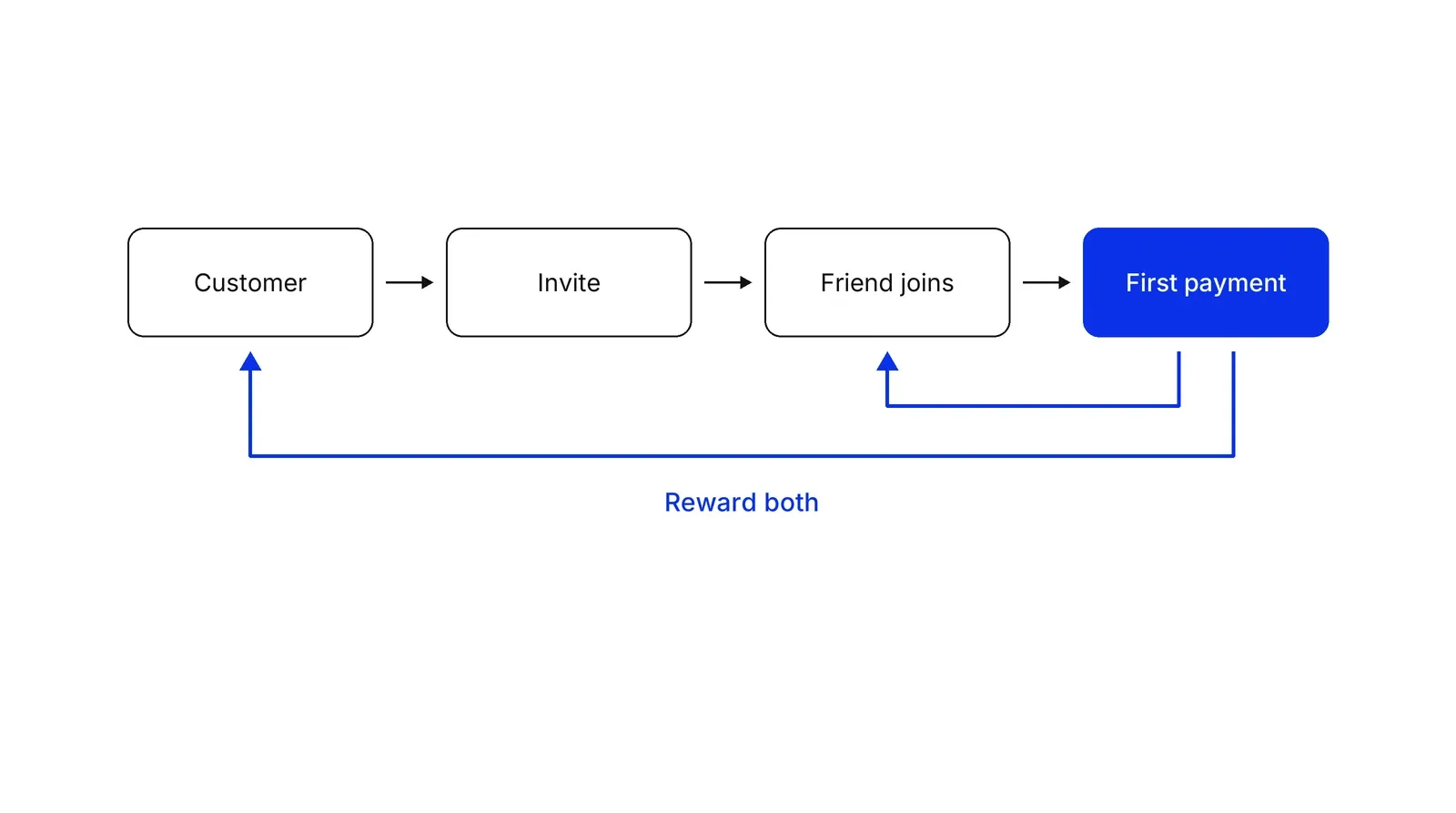
Paying on a later event keeps the cost tied to value. It also delays the reward, so the page that explains the program should say when it arrives.
Who should be paid, the referrer or the friend?
In most programs, both. The evidence points two ways, which is why the split deserves a test. In four experiments, Ryu and Feick found that rewards raise the likelihood of referring, most for weak ties and weaker brands. For those cases paying the referrer mattered most, while for strong ties and stronger brands, sharing part of the reward with the friend worked better.
The reason to split is the receiver. Verlegh and colleagues found that a reward makes receivers suspect the referrer’s motive, more so for unsolicited and weak-tie referrals, and that rewarding both parties or using symbolic rewards removed the effect. Orsingher and Wirtz found that a bigger incentive is more attractive but also lowers how the referrer expects to be seen, and recommended rewards that are useful yet small in face value, aimed at strong ties.
How big should the reward be?
Size it from margin: the reward for both sides, plus losses to abuse, must stay below the gross margin a referred customer brings. Take an illustrative payments app where a referred customer brings $120 of margin in 12 months. A $30 reward to each side costs $60, leaving $60. If one reward in ten goes to a fake account, the cost per real customer is about $67.
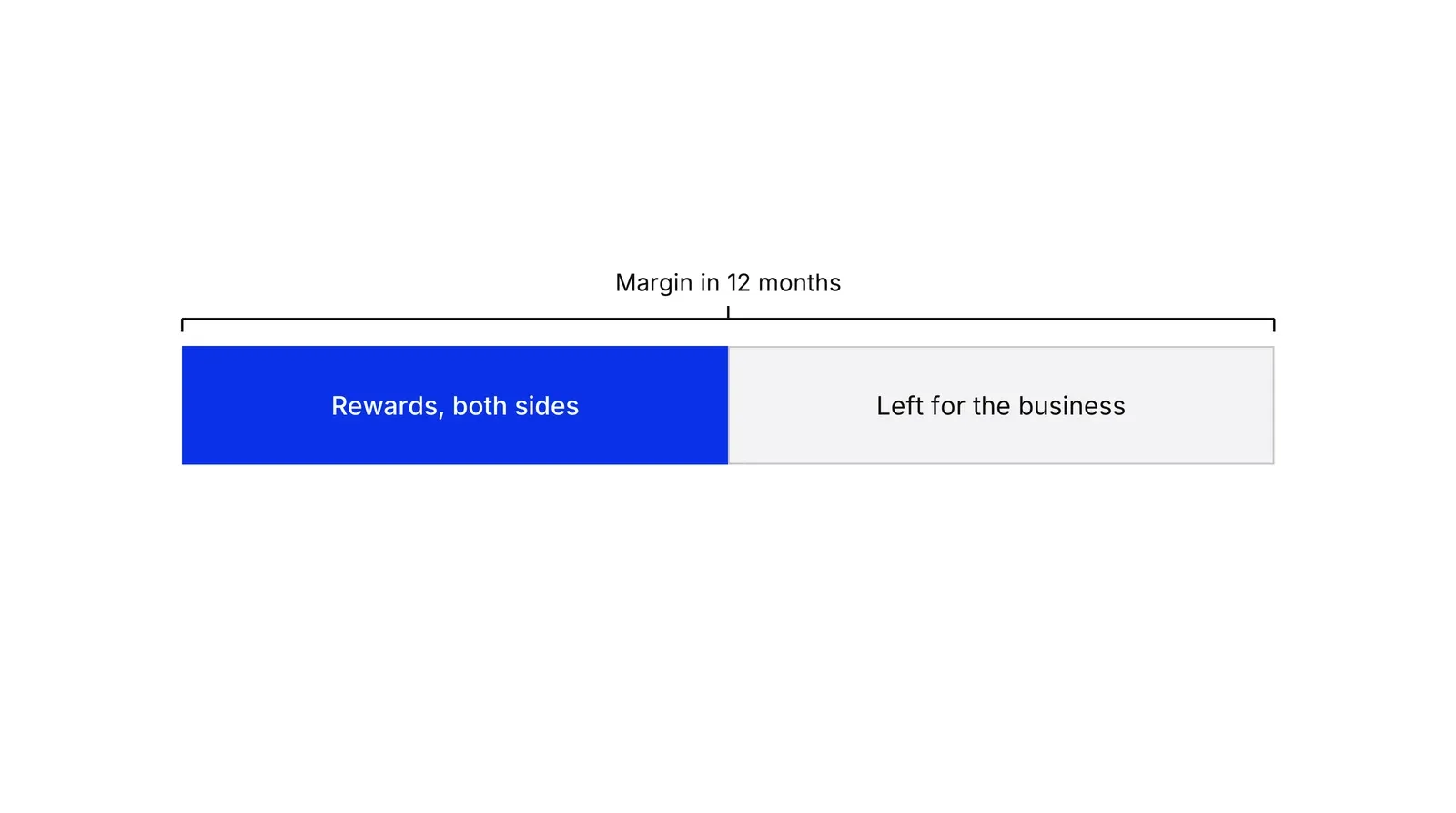
The ceiling has a floor too. Biyalogorsky, Gerstner and Libai modelled a “delight threshold”, the level of satisfaction at which a customer recommends without being paid. When customers are easy to delight, a reward goes to people who would have referred anyway and is wasted. Lower the price instead, or leave the reward out. Kornish and Li add that a recommendation carries the referrer’s judgement of the friend, so the best bonus depends on how much the referrer cares about that friend.
Who refers best?
Not the biggest spenders. Kumar, Petersen and Leone argue in HBR that the customers who buy the most are probably not the best marketers. Satisfaction alone is not enough either: Wirtz and Chew found it necessary but not sufficient for word of mouth, with incentives helping to turn it into action.
Reach matters less than willingness. Hinz and colleagues found that seeding well-connected people was up to eight times more successful, because they take part more, not because they persuade more. Godes and Mayzlin found that, for a product with low awareness, word of mouth from less loyal customers between acquaintances drove sales best. Berman reviews the research and the Dropbox and PayPal programs side by side.
Referred customers are worth recruiting. Schmitt, Skiera and Van den Bulte tracked about 10,000 customers of a German bank for almost three years. Referred customers had a higher margin that eroded over time and a higher retention that persisted, and were worth at least 16% more. The bank paid a 25 euro voucher; the authors put the return at about 60% over six years. They warn that the gap varies by segment and advise a selective approach.
A follow-up on 1,799 referrer and referral pairs found that referred customers churn less only while their referrer stays. For the bank studied, the authors suggested recruiting referrers who joined at least six months ago, earn high margins and are unlikely to leave. The referrers gain too: in a cellular provider’s field experiment, defection among referrers fell from 19% to 7%.
What Dropbox and PayPal reported
Both cases are company-reported and describe the firm’s own results, not independent audits.
| Dropbox | PayPal | |
|---|---|---|
| Source | Drew Houston’s 2010 slides; 2018 S-1 | 2004 and 2003 talks by Levchin, Thiel and Musk |
| Reward | Extra storage for referrer and friend | Cash for opening an account |
| Reported effect | Referral program raised sign-ups 60% and made up 35% of daily sign-ups in 2010 | $10 per account was the cheapest acquisition method they found |
| Context | Paid search cost $233 to $388 per customer for a $99 product | Founders say a million customers came without sales force or ad budget |
In his 2010 slides, Houston credits PayPal’s $5 bonus as the inspiration and reports 2.8 million direct referral invites in the previous 30 days. The 2018 S-1 says Dropbox acquires users through word-of-mouth referrals, in-product referrals and content sharing, and only a small share through paid marketing.
For PayPal, the founders’ 2004 talk says that paying each customer $10 to open an account was the cheapest method of those they compared, and Musk’s 2003 talk calls PayPal a case of viral marketing. Retellings online give other bonus sizes, growth rates and total costs, and these sources do not agree, so this page uses only the founders’ own accounts.
What rules apply?
Disclose paid recommendations. Under 16 CFR 255.5, a connection that might materially affect the weight of an endorsement must be disclosed when the audience would not expect it, and payments and free products count. Cash referral fees also look different between consumers and companies: the Knowledge at Wharton summary of the German bank study notes that paying business customers’ employees could look like a bribe.
A Growth Lab plan starts from the margin of a referred customer and the qualifying event.
How to apply Referral program design, step by step
- Check that people already recommend you. Survey recent customers on whether they would recommend you, and look at how many new customers already say a friend sent them. A reward adds to willingness that exists; it does not create it. Result: a list of customer segments that are satisfied enough to be invited to refer.
- Define the qualifying event. Pay out on an action that proves a real customer, such as a first payment, a completed appointment or a verified account, not on a click or a sign-up form. Result: one sentence that says exactly when a referral counts.
- Set the reward ceiling from margin. Estimate the gross margin a referred customer brings in the first 6 to 12 months, then decide what share you will spend on rewards for both sides. Add the share of rewards you expect to lose to abuse. Result: a maximum total reward per qualified referral.
- Choose who is rewarded and in what form. Decide whether the referrer, the friend or both receive the reward, and whether it is cash, credit, product or a feature. Prefer a reward that is useful but small in face value, and split it between both sides. Result: a reward table with sides, amounts and forms.
- Build the share flow and attribution. Give each customer a personal link or code, make sharing a two-tap action at the moment of satisfaction, and record who referred whom. Result: every new customer carries a referrer ID, and you can see invites, conversions and rewards in one report.
- Add limits, checks and disclosure. Cap rewards per referrer, block self-referrals and duplicate devices or payment details, hold rewards until the qualifying event, and state the reward to the person who receives a recommendation. Result: a short rule set published with the program.
- Launch to one segment and read the numbers. Open the program to one customer segment first. Track the share of customers who refer, invites per referrer, conversion of invites, cost per qualified referral and the retention of referred customers against others. Result: a go or no-go decision on wider rollout.
Examples
A payments app (illustrative)
A transfer app finds that a referred customer brings $120 of gross margin in the first 12 months. It pays $30 to the referrer and $30 to the friend once the friend sends a first transfer of at least $50, so the reward is $60, half the margin. If 10% of rewards go to fake accounts, the cost per real customer is $60 / 0.9, about $67. That compares with an illustrative paid-channel cost of $90.
A dental clinic (illustrative)
A clinic with 400 patients a month offers a free hygiene check to the existing patient and to the friend after the friend's first completed visit. The qualifying event is the visit, not the booking, so no-shows cost nothing. Rules on rewarding patients for referrals vary by country and by payer, so the clinic checks them with a lawyer before launching.
Dropbox's storage reward
Dropbox rewards both sides with free storage. Its help centre says a Basic user gets 500 MB per referred friend, up to 16 GB, and the space arrives only after the friend accepts, installs the app, logs in and verifies an email. The reward is the product itself, so it costs little and pushes both people toward actual use.
When to use it
Use it when customers already like the product and have friends or colleagues who could use it: consumer apps, fintech, banking, subscriptions, clinics and local services. It works best when you can track who referred whom and when the margin from a new customer is large enough to share.
When not to use it
Skip it when the product is not good enough to recommend, when customers rarely know anyone with the same need, or when you cannot attribute a new customer to a person. In B2B sales to companies, paying a customer's employee can look like a bribe, so a cash fee is usually the wrong form.
Common mistakes
- Paying on a sign-up instead of a qualifying action, which invites fake accounts and customers who never use the product.
- Setting the reward without checking margin, so each referral loses money before it earns it back.
- Rewarding only the referrer. Research on receivers shows that a reward to the referrer alone can make friends suspect a hidden motive.
- Opening the program to everyone at once, so you never learn which customers refer well.
- Forgetting disclosure. A recommendation that is paid for may need a clear statement of the reward.
FAQ
What is a good referral reward?
One that you can afford from the margin of a referred customer, that the person finds useful and that is split between both sides. Dropbox used free storage, PayPal paid cash, and a German bank in a Journal of Marketing study paid a 25 euro voucher. Test two or three sizes on separate segments.
Should the referrer or the friend get the reward?
Usually both. Journal of Marketing experiments by Ryu and Feick found that for weak ties and weaker brands the referrer's reward matters most, while for strong ties and strong brands sharing the reward with the friend works better. Verlegh and colleagues found that rewarding both sides removes receivers' suspicion.
Are referred customers more valuable?
In one study they were. Schmitt, Skiera and Van den Bulte tracked about 10,000 customers of a German bank for almost three years and found referred customers worth at least 16% more, mostly through higher retention. The margin gap shrank over time, and the size of the gap varied by segment.
How do you stop referral fraud?
Pay only on a qualifying action such as a first payment, hold rewards until it happens, cap rewards per referrer and block self-referrals and repeated devices or payment details. Review flagged accounts by hand. Build a loss rate for abuse into the reward ceiling.
Do referral programs affect the people who refer?
Yes. In a field experiment with a cellular provider, Garnefeld and colleagues found referrers' defection rate fell from 19% to 7% within a year and their monthly revenue rose 11.4% against a matched control group. The effect was strongest for newer customers.
Sources
- Drew Houston, Startup Lessons Learned (Dropbox), slides, 2010
- Dropbox, Inc., Form S-1 registration statement, SEC, 2018
- Dropbox Help Center, How much free space do I get?
- Max Levchin and Peter Thiel, Selling Customers: Getting the Product Out, Stanford Entrepreneurial Thought Leaders, 2004
- Elon Musk, Success Through Viral Marketing: PayPal, Stanford Entrepreneurial Thought Leaders, 2003
- Philipp Schmitt, Bernd Skiera, Christophe Van den Bulte, Referral Programs and Customer Value, Journal of Marketing 75(1), 2011
- Christophe Van den Bulte, Emanuel Bayer, Bernd Skiera, Philipp Schmitt, How Customer Referral Programs Turn Social Capital into Economic Capital, Journal of Marketing Research 55(1), 2018
- Knowledge at Wharton, Turning social capital into economic capital: straight talk about word-of-mouth marketing
- Gangseog Ryu, Lawrence Feick, A Penny for Your Thoughts: Referral Reward Programs and Referral Likelihood, Journal of Marketing 71(1), 2007
- Jochen Wirtz, Patricia Chew, The effects of incentives, deal proneness, satisfaction and tie strength on word-of-mouth behaviour, International Journal of Service Industry Management 13(2), 2002
- Chiara Orsingher, Jochen Wirtz, Psychological drivers of referral reward program effectiveness, Journal of Services Marketing 32(3), 2018
- Peeter Verlegh, Gangseog Ryu, Mirjam Tuk, Lawrence Feick, Receiver responses to rewarded referrals: the motive inferences framework, Journal of the Academy of Marketing Science 41(6), 2013
- Laura Kornish, Qiuping Li, Optimal Referral Bonuses with Asymmetric Information, Marketing Science 29(1), 2010
- Eyal Biyalogorsky, Eitan Gerstner, Barak Libai, Customer Referral Management: Optimal Reward Programs, Marketing Science 20(1), 2001
- Ina Garnefeld, Andreas Eggert, Sabrina Helm, Stephen Tax, Growing Existing Customers' Revenue Streams Through Customer Referral Programs, Journal of Marketing 77(4), 2013
- V. Kumar, J. Andrew Petersen, Robert Leone, How Valuable Is Word of Mouth?, Harvard Business Review, 2007
- Barry Berman, Referral marketing: Harnessing the power of your customers, Business Horizons 59(1), 2016
- Oliver Hinz, Bernd Skiera, Christian Barrot, Jan Becker, Seeding Strategies for Viral Marketing: An Empirical Comparison, Journal of Marketing 75(6), 2011
- David Godes, Dina Mayzlin, Firm-Created Word-of-Mouth Communication: Evidence from a Field Test, Marketing Science 28(4), 2009
- US Federal Trade Commission, Guides Concerning the Use of Endorsements and Testimonials in Advertising, 16 CFR 255.5
Last updated Oct 9, 2026

Marketing agency or growth system: when a company outgrows its agency
An agency is the right call while the founder still runs most of the company. Once the business starts copying itself into new locations or markets, it needs a system that sets goals, tests hypotheses and owns the result.

Why healthcare marketing agencies stall: the short, mid and long wins model we use with clinics
Most agencies own the click and nobody owns the front desk. How we structure clinic work in three horizons, the research behind each one, and one year of results.

Why channel tests stall after month three
Most paid channel tests do not end with a decision. They end when the budget runs out, the attribution model changes, or everyone quietly stops looking at the dashboard.