Change management (Kotter's 8 steps)
Kotter's 8 steps are a sequence for leading organizational change, from creating urgency to making the new way the default, with a literature review that backs most steps but not the whole model.
Kotter's 8 steps are a model for leading organizational change, set out by John Kotter in a 1995 Harvard Business Review article and a 1996 book. The steps run from creating urgency to anchoring the new way in daily work. A 2012 literature review found support for most steps but no formal test of the whole model, so it works best as a planning checklist.
- Origin
- John P. Kotter, 1995; book 1996; revised 2012-2014
- Level
- 401 · Expert
- Fits
- Scale-up, Enterprise
- Time to apply
- Two to three hours to plan the first three steps, then months of work on the rest
- What you need
- one change with a named sponsor, a start date and people who must do something differently · a group of five to ten people from different levels and departments who can meet weekly · a way to see early results, such as a metric or a pilot team
Kotter’s 8 steps are a sequence for leading a large change in an organization, from making people feel the need to act to making the new way the normal one. John Kotter published the idea as a 1995 Harvard Business Review article after watching more than 100 companies try to remake themselves. The eight-step process itself appears in his 1996 book Leading Change, according to Appelbaum and colleagues. Later he changed the model, and researchers have tested parts of it.
What are the 8 steps?
The steps are urgency, a guiding coalition, a vision, communication, removing barriers, short-term wins, consolidating gains and anchoring change. Pollack and Pollack list the 1996 wording, and Kotter Inc. uses newer names for the same order.
| # | 1996 wording | Current wording |
|---|---|---|
| 1 | Establishing a sense of urgency | Create a sense of urgency |
| 2 | Creating the guiding coalition | Build a guiding coalition |
| 3 | Develop a vision and strategy | Form a strategic vision |
| 4 | Communicating the change vision | Enlist a volunteer army |
| 5 | Empowering broad-based change | Enable action by removing barriers |
| 6 | Generating short-term wins | Generate short-term wins |
| 7 | Consolidating gains and producing more change | Sustain acceleration |
| 8 | Anchoring new approaches in the culture | Institute change |
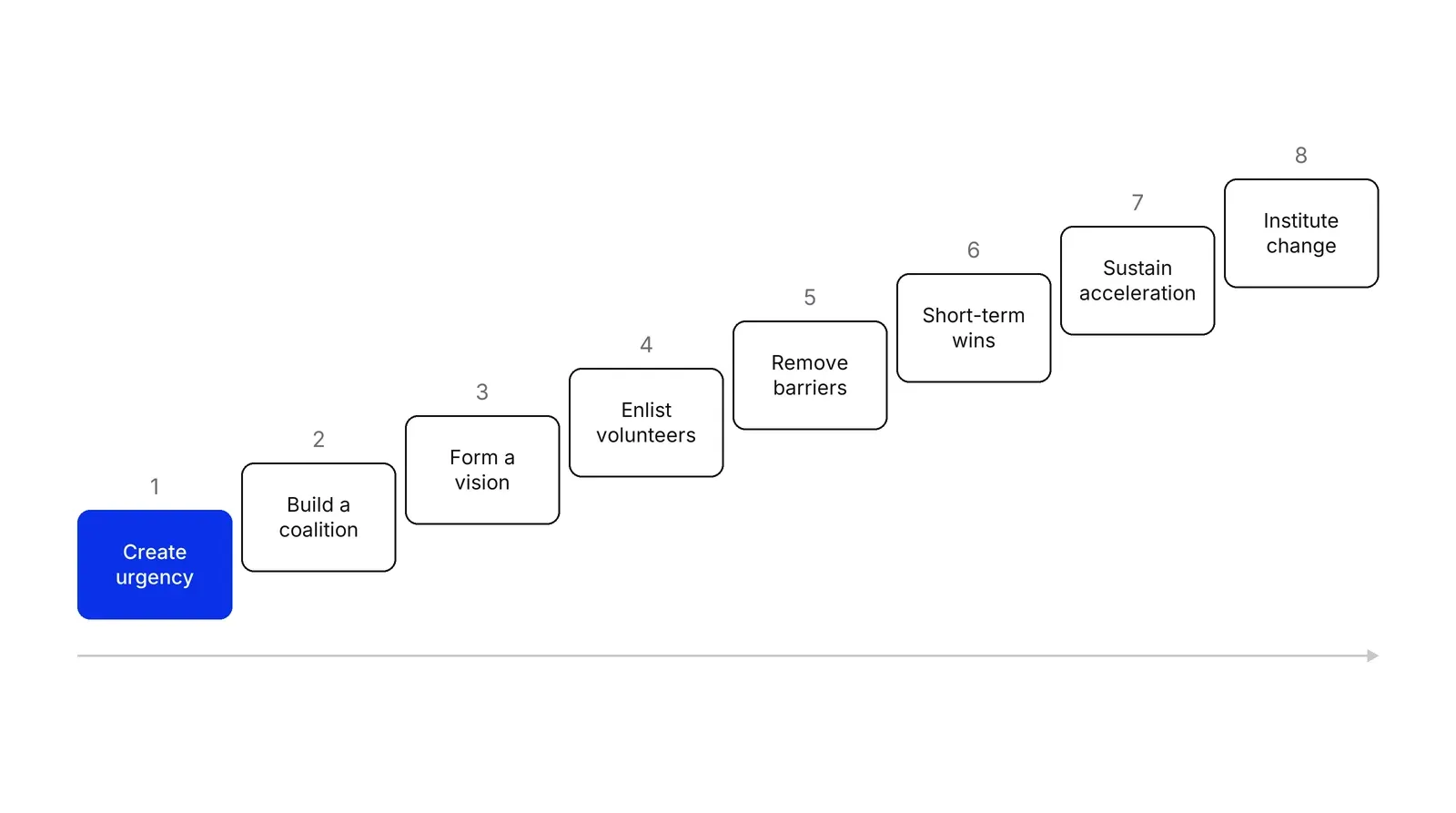
Kotter treats order as important. Pollack and Pollack quote the book saying that skipping even a single step, or getting too far ahead without a solid base, almost always creates problems. Kotter also allows earlier steps to be revisited. In the same paper he is cited as calling lack of urgency the single biggest error in changing organizations, which is why he wrote a whole book on it, A Sense of Urgency.
What changed in Accelerate?
In Accelerate, Kotter argued that a hierarchy cannot drive constant change alone, and proposed adding a second system beside it. The idea started in an HBR article in November 2012 and became a 2014 book from Harvard Business Review Press. The publisher describes a “dual operating system”: the existing hierarchy runs daily operations, and a more agile, network-like structure works on strategic challenges next to it.
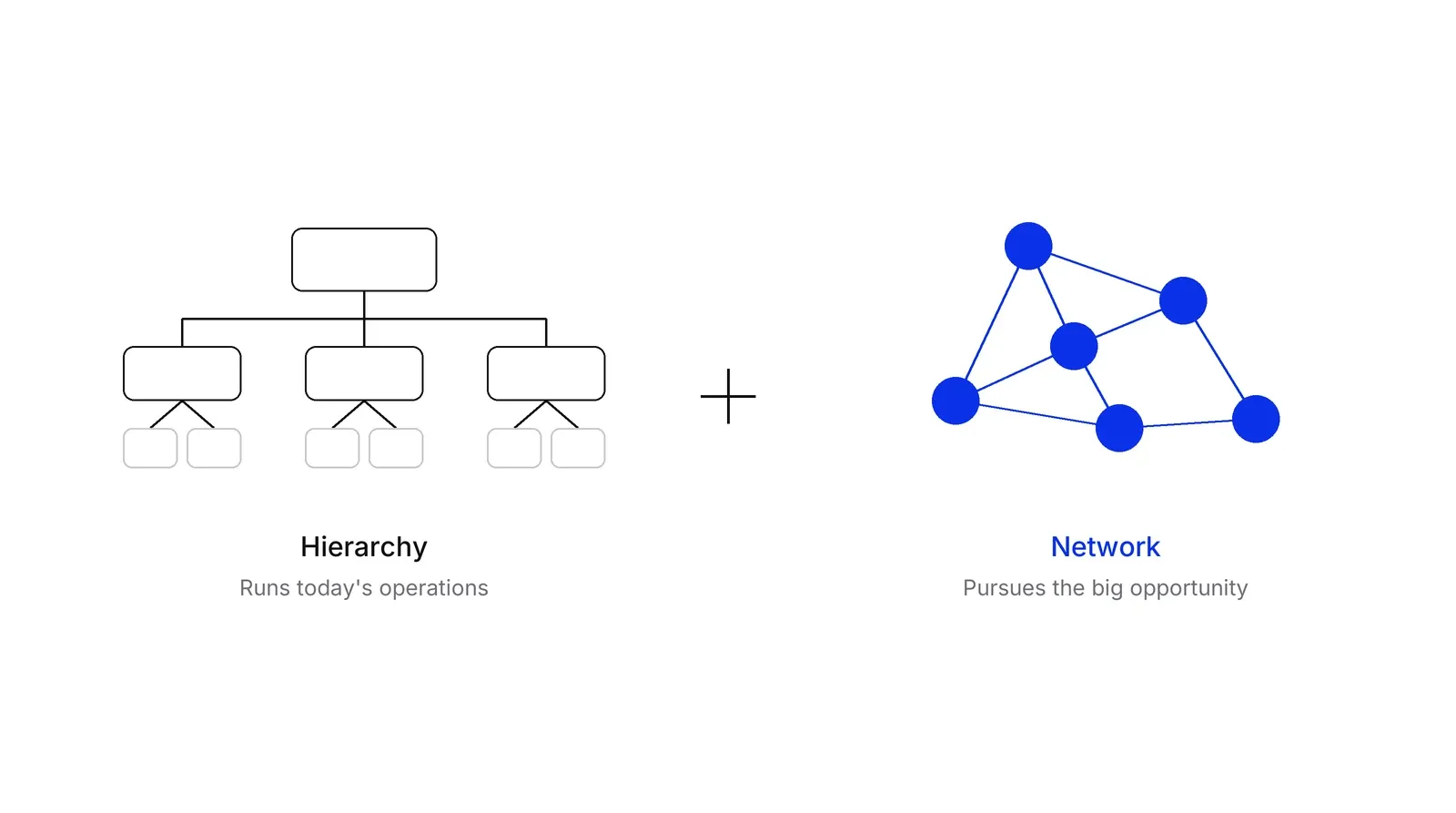
According to the publisher, the network rests on five principles and eight Accelerators, and leaders build urgency in others largely by modelling it. Kotter Inc. says the linear eight steps evolved into the 8 Accelerators. We read its newer step names, such as “enlist a volunteer army”, as a shift toward volunteers across levels doing the work, not only a top-down coalition. For the design question behind it, see operating model design.
What is Lewin’s three-step model?
Lewin’s model describes change as unfreezing the current state, moving to a new one and freezing it there. It is usually credited to Kurt Lewin’s 1947 article in the first volume of Human Relations. Cummings, Bridgman and Brown compared what Lewin wrote with later textbooks and argue that he never developed such a model, and that it took form after his death. Burnes defends Lewin’s planned approach as still relevant, and a 2018 review links 13 later planned-change models back to it. Lewin’s other work is still being reassessed: Burnes and Cooke re-evaluate his field theory, and a 2017 special issue examines his continuing influence. The practical reading is that Lewin gives the idea, and Kotter turns it into leadership tasks. The ADKAR page compares both with a model of individual change.
What does the evidence say?
The evidence supports the parts more than the whole. Appelbaum and colleagues reviewed 15 years of literature for each of the eight steps in 2012. They found support for most steps, no formal study covering the entire model, and no evidence against it. They concluded that the model owes its popularity to a usable format more than to scientific consensus, and suits implementation planning, with other tools alongside.
Other research points the same way:
- Stouten, Rousseau and De Cremer found that popular change models rely more on expert opinion than on scientific evidence, and built their own list of ten evidence-based steps.
- Todnem By described change theories as often contradictory and mostly lacking empirical evidence.
- A case study by Pollack and Pollack found the linear picture did not match the complexity of the work, and the team ran several instances of the process at once.
- Oreg, Vakola and Armenakis reviewed 79 quantitative studies of how employees react to change, a body of work separate from the eight steps.
Do 70 percent of changes fail?
No source we found measured it. Beer and Nohria wrote in 2000 that about 70% of change initiatives fail, and the excerpt we read gives no source for the figure. Hughes reviewed five published instances in 2011 and found no valid and reliable empirical evidence for any. In 2022 he called the persistence of the belief a failure of scholarship. Use the claim as a story, not as a statistic.
How do you use it well?
Use the steps as a checklist for the leaders, and use other tools for the work between them. A PDCA loop turns a short-term win into a tested routine, and kaizen keeps people improving the new way after step 8. Leaders can pair step 4 and 5 with situational leadership, which matches support to how ready each person is. A Growth Lab plan, described on the practices page, can start from the first three steps.
How to apply Change management (Kotter's 8 steps), step by step
- Test the urgency. Ask 15 people in different roles whether they would say the change is needed now, and why. If the answers are lukewarm, work on the reason before the plan. Result: a short list of facts that make the case, with names of the people who already agree.
- Form the guiding group. Pick people with formal authority, real expertise and the trust of their peers, drawn from several levels. Give the group a weekly slot and a clear task. Result: a named group that meets and owns the change.
- Write a vision people can repeat. Describe the future in a few sentences that a team member could say back without notes, plus the strategy to reach it. Result: one paragraph the guiding group signs off, and a plan for how to say it often.
- Remove blockers and recruit volunteers. List what stops people from acting: a rule, a tool, a manager, a missing approval. Fix the blockers you control and invite volunteers to take on parts of the work. Result: a list of removed blockers and a set of people who chose to join.
- Plan and publish short-term wins. Choose results that arrive in weeks and are visible to the whole group, then tell people about them. Result: two or three dated wins that show the change works.
- Keep going, then fix the new way in place. Use the credibility from the wins to change the systems that still push people to the old way: reporting lines, targets, hiring criteria, the onboarding checklist. Result: the old process is gone from the documents people use.
Examples
A clinic network moving to one booking system
Illustrative, no real clinic implied. The medical director shows no-show rates by site, which creates urgency. A guiding group of two doctors, a head receptionist and an IT lead owns the plan. A pilot at one site books faster by the second week, and that result is the short-term win. The old paper diary is removed from the onboarding checklist at the end.
A payments company changing its merchant onboarding
Illustrative. Compliance, sales and support leads form the guiding group. The blocker is that sales and compliance use separate case tools, so the group merges them for one merchant segment first. Approval time for that segment becomes the visible win, and the other segments follow.
A 40-person marketing team adopting weekly experiments
Illustrative. The head of marketing names a volunteer group of six who each run one test per week. Their first two results are published to the whole team. The step that matters most is the last one: the monthly plan template now has an experiments section, so the old planning format cannot return.
When to use it
Use it for a change that is large, crosses departments and needs many people to change habits, such as a new operating process, a new system or a merger of teams. It gives leaders a sequence to follow and a vocabulary to share. It suits a case where the main risk is that people will not see why the change matters or that it will fade after launch.
When not to use it
Do not use it as a recipe that guarantees success, because no study has tested the whole model. It is a poor fit for small changes one team can make alone, and for change that needs to start from the people doing the work. Do not treat the order as a law: one case study found a real program ran several cycles at once.
Common mistakes
- Skipping step 1 and starting with the plan, so people comply on paper and carry on as before.
- Treating the guiding group as a project team of managers, with no one from the front line.
- Announcing the vision once, instead of repeating it in every meeting and decision.
- Declaring success after the first win and stopping before systems and incentives are changed.
- Quoting 'most change fails' to create urgency, when the number has no empirical source.
FAQ
What are Kotter's 8 steps?
They are: create a sense of urgency, build a guiding coalition, form a strategic vision, enlist a volunteer army, enable action by removing barriers, generate short-term wins, sustain acceleration, and institute change. The wording is from Kotter Inc. The 1996 book used slightly different names for the same eight stages, ending with anchoring new approaches in the culture.
Did Kotter update the 8 steps?
Yes. In Accelerate (2014), built on a 2012 HBR article, Kotter proposed a dual operating system: the hierarchy keeps running the business and a network of volunteers pursues strategic change. Kotter Inc says he evolved the linear 8 steps into the 8 Accelerators in that book.
How is Kotter's model different from Lewin's?
Lewin's three steps (unfreeze, change, refreeze) are a general idea of how groups change. Kotter's eight steps are a leader's process for a whole organization. Cummings, Bridgman and Brown (2016) argue Lewin never developed the three-step model himself and that it took shape after his death.
Is Kotter's change model backed by evidence?
Partly. A 2012 review in the Journal of Management Development found support for most of the eight steps in 15 years of literature, but no formal study of the whole model. It said the model is popular for its usable format, not for scientific consensus, and works best as an implementation planning tool.
Sources
- John P. Kotter, Leading Change: Why Transformation Efforts Fail, Harvard Business Review, March-April 1995
- John P. Kotter, Leading Change, Harvard Business School Press, 1996 (library catalogue record)
- John P. Kotter, Accelerate!, Harvard Business Review, November 2012
- John P. Kotter, Accelerate: Building Strategic Agility for a Faster-Moving World, Harvard Business Review Press, 2014
- Kotter Inc., The 8 Steps for Leading Change (vendor material)
- Appelbaum, Habashy, Malo, Shafiq, Back to the future: revisiting Kotter's 1996 change model, Journal of Management Development 31(8), 2012
- Stouten, Rousseau, De Cremer, Successful Organizational Change: Integrating the Management Practice and Scholarly Literatures, Academy of Management Annals 12(2), 2018
- Pollack and Pollack, Using Kotter's Eight Stage Process to Manage an Organisational Change Program: Presentation and Practice, Systemic Practice and Action Research 28(1), 2015
- Pollack and Pollack, prepublication version, University of Technology Sydney repository
- Oreg, Vakola, Armenakis, Change Recipients' Reactions to Organizational Change, Journal of Applied Behavioral Science 47(4), 2011
- Todnem By, Organisational change management: A critical review, Journal of Change Management 5(4), 2005
- Mark Hughes, Do 70 Per Cent of All Organizational Change Initiatives Really Fail?, Journal of Change Management 11(4), 2011
- Mark Hughes, Reflections: How Studying Organizational Change Lost Its Way, Journal of Change Management 22(1), 2022
- Michael Beer and Nitin Nohria, Cracking the Code of Change, Harvard Business Review, May-June 2000
- Kurt Lewin, Frontiers in Group Dynamics, Human Relations 1(1), 1947
- Cummings, Bridgman, Brown, Unfreezing change as three steps: Rethinking Kurt Lewin's legacy for change management, Human Relations 69(1), 2016
- Bernard Burnes, Kurt Lewin and the Planned Approach to Change: A Re-appraisal, Journal of Management Studies 41(6), 2004
- Burnes and Cooke, Kurt Lewin's Field Theory: A Review and Re-evaluation, International Journal of Management Reviews 15(4), 2013
- Rosenbaum, More, Steane, Planned organisational change management: forward to the past, Journal of Organizational Change Management 31(2), 2018
- Burnes and Bargal, Kurt Lewin: 70 Years On, Journal of Change Management 17(2), 2017
- Prosci, ADKAR vs Kotter (vendor material)
Last updated Oct 9, 2026


Fractional COO or embedded operations team? How to choose at Series A
The two models solve different problems: how to tell which one your company needs, and what each costs in time and control.

What operational systems successful fintech startups use: lessons from ten companies
Starling, Monzo, Qonto, bunq, Lunar, Pleo, Tide, Ramp, Mercury and Column scaled on four operating systems. Regulators' findings show what breaks when one of them lags behind growth.

What a revenue operations manager actually owns
Pipeline definitions, CRM hygiene, forecasting and the handoffs between marketing, sales and success. What the role covers, and how it differs from sales ops.