Jobs to be done (JTBD)
Jobs to be done is a theory of why customers buy: people hire a product to make progress in a specific situation, so you study the situation and the struggle, not the customer's profile.
Jobs to be done (JTBD) is a theory of customer choice: people hire a product to make progress in a specific circumstance and fire it when something does the job better. Teams use it to find what really triggers a purchase and who the real competitors are. Two schools apply it differently: switch interviews about the story of a purchase, and Outcome-Driven Innovation surveys that score unmet needs.
- Origin
- Clayton Christensen (popularized the term); Bob Moesta (switch interviews); Tony Ulwick (Outcome-Driven Innovation). Who originated it is disputed, 1990s; Christensen in HBR 2005 and 2016
- Level
- 201 · Tool
- Fits
- Startup, Small and mid-size, Scale-up
- Time to apply
- two to four weeks: a week to recruit, one to two weeks of interviews, a few days of analysis
- What you need
- one purchase decision you want to understand, such as switching to your product or leaving it · 10 to 20 people who made that decision recently, including some who left or chose something else · two people per interview: one asks, one takes notes · for the ODI route, a survey tool and a few hundred respondents
Jobs to be done (JTBD) is a theory of why people buy. A customer “hires” a product to make progress in a specific circumstance, and “fires” it when something else does that job better. Christensen and his co-authors define the job in Harvard Business Review as “the progress that the customer is trying to make in a given circumstance.” Product teams, marketers and founders use it to find out what triggers a purchase and what they are really competing with.
The idea is older than the name. Theodore Levitt told Harvard students that people want a quarter-inch hole, not a quarter-inch drill, a line Quote Investigator traces to a 1942 advertisement. Who turned it into a method is disputed. Strategyn says Tony Ulwick created JTBD in 1990 and introduced his process to Christensen in 1999. Bob Moesta’s firm says he developed it with Christensen from the mid-1990s. Christensen’s 2016 article says the insight grew out of his Harvard Business School course over two decades. Everyone agrees Christensen made the term famous.
What counts as a job?
A job is the progress a person wants in a particular situation, and it has functional, social and emotional sides, according to the Christensen Institute. The situation matters more than the person. Christensen’s own example: his age, height and minivan do not explain why he buys the New York Times; a long flight does.
Moesta’s condo project shows the difference in practice. A Detroit-area builder was targeting downsizers with granite counters and bay windows, and sales stayed flat. Buyers’ timelines kept returning to one object, the dining room table that held every family birthday. Buyers were held back by the anxiety of giving it up, and no missing feature explained the slow sales. The real competitor was staying put.
That is the second idea in the theory: competition is defined by the job. If the job is “get through a dull commute,” the rival is whatever else people hire for it.
The milkshake story, as Christensen told it
The milkshake case is the most quoted JTBD example, and its details change with the teller. In the versions Christensen published, a fast-food chain had asked typical milkshake buyers how to improve the shake, made the changes, and saw no change in sales. A researcher then spent a day in one restaurant watching who bought shakes and when. The 2006 HBS excerpt of Christensen’s 2005 HBR article and his 2007 MIT Sloan Management Review article both say 40% of the milkshakes were bought in the early morning, mostly by people alone who drove off with them.
Interviews showed a shared job: a long, boring drive, one free hand, and a need to stay full until mid-morning. A thick shake took about twenty minutes to drink through a thin straw. Bagels were dry and sticky, a banana did not last the drive, and doughnuts did not hold off hunger until 10 a.m. Later in the day, parents bought shakes for children, a different job that called for a thinner shake. The excerpt adds that the company and the product were disguised, so the chain is not named.
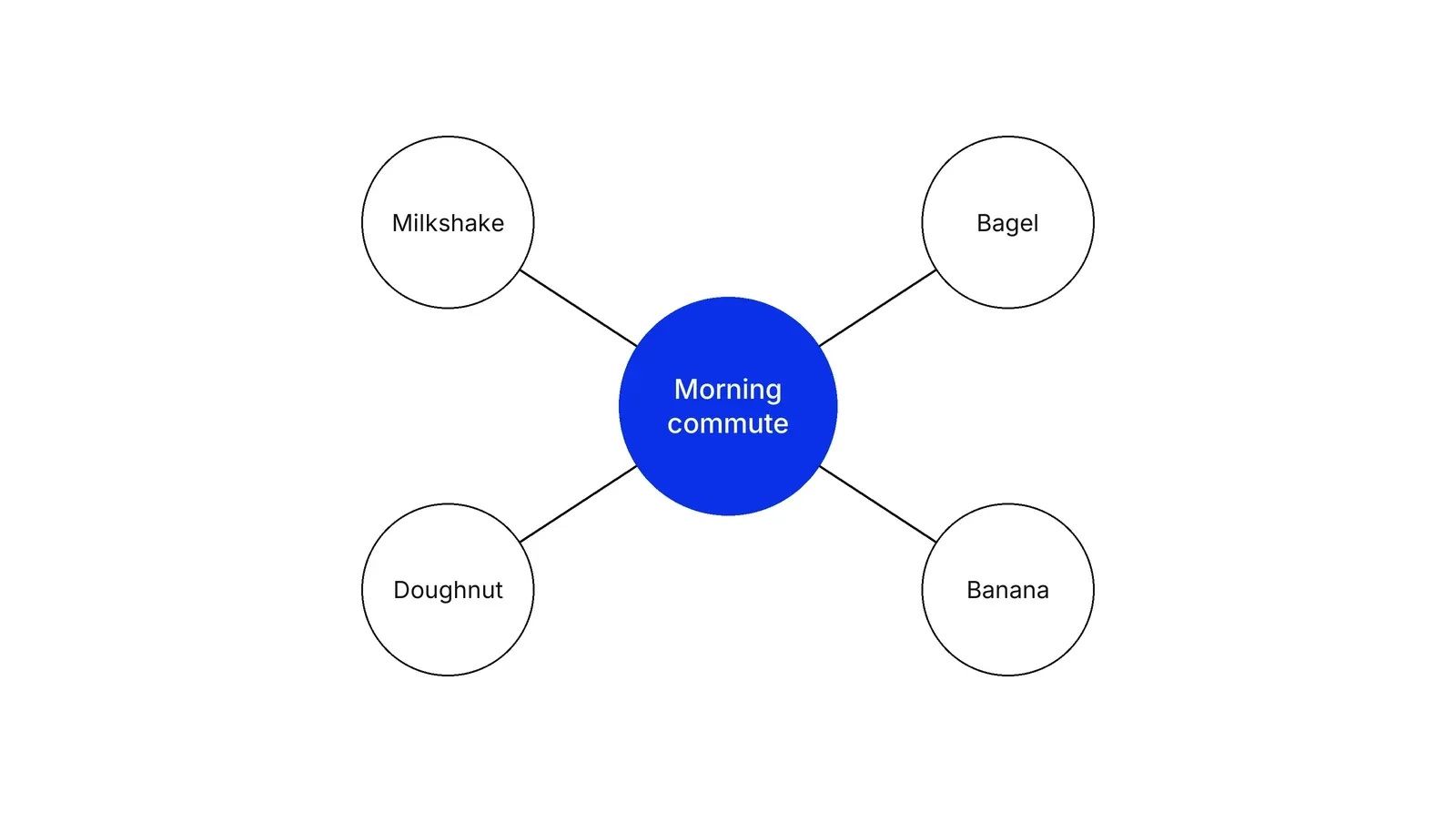
Treat other numbers with care. Moesta, who tells the story as his own team’s project, says in his guide only that the buyers arrived alone before 8:00 a.m. Popular retellings add a share sold before 8:30 or a jump in sales; we found neither in a primary source, and none of the versions we read gives a sales result.
Two schools that disagree
JTBD has two main working schools, and they disagree on what a job is and how to study it. Christensen and Moesta treat a job as progress in a life situation. Ulwick’s Outcome-Driven Innovation (ODI) treats it as a stable, functional task that can be broken into steps and measured.
| Progress school (Christensen, Moesta) | Outcome-Driven Innovation (Ulwick) | |
|---|---|---|
| What a job is | Progress in a circumstance, with functional, social and emotional sides | A core functional job, solution-free and stable over time |
| Main research | Switch interviews: the timeline of one purchase | Job mapping interviews, then a survey |
| Sample | About 10 to 20 recent switchers | Interviews plus a quantitative survey |
| Output | A few jobs with their forces and hiring criteria | 50 to 150 outcome statements ranked by opportunity |
| Best for | Why people switch, what blocks them, messaging | Which unmet needs to build for, in what order |
The split changes what you find. A progress interview would treat the dining room table as the heart of the job; a functional job map of “move to a new home” might list it as one step’s detail. Many teams use interviews first and an ODI survey second, as Lucassen and colleagues did in a 2018 requirements-engineering study.
Switch interviews and the four forces
A switch interview is a conversation with someone who recently changed what they use, reconstructing the purchase from first thought to first use. Moesta’s team looks for the “struggling moment” and four forces, as the HBR Intercom sidebar describes.
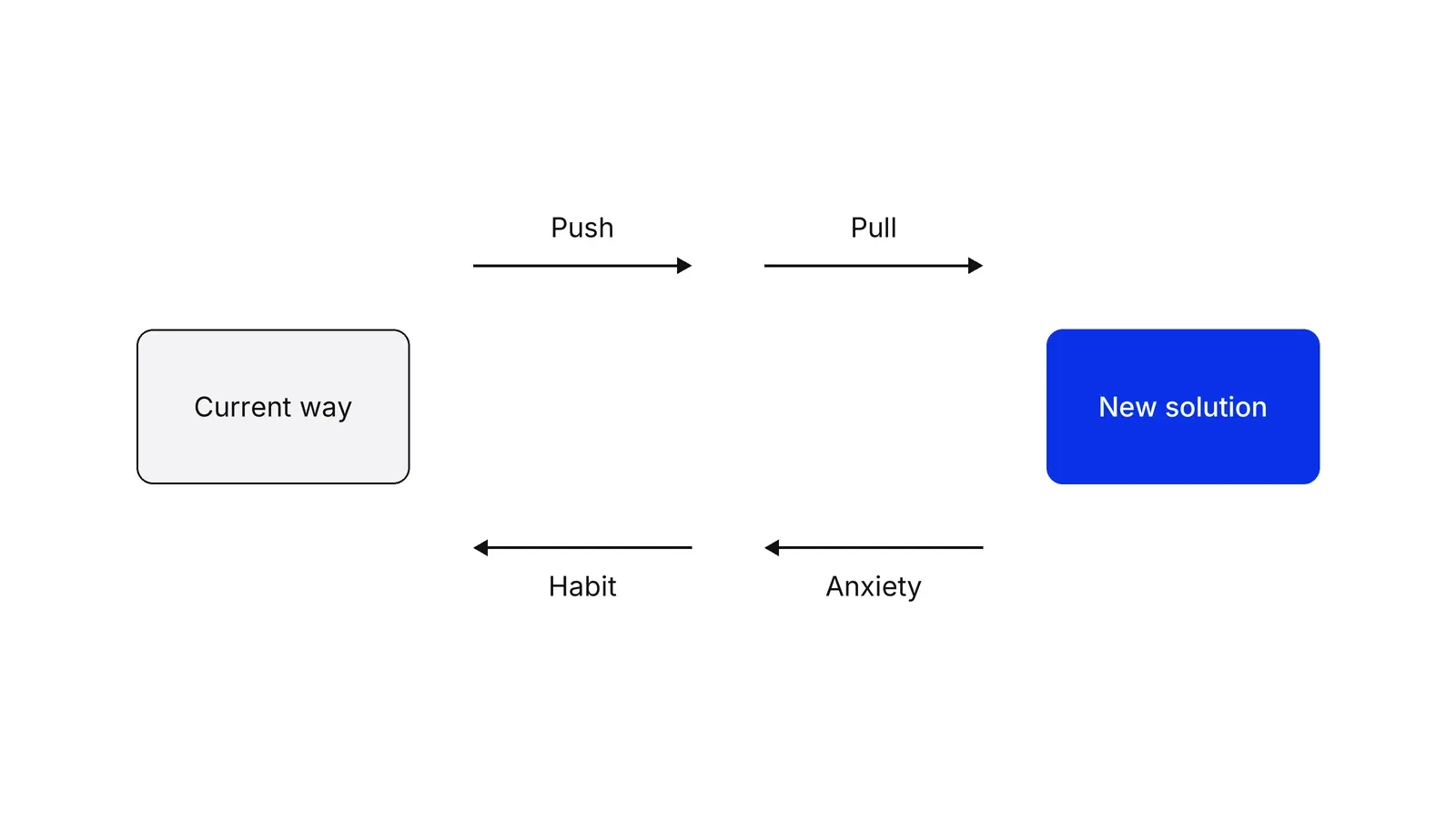
The push comes from the current situation, the pull from the new solution. Anxiety about the new thing and habits of the present hold people back. The condo builder raised sales mainly by reducing anxiety, with storage and moving help.
Outcome-Driven Innovation in brief
ODI breaks a job into steps on a universal job map: define, locate, prepare, confirm, execute, monitor, modify and conclude. For each step, customers state how they measure success, and Strategyn says a job typically yields 50 to 150 outcome statements. A survey asks for each one how important it is and how satisfied people are today. The opportunity score is importance + max(importance − satisfaction, 0).
Take an illustrative outcome rated 9 for importance and 4 for satisfaction: 9 + 5 = 14. Another rated 8 and 8 scores 8 + 0 = 8. The first is underserved and goes to the top of the list.
Strategyn’s flagship case is Cordis, whose angioplasty balloon share it says rose from under 1% to over 20%, and it reports an 86% success rate for ODI projects. Both figures are self-reported by the firm that sells the method.
What the evidence says
Most published research on JTBD consists of case studies and method papers; we found no controlled tests. A rural food pantry study of 12 patrons found demographic segments missed the social and emotional sides of their needs. An ODI-style study of TV owners in the Journal of Cleaner Production found 30 needs, 11 of them poorly met. In their 2018 paper, Lucassen and colleagues noted that job stories had “not been studied in research yet.” So far, most evidence for JTBD comes from practitioners and the firms that sell it.
JTBD sits close to buyer personas and market segmentation, and Christensen built it partly as a companion to disruptive innovation. In our Growth Lab work a job story becomes a hypothesis for a HADI loop: the change, the result it should produce for that job, and a date to check.
How to apply Jobs to be done (JTBD), step by step
- Pick the moment of choice. Choose a switch you want to explain: signing up, upgrading, cancelling, picking a competitor. JTBD studies a decision in context, so a vague scope such as 'our users' gives vague jobs. Result: one sentence naming the decision and the people who made it in the last few months.
- Recruit recent switchers. List people who made that choice recently, while they still remember the details. Include new customers and people who left or changed how they use you, as Moesta's team did for Intercom. The Re-Wired Group says ten varied interviews can be enough and suggests fifteen or twenty for a first project. Result: a recruit list across wins and losses.
- Interview for the timeline. Ask each person to tell the story from the first thought that something had to change to the day they bought and started using it. Ask what happened, where they were and who else was involved, not what they would like. Probe vague words until you know what they mean. Result: transcripts in customers' own words, with dates and events.
- Code the forces and the struggle. Mark in each story the push of the old situation, the pull of the new solution, the anxiety about the new one and the habits that kept people in place. Note what they hired before and what they compared. Result: a forces sheet per interview and a list of real competitors, including doing nothing.
- Cluster into a few jobs. Group stories that share a circumstance and a desired progress, ignoring age, job title and company size. Write each cluster as a job statement or a job story: 'When ___, I want to ___, so I can ___.' Result: three to five jobs, each with its triggers, criteria and anxieties.
- Turn jobs into decisions, and size them if needed. Change the product, the onboarding, the offer or the message to serve one job and remove its anxieties. If you need to rank many needs, run an ODI-style survey that scores importance and satisfaction for each outcome. Result: a short list of changes tied to a named job, ready to test.
Examples
Detroit-area condominiums: the dining room table
Documented in Harvard Business Review, 2016. A builder targeting downsizers got plenty of visits but few sales, and adding features from focus groups did not help. Bob Moesta asked buyers to draw a timeline of how they got there. Buyers kept saying they were free to move once they knew what to do with their dining room table. The builder made room for the table, offered moving services and two years of storage, and raised prices by $3,500. HBR reports the business grew 25% by 2007, a year when industry sales fell 49%.
Intercom: four jobs instead of one product
Documented in the same HBR article. Intercom's personas had too many 'typical users' with little in common. Moesta's team interviewed new customers and customers who had left or cut back, and found four jobs: help me observe, engage, learn and support. Intercom split its offer into four products, organized R&D into four teams and let prospects buy only the part that fit their first job. Des Traynor reported a higher conversion rate.
A private clinic choosing what to fix first
Illustrative. A clinic interviews 15 patients who booked a first visit in the last two months and 5 who booked elsewhere. Price and location come up less than expected. The push is a symptom that started to affect work; the main anxiety is not knowing the total cost before the visit. Several patients went to a competitor because it showed a fixed price for the first consultation. The clinic tests a fixed first-visit price on its booking page, which targets the anxiety and adds no new service, and measures bookings for a month.
When to use it
Use it when you need to know why people buy, switch or leave: before building a new product, when a launch is not converting, when churn rises and nobody agrees why, or when you suspect your real competitor is a spreadsheet, a workaround or doing nothing. It works for consumer and B2B purchases alike.
When not to use it
Skip it when the question is narrow and measurable, such as which of two button labels converts better; an A/B test answers faster. It adds little when you cannot reach recent buyers. Do not expect a survey-only version to replace interviews: without the stories you will score needs you have not understood.
Common mistakes
- Writing jobs in a workshop from what the team believes. A job comes from interviews with people who recently made the choice.
- Asking customers what they want. Ask what happened. Christensen's milkshake chain had already improved the shake along the lines customers suggested, with no effect on sales.
- Defining the job too broadly ('be happy') or too narrowly ('order a shake at 7 a.m.'). Moesta's guide aims for three to five jobs per product.
- Ignoring anxiety and habit. Many purchases stall because of fear of the new or comfort with the old, and adding features does not fix that.
- Treating the two schools as one method. Switch interviews and ODI surveys answer different questions; say which one you ran.
FAQ
What is jobs to be done in marketing?
In marketing, jobs to be done means segmenting and messaging by the situation and progress a customer wants, not by demographics. You learn what pushes people to look, what they compare and what worries them, then speak to that moment. Christensen argued the job, not the customer, is the unit of analysis.
What is an example of jobs to be done?
The best-known example is Christensen's milkshake story. A fast-food chain found that many shakes were bought early in the morning by commuters, who hired them to make a long, boring drive bearable and stay full until mid-morning. Their alternatives were bagels, bananas and doughnuts. Improving the shake for that job meant making it thicker.
How do you write a job statement?
Describe the progress in the customer's words and the circumstance, with no product in it. A common format is the job story used at Intercom: 'When ___, I want to ___, so I can ___.' The ODI school writes the core job as a short, solution-free phrase, such as Strategyn's example 'monitor a patient's vital signs'.
What is the difference between JTBD and Outcome-Driven Innovation?
JTBD is the broader theory that people hire products to get jobs done. Outcome-Driven Innovation is Tony Ulwick's method for applying it: map the steps of a functional job, collect 50 to 150 desired outcomes, and survey customers on importance and satisfaction to find underserved needs. Switch interviewers focus on the story behind a purchase instead.
Is a job to be done the same as a persona?
No. A persona describes a type of person; a job describes a situation and the progress wanted in it, and very different people can share one job. Nielsen Norman Group sees the two as compatible, and HBR notes personas can be a starting point for jobs research. Intercom dropped personas for job stories.
Sources
- Clayton M. Christensen, Taddy Hall, Karen Dillon, David S. Duncan, Know Your Customers' Jobs to Be Done, Harvard Business Review, September 2016
- Clayton M. Christensen, Scott Cook, Taddy Hall, Marketing Malpractice: The Cause and the Cure, Harvard Business Review, December 2005
- Harvard Business School Working Knowledge, What Customers Want from Your Products (excerpt of Marketing Malpractice), January 2006
- Harvard Business School Working Knowledge, Carmen Nobel, Clay Christensen's Milkshake Marketing, February 2011
- MIT Sloan Management Review, Christensen, Anthony, Berstell, Nitterhouse, Finding the Right Job for Your Product, Spring 2007
- Clayton Christensen Institute, Jobs to Be Done
- Clayton Christensen Institute, Competing Against Luck (Christensen, Hall, Dillon, Duncan, 2016)
- Anthony W. Ulwick, Turn Customer Input into Innovation, Harvard Business Review, January 2002
- Lance A. Bettencourt, Anthony W. Ulwick, The Customer-Centered Innovation Map, Harvard Business Review, May 2008
- Strategyn, Outcome-Driven Innovation
- Strategyn, Jobs-to-be-Done: overview and universal job map
- Strategyn, Jobs-to-be-Done Theory and Methodology
- Strategyn, History of Jobs-to-be-Done
- Strategyn, Cordis case study
- The Re-Wired Group (Bob Moesta), The Complete Guide to Jobs to Be Done, 2022
- Intercom, Paul Adams, How We Accidentally Invented Job Stories, 2016
- Intercom, Des Traynor, New Book: Intercom on Jobs-to-be-Done, 2016
- Nielsen Norman Group, Page Laubheimer, Personas vs. Jobs-to-Be-Done, 2017
- Quote Investigator, People Don't Want a Quarter-Inch Drill. They Want a Quarter-Inch Hole, 2019
- Lucassen, van de Keuken, Dalpiaz, Brinkkemper et al., Jobs-to-be-Done Oriented Requirements Engineering: A Method for Defining Job Stories, REFSQ 2018
- Hankammer, Brenk, Fabry, Nordemann, Piller, Towards Circular Business Models: Identifying Consumer Needs Based on the Jobs-to-Be-Done Theory, Journal of Cleaner Production, 2019
- Vaterlaus, Cottle, Patten, Gibbons, Understanding Customers: The Jobs to Be Done Theory Applied in the Context of a Rural Food Pantry, Journal of the Academy of Nutrition and Dietetics, 2018
- Klaus Oestreicher, Segmentation and the Jobs-to-be-Done Theory: A Conceptual Approach to Explaining Product Failure, conference paper, 2009
- Lewis, Hermida, Lorenzo, Jobs-to-Be-Done and Journalism Innovation, Media and Communication, 2024
- Holly Jarvis Whitaker, Jobs to Be Done: An Innovative Needs Assessment Method, Journal of Extension, 2018
Last updated Oct 9, 2026


Marketing agency or growth system: when a company outgrows its agency
An agency is the right call while the founder still runs most of the company. Once the business starts copying itself into new locations or markets, it needs a system that sets goals, tests hypotheses and owns the result.

Why healthcare marketing agencies stall: the short, mid and long wins model we use with clinics
Most agencies own the click and nobody owns the front desk. How we structure clinic work in three horizons, the research behind each one, and one year of results.

Why channel tests stall after month three
Most paid channel tests do not end with a decision. They end when the budget runs out, the attribution model changes, or everyone quietly stops looking at the dashboard.