Business process automation
Business process automation is the practice of handing the repeatable steps of a process to software, and the discipline is choosing which processes to hand over first and proving the payoff.
Business process automation is the use of software, such as robotic process automation, workflow engines or AI agents, to run the repeatable steps of a business process without a person doing them. It pays off on processes with high volume, clear rules and few exceptions. Choosing the process and measuring hours saved matters more than choosing the tool.
- Origin
- No single originator; practice. Michael Hammer's 1990 critique and Lacity and Willcocks's RPA case research shaped it, Practice; Hammer 1990; RPA case research from 2015
- Level
- 301 · Advanced
- Fits
- Startup, Small and mid-size, Scale-up
- Time to apply
- one week to score and pick the first process, then four to twelve weeks to build and measure it
- What you need
- a list of recurring processes with monthly volumes and minutes per case · access to a sample of real cases, including the odd ones · one named owner for the process and one for the automation
Business process automation is the use of software to carry out the repeatable steps of a business process, so that people handle only the cases that need judgment. It has no single inventor, and no standard definition of where automation ends and software development begins. Michael Hammer’s 1990 Harvard Business Review article argued that companies should redesign work instead of paving old processes with technology, and the debate about what to hand to machines has run since. Today the word covers three kinds of tools: robotic process automation (RPA), workflow engines and AI agents.
The hard part is picking the right process, then proving it paid off.
How do you choose what to automate?
Choose processes that score well on three tests: volume, rule clarity and exception rate. A process that runs thousands of times a month, follows rules a new hire could read and rarely needs a judgment call is the best first candidate.
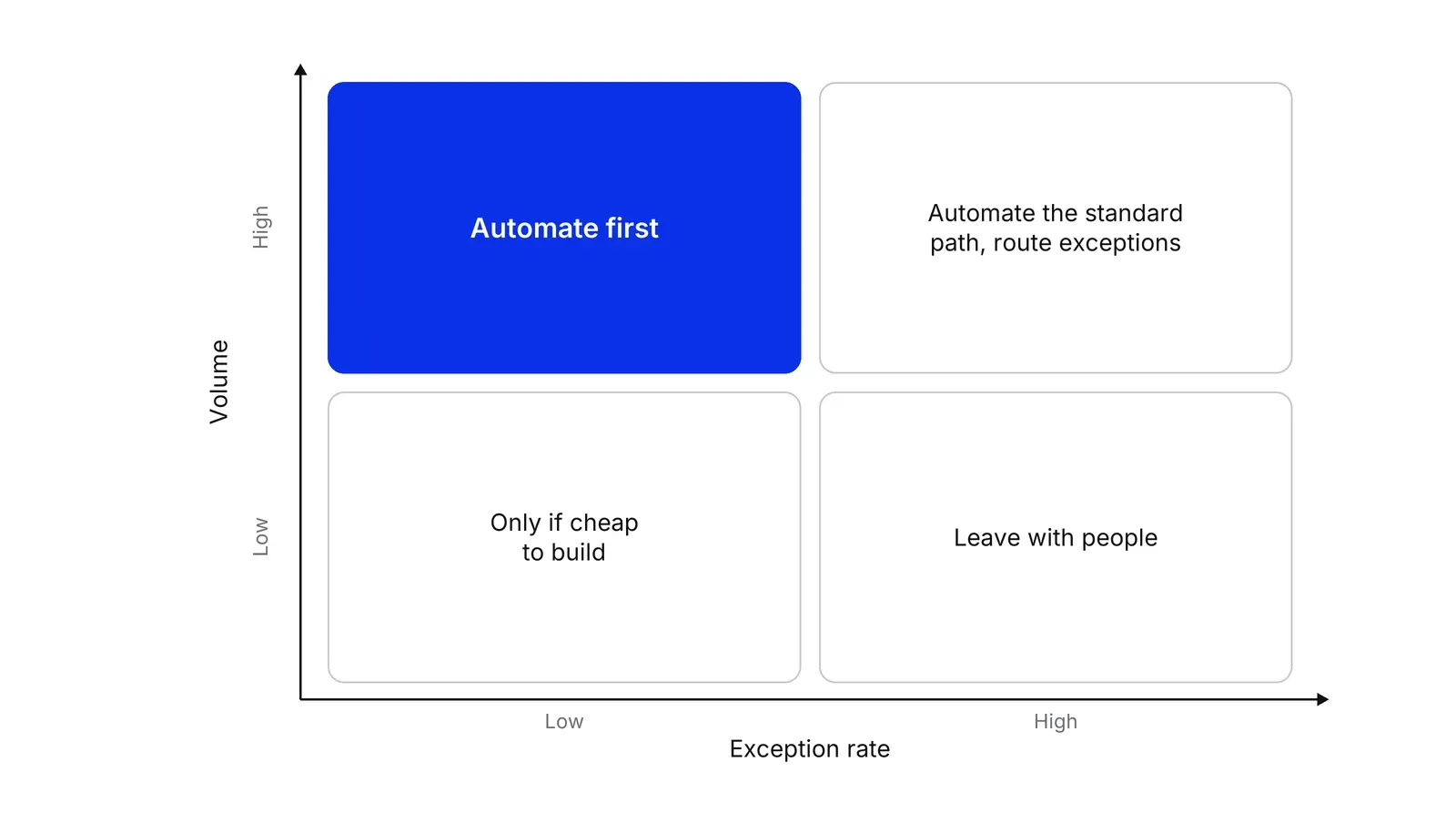
Lacity, Willcocks and Craig compared the attributes academic research lists for outsourcing with what RPA adopters reported. For RPA, the high-value attributes were high volume, high standardization, rules-based work and process maturity. Telefónica O2, which began with a trial in 2010 and later ran 400,000 to 500,000 robot transactions a month, added a simpler filter in the same case: a process is automatable if automation saves at least three full-time employees. Its team tended to pick simple processes with at least 1,000 transactions a week, and noted that a complex process handled 30 times a day can still clear the same bar.
Rule clarity deserves a hard look. Autor, Levy and Murnane showed in 2003 that computers take over tasks that follow explicit rules. Robots are literal: the O2 case notes that a human reads “St. Louis” and “Saint Louis” as the same place while a robot needs to be told. Knowledge work is a poorer fit. Davenport, Jarvenpaa and Beers described it in 1996 as irregular and sometimes chaotic.
Exception rate decides the economics. Every exception goes back to a person, so the savings shrink with it. Count exceptions from a sample of real cases. Mapping the process first helps, and BPMN process mapping, based on the OMG standard, shows where the branches are, while a SIPOC page fixes where the process starts and ends. Researchers are working on finding candidates from data: Leno and colleagues propose discovering automatable routines from logs of user interactions.
Why fix the process before automating it?
Because software runs a bad process exactly as written. Hammer’s point was that applying technology to existing work often preserves its waste. The Dumas and colleagues textbook treats redesign and automation as separate stages of one process lifecycle, with redesign first. Delete steps, settle the rules and confirm the exception route before building anything. A value stream map is a common way to find the waste.
RPA, workflow or AI agent: which tool?
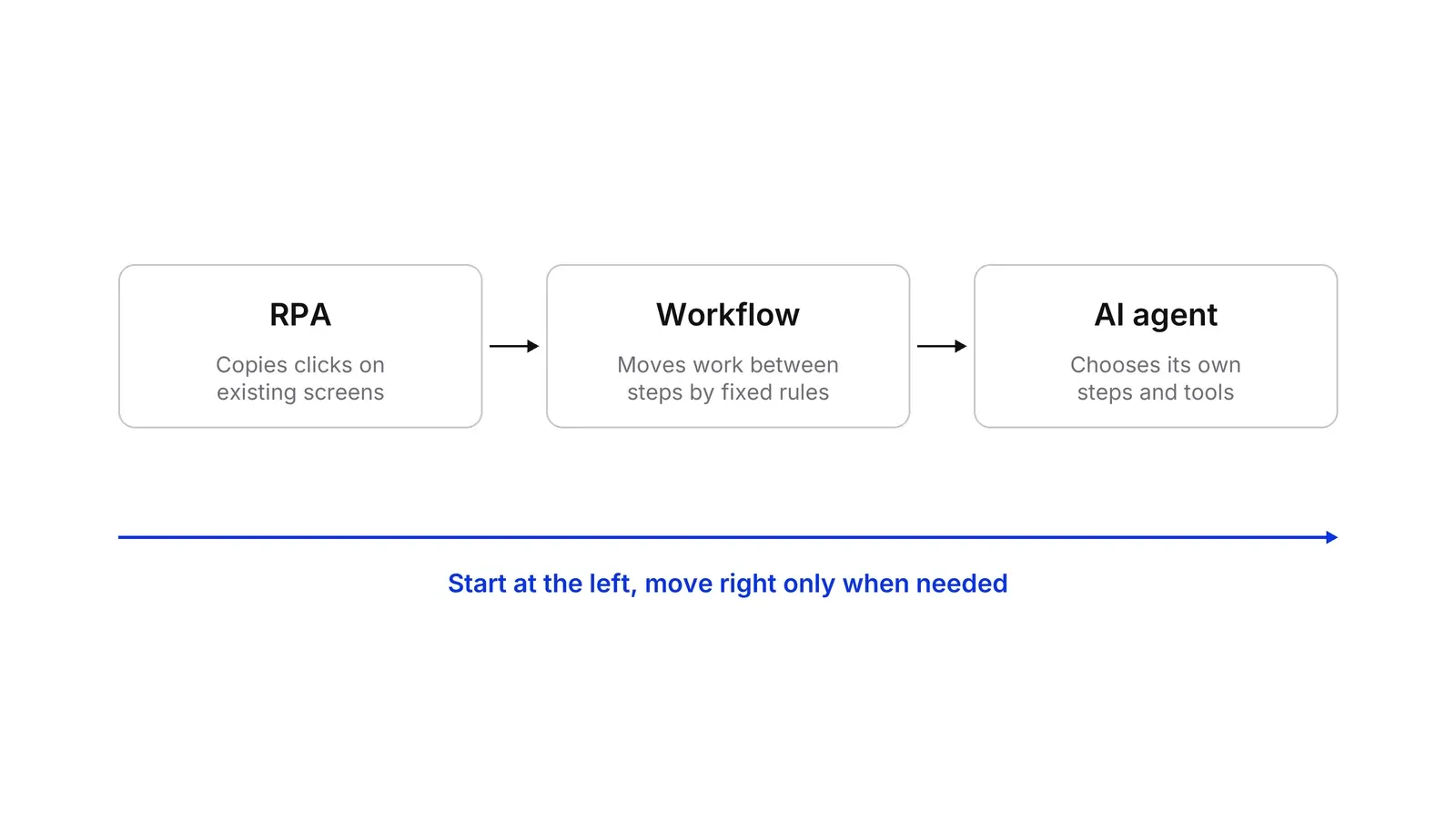
Use the least autonomous tool that does the job. RPA operates other systems through their screens, a workflow engine moves work along predefined rules, and an AI agent chooses its own steps. Anthropic’s engineering guidance draws the same line between workflows, which follow “predefined code paths,” and agents, which direct their own process, and advises starting with the simplest solution.
| RPA | Workflow | AI agent | |
|---|---|---|---|
| How it works | Imitates a user on existing screens | Predefined steps and rules, usually through APIs | Model decides steps and calls tools |
| Best for | Legacy systems with no API | Stable, rule-based processes | Unstructured input, open-ended tasks |
| Main risk | Breaks when a screen changes | Rigid when rules change | Inconsistent results, higher cost |
The editorial by van der Aalst, Bichler and Heinzl describes RPA as working on interfaces the way a person would, and recalls the Straight Through Processing hype of the mid-1990s. Agostinelli and colleagues found that today’s RPA tools mostly handle simple, predictable processes.
AI agents need the most caution. The tau-bench benchmark reports that even strong function-calling agents succeeded on under half of its tasks, and that success across eight repeated runs of the same retail task fell below 25 percent. The evidence on AI assistance for people is stronger. Brynjolfsson, Li and Raymond found a 14 percent gain in issues resolved per hour among 5,179 support agents, and 34 percent for novices. Dell’Acqua and colleagues found consultants did better inside what they call a jagged frontier and 19 percentage points worse outside it. Both studies measure people assisted by AI, not unsupervised agents. Eloundou and colleagues estimate that about 80 percent of US workers could have at least 10 percent of their tasks affected by language models, which says where to look, not what to automate. Davenport and Ronanki’s 2018 advice fits: start with modest projects, and note the MD Anderson Watson project that cost over $62 million before being put on hold. A fixed workflow with one AI step for reading or classifying is often the safer design.
How do you measure ROI?
Count hours returned, subtract what the automation costs to run, and compare the net gain with the build cost over a stated period. For scale, Telefónica O2’s bar of three full-time employees saved equals roughly 480 hours a month at 160 hours each. Here is illustrative arithmetic, not a benchmark: a finance team processes 6,000 invoices a month at 4 minutes each, and 20 percent are exceptions that still go to people.
| Line | Value |
|---|---|
| Hours returned (4,800 cases at 4 minutes) | 320 hours a month |
| Value at $25 an hour | $8k a month |
| Run cost (licences, upkeep) | $1k a month |
| Net gain after run cost | 7k USD a month |
| Build cost | $30k |
| Payback | about 4.3 months |
| First-year ROI | (12 x 7k - 30k) / 30k = 180% |
Always name the period. Lacity and Willcocks report a three-year ROI of 650 to 800 percent in the O2 working paper, and up to 200 percent a year in their journal abstract. Those numbers are not in conflict, because they cover different spans. Track error rate and cycle time next to hours, since O2 also reported that customer chase-up calls fell by over 80 percent a year. Put process and bot owners in a RACI matrix, and tie the result to a KPI tree.
What does the research not tell us?
Less than the vendor case studies suggest. Syed and colleagues note that academic research on RPA is thin, and Wewerka and Reichert found only 63 publications in their review. Many published results come from early adopters, and the O2 figures are reported by the company’s own managers. Treat published ROI as an upper reference, not a forecast. Hofmann, Samp and Urbach add that governance has to cover both the direct and indirect effects of automation on the firm. A reasonable first step for a team unsure where to begin is the AI for Real Work practice.
How to apply Business process automation, step by step
- List the recurring processes with volumes. Write down every process that repeats weekly or daily, how many cases it handles a month and how many minutes one case takes. Multiply the two. Result: a ranked list of processes by hours consumed.
- Score each on the three tests. Mark volume (high or low), rule clarity (can a new hire follow written rules, yes or no) and exception rate (the share of cases that need a judgment call). Pull 30 real cases to count exceptions instead of guessing. Result: every process placed in one of the four boxes of the volume and exceptions grid.
- Fix the process on paper first. Map the chosen process, delete steps nobody needs and settle the rules. Automating a broken process only makes it fail faster. Result: a one-page map and a written rule set that two people read the same way.
- Pick the simplest tool that works. Use a native integration or a rule-based workflow where systems expose an API, a screen-level bot where they do not, and an AI model only for the steps that need judgment over unstructured input. Result: a tool choice with a one-line reason.
- Build the exception route before the happy path. Decide where a case goes when the automation cannot finish it, who owns that queue and how fast it must clear. Result: a named exception owner and a service time.
- Measure against the baseline for 90 days. Track hours returned, cases finished with no human touch, errors and cycle time against the numbers from step 1, then compute payback. Result: a keep, fix or stop decision backed by data.
Examples
Telefónica O2 and its back office
Telefónica O2, the UK mobile operator, started a robotic process automation trial on two high-volume, low-complexity processes. By April 2015, Lacity, Willcocks and Craig report, it ran more than 160 robots across 15 core processes, with a 12-month payback and a three-year ROI of 650 to 800 percent. Its own rule for picking processes was simple: automate only if it saves at least three full-time employees.
A payments team and payout reconciliation
Illustrative, no real company implied. A payments company matches tens of thousands of payout records a month against bank statements by hand. Most rows match by reference number and amount. About one in ten has a missing reference or a partial payment. The team automates the exact matches, sends the fuzzy ones to a review queue with the likely match pre-filled, and keeps an owner for that queue. Volume is high, rules are clear and the exception path is designed, so it lands in the first box.
A clinic and appointment reminders
Illustrative, no real clinic implied. A clinic with 400 patients a month sends reminders by hand and chases confirmations by phone. Reminders follow a fixed rule, so a scheduled workflow handles them. Rescheduling, which depends on the doctor's calendar and the patient's situation, stays with the front desk. The automation covers the rule-bound part and leaves the judgment part to people.
When to use it
Use it when a team spends hours on the same digital task every week, errors in that task are costly, and the steps can be written down. It also fits a growth phase, when volume will double and hiring to match is the alternative.
When not to use it
Skip it for a process that changes monthly, one that runs a few dozen times a year, or one whose steps nobody can state. Also skip it when the process itself is wasteful: redesign comes first. It adds little where the real constraint is a decision, not a task.
Common mistakes
- Automating the process as it is, including steps that exist only because of old system limits, instead of removing them first.
- Choosing by what the tool can do, not by hours saved, so a clever bot ends up covering a process that takes four hours a month.
- Counting the happy path only. If 20 percent of cases need a person, the savings and the staffing plan must show that.
- Giving no one ownership of the bot. Screens change, rules change and a robot with no owner fails quietly.
- Reaching for an AI agent when a fixed workflow would do, and paying in cost and unpredictability for flexibility the process does not need.
FAQ
Which business processes should you automate first?
Start with processes that have high volume, written rules and a low exception rate, and that save a meaningful amount of staff time. Telefónica O2 used a threshold of at least three full-time employees saved. Check a sample of real cases, because the exception rate people guess is usually lower than the real one.
What is the difference between RPA, workflow automation and AI agents?
RPA software operates other systems through their user interfaces, like a person clicking. A workflow engine moves work between steps by predefined rules. An AI agent decides its own steps and tools. Anthropic's engineering guidance recommends the simplest option that works and adding autonomy only when it measurably helps.
How do you calculate the ROI of automation?
Subtract the cost of running the automation from the value of the hours it returns, then compare that net gain with the build cost. State the period. Lacity and Willcocks report a three-year ROI of 650 to 800 percent for Telefónica O2, while their journal abstract says up to 200 percent a year.
Can AI replace RPA?
Not for work that must run the same way every time. Benchmarks of tool-using AI agents show inconsistent results across repeated runs, while rule-based automation is predictable. AI is useful where input is unstructured or the step needs judgment, and many teams place it inside a fixed workflow rather than in charge of it.
Sources
- Michael Hammer, Reengineering Work: Don't Automate, Obliterate, Harvard Business Review, July-August 1990
- Mary Lacity, Leslie Willcocks, Robotic Process Automation at Telefónica O2, MIS Quarterly Executive 15(1), 2016
- Mary Lacity, Leslie Willcocks, Andrew Craig, Robotic Process Automation at Telefónica O2, Outsourcing Unit Working Paper 15/02, LSE, 2015
- Mary Lacity, Leslie Willcocks, A New Approach to Automating Services, MIT Sloan Management Review 58(1), 2016
- Wil van der Aalst, Martin Bichler, Armin Heinzl, Robotic Process Automation, Business & Information Systems Engineering 60(4), 2018
- Rehan Syed and colleagues, Robotic Process Automation: Contemporary Themes and Challenges, Computers in Industry 115, 2020
- Judith Wewerka, Manfred Reichert, Robotic Process Automation: A Systematic Literature Review and Assessment Framework, arXiv, 2020
- Peter Hofmann, Caroline Samp, Nils Urbach, Robotic Process Automation, Electronic Markets 30(1), 2020
- Volodymyr Leno and colleagues, Robotic Process Mining: Vision and Challenges, Business & Information Systems Engineering 63(3), 2021
- Simone Agostinelli, Andrea Marrella, Massimo Mecella, Towards Intelligent Robotic Process Automation for BPMers, arXiv, 2020
- Marlon Dumas, Marcello La Rosa, Jan Mendling, Hajo Reijers, Fundamentals of Business Process Management, 2nd edition, Springer, 2018
- Object Management Group, Business Process Model and Notation (BPMN), version 2.0.2
- Thomas Davenport, Sirkka Jarvenpaa, Michael Beers, Improving Knowledge Work Processes, MIT Sloan Management Review, Summer 1996
- David Autor, Frank Levy, Richard Murnane, The Skill Content of Recent Technological Change, Quarterly Journal of Economics 118(4), 2003
- Thomas Davenport, Rajeev Ronanki, Artificial Intelligence for the Real World, Harvard Business Review, January-February 2018
- Anthropic, Building effective agents
- Shunyu Yao and colleagues, tau-bench: A Benchmark for Tool-Agent-User Interaction in Real-World Domains, arXiv, 2024
- Fabrizio Dell'Acqua and colleagues, Navigating the Jagged Technological Frontier, Harvard Business School Working Paper 24-013, 2023
- Erik Brynjolfsson, Danielle Li, Lindsey Raymond, Generative AI at Work, NBER Working Paper 31161, 2023
- Tyna Eloundou and colleagues, GPTs are GPTs: An Early Look at the Labor Market Impact Potential of Large Language Models, arXiv, 2023
Last updated Oct 9, 2026


Fractional COO or embedded operations team? How to choose at Series A
The two models solve different problems: how to tell which one your company needs, and what each costs in time and control.

What operational systems successful fintech startups use: lessons from ten companies
Starling, Monzo, Qonto, bunq, Lunar, Pleo, Tide, Ramp, Mercury and Column scaled on four operating systems. Regulators' findings show what breaks when one of them lags behind growth.

What a revenue operations manager actually owns
Pipeline definitions, CRM hygiene, forecasting and the handoffs between marketing, sales and success. What the role covers, and how it differs from sales ops.