Media mix
A media mix is the set of paid channels a brand uses and the share of budget, reach and time each one gets, planned so the channels do different jobs instead of competing for the same buyers.
A media mix is the combination of paid channels a brand buys, such as TV, online video, search, social and outdoor, together with how much budget, reach and time each channel gets. Planning it means setting a total budget, giving each channel one job, reaching as many category buyers as possible, and moving money between channels as each one starts to show diminishing returns.
- Origin
- Media planning practice, no single inventor; reach and frequency ideas from Herbert Krugman (1972) and Erwin Ephron (1997); multi-channel evidence from the IPA Databank (Les Binet and Peter Field), No single date
- Level
- 301 · Advanced
- Fits
- Small and mid-size, Scale-up, Enterprise
- Time to apply
- one day for a first plan; a quarter to see whether the split works
- What you need
- last year's spend and results per channel, by month · your market share and an estimate of competitors' spend · the size of your category: how many people or companies buy it in a year · one person who owns the total budget across channels
A media mix is the set of paid channels a brand buys and the share of budget, reach and time each one gets. TV, online video, search, paid social, audio, print and outdoor are the usual options. The plan answers four questions: how much to spend in total, what job each channel does, how many people to reach and how often, and when to be on air.
No one invented the media mix. It grew out of agency media planning, and most of what we know about it comes from two kinds of evidence: databases of campaign results, such as the IPA Databank analysed by Les Binet and Peter Field, and academic studies of how sales respond to advertising.
How big should the total budget be?
Set the total by comparing your share of voice with your market share. Share of voice (SOV) is your share of all advertising spend in your category. Binet and Field’s The long and the short of it shows that brands whose share of voice exceeds their market share tend to grow, and brands below it tend to shrink.
The gap between the two is called extra share of voice (ESOV). In Effectiveness in Context, they report that offline brands gained about 0.5 points of market share a year per 10 points of ESOV, and online brands about 1.3. Treat these as rough benchmarks for a growth target, not a formula.
Give each channel one job
Every channel in the mix should have one main job: building the brand among everyone who buys the category, or activating people who are ready to buy now. Brand channels reach widely and work over months. Activation channels, such as search and retargeting, catch demand that already exists.
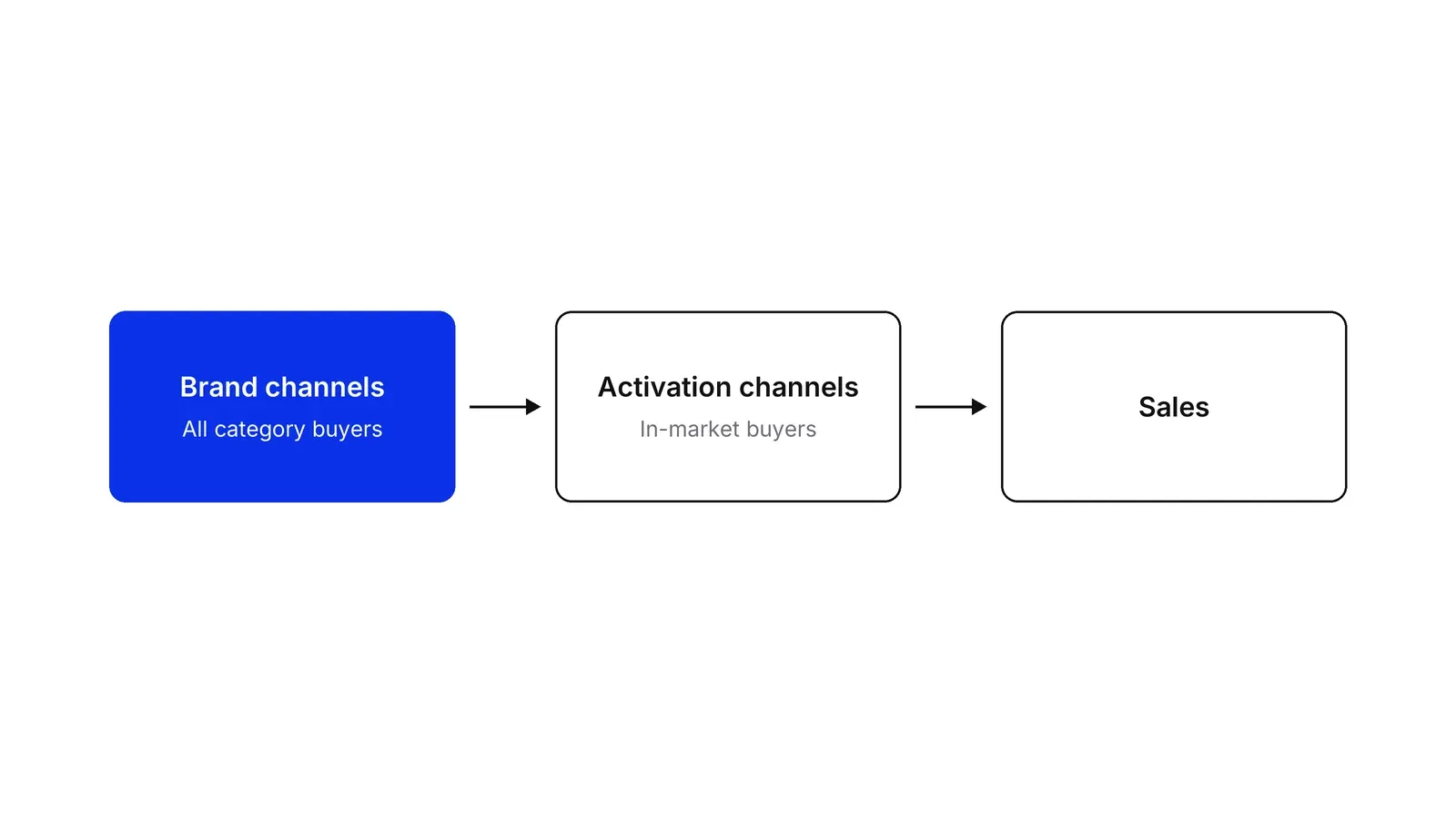
The two jobs work best together. In the IPA cases summarised in The long and the short of it, campaigns using both brand and activation channels were about twice as efficient as those using brand channels alone, measured by share growth per point of ESOV. Activation-only campaigns produced the weakest business effects of the three groups.
Reach first, then frequency
Reach is the number of different people who see your ads in a period; frequency is how many times each of them sees them on average. Google’s definition counts unique people, not cookies. Planning tools such as Google’s Reach Planner draw a reach curve: how many people a plan reaches as budget rises.
How much frequency you need is one of the oldest arguments in advertising, and the sources disagree:
- Herbert Krugman’s 1972 article “Why Three Exposures May Be Enough” became the source of the rule of three.
- Erwin Ephron’s recency planning (1997) argued for reaching as many people as possible in as many weeks as possible, because only a few are in the market at any time.
- Jennifer Taylor, Rachel Kennedy and Byron Sharp of the Ehrenberg-Bass Institute found that curves where the first exposure brings the biggest lift were “typical, but not universal” across four consumer goods categories.
- Demetrios Vakratsas and colleagues found threshold effects in SUVs and minivans: below a certain level, advertising did little. They did not find them for liquid detergent.
A fair reading: for established brands, reach usually beats frequency, but a new brand or a complex message may need several exposures before anything happens. Binet and Field’s B2B work also favours reaching as many category buyers as possible.
Diminishing returns: why one channel is rarely enough
Every channel saturates. Each extra unit of spend brings fewer extra sales than the one before, because the cheapest and most responsive audience is reached first. Google’s Meridian documentation calls this “diminishing marginal returns with increased media execution.”
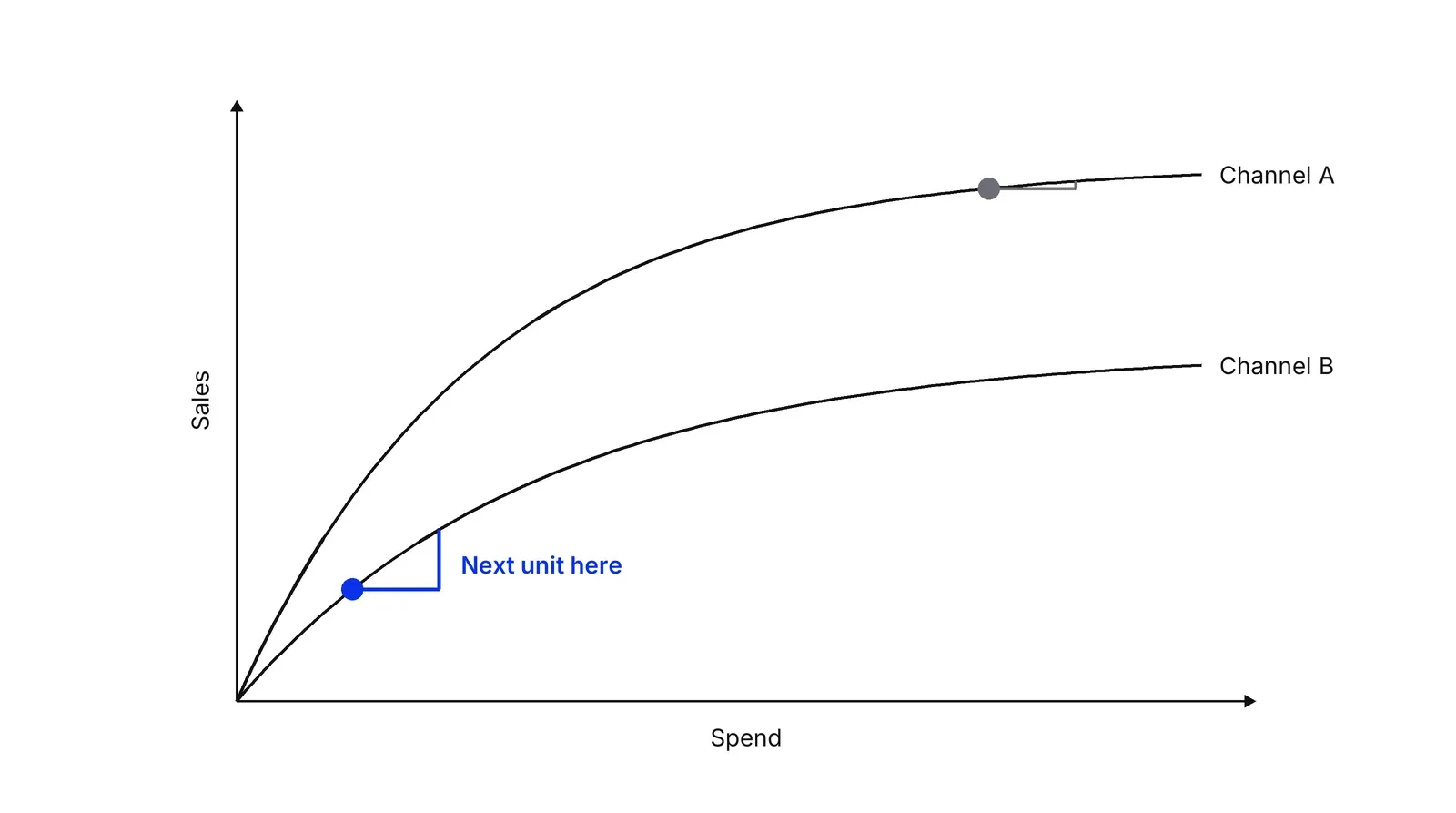
Many advertisers spend past the flat point. Bradley Shapiro, Günter Hitsch and Anna Tuchman studied TV for 288 brands in Econometrica and found negative returns at the margin for more than 80% of them. Thinkbox’s Profit Ability 2 (2024) defines a channel’s saturation point as the last spend level where each pound still returns at least a pound of profit. In its data, linear TV had the highest saturation point and paid social looked somewhat overspent.
This is the plain economic case for a mix: once the first channel flattens, the next unit of budget does more in a second channel that is still on the steep part of its curve.
What the evidence says about multi-channel campaigns
Several studies find that channels used together beat channels used alone, though none proves an ideal number:
| Study | Data | Finding |
|---|---|---|
| Naik and Raman, 2003 | Dockers TV and print | Synergy between media; as it grows, fund the weaker medium more |
| Binet and Field, 2013 | IPA Databank cases | Brand plus activation about twice as efficient as brand alone |
| Kantar AdReaction, via Ogilvy, 2018 | Pre-tests and survey of 14,000+ people | Integrated campaigns 31% more effective; integrated and adapted to each channel, 57% |
| Bell, Thomaz and Stephen, 2025 | 1,083 campaigns, 2008 to 2019 | No single best mix; TV and outdoor often paired with Facebook and YouTube in top performers |
| Analytic Partners | Vendor client data | Omnichannel firms report 32% higher ROI |
The Kantar and Analytic Partners figures come from vendors’ own data and are not peer reviewed. Peter Field’s 2007 review of IPA multi-channel cases adds a practical rule: start from one strong brand idea and adapt it to each channel.
Keep the brand on air
Continuity matters as much as the split. The Ehrenberg-Bass Institute tracked 57 Australian brands over 20 years and found that sales fell about 16% on average after a year without mass reach advertising. Lower weekly weight spread across the year usually costs less than a long silence followed by a burst.
Media mix planning versus marketing mix modeling
The two are often confused. Planning decides where the money goes before it is spent. Marketing mix modeling measures afterwards what each channel added, and its response curves feed the next plan.
| Media mix planning | Marketing mix modeling | |
|---|---|---|
| Question | Where should next period’s money go? | What did each channel add last period? |
| Inputs | Budget, reach curves, channel jobs, tests | Two or more years of weekly sales and spend |
| Output | A plan and a calendar | Response curves and estimated returns |
In Pushers’ Growth Lab work, the mix is set after the growth target and before any campaign brief, so every channel starts with a job and a measure.
How to apply Media mix, step by step
- Set the total from share of voice. Estimate your share of all advertising in your category and compare it with your market share. Spending above your market share tends to grow it; spending below tends to shrink it. Result: a total budget tied to a growth target, not to last year's number plus inflation.
- Give every channel one job. Write next to each channel whether it builds the brand among all category buyers or activates people who are ready to buy now, and which measure judges it. A channel with no job written down is a candidate to cut. Result: a one-page table of channels, jobs and measures.
- Plan reach before frequency. Count how many category buyers each brand channel can reach and at what cost per person reached, then pick the combination that reaches the most of them. Set a frequency cap so money does not go on the twelfth exposure to the same person. Result: a reach target and a frequency range for the period.
- Split the budget at the margin. For each channel, look at what the last step of spend brought, from your own tests or a model. Move money from channels where the last step added little to channels where it still added a lot. Result: a split that reflects diminishing returns, not habit.
- Schedule for continuity. Spread brand spend across the year so the brand is present in most weeks, and concentrate activation where demand peaks. Long dark gaps cost more than lower weekly weight. Result: a calendar with no long silent stretches.
- Measure and rebalance each quarter. Run at least one controlled test per quarter, such as pausing a channel in some regions, and compare the result with what each platform reports. Shift a slice of budget based on what you learn. Result: a mix that changes in steps, each backed by evidence.
Examples
Direct Line rebalances toward brand
In Effectiveness in Context, Les Binet and Peter Field describe how the UK insurer Direct Line moved its budget from activation-heavy to around 70:30 in favour of brand building. Money came out of direct mail, email, direct-response TV and banner ads and went into brand TV and online video. According to the authors, the new mix drove growth even though the total budget fell from £71m to £38m between 2011 and 2015.
Dockers and the synergy between TV and print
Prasad Naik and Kalyan Raman used market data on Dockers advertising in a 2003 Journal of Marketing Research paper and found synergy between TV and print: each made the other work better. Their model showed that as synergy grows, an advertiser should raise the total budget and give more money to the weaker medium, because its value now comes partly from what it does for the stronger one.
A dental clinic splitting 10,000 a month
Illustrative, no real clinic implied. A clinic spends its whole 10,000 monthly budget on search ads and gets 100 new patients. Search costs per patient have risen each quarter, a sign the channel is saturating at that spend. The owner moves 3,000 into local video and outdoor aimed at everyone in a 5 km radius, with search kept at 7,000. If new patients stay near 100 while search costs per patient fall, the brand channels are feeding search. If new patients drop below 90 for two months, the owner moves 1,500 back and tests again.
When to use it
Use it when you spend in two or more paid channels and the budget is set channel by channel by different people, when results from your main channel have flattened while its cost per sale keeps rising, or when you plan next year's budget and need to decide how much goes where.
When not to use it
Skip a formal mix plan when you are still testing whether any channel can bring customers at all; one channel tested properly answers that faster. It is also of little use with a budget so small that splitting it would leave every channel below the level where it shows any effect.
Common mistakes
- Splitting the budget evenly across channels, or by last year's shares, instead of by the job each channel does and where its returns still rise.
- Judging brand channels by last-click conversions, then cutting them and watching search volume fall a few months later.
- Buying high frequency on a small audience, so the same people see the ad ten times while most category buyers see it never.
- Adding channels because they are new, without a job for them or a message adapted to them.
- Going dark for months to save money, when a lower but steady weekly presence would keep the brand in buyers' memory.
FAQ
What is a media mix?
A media mix is the set of paid advertising channels a brand uses, such as TV, online video, search, social, audio, print and outdoor, and how much budget, reach and time each one gets. The term covers both the choice of channels and the split between them, planned for one period, usually a year or a campaign.
What is the difference between media mix and marketing mix?
The marketing mix is the broader set of decisions about product, price, place and promotion, often called the 4Ps. The media mix sits inside promotion and covers only paid media channels. Marketing mix modeling is a third thing: a statistical method that estimates how much each channel and other factors added to sales.
How many channels should a media mix have?
There is no proven number. Analyses of IPA cases by Binet and Field found campaigns that combine brand and activation channels more efficient than either alone. A 2025 Journal of Marketing study of 1,083 campaigns found no single mix that won on every measure. Add a channel only when it reaches buyers the others miss or does a different job.
What is a good frequency for advertising?
Sources disagree. Krugman argued in 1972 that three exposures may be enough, which planners turned into a rule of three. Ephron's recency planning and Ehrenberg-Bass research favour reaching more people at lower frequency. Other studies find thresholds below which ads do little. A sensible plan sets a minimum and a cap, then tests.
How do you allocate budget across media channels?
Start with a total set by share of voice against market share, then give each channel a job. Within that, move money to channels where the last step of spend still brings a clear return and away from those that have flattened. Check the split with controlled tests or a marketing mix model each quarter.
Sources
- IPA, Les Binet and Peter Field, The long and the short of it, presentation (PDF)
- IPA, The key works of Les Binet and Peter Field
- Les Binet and Peter Field, Effectiveness in Context: A Manual for Brand Building, IPA (PDF)
- Les Binet and Peter Field, The 5 Principles of Growth in B2B Marketing, LinkedIn B2B Institute, 2019 (PDF)
- Peter Field, Getting the best from multi-channel campaigns, Admap, December 2007 (WARC)
- Herbert E. Krugman, Why Three Exposures May Be Enough, Journal of Advertising Research 12(6), 1972
- WARC, Herbert E. Krugman, Why three exposures may be enough, Journal of Advertising Research
- Erwin Ephron, Recency Planning, Journal of Advertising Research, 1997 (WARC)
- Jennifer Taylor, Rachel Kennedy, Byron Sharp, Is Once Really Enough? Making Generalizations about Advertising's Convex Sales Response Function, Journal of Advertising Research 49(2), 2009
- Demetrios Vakratsas, Fred M. Feinberg, Frank M. Bass, Gurumurthy Kalyanaram, The Shape of Advertising Response Functions Revisited, Marketing Science 23(1), 2004
- Prasad A. Naik, Kalyan Raman, Understanding the Impact of Synergy in Multimedia Communications, Journal of Marketing Research 40(4), 2003
- J. J. Bell, F. Thomaz, A. T. Stephen, Beyond the Pair: Media Archetypes and Complex Channel Synergies in Advertising, Journal of Marketing 89(4), 2025 (Oxford Research Archive)
- Bradley T. Shapiro, Günter J. Hitsch, Anna E. Tuchman, TV Advertising Effectiveness and Profitability: Generalizable Results From 288 Brands, Econometrica 89(4), 2021
- Raj Sethuraman, Gerard J. Tellis, Richard A. Briesch, How Well Does Advertising Work? Generalizations from Meta-Analysis of Brand Advertising Elasticities, Journal of Marketing Research 48(3), 2011
- Thinkbox, Profit Ability 2: the new business case for advertising, May 2024
- Analytic Partners, Report: omnichannel increases ROI
- Google Ads Help, About Reach Planner
- Google Ads Help, Measuring reach and frequency
- Google Ads API, Reach forecasting concepts
- Google, Meridian, Media saturation and lagging
- Ehrenberg-Bass Institute, Q&A: What happens when brands stop advertising? (Nicole Hartnett)
- Nicole Hartnett, Adam Gelzinis, Virginia Beal, Rachel Kennedy, Byron Sharp, When Brands Go Dark, Journal of Advertising Research 61(3), 2021
- Ehrenberg-Bass Institute and LinkedIn B2B Institute, How B2B Brands Grow, November 2023
- Byron Sharp, How Brands Grow: What Marketers Don't Know, Oxford University Press, 2010, ESCP library record
- Ogilvy, Nicola Watts, Five principles to optimize multichannel campaigns, March 2018 (Kantar Millward Brown AdReaction)
- PRmoment, Integrated campaigns are 31% more effective at building brands, February 2018
Last updated Oct 9, 2026


Marketing agency or growth system: when a company outgrows its agency
An agency is the right call while the founder still runs most of the company. Once the business starts copying itself into new locations or markets, it needs a system that sets goals, tests hypotheses and owns the result.

Why healthcare marketing agencies stall: the short, mid and long wins model we use with clinics
Most agencies own the click and nobody owns the front desk. How we structure clinic work in three horizons, the research behind each one, and one year of results.

Why channel tests stall after month three
Most paid channel tests do not end with a decision. They end when the budget runs out, the attribution model changes, or everyone quietly stops looking at the dashboard.