Bullseye framework
The Bullseye framework is a method from the book Traction for choosing which of 19 customer acquisition channels a startup should test first, running cheap tests on a few, and putting the team's effort behind the one that works.
The Bullseye framework is a channel selection method from Traction by Gabriel Weinberg and Justin Mares. A startup brainstorms one idea for each of 19 traction channels, picks the three most promising, tests them cheaply in parallel, then focuses on the single channel that produces customers at an acceptable cost, and repeats the process when that channel saturates.
- Origin
- Gabriel Weinberg and Justin Mares, 2013 blog post; book 2014, revised edition 2015
- Level
- 201 · Tool
- Fits
- Startup
- Time to apply
- a half-day workshop to rank channels, then about a month of parallel tests
- What you need
- a traction goal with a number and a date, such as 2,000 paying users by June · a spreadsheet with one row per channel for ideas, guessed cost per customer and volume · a test budget in the hundreds of dollars per channel, not thousands · one owner per test who reports results weekly
The Bullseye framework is a method for choosing which customer acquisition channel a startup should work on now. It comes from Traction, a book by Gabriel Weinberg, the founder of DuckDuckGo, and Justin Mares. Weinberg first published the idea as a blog post in January 2013, according to the Hacker News thread that shared it. The authors self-published the book in 2014, and Portfolio, a Penguin imprint, released a revised edition in October 2015.
The book rests on two findings from interviews with more than forty founders. Most founders only consider channels they already know, so many startups crowd into search ads and PR. And nobody can predict which channel will work until they test it. Bullseye is the authors’ answer to both problems.
What are the 19 traction channels?
A traction channel is any route by which a startup gets users or customers. The book names nineteen: viral marketing, PR, unconventional PR, search engine marketing, social and display ads, offline ads, SEO, content marketing, email marketing, engineering as marketing (free tools and widgets that bring in users), targeting blogs, business development, sales, affiliate programs, existing platforms, trade shows, offline events, speaking engagements and community building.
The list is long on purpose. The authors write that every channel has worked for startups at different stages, and that a channel your competitors dismiss can let you grow while they stall.
How do the three rings work?
The rings are a way to narrow nineteen options down to one. The outer ring holds every channel, each with at least one concrete idea. The middle ring holds the three most promising channels, which you test. The centre holds the single channel that produced customers at a cost and volume that meet your goal.
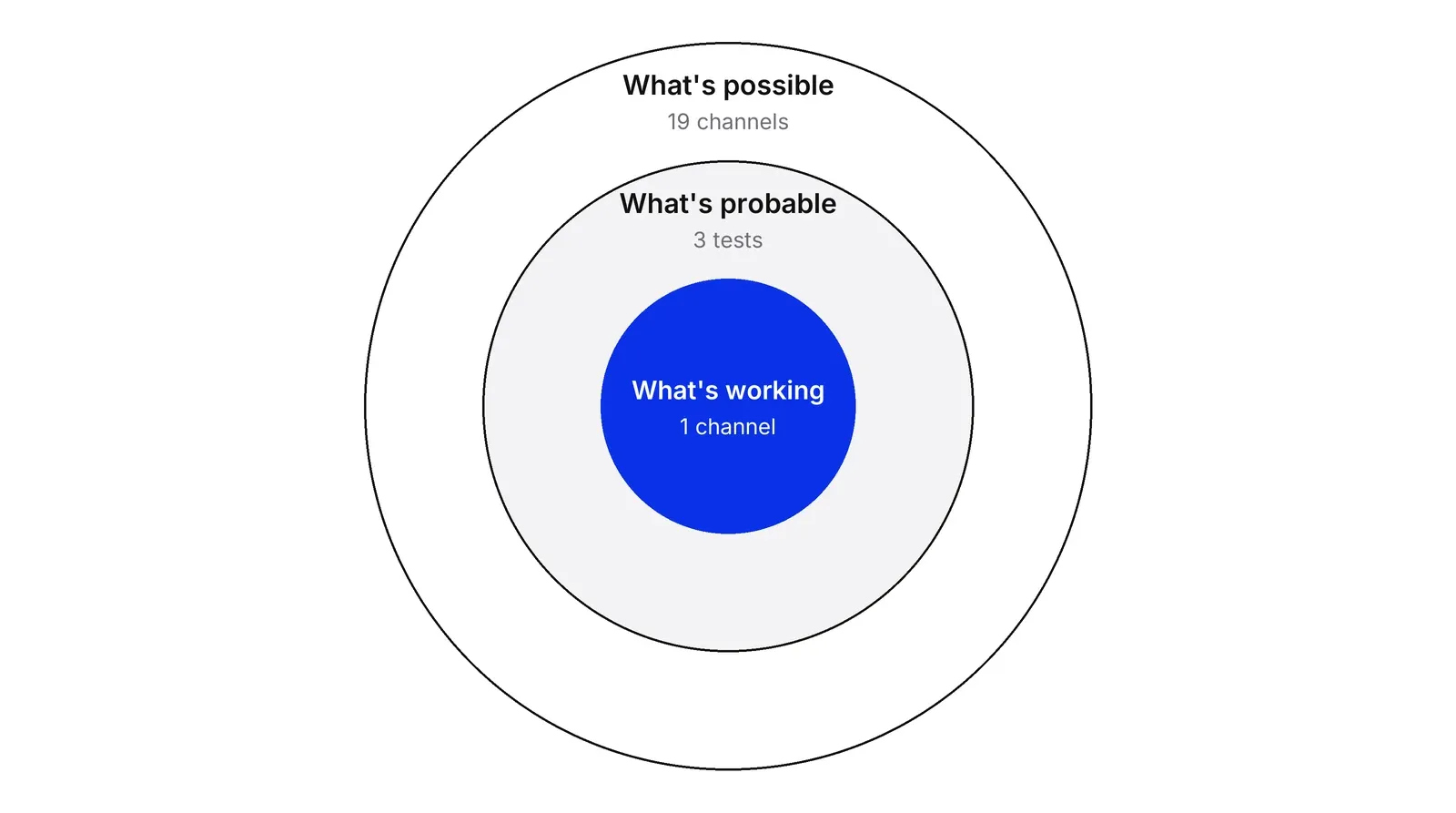
Weinberg described this order in a 2015 Mixergy interview: the 19 channels on the outside, your top three tests in the middle, and in the centre the one channel that will carry growth. He also added a step zero, setting a numeric traction goal, so every test has something to be judged against.
Why three tests and not one? Tests take time to set up and run, so testing channels one after another wastes months. Testing ten at once spreads the team too thin. The authors say the drop in excitement usually comes around the third channel anyway.
Two editions, two sets of labels
Readers often find the framework described in two ways, because the two editions package it differently.
| 2014 edition | 2015 edition and talks | |
|---|---|---|
| Structure | Five steps: brainstorm, rank, prioritize, test, focus | Three rings, with a goal set first |
| Ring labels | Columns: inner circle, potential, long shot | What’s possible, what’s probable, what’s working |
| What “inner” means | The three channels you test | The one channel that works |
| Suggested test size | A few hundred dollars | Up to about a month and $1,000 |
The 2014 steps come from the book itself and from co-author Justin Mares’s 2014 essay. The ring labels come from the 2015 telling, summarised by Tech.co in 2017. The logic is the same in both.
What does a cheap test look like?
A Bullseye test answers three questions: what a customer costs through the channel, how many customers the channel can supply, and whether they are the customers you want. It does not try to get much traction yet. The 2014 edition suggests running four Facebook ads instead of forty. In a 2015 talk in Philadelphia Weinberg put the limit at under a month and under $1,000 per test.
If no channel works, you go back to the brainstorm with what you learned, often with new messaging. If results are mixed, look for the small group of customers who responded well and find out why.
The 50% rule
The 50% rule is the book’s advice to spend half your time on product and half on traction, in parallel, from the start. The authors call the opposite habit the Product Trap: believing that a better product will bring customers by itself.
Dropbox is their main example. Drew Houston’s 2010 slides show paid search cost $233 to $388 per customer for a $99 product. The book rounds this to $230. Dropbox then built a two-sided referral program, which the same slides say permanently increased signups by 60%. The channel test changed the product.
Why do you rerun Bullseye?
Growth comes in spurts. A channel works, then saturates or gets more expensive, and growth flattens until you find the next one. The 2014 edition says its cover was drawn to show this curve.
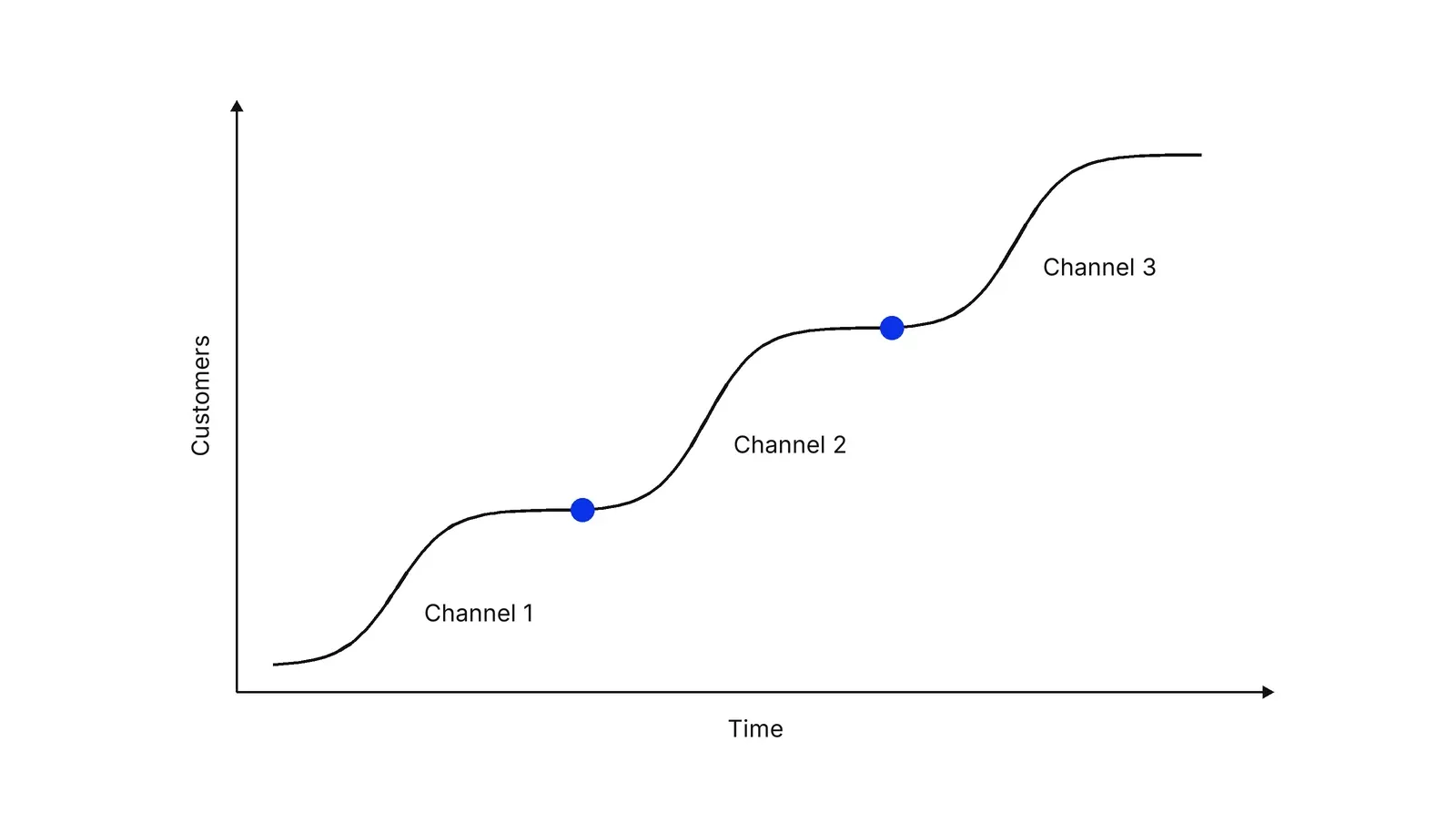
Andrew Chen’s law of shitty clickthroughs gives a reason: the first banner ad in 1994 drew a 78% clickthrough rate, while Facebook ads averaged 0.05% in 2011. Channels decay as everyone piles in. Weinberg told the SaaS Club podcast he had run Bullseye at DuckDuckGo six or seven times. Long shots from one round can become the winner in the next.
What does the evidence say?
No peer-reviewed study has tested Bullseye itself. Its support is founder interviews, which carry survivorship risk: we hear from the startups whose channel worked.
Research on startup experimentation points the same way. Koning, Hasan and Chatterji studied more than 35,000 startups; Duke’s summary reports that fewer than one in five used A/B testing, and adopters saw performance rise 30% to 100% after a year. A 2024 replication across 759 firms found that founders trained to test hypotheses dropped unpromising ideas more often.
How it fits with other growth tools
| Tool | Question it answers |
|---|---|
| Bullseye | Which channel should we work on now? |
| Growth loops | How can a working channel feed itself? |
| Product-channel fit | Does the product suit the channel’s rules? |
| Product-market fit | Do enough customers want and keep the product? |
Brian Balfour adds a warning that matters for Bullseye: channels do not mold to products, so the product often has to change to fit the winning channel. In Pushers’ Growth Lab work, each channel test runs as one HADI loop, with the number to beat written down before the money is spent.
How to apply Bullseye framework, step by step
- Set the goal first. Write down how much traction you need and of what kind, tied to a milestone such as raising a round or breaking even. Weinberg calls this step zero. Result: one number and one date that every test is judged against.
- Brainstorm across all 19 channels. Write at least one concrete idea for every channel, including the ones you would normally dismiss, such as offline ads or trade shows. For each idea, guess the cost to acquire a customer, how many customers it could bring and how long a test would take. Result: a spreadsheet with an idea in every row.
- Rank into three groups. Sort the channels into promising, possible and long shot, using your research on how similar companies found customers. Result: every channel sits in one of three columns.
- Pick three channels to test. Take the top three. Draw the line where your excitement drops off, which the authors say usually happens around the third channel. Three lets you test in parallel without losing focus. Result: three named tests with an owner each.
- Run cheap, fast tests. Design each test to answer three questions: what a customer costs through this channel, how many customers it can supply, and whether they are the customers you want. Keep it small, four ads rather than forty. Result: measured numbers replacing the guesses in your spreadsheet.
- Focus on the winner. Put the team's acquisition effort behind the one channel that worked and keep testing tactics inside it until saturation or rising costs flatten the results. If no channel worked, go back to the brainstorm with new messaging. Result: one channel driving growth, and a date to rerun the process.
Examples
Mint: blogs first, then PR
According to Traction, Noah Kagan told the authors how Mint, the personal finance site later bought by Intuit for $170 million, set a goal of 100,000 users in the first six months after launch. The team picked targeting blogs, PR and search ads as its three test channels and ran small tests: a sponsored newsletter, outreach to finance personalities, a few Google ads. Per Traction, sponsoring mid-level finance bloggers and guest posting won and brought the first 40,000 users. When that channel maxed out, the team reran the process, moved to PR, and reached 1 million users within six months of launch.
DuckDuckGo: six or seven rounds
According to Weinberg in interviews with Mixergy and SaaS Club, he started DuckDuckGo with SEO because it had worked at his previous company. It reached about 10,000 searches a month, which he later called the wrong channel at that stage because the volume was tiny. A 2011 billboard in San Francisco generated press. According to Philadelphia Magazine, traffic then doubled to eight million searches a month, then reached 40 million by mid-2012. Weinberg said he has run Bullseye six or seven times, moving through content marketing, social and display ads, PR and business development.
A telehealth dermatology service picking its first channel
Illustrative, no real company implied. A telehealth dermatology startup needs 1,500 paid consultations in four months to reach break-even. Its brainstorm favours search ads, but the ranking puts targeting blogs (skincare writers), business development (pharmacies that refer customers) and search ads in the top three. Each test gets $600 and three weeks. Search ads bring 6 bookings, $100 each against a $60 consultation fee. Two pharmacy partners bring 45 bookings at about $13 each in referral fees. The team focuses on pharmacy partnerships and reruns the process when that channel stops growing.
When to use it
Use it when a startup has a product that some customers want and no reliable way to get more of them, when the team keeps arguing for the channels it already knows, or when the channel that brought the first users has flattened out. It suits founders and small teams who need to pick a direction with a few thousand dollars and a few weeks.
When not to use it
Skip it before anyone uses the product, because channel tests on a product nobody keeps will show high costs whatever the channel. It also adds little for a large company with a mature channel mix, where marketing mix modelling or incrementality testing answers the budget question better, or for a business whose channel is fixed by regulation or a single partner.
Common mistakes
- Skipping channels in the brainstorm because they feel wrong for the industry, which is how founders end up testing only search ads and PR.
- Running tests that are too large, such as a full campaign with a big budget, when the question is only whether the channel can work at all.
- Testing one channel after another instead of three in parallel, which turns a one-month search into a six-month one.
- Keeping several channels going after a clear winner appears, so no channel gets the attention needed to find its best tactics.
- Treating the result as permanent. Channels saturate and get more expensive, and the long shots from the last round can become the winner in the next.
FAQ
What is the Bullseye framework?
It is a method for finding the customer acquisition channel that will move a startup's growth, set out in Traction by Gabriel Weinberg and Justin Mares. You brainstorm ideas for all 19 traction channels, test the three most promising cheaply and in parallel, and focus on the one that works until it stops working.
What are the 19 traction channels?
Viral marketing, PR, unconventional PR, search engine marketing, social and display ads, offline ads, SEO, content marketing, email marketing, engineering as marketing, targeting blogs, business development, sales, affiliate programs, existing platforms, trade shows, offline events, speaking engagements and community building. The authors found startups getting traction through each of them.
What is the 50% rule in Traction?
It is the authors' advice to spend about half your time on product and half on traction, running both in parallel from the start. They argue that founders who build first and look for customers later fall into what they call the Product Trap, the belief that a better product will bring customers by itself.
How much should a Bullseye test cost?
Little. The 2014 edition says a few hundred dollars should give a rough read on a channel and suggests running four Facebook ads, not forty. In 2015 talks Weinberg said a test should ideally take no longer than a month and cost no more than $1,000.
How is Bullseye different from growth loops?
Bullseye helps you choose which channel to work on now. Growth loops describe how a working channel can feed itself, when new users create the invites, content or revenue that bring the next users. Teams often use Bullseye to find a channel, then look for a loop inside it.
Sources
- Gabriel Weinberg and Justin Mares, Traction: A Startup Guide to Getting Customers, S-curves Publishing, 2014, chapters 1 to 3
- OverDrive, Traction: How Any Startup Can Achieve Explosive Customer Growth, Portfolio (Penguin Publishing Group), 2015
- Justin Mares, Strategize, Test, Measure: The Bullseye Framework, brianbalfour.com, September 2014
- Mixergy, Gabriel Weinberg interview on Traction, September 2015
- Mixergy, Master Class: How to get traction, with Gabriel Weinberg
- Philadelphia Magazine, DuckDuckGo founder's advice at Philly Startup Leaders Bootcamp, October 2015
- SaaS Club podcast, episode 34, Gabriel Weinberg on the Bullseye framework
- Hacker News, The Bullseye Framework for getting traction (link to Weinberg's blog post), January 2013
- Gabriel Weinberg, About
- Tech.co, Hit your customer bullseye with this three-step framework, January 2017
- Paul Graham, Do Things That Don't Scale, July 2013
- Drew Houston, Dropbox: Startup Lessons Learned, slides, April 2010
- Rembrand Koning, Sharique Hasan, Aaron Chatterji, Experimentation and Start-up Performance: Evidence from A/B Testing, Management Science 68(9), 2022
- Duke Fuqua Insights, Scientific approach to testing ideas helps startups fail and scale faster, July 2021
- Arnaldo Camuffo et al., A Scientific Approach to Entrepreneurial Decision Making: Large Scale Replication and Extension, Strategic Management Journal 45(6), 2024
- Innovation Growth Lab, What are the effects of a scientific approach to entrepreneurial experimentation?, January 2018
- Brian Balfour, Product Channel Fit Will Make or Break Your Growth Strategy, July 2017
- Andrew Chen, The Law of Shitty Clickthroughs
- Eric Ries, The Lean Startup, Principles
- Marc Andreessen, The only thing that matters, June 2007
- MIT Technology Review, New search engine tries billboard advertising, January 2011
- Philadelphia Magazine, Paoli-based DuckDuckGo lets you browse the web privately, July 2013
Last updated Oct 9, 2026


Marketing agency or growth system: when a company outgrows its agency
An agency is the right call while the founder still runs most of the company. Once the business starts copying itself into new locations or markets, it needs a system that sets goals, tests hypotheses and owns the result.

Why healthcare marketing agencies stall: the short, mid and long wins model we use with clinics
Most agencies own the click and nobody owns the front desk. How we structure clinic work in three horizons, the research behind each one, and one year of results.

Why channel tests stall after month three
Most paid channel tests do not end with a decision. They end when the budget runs out, the attribution model changes, or everyone quietly stops looking at the dashboard.