Organizational design (Galbraith's Star Model)
Organizational design is the deliberate choice of structure, processes, rewards and people so that a company can carry out its strategy, and Jay Galbraith's Star Model is the standard way to check that these five policies fit together.
Organizational design is the deliberate choice of how a company is built to carry out its strategy. Jay Galbraith's Star Model splits that choice into five policies: strategy, structure, processes, rewards and people. Its central claim is that the five must be aligned, so changing the org chart alone rarely changes how people behave.
- Origin
- Jay R. Galbraith, 1960s to 1977 (sources differ); books 1995, 2002, 2014
- Level
- 401 · Expert
- Fits
- Scale-up, Enterprise
- Time to apply
- A 2-day workshop for a first draft of one unit, then 4 to 8 weeks of piloting
- What you need
- a written strategy that says who the customers are and what the company must be best at · the current org chart, with who decides what today · the current goals, bonus and promotion rules for the roles you will change · one executive who owns the design and can say no to trade-offs
Organizational design is the work of choosing how a company is built so that it can carry out its strategy. Jay Galbraith’s Star Model breaks that work into five policies: strategy, structure, processes, rewards and people. Operating model design decides how work gets delivered across processes, systems and suppliers. This page is about the organization itself: who is grouped with whom, who decides, what people are paid for and who gets hired.
Where does the Star Model come from?
Galbraith was the founder of Galbraith Management Consultants and, per Wiley’s author note, a professor emeritus at IMD in Lausanne. His starting point was information. After the 1973 book Designing Complex Organizations, he asked in a 1974 Interfaces article why task uncertainty is related to organizational form, drawing on Herbert Simon’s idea of cognitive limits. In a later paper he says that this work used the information-processing capacity of an organization as its central concept.
The date of the star itself is unsettled. His consultancy says he developed it in the 1960s. In a 2012 article Galbraith writes that he began to use it to guide his design practice and cites his 1977 book Organization Design and the 2002 edition of Designing Organizations. That book first appeared in 1995 as an executive briefing, was revised in 2002 and reached a third edition in 2014. With Amy Kates he applied the model to five challenges in Designing Your Organization: customers, borders, matrix, centralization and innovation.
What are the five policies?
Strategy sets the direction. The other four are policies that management can choose, and together they shape behavior. Galbraith’s consultancy states that managers influence performance and culture by choosing which behaviors the policies encourage.
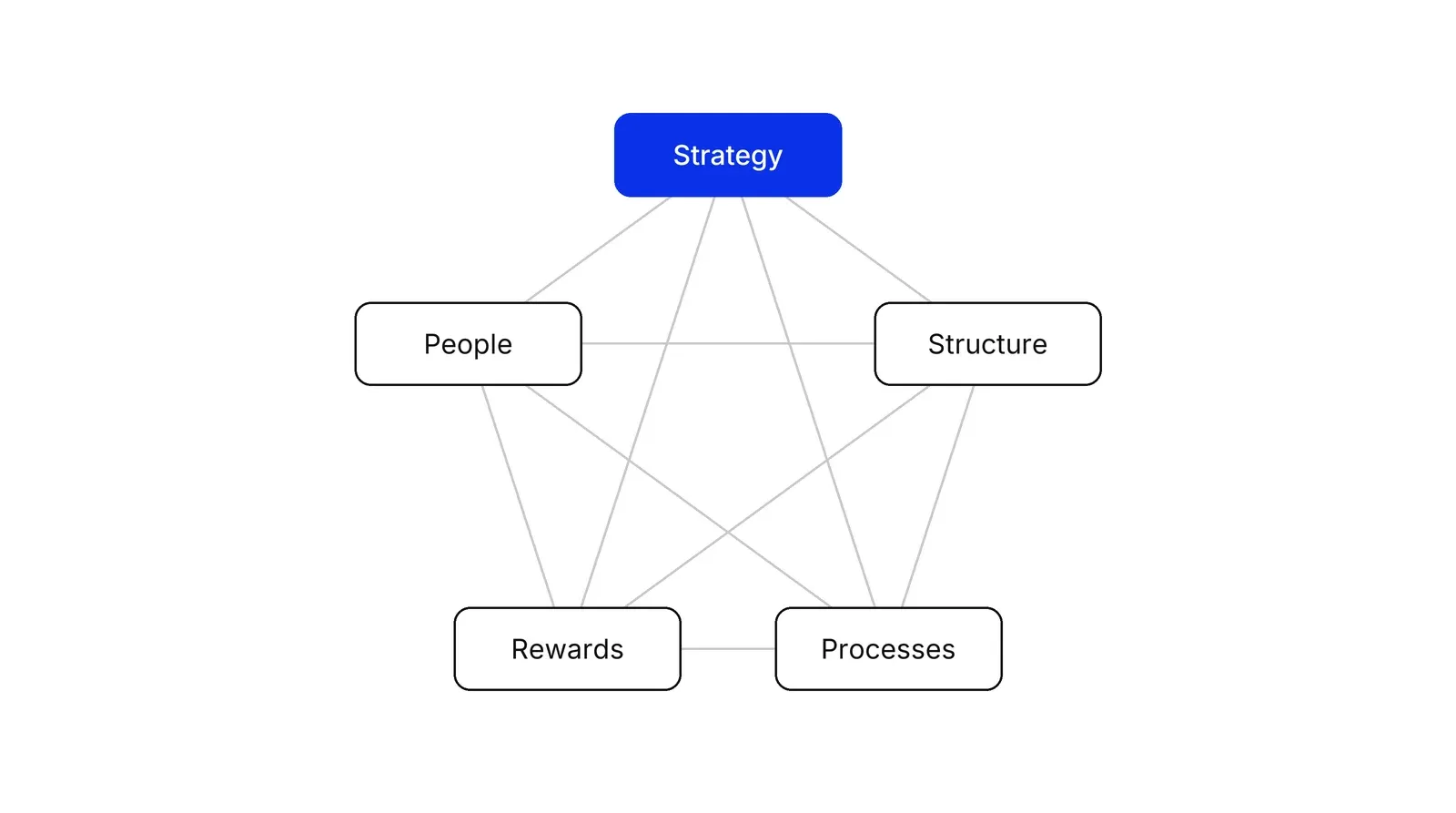
| Policy | What it decides | Typical choices |
|---|---|---|
| Strategy | The direction | Which customers, which portfolio of businesses |
| Structure | Where decision-making power sits | How people are grouped: by function, product, market |
| Processes | How information flows | Vertical: planning, budgeting. Lateral: teams, councils, matrix |
| Rewards | Motivation for desired behavior | Pay, bonuses, careers |
| People | Who is selected and developed | Hiring, training, rotation |
The processes row has two parts. In The Future of Organization Design, Galbraith describes vertical processes that strengthen the hierarchy, such as resource allocation, and lateral ones that run from informal relationships to formal teams and matrix processes. On people, he describes firms using rotational assignments to develop managers who identify with the whole company.
Why must the five line up?
A single policy cannot carry the design, because each one changes what the others do. The 1980 article that introduced McKinsey’s 7S was titled “Structure is not organization” for the same reason. Economists Paul Milgrom and John Roberts analyzed systems whose parts complement each other in a 1995 paper, applying the theory to modern manufacturing and to the strategy and structure of Lincoln Electric.
Galbraith’s own grid shows what a complete star looks like. In the 2012 article each portfolio strategy gets its own structure and its own pay and career rules. A single-business company such as BMW, his example, uses a functional structure with company-wide bonuses and careers. A holding company such as Berkshire Hathaway uses subsidiary-level bonuses and careers.
The usual failure is a gap between what is asked and what is paid. Steven Kerr’s 1975 paper collects cases of reward systems that pay off for one behavior while the rewarder hopes for another.
Which structures does the Star Model choose between?
Structure follows strategy, an idea Galbraith traces to Chandler’s 1962 book. In Galbraith’s summary, Chandler paired a functional structure with a single business and a multidivisional one with diversification, and Galbraith extended the list: international growth led to three-dimensional structures, and customer focus led to front-back and four-dimensional ones. Henry Mintzberg’s five configurations offer another cut of the same question.
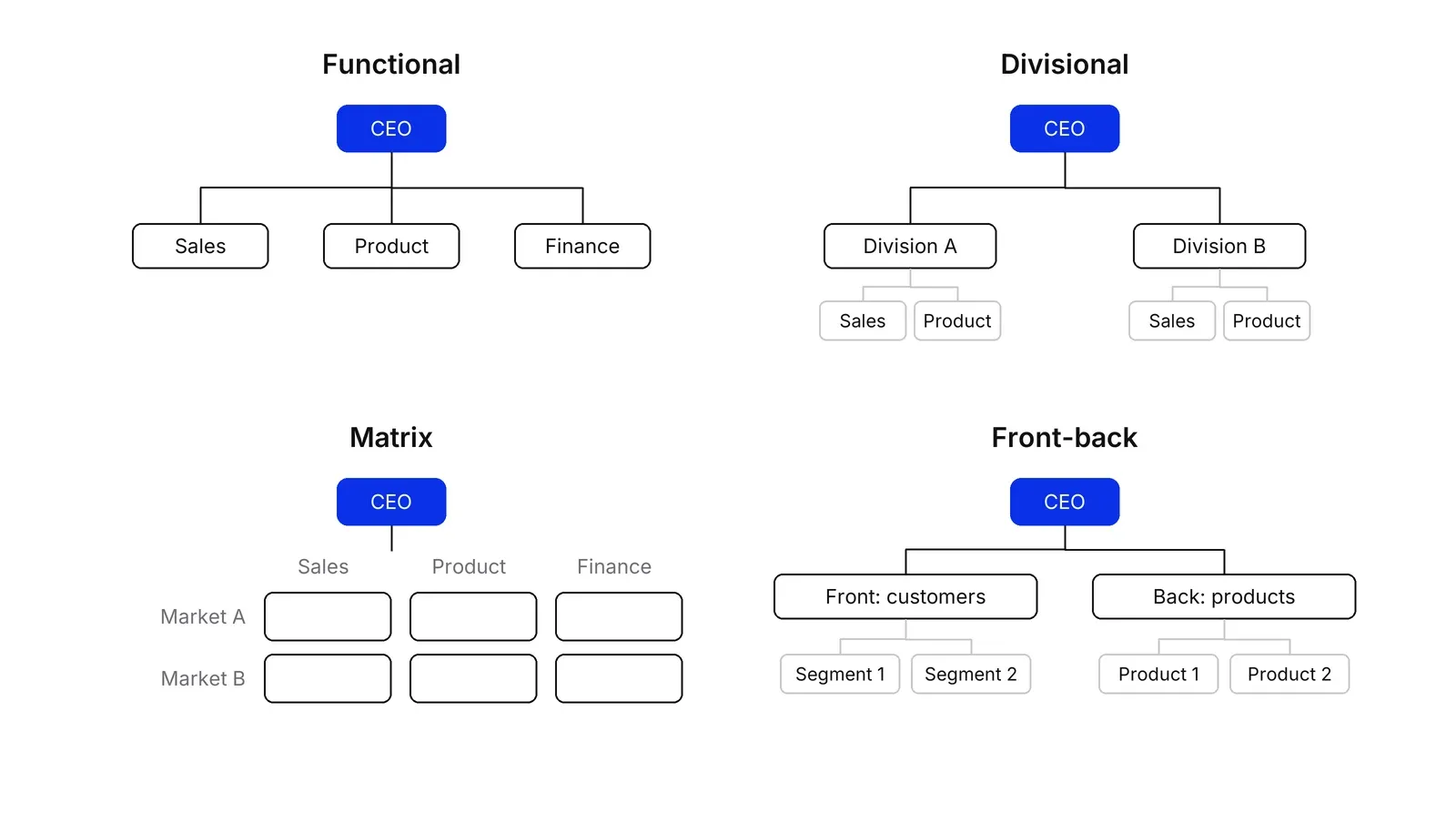
| Structure | Groups people by | Fits | Strain |
|---|---|---|---|
| Functional | Skill: sales, product, finance | One business, per Galbraith’s reading of Chandler | Lawrence and Lorsch studied how organizations divide work into units and then join it up |
| Divisional | Product, market or region, each with its own functions | Several businesses | Ballmer cited a single strategy instead of divisional ones when Microsoft left it |
| Matrix | Two dimensions at once, such as product and region | Several product lines, countries or segments, per Galbraith | Bartlett and Ghoshal call it a frame of mind more than a structure |
| Front-back | Customers at the front, products at the back | Mass customization, per Galbraith’s 2012 paper | Needs strong leadership to link the two ends |
Galbraith describes the front end as built around customer relationships and channels and the back end around products and brands. In his 2005 note he calls leadership the third leg that links the two. His book Designing the Customer-Centric Organization covers structure, management processes, rewards and people practices for this case. The number of layers and direct reports in any of these is a further structural choice, covered under span of control.
How is the Star Model different from McKinsey 7S?
Both ask whether the parts of an organization fit. Galbraith himself notes that every consulting firm has a version of one or the other. The difference is in the logic. On this site the 7S is covered as a diagnostic checklist, while the star starts from strategy and treats the other four as design levers.
| Star Model | McKinsey 7S | |
|---|---|---|
| Elements | Strategy, structure, processes, rewards, people | Strategy, structure, systems, shared values, style, staff, skills |
| Source | Galbraith; year disputed | Waterman, Peters and Phillips, June 1980 |
| Order | Strategy first, four policies follow | No element ranked first |
| Culture | A result of the behaviors policies encourage | Shared values at the center |
| Rewards | Its own policy | No separate element |
Nadler and Tushman’s congruence model of the same year makes a similar argument for fit.
Using it in practice
Read the design as five pairs and look for contradictions. Decision rights come from a RACI matrix, role profiles from a competency model, and two applied cases are marketing team structure and growth team structure. A Marketing-Operational System plan starts from the same question for a marketing team: which structure, processes, rewards and people its strategy needs.
How to apply Organizational design (Galbraith's Star Model), step by step
- Restate the strategy as design criteria. Write the strategy in two or three sentences, then list four or five things the organization must be good at to deliver it, such as one customer interface or fast product launches. Result: a short list of criteria against which every option is scored.
- Choose the main way to group people. Compare functional, divisional, matrix and front-back structures against the criteria. Pick one primary split and say how the second dimension will be handled. Result: one structure option, with the reasons it beats the others.
- Design the processes that cross the structure. List the planning, budgeting and cross-team forums that connect the units, and name the owner of each. Use a RACI matrix to settle who decides. Result: a map of vertical and lateral processes with owners and meeting rhythm.
- Align rewards with the new structure. For each changed role, write what it is measured on and how pay and promotion follow. Check each rule against the behavior you want, as Kerr's rewarding-A-hoping-for-B test suggests. Result: a goal and incentive sheet per role.
- Define the people practices. Describe who you will select for the new roles, how they are developed and where they rotate. A competency model gives the vocabulary. Result: role profiles and a development plan for the first cohort.
- Check the five pairs, then pilot. Read the design pair by pair: does the structure suit the strategy, do the rewards fit the structure, do the people fit the processes. Pilot in one unit before widening. Result: a list of conflicts with fixes, and a pilot with a review date.
Examples
Microsoft's 2013 move from divisions to functions
Documented. On 11 July 2013 Steve Ballmer announced that Microsoft would organize by function: engineering, marketing, finance and others, with four engineering groups, replacing business-group divisions. He wanted a single strategy, not a collection of divisional strategies. The announcement also set up cross-group initiative teams and company-wide planning, which are processes, and named new engineering leaders, which is people. The text does not mention pay or incentives. Seen through the star, structure, processes and people moved in the announcement, and rewards were not part of it.
Procter & Gamble's front-back model
Documented, as reported by Galbraith. Around 2000 P&G adopted Organization 2005, a front-back design with global business units organized by product and market development organizations facing customers. Galbraith wrote that when P&G went to Organization 2005, Jager tried to bridge the two sides alone and failed, and that Lafley, on taking over, added vice-chairmen to lead clusters of business units and market organizations. Galbraith adds that the top groups at P&G and Intel meet weekly for about half a day. At P&G and IBM, he notes, about half of the top group was new within a year or two of the move. For the star, a structure choice pulled in leadership capacity, meeting rhythm and different people.
A payments company adds a second product
Illustrative, no real company implied. A 120-person company sells merchant acquiring through a functional structure and launches payouts for marketplaces. Hand-offs between sales and product multiply, so it considers one unit per product. The star check catches a conflict: if each unit pays its sales reps on its own product only, nobody sells across products to customers who need both. The team keeps one customer-facing sales team paid on customer revenue and puts product ownership in the back, which is a front-back split.
When to use it
Use it when strategy has changed and the organization has not: a new product line, a new market, a merger, or growth that makes the old structure slow. It also fits when a reorganization was announced but behavior did not change, because the cause is usually a policy outside the org chart, such as rewards or planning.
When not to use it
Skip a full design for a problem in one process or one team. Fix the process or the team first. Avoid it too when the strategy is unsettled, since every policy is derived from it, and when no executive will accept that a structure gives something up. Galbraith calls his method top-down, for enterprise, business unit, region or function levels, and says bottom-up methods suit lower levels.
Common mistakes
- Redrawing the org chart and stopping. The 1980 McKinsey article that introduced 7S was titled Structure is not organization, and Galbraith's star adds four more policies for the same reason.
- Paying for the wrong behavior. Kerr's 1975 paper collects cases of reward systems that pay for one behavior while the rewarder hopes for another.
- Adding a second reporting line without changing planning, rewards and people. Galbraith's matrix book argues that structures do not fail, and that management fails to implement them correctly.
- Copying another company's chart. Galbraith's grid pairs each portfolio strategy with its own structure, pay and career rules, so a design that fits a single-business firm breaks in a holding company.
- Treating the design as finished. Galbraith describes structures as accumulating over time as strategies are added, so the review has to repeat.
FAQ
What is the Galbraith Star Model?
It is a framework by Jay Galbraith with five design policies: strategy, structure, processes, rewards and people. Strategy sets the direction, and the other four are policies managers choose to encourage the behaviors that strategy needs. Its main claim is that all five must be aligned for the organization to work.
What are the main types of organizational structure?
Galbraith's work covers functional, divisional, matrix and front-back structures. Chandler tied the first two to strategy: functional for a single business, multidivisional for diversification. Matrix groups people by two dimensions at once. Front-back puts customer-facing units at the front and product units at the back.
What is the difference between the Star Model and McKinsey 7S?
The star has five policies and puts strategy first. The 7S has seven elements, none ranked first, with shared values at the center. The star treats culture as a result of the behaviors policies encourage, and it has an explicit rewards policy. The 7S has no separate rewards element.
What are the goals of organizational design?
The goal is an organization that can execute its strategy. Galbraith traces his approach to Chandler's idea that structure follows strategy. In practice that means choosing a structure, the processes that link units, the rewards and the people so that day-to-day behavior produces the results the strategy needs.
When was the Star Model created?
Sources differ. Galbraith's consultancy says he developed it in the 1960s. In a 2012 article Galbraith cites his 1977 book Organization Design and the 2002 edition of Designing Organizations for the model. The first edition of that book came out in [1995](https://archive.org/details/designingorganiz00galb), and the third in [2014](https://www.wiley.com/en-us/designing-organizations-strategy-structure-and-process-at-the-business-unit-and-enterprise-levels-3rd-edition-p-9781118409954).
Sources
- Jay R. Galbraith, Designing Organizations, 3rd ed., Jossey-Bass (Wiley), 2014
- Jay R. Galbraith, Designing Organizations: An Executive Guide to Strategy, Structure, and Process, Jossey-Bass, 2002, Internet Archive record
- Jay R. Galbraith, Designing Organizations: An Executive Briefing on Strategy, Structure, and Process, Jossey-Bass, 1995, Internet Archive record
- Jay R. Galbraith, Organization Design, Addison-Wesley, 1977, Internet Archive record
- Jay R. Galbraith, Designing Complex Organizations, Addison-Wesley, 1973, Internet Archive record
- Jay R. Galbraith, Organization Design: An Information Processing View, Interfaces 4(3), 1974
- Jay R. Galbraith, The Evolution of Enterprise Organization Designs, Journal of Organization Design 1(2), 2012
- Jay R. Galbraith, The Future of Organization Design, Journal of Organization Design 1(1), 2012
- Jay R. Galbraith, The Front-Back Model: How Does It Work?, November 2005
- Galbraith Management Consultants, The Star Model
- Amy Kates, Jay R. Galbraith, Designing Your Organization: Using the STAR Model to Solve 5 Critical Design Challenges, Jossey-Bass (Wiley)
- Jay R. Galbraith, Designing Matrix Organizations That Actually Work, Jossey-Bass (Wiley), 2008
- Jay R. Galbraith, Designing the Customer-Centric Organization, Jossey-Bass (Wiley), 2005
- Alfred D. Chandler Jr., Strategy and Structure: Chapters in the History of the Industrial Enterprise, MIT Press, 1962, Internet Archive record
- Paul R. Lawrence, Jay W. Lorsch, Differentiation and Integration in Complex Organizations, Administrative Science Quarterly 12(1), 1967
- Henry Mintzberg, Structure in 5's: A Synthesis of the Research on Organization Design, Management Science 26(3), 1980
- Christopher A. Bartlett, Sumantra Ghoshal, Matrix Management: Not a Structure, a Frame of Mind, Harvard Business Review, July-August 1990
- Steven Kerr, On the Folly of Rewarding A, While Hoping for B, Academy of Management Journal 18(4), 1975
- Paul Milgrom, John Roberts, Complementarities and Fit: Strategy, Structure, and Organizational Change in Manufacturing, Journal of Accounting and Economics 19(2-3), 1995
- Robert H. Waterman Jr., Thomas J. Peters, Julien R. Phillips, Structure is not organization, Business Horizons 23(3), 1980
- David A. Nadler, Michael L. Tushman, A model for diagnosing organizational behavior, Organizational Dynamics 9(2), 1980
- Microsoft News Center, One Microsoft: Company realigns to enable innovation at greater speed, efficiency, 11 July 2013
Last updated Oct 9, 2026


Fractional COO or embedded operations team? How to choose at Series A
The two models solve different problems: how to tell which one your company needs, and what each costs in time and control.

What operational systems successful fintech startups use: lessons from ten companies
Starling, Monzo, Qonto, bunq, Lunar, Pleo, Tide, Ramp, Mercury and Column scaled on four operating systems. Regulators' findings show what breaks when one of them lags behind growth.

What a revenue operations manager actually owns
Pipeline definitions, CRM hygiene, forecasting and the handoffs between marketing, sales and success. What the role covers, and how it differs from sales ops.