Three horizons of growth
The three horizons of growth is a McKinsey model for managing a company's current core, its emerging businesses and its long-term options at the same time, so growth does not stall when the core matures.
The three horizons of growth is a portfolio model from McKinsey consultants Mehrdad Baghai, Stephen Coley and David White. Horizon 1 is the core business that earns today's profit, horizon 2 is emerging businesses that need investment to scale, and horizon 3 is small options for future growth. Companies are meant to fund and manage all three at once, not one after another.
- Origin
- Mehrdad Baghai, Stephen Coley and David White (McKinsey), 1996 article; 1999 book The Alchemy of Growth
- Level
- 301 · Advanced
- Fits
- Scale-up, Enterprise
- Time to apply
- one half-day session to map the portfolio, then a quarterly review
- What you need
- a list of every business line, product and funded initiative, with this year's revenue, profit and spend · an estimate of when each initiative should start to move earnings · the CEO and finance lead in the room, since the output is a budget split
The three horizons of growth is a model for running a company’s present and future businesses side by side. It sorts everything a company funds into three groups: the core that pays the bills today, the emerging businesses that should become the next core, and the small bets that might matter years from now. Its point is that all three need money, people and management attention at the same time.
The model comes from McKinsey. Mehrdad Baghai, Stephen Coley and David White first drew it in a 1996 McKinsey Quarterly article, Staircases to growth, written with Charles Conn and Robert McLean, as a chart called “concurrent management across three time horizons”. The team had studied 40 fast-growing companies that averaged 25% annual sales growth. The idea became the backbone of their book The Alchemy of Growth, published by Perseus in 1999. Sources that date it to 2000 are citing the US paperback. Baghai himself has said the model appeared “in various forms” between 1995 and 1997.
What goes in each horizon?
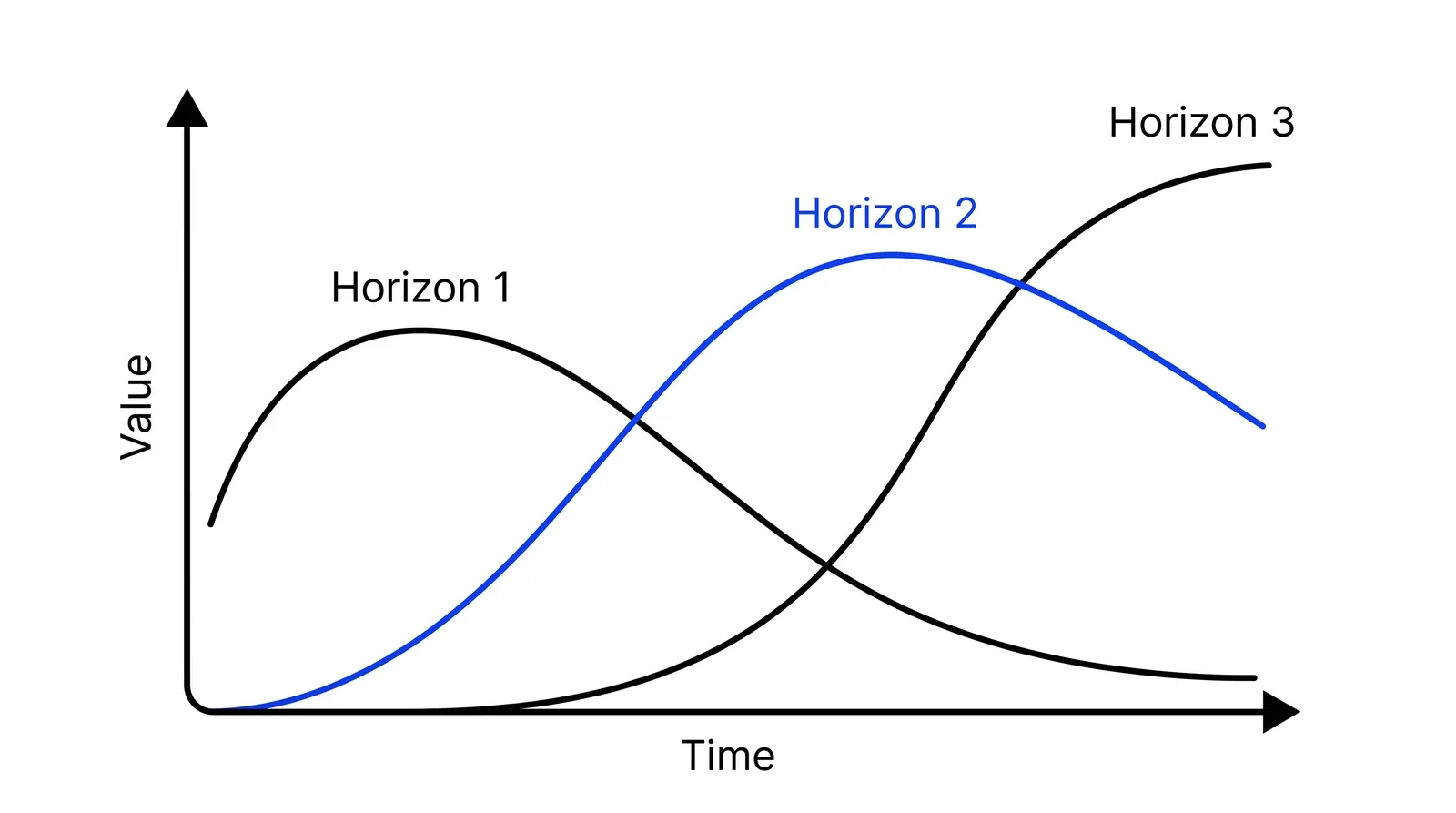
Each horizon is a group of businesses at a different stage, and each needs a different kind of management. Steve Coley’s 2009 McKinsey Quarterly summary defines them this way. Horizon 1 is the core most closely tied to the company’s name, which brings the greatest profit and cash flow. Horizon 2 is emerging ventures likely to earn substantial profit later, which may need heavy investment first. Horizon 3 is ideas for growth further out, such as research projects, pilot programs or minority stakes in new businesses.
| Horizon | 1996 label | What it holds | Judge it on |
|---|---|---|---|
| 1 | Defend and extend current core | Today’s main products and customers | Profit, cash, market share |
| 2 | Build momentum of emerging growth engines | New businesses with paying customers that are not yet big | Revenue growth, customer adoption |
| 3 | Create options for future staircases | Research, pilots, small stakes | What each option proved, and at what cost |
The labels in the second column are from the 1996 article. The last column is our working suggestion, built on the article’s point that targets, people, metrics and incentives right for long-term options often clash with those that drive short-term results.
Why all three run at the same time
The horizons are a portfolio, not a sequence. McKinsey’s 2009 summary says the time axis on the chart should not be read as a prompt for when to pay attention, and that companies must manage all three horizons concurrently. Time describes how a venture moves from horizon 3 to horizon 2 and then into the core.
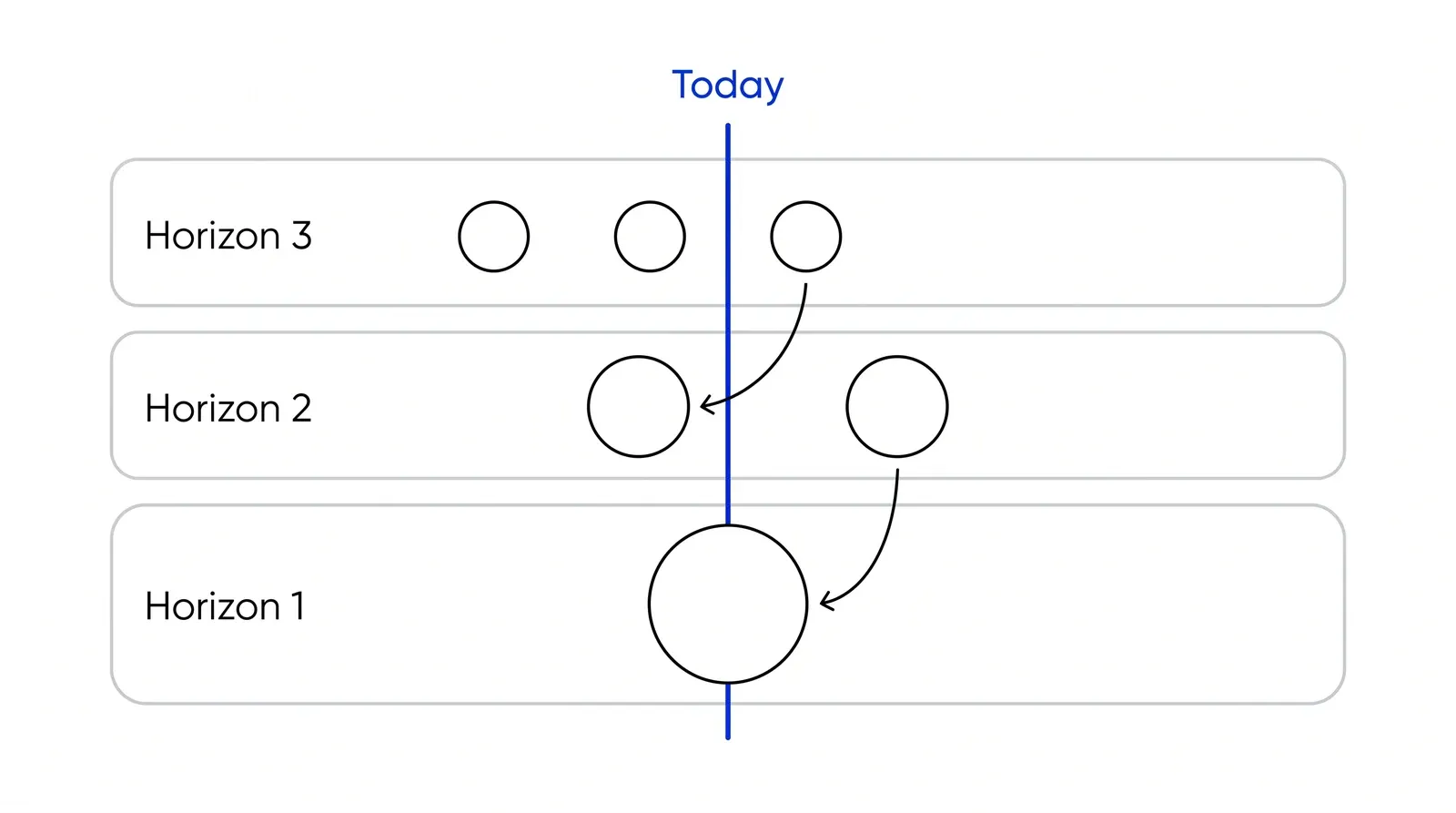
The 1996 article describes what happens when one horizon is neglected. Companies that protect only the core see growth stall after three to five years. Companies excited by new ventures neglect the core and lose the cash and investor confidence they need to keep growing. Its worked example is Disney’s 1984 to 1988 turnaround, which raised theme park prices in horizon 1 while rebuilding animation in horizon 2 and testing the first Disney Store in horizon 3.
How long is a horizon?
As long as your industry says it is. The 1996 article states that the years per horizon vary by industry: in pulp and paper or chemicals, the tail of horizon 1 may be five or ten years out, while software and internet businesses may see horizon 3 within five years. In a 2019 reply to Steve Blank, Baghai gave forest products a horizon 3 of 10 to 20 years and semiconductors one of 18 months.
He also said the horizons describe when a business will affect revenue and earnings, not how new it is. A disruptive product that pays back this year belongs in horizon 1. An incremental one that will matter only in five years belongs in horizon 3.
Steve Blank’s critique and the authors’ reply
In January 2019 Steve Blank, a Stanford adjunct professor who worked at eight tech startups, argued that the model had a fatal flaw. He noted that some organizations gave the horizons fixed lengths: 3 to 12 months for horizon 1, 24 to 36 for horizon 2, and 36 to 72 for horizon 3. Today, he wrote, disruptive horizon 3 ideas can be built from existing technology and shipped as fast as horizon 1 features. His example was Uber, assembled from smartphones and drivers that already existed. A version ran in Harvard Business Review a month later.
Baghai answered in the blog’s comments. He wrote that the model was built as “a growth strategy framework, not an innovation framework”, that Blank’s definitions were not the book’s, and that timings were never meant to be fixed. Blank accepted the points and changed the post’s title. The fair reading: Blank’s warning applies to companies that treat horizon 3 as a distant, slow lane, which many do.
| Question | Blank, 2019 | Baghai, 2019 |
|---|---|---|
| What defines a horizon? | Type of innovation, with time attached | When a business affects earnings |
| How long is horizon 3? | Can be as short as horizon 1 | Set per company: 18 months to 20 years |
| Is the model broken? | It needs speed across all three horizons | No, it allows for faster timelines |
Horizon 2 is where companies fail
Geoffrey Moore argued in Harvard Business Review in 2007 that mature companies often fail through a “Horizon 2 vacuum”. Horizon 1 has the budget and the board’s attention. Horizon 3 is cheap and exciting. Horizon 2 needs real money before it earns real profit, and it is judged against the core’s margins.
Research on ambidextrous organizations, firms that explore and exploit at once, points the same way. James March’s 1991 paper argued that organizations refine exploitation faster than exploration, which works in the short run and becomes self-destructive in the long run. O’Reilly and Tushman’s 2004 HBR study of 35 breakthrough attempts in 15 business units found that more than 90% of those run as separate units under a shared senior team reached their goals. Only 25% of those run inside the existing functions did, and none of the cross-functional or unsupported teams. No peer-reviewed test of the three horizons model itself turned up in our search.
How to split the budget across horizons
There is no official split in the original model. The 1996 article says the balance depends on the industry and the company’s starting position. A stalled company needs short-term fixes in the core, while a healthy core in a fast-changing industry calls for more weight on horizons 2 and 3.
The figure people quote, 70/20/10, comes from a different framework. Bansi Nagji and Geoff Tuff’s 2012 HBR article found that outperforming firms put about 70% of innovation resources into core offerings, 20% into adjacent ones and 10% into transformational ones, while returns came in the inverse ratio, according to Deloitte’s summary. It covers innovation spending only, and the authors say the right mix differs by industry. In Pushers’ Growth Lab we start from the company’s own numbers and ask whether horizon 2 has an owner and a budget.
Not the same as the futures three horizons
A second model shares the name. Bill Sharpe, Anthony Hodgson and colleagues use three horizons in foresight work, where horizon 1 is business as usual, horizon 2 is the turbulent transition and horizon 3 is the pattern that will replace the present system (Ecology and Society, 2016). Curry and Hodgson’s 2008 paper says Hodgson adapted it from The Alchemy of Growth. The McKinsey model plans a company’s portfolio. The futures model maps change in a whole system, such as an energy market. To choose which new markets feed horizon 3, pair the horizons with the Ansoff matrix.
How to apply Three horizons of growth, step by step
- List everything you fund. Write down every business line, product and initiative that takes money or people, from the core product to a two-person pilot. Add its revenue, profit and annual spend. Result: one table of the whole portfolio, with nothing left off because it is small.
- Set the length of each horizon for your industry. Decide what short, medium and long term mean for you. The original article says the years per horizon vary by industry, and Baghai later gave forest products a horizon 3 of 10 to 20 years against 18 months in semiconductors. Result: three time ranges written at the top of the table.
- Tag each line by when it moves earnings. Place each item in the horizon where it will make a real difference to profit, not by how new or clever it is. A disruptive feature that pays back this year is horizon 1. Result: every row tagged H1, H2 or H3.
- Compare money and people with the tags. Total the spend and the headcount in each horizon. A typical finding is that almost everything sits in horizon 1, with horizon 2 thin or empty. Result: a picture of the current split and the gaps in the pipeline.
- Give each horizon its own goals and owners. Judge horizon 1 on profit and cash, horizon 2 on revenue growth and customer adoption, and horizon 3 on what each option has proved and at what cost. Name one owner per horizon 2 business. Result: a scorecard per horizon instead of one profit target for everything.
- Review every quarter and move items between horizons. Each quarter, promote options that proved their case, close those that did not, and check that horizon 2 kept its budget. Result: a pipeline that refills itself, and a written record of what was stopped and why.
Examples
Disney's turnaround, 1984 to 1988
McKinsey's 1996 article that first set out the horizons used Disney as its worked case. In horizon 1, Disney raised theme park admission prices by 45% and released film classics on home video. In horizon 2, it rebuilt its animation and film groups, grew resorts and planned the Disney-MGM studios. In horizon 3, it tested the first Disney Store and direct mail, bought the KCAL TV station and studied the music business. According to the article, revenue more than doubled between 1984 and 1988 and net income rose from about $100 million to over $500 million.
A payments company mapping its portfolio
Illustrative, no real company implied. A cross-border payments firm earns 90% of its profit from card acquiring for online shops (horizon 1). It has a payouts product for marketplaces with 40 live clients that loses money but grows each month (horizon 2), and two pilots: stablecoin settlement and a lending product for merchants (horizon 3). The mapping shows that 85% of engineers sit in horizon 1 and the payouts team has three people. The board moves six engineers to payouts and sets it a client target, not a profit target, for the next two quarters.
A clinic group planning beyond its core
Illustrative, no real clinic implied. A group of four dental clinics makes its profit from implants and orthodontics (horizon 1). A fifth site in a new district opened last year and is not yet profitable (horizon 2). A small team tests remote orthodontic check-ups by video for existing patients (horizon 3). The owners agree to judge the new site on bookings per month for its first 18 months and to give the video pilot six months to show whether patients keep their appointments.
When to use it
Use it when a company's core business is still profitable but growth is slowing, when leadership argues about whether to fund new ventures or protect the core, or before annual budgeting in a company with several business lines. It is most useful for scale-ups and enterprises that already have a core to defend and cash to invest.
When not to use it
Skip it for an early startup that is still looking for its first repeatable business; it has one horizon and should spend everything on it. It also does not tell you which new business to enter. For that, use the Ansoff matrix, market analysis or disruptive innovation theory, then use the horizons to fund and manage what you chose.
Common mistakes
- Fixing horizons to set month ranges such as 3 to 12, 24 to 36 and 36 to 72 months. The authors meant each company to set its own timing.
- Treating the horizons as a sequence: fix the core first, then start horizon 2, then think about horizon 3. By the time the core flattens, there is nothing ready to replace it.
- Equating horizon 3 with disruptive technology. Baghai defines the horizons by when a business affects earnings, so a disruptive product that pays back this year belongs in horizon 1.
- Judging horizon 2 and 3 with horizon 1 metrics such as margin and payback, which kills them before they can scale.
- Copying 70/20/10 as a rule. It is a benchmark from one study of innovation spending, and its authors say the right split differs by industry and company.
FAQ
What are the three horizons of growth?
Horizon 1 is the core business that brings most of today's profit and cash. Horizon 2 is emerging businesses that are growing and will need investment to become the next core. Horizon 3 is small options such as research projects, pilots or minority stakes. McKinsey's model says a company should manage all three at the same time.
Who created the three horizons model?
McKinsey consultants Mehrdad Baghai, Stephen Coley and David White. It appeared in their 1996 McKinsey Quarterly article Staircases to growth, written with Charles Conn and Robert McLean, and became the core of their 1999 book The Alchemy of Growth. Some sources give 2000, the year of the US paperback edition.
Is the three horizons model still relevant?
Mostly, if horizons are defined by when a business moves earnings. Steve Blank argued in 2019 that disruptive horizon 3 ideas can now ship as fast as horizon 1 features. Co-author Mehrdad Baghai replied that horizon lengths were never fixed and should be set per company, and Blank changed his post's title.
What is the difference between the three horizons and the 70/20/10 rule?
The three horizons sort businesses by when they will drive earnings. The 70/20/10 rule comes from Bansi Nagji and Geoff Tuff's 2012 HBR article on innovation portfolios: outperforming firms put about 70% of innovation resources into core offerings, 20% into adjacent ones and 10% into transformational ones.
How long is each horizon?
There is no standard length. The original 1996 article says the years in each horizon vary by industry: in pulp and paper the tail of horizon 1 may be five or ten years out, while in software horizon 3 may be five years away or less. Set the ranges for your own market.
Sources
- Mehrdad Baghai, Stephen C. Coley, David White, with Charles Conn and Robert J. McLean, Staircases to growth, McKinsey Quarterly, 1996 Number 4
- McKinsey Quarterly, Enduring Ideas: The three horizons of growth (Steve Coley), December 2009
- Mehrdad Baghai, Stephen Coley, David White, The Alchemy of Growth, Perseus Books, 1999, East Carolina University library record
- Hachette Book Group, The Alchemy of Growth, Basic Books paperback, 2000
- Steve Blank, The Fatal Flaw of the Three Horizons Model (with Mehrdad Baghai's reply in the comments), January 2019
- Steve Blank, McKinsey's Three Horizons Model Defined Innovation for Years. Here's Why It No Longer Applies, Harvard Business Review, February 2019
- Geoffrey A. Moore, To Succeed in the Long Term, Focus on the Middle Term, Harvard Business Review, July-August 2007
- Geoffrey A. Moore, Zone to Win: Organizing to Compete in an Age of Disruption, Diversion Books, 2015
- Bansi Nagji, Geoff Tuff, Managing Your Innovation Portfolio, Harvard Business Review, May 2012
- Deloitte, Managing your innovation portfolio (summary of Nagji and Tuff), archived copy
- Charles A. O'Reilly III, Michael L. Tushman, The Ambidextrous Organization, Harvard Business Review, April 2004
- Harvard Business School Working Knowledge, A Clear Eye for Innovation (O'Reilly and Tushman), April 2004
- Michael L. Tushman, Charles A. O'Reilly III, Ambidextrous Organizations: Managing Evolutionary and Revolutionary Change, California Management Review 38(4), 1996
- Charles A. O'Reilly III, Michael L. Tushman, Organizational Ambidexterity: Past, Present and Future, Stanford GSB Working Paper 2130, 2013
- James G. March, Exploration and Exploitation in Organizational Learning, Organization Science 2(1), 1991
- Sebastian Raisch, Julian Birkinshaw, Organizational Ambidexterity: Antecedents, Outcomes, and Moderators, Journal of Management 34(3), 2008
- Peter Carbone, How Do Large Companies Manage Their Investments Across the Three Horizons?, Technology Innovation Management Review 2(4), 2012
- Joseph L. Bower, Clayton M. Christensen, Disruptive Technologies: Catching the Wave, Harvard Business Review, January-February 1995
- Bill Sharpe, Anthony Hodgson, Graham Leicester, Andrew Lyon, Ioan Fazey, Three horizons: a pathways practice for transformation, Ecology and Society 21(2), 2016
- Andrew Curry, Anthony Hodgson, Seeing in Multiple Horizons: Connecting Futures to Strategy, Journal of Futures Studies 13(1), 2008
- Tuck School of Business at Dartmouth, Three Boxes, One Playbook (Vijay Govindarajan's Three-Box Solution)
Last updated Oct 9, 2026


Marketing agency or growth system: when a company outgrows its agency
An agency is the right call while the founder still runs most of the company. Once the business starts copying itself into new locations or markets, it needs a system that sets goals, tests hypotheses and owns the result.

Why healthcare marketing agencies stall: the short, mid and long wins model we use with clinics
Most agencies own the click and nobody owns the front desk. How we structure clinic work in three horizons, the research behind each one, and one year of results.

Why channel tests stall after month three
Most paid channel tests do not end with a decision. They end when the budget runs out, the attribution model changes, or everyone quietly stops looking at the dashboard.