Fractional leadership model
The fractional leadership model is a way to staff a senior role, such as CMO, CFO or COO, with one experienced person who gives the company part of their week while serving other clients too.
The fractional leadership model is an arrangement in which an experienced executive acts as a company's CMO, CFO, COO or similar, but part-time and for several clients at once. It suits companies that need real senior judgment, often one to three days a week, and cannot yet justify or fill a full-time seat. It works only when scope, decision rights and the handover are agreed first.
- Origin
- No single originator; practice with job-posting growth visible from 2018, 2018 onward
- Level
- 401 · Expert
- Fits
- Startup, Small and mid-size, Scale-up
- Time to apply
- two weeks to write the scope, then a 90-day review
- What you need
- one outcome the function must deliver in the next six to twelve months · a named person inside the company who works with the executive every week · a budget stated as days per week and months, not as an open retainer
The fractional leadership model is a way to fill a senior role, such as marketing, finance or operations chief, with one experienced person who gives the company part of their week and serves other clients in the rest. The person is embedded in the team, takes decisions and answers for results, which separates the role from a consultant who advises and leaves. Revelio Labs, a workforce-data firm, defines a fractional executive as an experienced leader working part-time or temporarily at director level or above, and able to stay embedded for long periods.
No one person invented the model, and we found no authoritative origin story. What exists is data showing that the label spread. Revelio’s March 2025 analysis found that executive postings mentioning fractional work rose from 5 per 1,000 in 2018 to 18 per 1,000 in 2024. Academic study is thinner: the first systematic work we found covers part-time CIOs, by Kratzer and colleagues in Germany, with a project running from 2020 to 2023 and 62 fractional CIOs in 10 countries.
What the numbers show, and what they do not
Demand is growing, and it is concentrated in small and medium companies and in finance. Lightcast, a labor-market data firm, counted at least 34,000 US workers with “fractional” in their job title in 2025, up 265% from 2019. The same Lightcast analysis reports 677 US fractional postings in 2025, and that 97% of its 2026 postings came from small and medium companies. Finance made up 46% of postings, business management 12% and marketing and PR 10%.
Revelio’s September 2026 figure is 24 per 1,000 new executive postings in 2026 against 9 per 1,000 five years earlier, with CFO roles the largest category at 20%, followed by marketing and operations. Neither firm publishes its sample or exact classification rules on the pages we read, and the two Revelio releases use different baselines, so treat them as direction, not measurement.
The buyer side is the weakest. A joint survey by Duct Tape Marketing, ActiveCampaign and Databox drew 271 respondents, but only 16 were companies that had hired a fractional CMO, and the page does not state the year. We do not use widely repeated forecasts of the share of companies that will employ fractional executives, because we could not trace them to a named survey with a sample.
Fractional CMO, CFO and COO compared
The three seats differ in what the part-time person actually does and in the trigger that justifies them.
| Seat | What the part-time leader typically owns | Fit signal | Watch for |
|---|---|---|---|
| Fractional CFO | Financial planning and modeling, cash flow, fundraising preparation | The board asks questions finance cannot answer, or a fundraise is near (CRV puts this around seed to Series A) | Day-to-day accounting and controls belong to a controller, not the CFO seat |
| Fractional CMO | Positioning, budget allocation, channel and agency decisions, marketing hiring | Marketing runs on tactics with no owner of strategy | Buyers in the Duct Tape survey ranked expertise, cost against a full-time CMO and unbiased guidance highest |
| Fractional COO | Operating rhythm, process, cross-team delivery | A founder is the bottleneck for execution | Bennett and Miles argue the COO role depends heavily on who the CEO is, so the scope must be built around that CEO’s gaps |
CRV, a venture firm, gives rough ARR markers for finance: a fractional CFO before fundraising at around $1 million to $3 million ARR, and a growing mismatch with part-time support near $8 million. These are an investor’s rules of thumb, not measured thresholds. For design of the whole function around the seat, see operating model design.
When a part-time seat fits
A fractional seat fits when the work needs senior judgment but not a full week. The Kratzer research recommends a fractional CIO for roughly one to three days a week, and its three groups of fractional CIOs worked for three to five clients at once, around 1.3 to 1.7 days per client weekly for those with three or four clients and about one day for those with five.
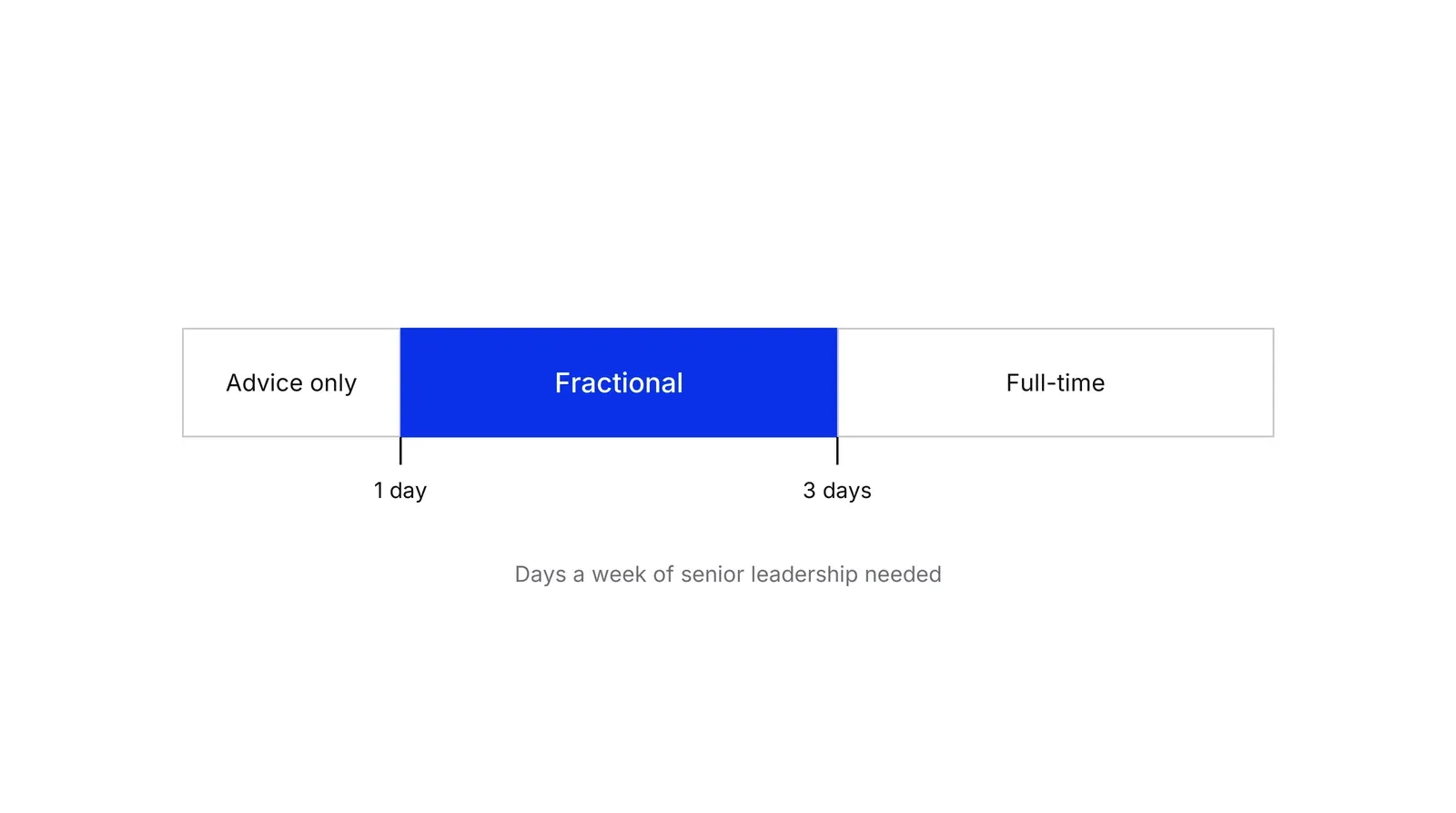
The model sits between two familiar options. Kratzer and colleagues describe a full-time executive as well integrated and with little incentive to generate follow-up work, and a consultant as flexibly tied and bringing an outside view. A fractional executive combines some of both. Interim executives are a different case: in the IIM and INIMA survey of 53 UK interim managers (January 2023), 44% worked at C-suite level, 52% of the last assignments ran longer than 11 months, and 45% were on full-time assignments.
When it does not fit
It does not fit when the need is daily presence or a large team. Kratzer and colleagues found that the most hands-on type, the full-ownership CIO, needs extensive directive powers and strong trust, which many small firms struggle to grant. If the CEO keeps every decision, the executive becomes an adviser with a longer title.
Divided attention is a second limit. A lab study by Sophie Leroy, with 84 and 78 undergraduates in two experiments, found that unfinished tasks leave attention behind when people switch to another task. We found no study that measures this in fractional leaders, so it is a reason to protect each client’s fixed days, not proof of a loss.
Tax status is a third. In the UK, HMRC’s off-payroll rules ask whether the worker would be an employee if engaged directly, and the IRS looks at behavioral control, financial control and the type of relationship.
Scoping the engagement
Scope the work, not the role. Yokoi’s IMD article says an engagement should start from the work to be done, with budget, the leader’s characteristics, expected responsibilities and the endpoint agreed before it begins. Three documents carry most of the weight.
The first is a list of outcomes with dates. The second is decision rights. Rogers and Blenko’s HBR article argues that clear decision roles drive results, and a RACI matrix is the simplest way to record who decides and who executes. The third is a cadence: a weekly session, a monthly review and a quarterly operating rhythm that includes the 90-day checkpoint.
Handing over
Plan the ending first. Kratzer and colleagues describe engagement types that finish with a handover, for example by hiring a full-time CIO. CRV advises asking the fractional CFO when the switch should happen, since they may see it first. When the fractional seat grows into a full team, the question becomes where it belongs in the growth team structure.
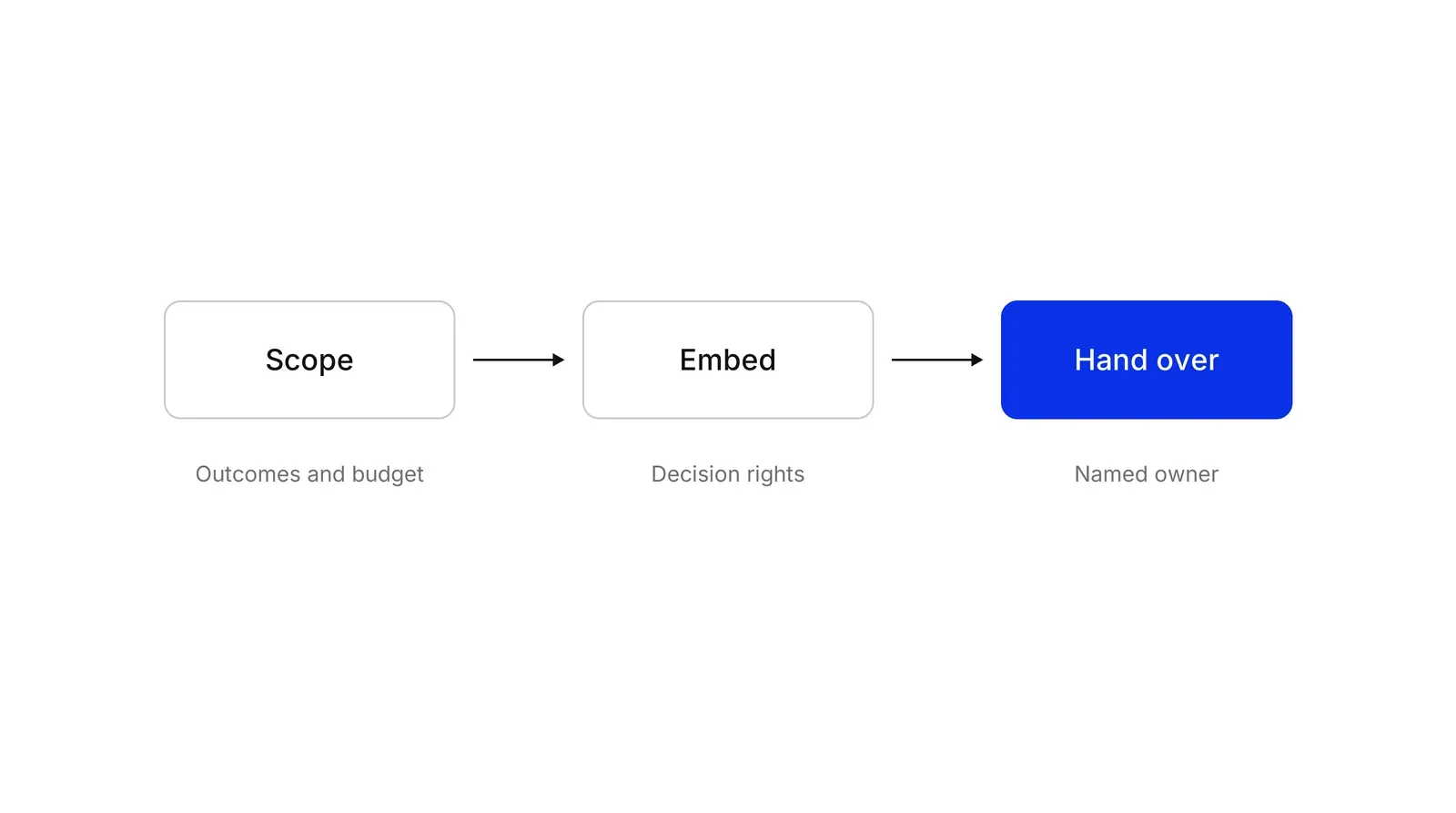
For the successor, use the structure Talya Bauer sets out for onboarding: compliance, clarification, culture and connection, with about 90 days to prove themselves. In practice that means a written role, the outcome history, the decision log and introductions to the people the executive worked with. Even full-time seats turn over: Spencer Stuart’s 2017 study of 100 of the most-advertised US brands put average CMO tenure at 44 months, so a handover document pays off whoever holds the role next.
Teams weighing outside senior help that is built around outcomes can compare options on the practices page.
How to apply Fractional leadership model, step by step
- Name the work, not the title. Write down what the function must produce in the next two quarters, for example a funding-ready financial model or a lead-to-appointment process that runs without the founder. Result: three to five outcomes with a date each.
- Measure the days. Estimate how many days a week of senior work those outcomes need. Under one day points to an adviser. Past about three points to a full-time hire. Result: a number between one and three, or a decision to hire.
- Choose the engagement type. Decide whether you need strategy and alignment, a repair of a function that is failing, a build for fast growth, or hands-on cover for a team that does not exist yet. Result: one type, named in the contract.
- Write decision rights. List which decisions the executive makes, which they recommend and which stay with the CEO, and who inside the company is accountable for execution. Result: a one-page responsibility chart.
- Fix the rhythm. Set a weekly working session, a monthly review against the outcomes and a 90-day checkpoint. Result: dates in the calendar before the first day.
- Agree the ending on day one. Decide what the exit looks like: a full-time hire, a promoted insider, or a smaller standing retainer. Name the successor role and the documents to be handed over. Result: an exit condition written into the agreement.
Examples
A payments start-up before its Series A
Illustrative, no real company implied. A 30-person payments company has reliable accounting but cannot produce a cash forecast the board trusts. Two days a week of finance leadership for six months is enough to build the model, the board pack and the data room. When the company starts preparing a Series B and finance becomes a daily job, the founder uses the exit condition written at the start and hires a full-time CFO.
A clinic group opening its fifth site
Illustrative, no real clinic implied. Four clinics run on the founder's memory: booking rules, supplier terms and staff rosters differ by site. A fractional COO spends one and a half days a week for a year writing the shared procedures, setting the weekly operating review and training a site manager to run it. The handover is to that manager, with the procedures as the deliverable.
Rapid scaling in the fractional CIO research
In the Kratzer, Westner and Strahringer research on part-time CIOs, one engagement type is rapid scaling: a start-up with no IT department but fast growth brings in a fractional CIO to set up the structure, build the team and finally hire a full-time CIO to take over. The ending is part of the job description. The same logic carries over to marketing and finance seats.
When to use it
Use it when the function needs senior judgment that is real but does not fill a full-time week, when a founder is carrying a function they are weak at, when a full-time leader has left and the search will take months, or before a fundraise or expansion that exposes a gap. It also suits a company that wants an outside view from someone who sits inside the team.
When not to use it
Skip it when the need is daily presence, a large team to manage or heavy execution, because a person splitting their week cannot supply that. Skip it when nobody inside the company can own the work between sessions, when the CEO will not delegate decisions, or when the arrangement would in practice be an employee in all but name, which carries tax risk in some countries.
Common mistakes
- Hiring for a title instead of an outcome, so the executive spends the first month inventing a job.
- Giving the role advice without authority, then expecting results that need decisions, budget or direct control of people.
- Having no internal counterpart, so the plan stalls between the executive's days.
- Leaving the handover until the last month, when the executive is already half gone and the successor has no context.
- Treating a fractional seat as a permanent cheap substitute for a full-time leader after the workload has outgrown it.
FAQ
What is a fractional CMO?
A fractional CMO is an experienced marketing leader who runs a company's marketing function part-time, usually for several clients. Unlike an agency, they sit inside the team and own decisions on budget, positioning and hiring. They fit companies that need senior marketing judgment but not a full-time executive.
How many days a week does a fractional executive work for one client?
In the research on fractional CIOs, the three groups studied worked for three to five clients at once, which the authors translated into roughly one to 1.7 days per client a week. They recommend a part-time seat for about one to three days a week. Other functions have no comparable study.
What is the difference between a fractional and an interim executive?
An interim executive usually fills a seat full-time for a bounded change assignment. In the 2023 IIM and INIMA survey of 53 UK interim managers, 45% were on full-time and 17% on part-time assignments. A fractional executive works part-time for several clients, often with no fixed end date.
How much does a fractional CMO cost?
We found no named survey with a sample that reports fractional CMO fees, so we do not quote a range. Price the engagement as days per week, number of months and the outcomes in scope, then compare that with the loaded cost of a full-time hire in your market.
Can a fractional executive be treated as a contractor?
It depends on the country and the facts of the arrangement. In the UK the off-payroll rules look at whether the person would be an employee if engaged directly, and the US IRS looks at behavioral control, financial control and the type of relationship. Take local tax advice before signing.
Sources
- Simon Kratzer, Markus Westner, Susanne Strahringer, Traction with fraction: strategic IS management in SMEs through Fractional CIOs, International Journal of Information Systems and Project Management 12(1), 2024
- Simon Kratzer, What Makes Fractional CIO Engagements in SMEs Successful? A Research Framework, Hawaii International Conference on System Sciences, 2022
- Christopher Michael Palmisano, dissertation on fractional leaders, University of Denver, 2025
- Tomoko Yokoi, Amy Bonsall, How Part-Time Senior Leaders Can Help Your Business, Harvard Business Review, July 2024
- Tomoko Yokoi, The Fractional Gains of Senior Leaders: Fact or Fallacy, IMD, September 2024
- Lightcast, The Rise of Fractional Leadership
- Revelio Labs, Financial Times Features Revelio Labs Data on the Rise of Fractional Executives, September 2026
- Revelio Labs, Everyone Needs a Side Hustle These Days, Even Executives, March 2025
- Charles Stuart, Elisabetta Battistella, IIM-INIMA Annual Survey 2023 (UK interim managers)
- Institute of Interim Management, About the Institute and its annual survey
- Duct Tape Marketing, ActiveCampaign, Databox, Fractional CMO Insights Survey results
- CRV, When to Hire a CFO, June 2026
- CRV, How to Hire a CFO, 2026
- California State University, Fullerton, What in the world is a fractional executive? (on So and Teckchandani, Journal of Business Strategy, 2023)
- Nate Bennett, Stephen A. Miles, Second in Command: The Misunderstood Role of the Chief Operating Officer, Harvard Business Review, May 2006
- Paul Rogers, Marcia Blenko, Who Has the D? How Clear Decision Roles Enhance Organizational Performance, Harvard Business Review, January 2006
- SHRM, Don't Underestimate the Importance of Good Onboarding (on Talya Bauer's four levels of onboarding)
- British Psychological Society Research Digest, on Sophie Leroy's 2009 attention residue experiments
- Chartered Accountants Ireland, The rise of the fractional executive, August 2024
- HM Revenue and Customs, Understanding off-payroll working (IR35)
- US Internal Revenue Service, Independent contractor (self-employed) or employee?
- Spencer Stuart, CMO Tenure Study 2017
Last updated Oct 9, 2026


Fractional COO or embedded operations team? How to choose at Series A
The two models solve different problems: how to tell which one your company needs, and what each costs in time and control.

What operational systems successful fintech startups use: lessons from ten companies
Starling, Monzo, Qonto, bunq, Lunar, Pleo, Tide, Ramp, Mercury and Column scaled on four operating systems. Regulators' findings show what breaks when one of them lags behind growth.

What a revenue operations manager actually owns
Pipeline definitions, CRM hygiene, forecasting and the handoffs between marketing, sales and success. What the role covers, and how it differs from sales ops.