Playing to Win (strategy choice cascade)
Playing to Win is A.G. Lafley and Roger Martin's way of writing a strategy as five linked choices, from what winning means to the systems that keep the company able to win.
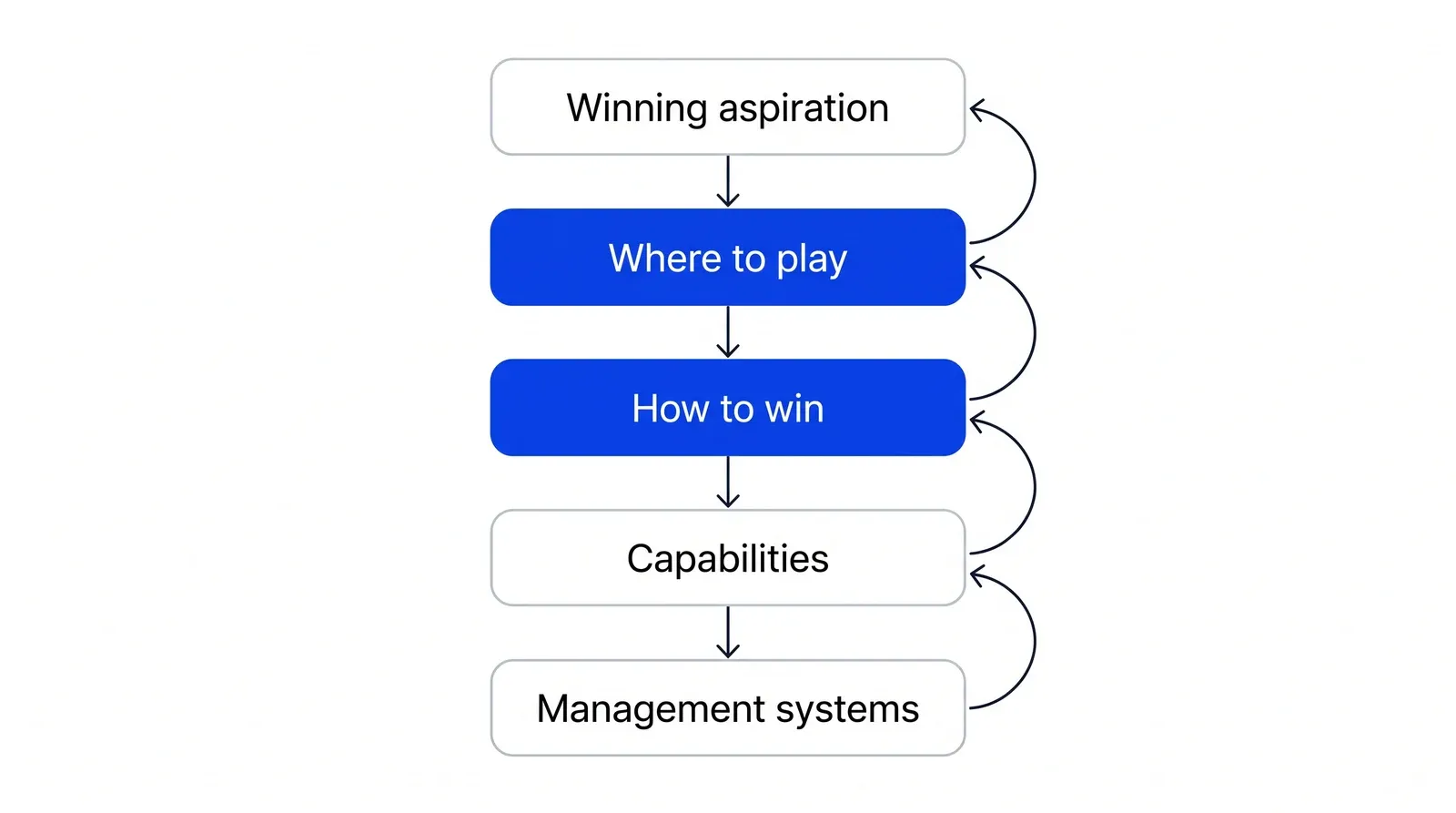
Playing to Win is a strategy framework from A.G. Lafley and Roger Martin's 2013 book of the same name. It defines strategy as five linked choices, called the strategy choice cascade: a winning aspiration, where to play, how to win, the capabilities required and the management systems that support them. Its purpose is to replace long planning documents with a few choices that fit together.
- Origin
- A.G. Lafley and Roger L. Martin, 2013
- Level
- 301 · Advanced
- Fits
- Scale-up, Enterprise
- Time to apply
- two or three half-day workshops for a first version, then a review whenever a key assumption breaks
- What you need
- a small team that includes the person who signs off on budgets · what your target customers say they value, in their words, and how rivals serve them · the courage to write down what the company will not do
Playing to Win is a framework that treats strategy as five connected choices: what winning means, where to compete, how to win there, which capabilities that requires and which management systems keep those capabilities alive. The set of choices is called the strategy choice cascade. Roger Martin’s site sums up the premise in three words: “strategy is choice”.
The framework comes from the book Playing to Win: How Strategy Really Works by A.G. Lafley and Roger Martin, which Harvard Business Review Press published in February 2013. Lafley ran Procter & Gamble from 2000 to 2009, and P&G brought him back as chief executive in May 2013. Martin, then dean of the Rotman School of Management, advised him through those years, and the book draws its cases from that work. It won the Thinkers50 Best Book Award for 2012-2013. Monitor Deloitte, which describes its strategy method as closely aligned with Martin’s, uses the cascade in its client work.
What are the five choices?
The five choices are a winning aspiration, where to play, how to win, must-have capabilities and enabling management systems. Each one narrows the next, and together they should describe one coherent way of competing.
| Choice | Question it answers | Olay, as Martin describes it |
|---|---|---|
| Winning aspiration | What does winning look like? | A leading skincare brand at the centre of P&G beauty |
| Where to play | Which customers, regions, channels, products? | Women aged 35 to 49 seeing early signs of ageing |
| How to win | Why will those customers choose us? | Department-store quality at a mass-channel price |
| Capabilities | What must we be good at? | Better active ingredients and packaging |
| Management systems | What builds and measures those capabilities? | Not covered in his account |
The Olay column comes from Martin’s 2013 Thinkers50 interview, where he says the old Oil of Olay sold for about $3.99 and Olay Total Effects launched at $18.99. A higher price on its own would have failed. The new customer, the new reason to buy and the new capabilities had to arrive together.
Why where to play and how to win matter most
Where to play and how to win are the pair that decides whether a strategy works. Martin calls them “the heart of strategy” in the same interview. The aspiration sets the direction, and capabilities and systems only exist to serve the chosen pair.
Where to play is the field: customer segments, geographies, channels and product categories. How to win is the advantage on that field, usually lower cost or an offer customers value more. Michael Porter made the same point about trade-offs in 1996: “the essence of strategy is choosing what not to do”. A where to play that includes everyone has no trade-off in it, so there is nothing for rivals to find hard to copy.
The cascade is a system, not a sequence
The most common misuse of the cascade is filling in the boxes from top to bottom. Martin warned about it in a 2017 Harvard Business Review piece, where he names making the choices independently of each other as a common pitfall.
In a December 2024 note he calls it the lock and load problem. A team fixes its aspiration, then fixes a market, and by the time it reaches how to win the good options have already been ruled out. His fix is to sketch several complete possibilities, think about each where to play and how to win pair together, and only then test them against the aspiration and the capabilities. He adds that the return arrows in the diagram, running back up the cascade, “are there for a purpose too.”
The method for producing those possibilities is set out in “Bringing Science to the Art of Strategy”, which Lafley and Martin wrote with Jan Rivkin and Nicolaj Siggelkow in 2012. Instead of arguing about which option is right, the team asks what would have to be true for each option to work, then tests the conditions it doubts most. The steps on this page follow that process.
A plan is not a strategy
Playing to Win draws a hard line between strategy and planning. A plan lists initiatives, timelines and budgets for things the company controls. A strategy is a bet on how customers and rivals will respond, which the company does not control.
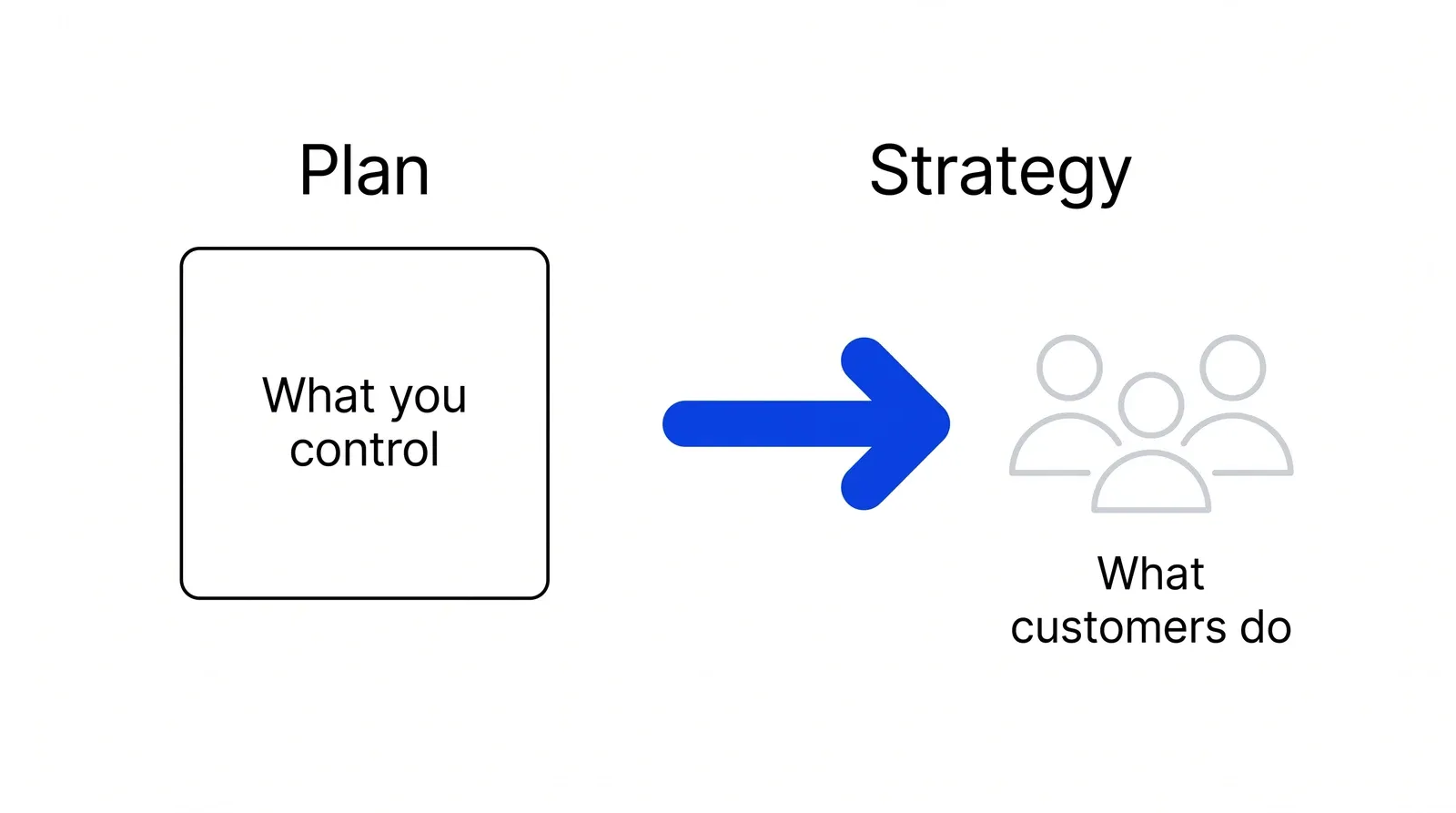
Martin’s 2014 article “The Big Lie of Strategic Planning” argues that executives retreat into planning because it feels safe, while real strategy means decisions that cut off options. HBR’s 2025 masterclass with him defines strategy as “a coherent set of choices that position an organization to win”. A practical test follows: if your strategy document is mostly a budget with commentary, the five choices have not been made.
How it compares with Rumelt and Porter
Playing to Win is often read next to Richard Rumelt’s kernel of good strategy and Porter’s positioning ideas. They answer different questions and work well together.
| Framework | Central question | What it adds |
|---|---|---|
| Playing to Win (Lafley, Martin, 2013) | Where will we play and how will we win? | Five linked choices, down to capabilities and management systems |
| Rumelt’s strategy kernel (2011) | What is the critical challenge? | A diagnosis first, then a guiding policy and coherent actions |
| Porter’s generic strategies (1980) | Low cost or differentiation, broad or narrow? | A menu of ways to win, useful inside the how to win box |
Rumelt’s Good Strategy/Bad Strategy is stronger on naming the problem before choosing a response. Playing to Win is stronger on carrying the choice down into capabilities and systems. A team can run a Rumelt diagnosis first, then use the cascade to write the answer.
What the evidence and the critics say
The evidence for Playing to Win is mostly case-based and told by the people who used it. P&G’s own 2009 filing says that under Lafley sales more than doubled, organic sales grew about 5% a year, core earnings per share grew about 12% a year, billion-dollar brands went from 10 to 22, and market value more than doubled. The publisher’s page adds that profits quadrupled; we did not find that figure in P&G’s filing. These are company-wide results with many causes, so they show the framework was used during a strong decade, not that it caused one.
The older critique comes from Henry Mintzberg and James Waters, who argued in 1985 that real strategies sit between deliberate and emergent, with much of what companies do arising from patterns nobody planned. Martin’s reply, in “Why Bother Doing Strategy?”, is that uncertainty never clears, so waiting for a strategy to emerge means letting competitors choose first. In practice the testing step and the return arrows are where emergent learning gets back into the cascade.
In Pushers’ Growth Lab work, the where to play and how to win pair comes before any channel plan, because a team that has not chosen its customers cannot judge which channels reach them.
How to apply Playing to Win (strategy choice cascade), step by step
- Agree what winning means. Write the winning aspiration as an outcome you can check against rivals and customers, such as being the payments provider that mid-sized importers pick first in two corridors. Result: one or two sentences that rule some futures out.
- Draft three or four complete possibilities. Do not lock the aspiration and then hunt for a market. Sketch several full strategies, each with its own where to play and how to win, the way Martin describes in his 2024 note on the cascade. Result: a short list of distinct, coherent options.
- Ask what would have to be true. For each possibility, list the conditions about customers, rivals, costs and your own skills that must hold for it to work. Result: a list of conditions per option, with the doubtful ones marked.
- Test the doubtful conditions. Run the cheapest test that would change your mind: customer interviews, a pricing pilot, a cost model. Result: evidence on the conditions that decide the choice.
- Choose, then name capabilities and systems. Pick the possibility with the fewest failed conditions, then list the few capabilities it needs and the meetings, metrics and budgets that will build them. Result: one page that states all five choices.
- Revisit when an assumption breaks. Keep the list of conditions and check it when results surprise you. Result: a decision to keep, adjust or replace the strategy, made on purpose.
Examples
Olay at Procter & Gamble
Roger Martin's 2013 Thinkers50 interview tells the story in cascade terms. The aspiration was a leading skincare brand at the centre of P&G's beauty business. Oil of Olay sold for about $3.99 to an ageing customer base. The new where to play was women aged 35 to 49 noticing early signs of ageing; the how to win was a mass-channel product good enough to replace department store creams, with Olay Total Effects at $18.99. That needed better ingredients and packaging, store sections that felt like department stores, and work with beauty editors. Martin says the brand grew 10% to 15% a year for over a decade, to $2.5 billion.
A cross-border payments company
Illustrative, no real company implied. A payments startup serving everyone loses on price to big banks. It writes three possibilities: freelancers in one corridor, importers of electronics from Asia, and marketplaces paying sellers. For importers, what would have to be true is that they value same-day settlement and invoice matching over the lowest fee. Twenty interviews confirm it. Capabilities follow: a compliance team for two corridors and an integration with the two accounting tools importers use.
A dental clinic group
Illustrative. A group of four clinics competes with chains on every service. Its cascade picks adults who need implants and full restorations within a 30-minute drive, and wins with one surgeon-led team, fixed treatment plans and financing on the first visit. Capabilities: case planning, a financing partner, follow-up calls. Management systems: weekly review of plan acceptance and complications, and a budget that stops funding whitening promotions.
When to use it
Use it when a company has a long plan but nobody can say why customers should choose it, when leaders disagree about which markets to serve, before a new business unit or market entry, or when a strategy document has grown past a few pages. It works best with a team that has authority over budgets.
When not to use it
It is a poor fit for a startup still searching for product-market fit, where fast experiments matter more than a written strategy, and for purely operational problems such as cutting delivery time. It also helps little if no one in the room can stop projects that contradict the choices.
Common mistakes
- Filling the five boxes one after another, locking the aspiration and market before anyone has found a way to win there.
- Writing a winning aspiration that is a generic mission statement, such as being customer-centric, which rules nothing out.
- Choosing where to play by market size alone, without a credible how to win in that market.
- Listing every capability the company has instead of the few that make the chosen way of winning possible.
- Treating the finished cascade as a plan of initiatives and budgets, which is what Martin warns against.
FAQ
What are the five questions of Playing to Win?
What is our winning aspiration? Where will we play? How will we win where we have chosen to play? What capabilities must be in place to win? What management systems are required to ensure those capabilities are in place? Roger Martin's own site lists them in that form, and A.G. Lafley and Martin set them out in their 2013 book.
What is the strategy choice cascade?
It is the diagram of the five Playing to Win choices, drawn as boxes running from the winning aspiration down to management systems. Choices higher up constrain those below, and the return arrows show that lower choices can force a rethink higher up. Martin says it is a system to be made coherent, not a form to fill in order.
What is the difference between where to play and how to win?
Where to play is the field you choose: customers, regions, channels, products. How to win is the reason those customers will pick you over rivals there, usually lower cost or a distinct offer. Martin calls the pair the heart of strategy and says they must be chosen together, because a market is only attractive if you can win in it.
Is Playing to Win the same as strategic planning?
No. Martin argues that planning lists actions and budgets the company controls, while strategy is a set of choices that bets on how customers and rivals will respond. In his 2014 Harvard Business Review article he calls planning a comfortable trap. A Playing to Win strategy should fit on a few pages.
Who wrote Playing to Win?
A.G. Lafley, chief executive of Procter & Gamble from 2000 to 2009 and again from 2013, and Roger Martin, then dean of the Rotman School of Management at the University of Toronto, who advised Lafley at P&G. Harvard Business Review Press published the book in February 2013, and later released an expanded edition with bonus articles.
Sources
- A.G. Lafley, Roger L. Martin, Playing to Win: How Strategy Really Works, expanded edition, Harvard Business Review Press store
- Publishers Weekly, review of Playing to Win: How Strategy Really Works (Harvard Business Review Press, 2013)
- Roger L. Martin, Playing to Win (book page)
- Roger L. Martin, Strategy (thought pillar)
- Roger L. Martin, The Danger of Locking & Loading: The Strategy Choice Cascade is a System, not a Sequence, December 2024
- Roger L. Martin, Strategic Choices Need to Be Made Simultaneously, Not Sequentially, Harvard Business Review, April 2017
- A.G. Lafley, Roger L. Martin, Jan W. Rivkin, Nicolaj Siggelkow, Bringing Science to the Art of Strategy, Harvard Business Review, September 2012
- Roger L. Martin, The Big Lie of Strategic Planning, Harvard Business Review, January-February 2014
- Harvard Business Review, A Plan Is Not a Strategy, Executive Masterclass with Roger L. Martin, May 2025
- HBR On Strategy podcast, The Difference Between a Plan and a Strategy, May 2023
- Roger L. Martin, The Execution Trap, Harvard Business Review, July-August 2010
- A.G. Lafley, What Only the CEO Can Do, Harvard Business Review, May 2009
- Roger L. Martin, Why Bother Doing Strategy?, The Conference Board Review
- Thinkers50, In Conversation: Roger Martin, 2013
- Procter & Gamble, A.G. Lafley retirement press release, Form 8-K exhibit, 2009
- Procter & Gamble, CEO transition press release, Form 8-K exhibit, May 2013
- Deloitte Australia, Playing to win: effective strategy
- Monitor Deloitte, Corporate and Business Unit Strategy (The Strategic Choice Cascade)
- Michael E. Porter, What Is Strategy?, Harvard Business Review, November-December 1996
- Henry Mintzberg, James A. Waters, Of Strategies, Deliberate and Emergent, Strategic Management Journal 6(3), 1985
- Penguin Random House, Richard Rumelt, Good Strategy/Bad Strategy, Crown, 2011
Last updated Oct 9, 2026


Marketing agency or growth system: when a company outgrows its agency
An agency is the right call while the founder still runs most of the company. Once the business starts copying itself into new locations or markets, it needs a system that sets goals, tests hypotheses and owns the result.

Why healthcare marketing agencies stall: the short, mid and long wins model we use with clinics
Most agencies own the click and nobody owns the front desk. How we structure clinic work in three horizons, the research behind each one, and one year of results.

Why channel tests stall after month three
Most paid channel tests do not end with a decision. They end when the budget runs out, the attribution model changes, or everyone quietly stops looking at the dashboard.