Behavioral economics in funnels
Behavioral economics in funnels means designing the steps where a visitor chooses, pays or cancels around how people actually decide, using levers such as defaults, anchors, framing and the number of options, and testing each one.
Behavioral economics in funnels is the use of research on how people actually decide to design the steps where a visitor chooses, pays or cancels. The main levers are defaults, anchors, loss framing, the number of options and wording. Defaults have the strongest evidence. Many other effects shrink in field tests, so each lever needs its own A/B test.
- Origin
- Daniel Kahneman and Amos Tversky (prospect theory); Richard Thaler and Cass Sunstein (choice architecture), 1979; 2008
- Level
- 301 · Advanced
- Fits
- Small and mid-size, Scale-up
- Time to apply
- One decision point and one A/B test per lever, two to four weeks each
- What you need
- a funnel map with conversion and drop-off at each step · a way to run randomized tests and to read results beyond the first click, such as revenue, refunds and cancellations · someone who can check the test design against consumer and privacy rules
Behavioral economics in funnels is the practice of designing the steps where a visitor chooses, pays or cancels around how people actually decide, not how a rational calculator would. Daniel Kahneman and Amos Tversky showed in their 1979 prospect theory paper that people judge outcomes against a reference point and feel losses more sharply than equal gains. Richard Thaler and Cass Sunstein turned such findings into advice in Nudge, where choice architecture means the deliberate design of how options are presented. This page covers five levers, what field evidence says about each, and how much to trust it.
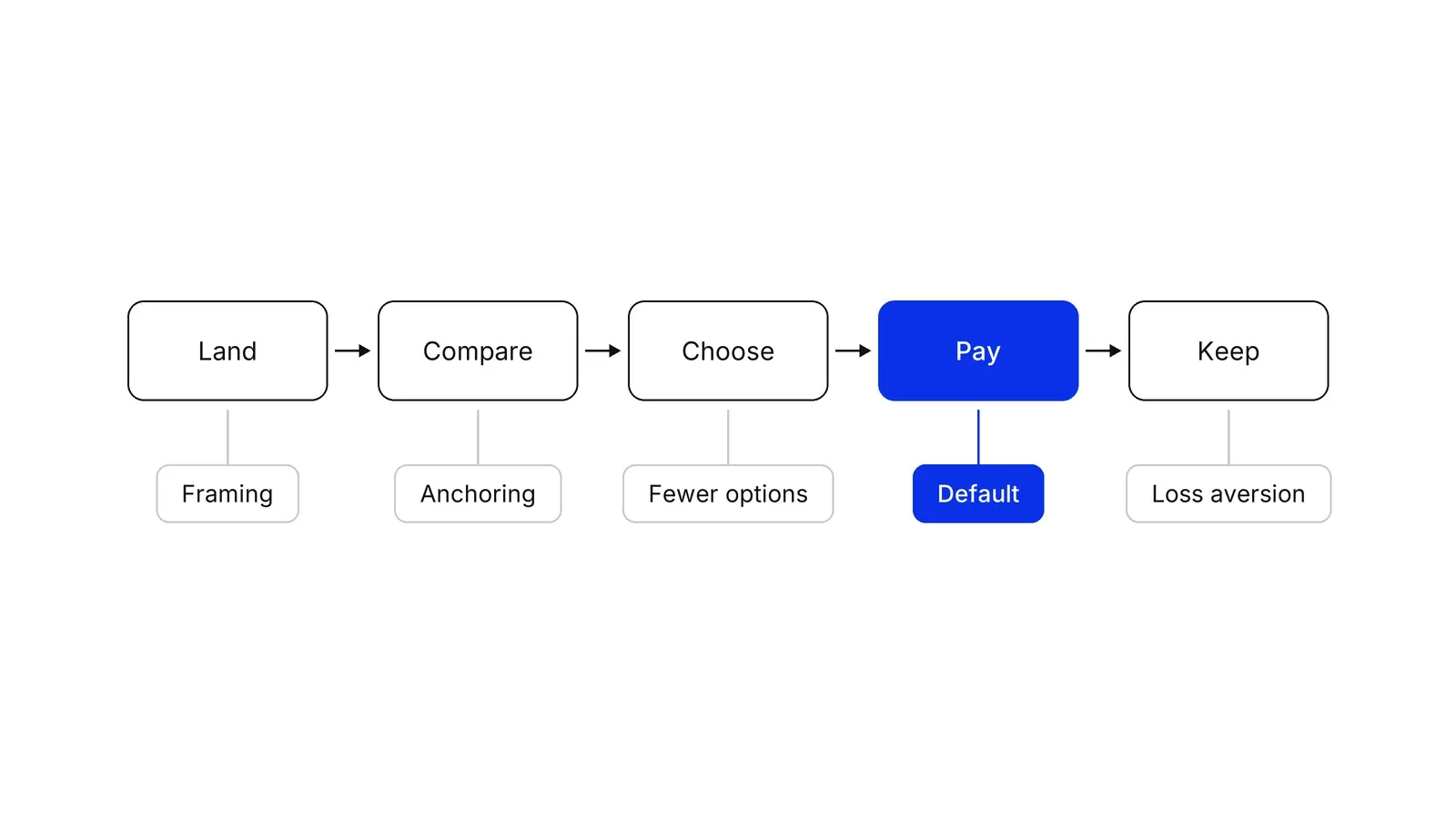
Defaults: the lever with the strongest evidence
A default is the option that applies when the person does nothing. In a 2003 Science paper, Eric Johnson and Daniel Goldstein compared organ donation across European countries: effective consent was 12% in Germany, where people must opt in, and 99.98% in Austria, where they must opt out. Countries differ in many ways, so they also ran an online experiment, where 42% agreed to donate under an opt-in framing against 82% under opt-out (Johnson and Goldstein).
Funnels use the same logic in plan selection, billing period and delivery options. The cost shows up in a well-known workplace case. After a US company switched to automatic 401(k) enrolment, participation among new hires rose from 37% to about 86%, yet 61% stayed at the default 3% contribution and default fund (Madrian and Shea). People stay where you put them, including where you put them by mistake.
The law limits this lever. The EU Court of Justice held in Planet49 that consent given through a preticked checkbox is not valid. Article 22 of the Consumer Rights Directive says a buyer who is charged extra through default options they had to reject can claim a refund.
Anchoring: the first number sets the scale
Anchoring is the pull of an earlier number on a later estimate. Tversky and Kahneman (1974) spun a wheel of fortune and asked people for the share of African countries in the United Nations: median answers were 25 after a spin of 10 and 45 after a spin of 65. The Many Labs project re-ran anchoring across 36 samples and found it among the largest effects.
Field results are more mixed. In 16 field studies of pay-what-you-want pricing, Jung, Perfecto and Nelson found that anchors worked when they sat far apart in the distribution of what people pay, low anchors moved payments more than high ones, and several factors that boost anchoring in the lab did nothing (Journal of Marketing Research, 2016). The practical lesson is to anchor inside a believable range. A Van Westendorp price sensitivity survey gives you that range, and offer architecture decides what sits next to the number.
Decoys, a cousin of anchoring, are less safe. Frederick, Lee and Baskin argued that the attraction effect may be limited to numeric product tables and fades when buyers see photos or taste the product (2014).
Loss aversion: real, but less uniform than the textbook
Loss aversion is the tendency for a loss to hurt more than an equal gain pleases. The textbook rule of thumb is about two to one. Gal and Rucker reviewed the evidence in 2018 and concluded it does not show that losses generally outweigh gains (Journal of Consumer Psychology). Mrkva and colleagues answered with five samples and 17,720 people: loss aversion appeared at every level of knowledge, but shrank with domain expertise and grew with age (2020).
In a funnel this suggests testing a message that names what the user keeps, such as saved reports at cancellation, against a neutral one. Expect an effect that varies by audience, and watch for the cancellation path turning into a maze.
Choice overload: the jam study and its sequels
Choice overload is the claim that more options can lower the chance of choosing. In the 2000 jam study by Iyengar and Lepper, 60% of shoppers stopped at a table with 24 jams and 40% at a table with 6, but 30% of the second group bought, against 3% of the first (source).
Later work did not confirm a general rule. A meta-analysis of 50 experiments found a mean effect virtually zero, with wide variation (Scheibehenne and colleagues, 2010). A 2015 meta-analysis of 99 observations found overload when the set is complex, the task hard, preferences unclear and the buyer wants to minimize effort (Chernev and colleagues). A direct mail test by a South African lender found that showing fewer example loans raised demand about as much as a 25% interest rate cut (Bertrand and colleagues). Cut options where buyers are unsure and the set is hard to compare.
Framing: same facts, different wording
Framing is the effect of describing the same outcome as a gain or a loss. Tversky and Kahneman’s 1981 paper showed choices flipping with the wording, and the gain-versus-loss framing effect was among the ten of 13 effects that held up in Many Labs. For consumers, beef described as 75% lean was rated better than beef described as 25% fat, and tasting it shrank the gap (Levin and Gaeth, 1988). A meta-analysis of attribute framing in food found a larger effect on attitudes, but an effect on intentions close to zero and not statistically significant (Dolgopolova and colleagues, 2021). Wording moves feelings more reliably than purchases.
| Lever | Typical funnel use | How well it holds up |
|---|---|---|
| Default | Preselected plan, billing period | Strongest and most consistent; legally restricted |
| Anchoring | Order and size of prices shown | Robust in the lab, weaker in field payments |
| Loss aversion | Cancellation and trial-end messages | Context dependent, debated |
| Fewer options | Plan and slot pickers | Average near zero, strong under complexity |
| Framing | Headlines, labels, value statements | Shifts attitudes more than intentions |
How big are nudge effects at scale?
A 2022 meta-analysis by Mertens and colleagues pooled more than 200 studies and reported an average effect of d = 0.45, with defaults the largest of nine techniques at d = 0.62. Maier and colleagues reanalysed the data for publication bias and got an estimate of 0.04, concluding that no evidence remained. Szaszi and colleagues agreed that large, consistent effects should not be expected, noted that effects vary widely and named defaults as the main exception. Even the sceptics find that some nudges work.
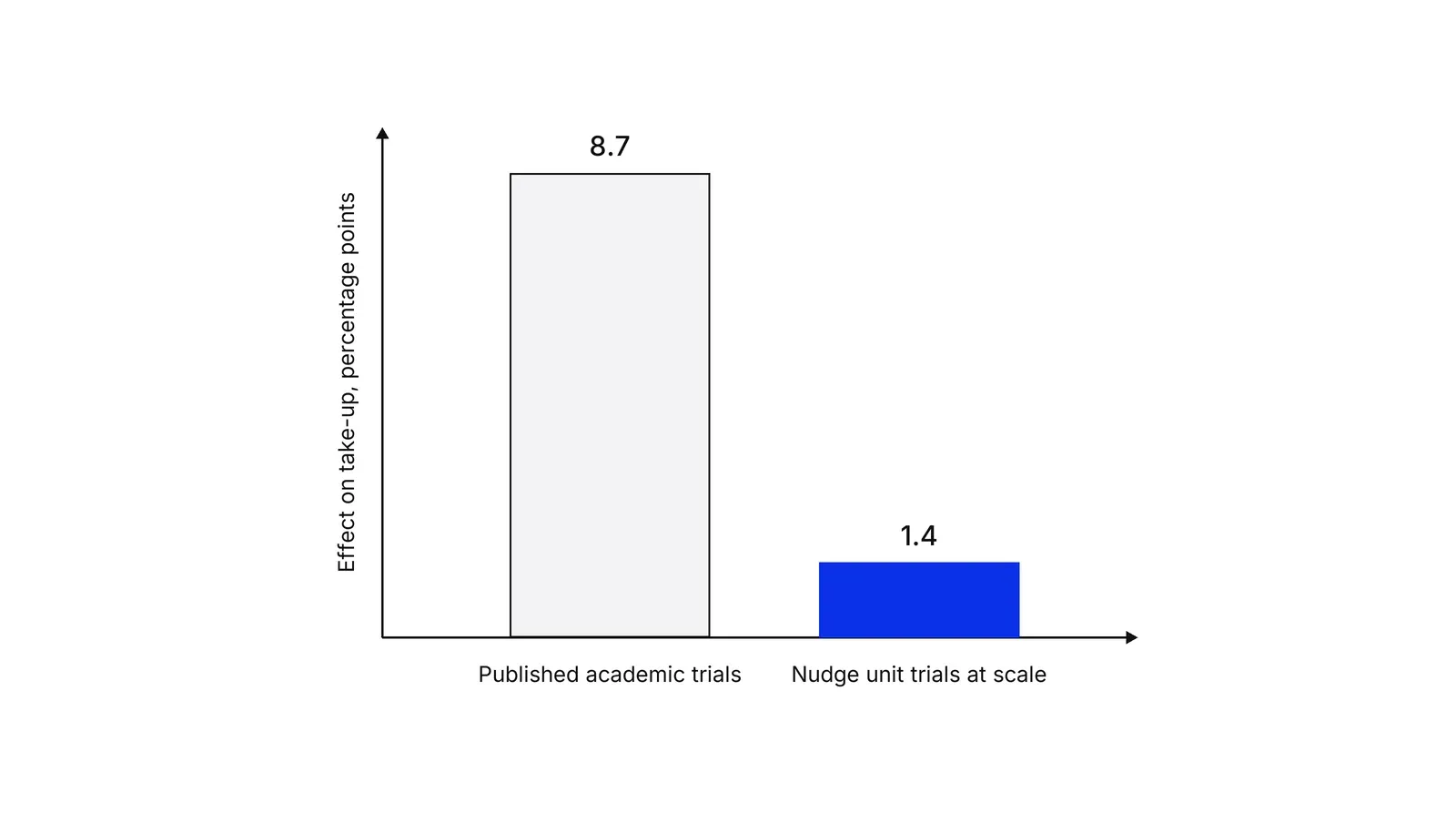
DellaVigna and Linos gathered 126 trials run by two US nudge units and compared them with published papers: 1.4 percentage points against 8.7 (Econometrica, 2022). Plan for small effects and test everything inside your CRO programme.
Where persuasion becomes a dark pattern
The FTC’s 2022 report Bringing Dark Patterns to Light lists preticked boxes, hard-to-find disclosures and confusing cancellation policies among the tricks it targets. A crawl of about 11,000 shopping sites found 1,818 dark pattern instances, and 183 sites used them deceptively (Mathur and colleagues). The same rule applies to the neighbouring levers of social proof and Cialdini’s principles: use only what is true and make the choice easy to reverse. A Growth Lab plan starts from the decision points in your funnel and adds levers one at a time (see Growth Lab).
How to apply Behavioral economics in funnels, step by step
- Map the decisions. List every step where a visitor must choose, pay, enter data or cancel, and write the drop-off at each. Behavioral levers act on decisions, not on pages. Result: a ranked list of five to eight decision points with real numbers.
- Name the likely bias at one decision. Take the worst decision point and ask what the visitor sees first, which option is preselected, how many options there are and how the wording presents the outcome. Write the hypothesis in one line: 'If we preselect the annual plan, more buyers will take it and refunds will not rise.' Result: a falsifiable hypothesis.
- Pick one lever and build the variant. Change a single thing: the default, the first price shown, the number of plans, or the wording of a message. Changing several at once hides which one worked. Result: one control and one variant that differ by one element.
- Check the legal and ethical line. Before launch, confirm that the variant gives no preticked consent, no extra paid items selected by default and no harder route to cancel. Result: a short sign-off from whoever owns consumer and privacy compliance.
- Run the test on a downstream metric. Set the primary metric before launch and make it something further down the funnel than the click: paid conversions, revenue per visitor, refunds, 90-day retention. Run it for full business cycles. Result: a readout that cannot be won with a misleading click.
- Keep, drop or re-test. Keep a lever only if the downstream metric improved. Plan to re-test winners after a few months, because published effects are often larger than effects at scale. Result: a short list of levers with measured size in your own funnel.
Examples
A dental clinic's booking flow
Illustrative. A clinic shows 14 appointment slots per day and loses visitors at the slot picker. The test shows the three earliest slots first with a 'more times' link (fewer options at the choice step) and words the reminder opt-in as 'Keep my reminders' with the box left for the patient to tick. The second change stays opt-in on purpose, because preticked consent is not valid consent in the EU. The primary metric is attended appointments, not bookings.
A B2B payments pricing page
Illustrative. A payments company sells three plans and a custom tier. The variant orders plans from highest to lowest price, so the first number the buyer reads is the largest, and preselects annual billing with a visible monthly switch. Both changes are tested against the current page, and refunds and 6-month churn are checked next to sign-ups. If annual buyers cancel at a higher rate, the preselection is dropped.
Pension enrolment, a documented case
A US company moved new hires from opt-in to automatic 401(k) enrolment. Participation among employees with 3 to 15 months of tenure was 37% before the change and about 86% after, but most of those hired under the new rule stayed at the default 3% contribution (Madrian and Shea, 2001). A default moves people to the option you set, so the default has to be one the buyer would pick on reflection.
When to use it
Use it at decision points with measurable drop-off: pricing pages, plan selection, checkout, onboarding and cancellation. It suits teams that already run A/B tests and can read downstream metrics, because every lever here is a hypothesis to test rather than a rule.
When not to use it
Skip it when traffic is too low to detect a small effect, when the real problem is the offer or the product, or when the lever would hide a cost or make cancelling harder. Fix a weak offer first. Do not use behavioral levers to compensate for one.
Common mistakes
- Treating textbook effects as guaranteed. Choice overload averaged close to zero in a 2010 meta-analysis of 50 experiments, and nudge effects at scale were far below published ones.
- Stopping at the click. A preselected plan or a loss-framed message can raise sign-ups and also raise refunds, so read revenue and retention.
- Stacking levers. Changing the default, the anchor and the copy together tells you nothing about which worked.
- Adding a decoy plan to a page with photos and real products because a textbook shows it working in a table of numbers. Frederick and colleagues found the attraction effect often disappears outside numeric lab displays.
- Crossing into dark patterns: preticked boxes, hidden costs, false urgency and long cancellation paths are the examples the FTC named in its dark patterns report.
FAQ
What is behavioral economics in marketing?
It is the use of findings on how people really decide, with shortcuts and reference points, to design pages and offers. It differs from classical economics, which assumes people weigh every option calmly. Marketers use it for defaults, anchors, framing and option count, and should test each effect in their own funnel.
Which cognitive biases matter most in a sales funnel?
Defaults have the most consistent evidence: Mertens and colleagues found them the strongest of nine nudge techniques. Anchoring is robust in lab tests, framing reliably changes attitudes, loss aversion varies by context, and choice overload depends on how complex the set is. Rank levers by evidence, then test.
Does the jam study prove that fewer choices increase sales?
No. In the 2000 Iyengar and Lepper study, shoppers who saw 6 jams bought far more often than those who saw 24. A 2010 meta-analysis of 50 experiments found an average effect near zero, and a 2015 one found overload appears when sets are complex and preferences uncertain.
Do nudges really work?
On average, a little. Mertens and colleagues reported d = 0.45, Maier and colleagues found no evidence left after correcting for publication bias, and Szaszi and colleagues saw no reason to expect large, consistent effects. Two nudge units measured 1.4 percentage points at scale, against 8.7 in published papers.
When does a nudge become a dark pattern?
When it steers people to something they would not choose if they saw the whole picture. The FTC's 2022 report names preticked boxes, hidden information and hard cancellation. In the EU, preticked consent is invalid and extra payments need express consent. Test: could the buyer explain what they agreed to?
Sources
- Daniel Kahneman, Amos Tversky, Prospect Theory: An Analysis of Decision under Risk, Econometrica 47(2), 1979
- Amos Tversky, Daniel Kahneman, Judgment under Uncertainty: Heuristics and Biases, Science 185, 1974
- Amos Tversky, Daniel Kahneman, The Framing of Decisions and the Psychology of Choice, Science 211, 1981
- Richard H. Thaler, Cass R. Sunstein, Nudge: The Final Edition, Yale University Press
- Eric J. Johnson, Daniel Goldstein, Do Defaults Save Lives?, Science 302, 2003
- Brigitte C. Madrian, Dennis F. Shea, The Power of Suggestion: Inertia in 401(k) Participation and Savings Behavior, NBER Working Paper 7682, 2000 (Quarterly Journal of Economics, 2001)
- Court of Justice of the European Union, Case C-673/17 Planet49, judgment of 1 October 2019
- European Union, Directive 2011/83/EU on consumer rights, Article 22 (additional payments)
- Richard A. Klein and others, Investigating Variation in Replicability: A Many Labs Replication Project, Social Psychology 45(3), 2014
- Minah H. Jung, Hannah Perfecto, Leif D. Nelson, Anchoring in Payment: Evaluating a Judgmental Heuristic in Field Experimental Settings, Journal of Marketing Research, 2016
- Shane Frederick, Leonard Lee, Ernest Baskin, The Limits of Attraction, Journal of Marketing Research, 2014
- David Gal, Derek D. Rucker, The Loss of Loss Aversion: Will It Loom Larger Than Its Gain?, Journal of Consumer Psychology 28(3), 2018
- Kellen Mrkva, Eric J. Johnson, Simon Gächter, Andreas Herrmann, Moderating Loss Aversion: Loss Aversion Has Moderators, But Reports of its Death are Greatly Exaggerated, Journal of Consumer Psychology 30(3), 2020
- Sheena S. Iyengar, Mark R. Lepper, When Choice is Demotivating: Can One Desire Too Much of a Good Thing?, Journal of Personality and Social Psychology 79(6), 2000
- Benjamin Scheibehenne, Rainer Greifeneder, Peter M. Todd, Can There Ever Be Too Many Options? A Meta-Analytic Review of Choice Overload, Journal of Consumer Research, 2010
- Alexander Chernev, Ulf Böckenholt, Joseph Goodman, Choice overload: A conceptual review and meta-analysis, Journal of Consumer Psychology 25(2), 2015
- Marianne Bertrand, Dean Karlan, Sendhil Mullainathan, Eldar Shafir, Jonathan Zinman, What's Advertising Content Worth? Evidence from a Consumer Credit Marketing Field Experiment, Quarterly Journal of Economics 125(1), 2010
- Irwin P. Levin, Gary J. Gaeth, How Consumers Are Affected by the Framing of Attribute Information Before and After Consuming the Product, Journal of Consumer Research 15(3), 1988
- Irina Dolgopolova, Bingqing Li, Helena Pirhonen, Jutta Roosen, The effect of attribute framing on consumers' attitudes and intentions toward food: A meta-analysis, Bio-based and Applied Economics, 2021
- Stephanie Mertens, Mario Herberz, Ulf J. J. Hahnel, Tobias Brosch, The effectiveness of nudging: A meta-analysis of choice architecture interventions across behavioral domains, PNAS 119(1), 2022
- Maximilian Maier and others, No evidence for nudging after adjusting for publication bias, PNAS 119(31), 2022
- Barnabas Szaszi and others, No reason to expect large and consistent effects of nudge interventions, PNAS 119(31), 2022
- Stefano DellaVigna, Elizabeth Linos, RCTs to Scale: Comprehensive Evidence from Two Nudge Units, Econometrica 90(1), 2022
- US Federal Trade Commission, Bringing Dark Patterns to Light, staff report, September 2022
- Arunesh Mathur and others, Dark Patterns at Scale: Findings from a Crawl of 11K Shopping Websites, ACM CSCW, 2019
Last updated Oct 9, 2026


Marketing agency or growth system: when a company outgrows its agency
An agency is the right call while the founder still runs most of the company. Once the business starts copying itself into new locations or markets, it needs a system that sets goals, tests hypotheses and owns the result.

Why healthcare marketing agencies stall: the short, mid and long wins model we use with clinics
Most agencies own the click and nobody owns the front desk. How we structure clinic work in three horizons, the research behind each one, and one year of results.

Why channel tests stall after month three
Most paid channel tests do not end with a decision. They end when the budget runs out, the attribution model changes, or everyone quietly stops looking at the dashboard.