E-E-A-T
E-E-A-T is the set of four qualities (experience, expertise, authoritativeness and trust) that Google's human search quality raters use to judge whether a page deserves trust, with trust at the centre.
E-E-A-T stands for experience, expertise, authoritativeness and trust, the criteria Google's search quality raters use to judge page quality. Trust is the most important of the four; the other three support it. Google says E-E-A-T is not a specific ranking factor, but its ranking systems use many signals meant to reward content with strong E-E-A-T, especially on health, money and safety topics.
- Origin
- Google Search Quality team, in the Search Quality Rater Guidelines, E-A-T by the mid-2010s; Experience added December 2022
- Level
- 201 · Tool
- Fits
- Startup, Small and mid-size, Scale-up
- Time to apply
- Half a day to audit ten key pages, then a standing check for every new page
- What you need
- the current Search Quality Rater Guidelines PDF, sections 2.3 and 3.4 · a list of your pages that touch health, money, safety or legal topics · named authors or reviewers who can stand behind those pages
E-E-A-T is the set of four qualities Google’s human quality raters use to judge whether a page can be trusted: experience, expertise, authoritativeness and trust. It comes from the Search Quality Rater Guidelines, a 182-page manual whose current version is dated 11 September 2025. Google works with about 16,000 external raters, according to its 2023 overview of the Rater Guidelines. SEO teams, publishers and anyone writing about health or money use the same document to check their own pages.
Where the idea came from
The concept started as E-A-T: expertise, authoritativeness and trustworthiness. SEO consultant Lily Ray dates it to the 2014 edition of the Rater Guidelines in Search Engine Journal. Google’s own record is thinner: an announcement from November 2015 says an abridged version came out in 2013 and the full manual followed in 2015.
On 15 December 2022 Google added a fourth letter. Four months earlier, the August 2022 helpful content update had already asked whether content showed “first-hand expertise”. Elizabeth Tucker’s Search Central post asked whether content shows “actual use of a product” or a visit to a place. Her example: for help filling out a tax return you want an accountant, but for reviews of tax software a forum of people who used it may serve you better.
What each letter means
Each quality has a one-line definition in section 3.4 of the Rater Guidelines. The test question below each is our paraphrase.
| Letter | Guideline definition | Test question for your page |
|---|---|---|
| Experience | The creator has “first-hand or life experience” with the topic | Did the author use, visit or live through what they describe? |
| Expertise | The creator has the knowledge or skill the topic needs | Would a professional in the field sign this? |
| Authoritativeness | The creator or site is “known as a go-to source” | Do others cite or recommend you on this topic? |
| Trust | The page is “accurate, honest, safe, and reliable” | Can a reader verify the claims and reach a real organization? |
The Rater Guidelines give a plain example for expertise: home rewiring advice from a skilled electrician beats advice from an antique homes enthusiast with no wiring knowledge. For authority, the official government passport page is the unique source on passport renewal.
Why trust sits at the centre
Trust is the member that decides the rating. The Rater Guidelines say untrustworthy pages have low E-E-A-T “no matter how” experienced or expert they seem, and give the example of a financial scam run by an expert scammer. Experience, expertise and authority count because they are evidence of trust.
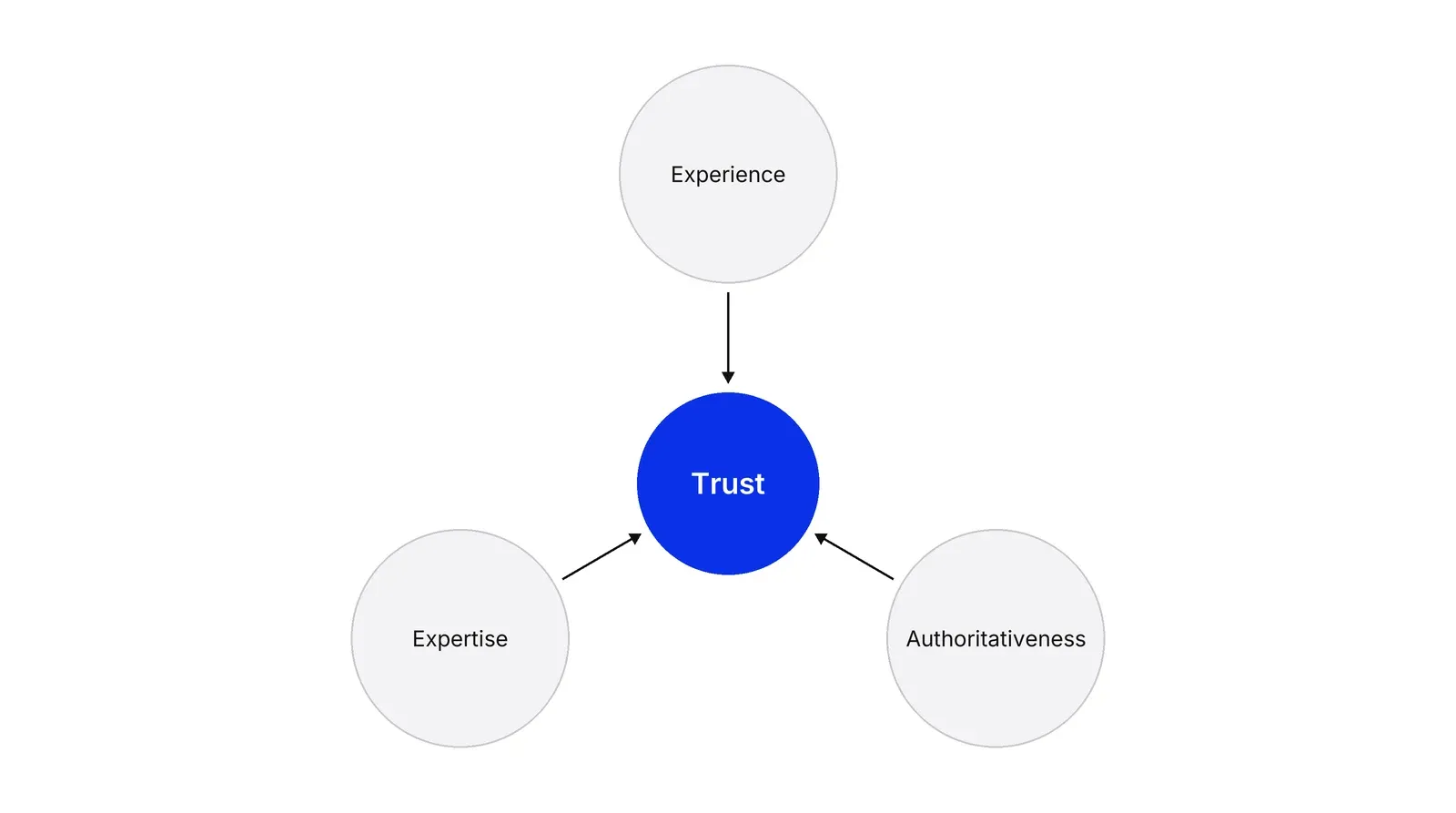
Raters gather that evidence from three places: what the site and its authors say about themselves, what independent sources say about them, and what is visible on the page. The Rater Guidelines also flag conflicts of interest. A review by someone who owns the product is valuable; a “review” by the manufacturer or a paid influencer is not, which matches the US rule on disclosing material connections in endorsements.
The same signals show up in older research on how people judge websites. Stanford’s Web Credibility guidelines, based on studies with over 4,500 people, advise making claims easy to verify, showing the real organization behind a site and making contact easy.
Is E-E-A-T a ranking factor?
No, not as a single measurable signal, and yes, as the target of many signals. Google’s page on helpful, people-first content says E-E-A-T “isn’t a specific ranking factor”, while its systems use “a mix of factors” to find content that shows it. Danny Sullivan put it the same way in 2019, as quoted by Marie Haynes: no technical thing “like with speed”, but signals act as a proxy.
The raters themselves cannot move a page. Section 0.1 of the Rater Guidelines states that no single rating can directly change how a page appears in Google. Google’s testing page counts 719,326 search quality tests and 4,781 launches in 2023, and says the ratings do not directly impact ranking. Ratings measure whether ranking systems work and supply examples for improving them; Google’s 2019 core update post compares them to feedback cards in a restaurant. Google’s disinformation paper from 2019 names PageRank, which reads links between sites, as the best known signal linked to authoritativeness. The same 2019 paper says Google ran over 200,000 experiments in 2017, leading to more than 2,400 changes to Search.
YMYL: where the bar goes up
YMYL stands for “Your Money or Your Life”: topics where a wrong page could hurt someone’s health, financial stability or safety, or the welfare of society. The Rater Guidelines split them into health or safety, financial security, government and civics, and other harm. Google says its systems give “even more weight” to strong E-E-A-T on these topics. Section 2.3 lists heart attack symptoms, investing, earthquakes, voting and driver’s licences as examples.
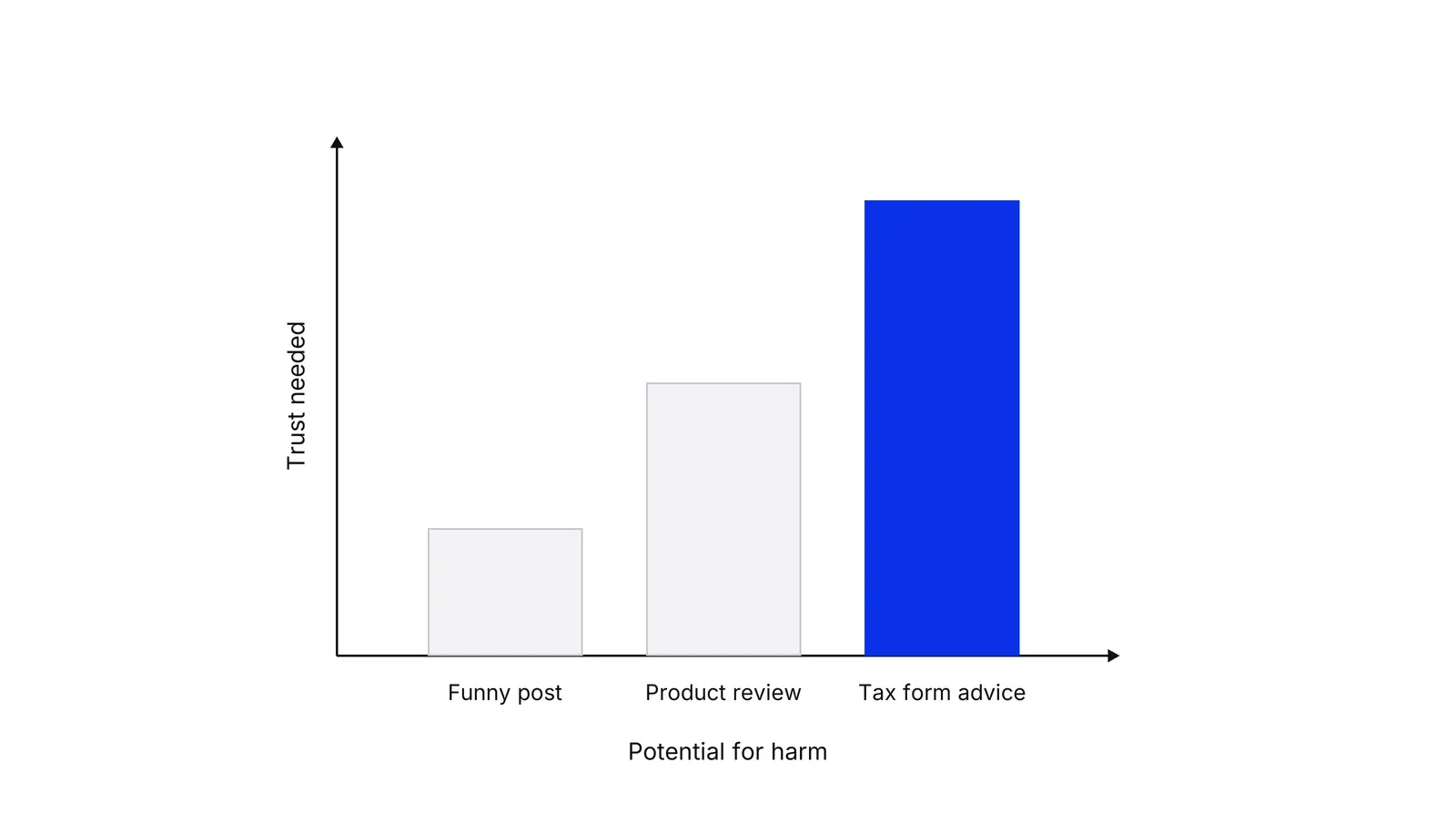
On YMYL topics, experience and expertise are not interchangeable. Section 3.4.1 of the Rater Guidelines draws the line with paired examples.
| YMYL topic | Valuable from lived experience | Best left to experts |
|---|---|---|
| Sleep in pregnancy | Safe pillow tips from people who struggled with it | Which sleep medications are safe |
| Taxes | A humorous video about the frustration of doing taxes | Instructions for filling out tax forms |
| Retirement | Reviews of retirement saving services by users | How much to save and what to invest in |
The US National Library of Medicine asks patients similar questions in its health information checklist: who runs the site, who pays for it, whether experts review the content, and whether it is up to date.
What E-E-A-T is not
| Common belief | What Google’s documents say |
|---|---|
| There is an E-E-A-T score | E-E-A-T itself is not a specific ranking factor |
| An author box fixes it | Fake or inflated author profiles are rated Lowest as deception |
| AI content is penalised | Google rewards quality “however it is produced”; mass-produced low-value pages break the scaled content abuse policy |
| Only experts count | First-hand experience can earn high E-E-A-T, even on YMYL topics, if it stays consistent with expert consensus |
| Reputation can make up for it | No positive reputation overcomes a lack of E-E-A-T for a page’s purpose |
For reviews, Google’s review guidance asks for proof of your own experience: photos, audio, measurements. In our marketing operations work we treat each YMYL page as a record with an owner, a reviewer and a review date, because trust decays when nobody checks the facts.
How to apply E-E-A-T, step by step
- Sort pages by potential harm. List your pages and mark each one that could affect someone's health, money, safety or civic rights if it were wrong. Those are YMYL pages in Google's terms, and they need the most evidence. Result: a short list of pages where trust problems would cost you the most.
- Answer who, how and why on every page. Google suggests asking who created the content, how it was made and why it exists. Add a byline that links to an author page, explain how you tested or researched the topic, including any use of AI, and cut pages that exist only to catch search traffic. Result: each page tells a stranger who stands behind it.
- Match the person to the topic. Decide whether each page needs experience or expertise. A review of a payroll app can come from someone who runs payroll every month. Advice on tax filing or drug dosage should come from, or be reviewed by, a qualified professional. Result: a named writer or reviewer with the right background for every YMYL page.
- Show the evidence on the page. Put proof where the reader can see it: your own photos and measurements in reviews, citations to primary sources for facts, dates of last review, and clear disclosure of paid relationships. Result: a reader can check the page without leaving it.
- Fix the site-level trust signals. Raters look at what you say about yourself, what others say about you and what is on the page. Publish an About page with a real address and owner, easy contact details, and customer service information for stores. Then search your brand name plus reviews to see what others say. Result: no gap between your claims and your reputation.
- Recheck after every core update. Core updates change how Google weighs pages as a whole. Wait a week after one finishes, compare traffic in Search Console, and review the pages that dropped against the Rater Guidelines. Result: a quarterly list of pages to improve, merge or remove.
Examples
A dental clinic blog
Illustrative. A clinic publishes 40 articles, 12 of them on treatments such as implants and gum disease. Those 12 are YMYL health pages. The clinic adds a named dentist as reviewer to each, with a link to a profile listing her licence and years in practice, and a 'last reviewed' date. Posts on choosing a toothbrush stay with the marketing writer, who adds photos of brushes the team actually tested. The clinic also removes an unsourced claim that whitening is 'completely safe for everyone', which a rater could read as harmful inaccuracy.
A payments startup's help centre
Illustrative. A B2B payments company writes guides on chargebacks, refunds and settlement times. These touch financial security, so each guide names the operations lead who wrote it, links to the card network rules it relies on, and states fees and timelines with a date. Opinion posts about product strategy carry less risk and need less proof. Customer support contacts and the licence number sit in the footer of every page, which covers the trust a store or financial service needs.
An affiliate review site
Illustrative. A site ranks laptops and earns commission on sales. Under Google Search Central review guidance, each review needs evidence of first-hand testing: the reviewer's own photos, battery measurements, and a comparison with the models it replaces. The site discloses affiliate links near the top, since the Rater Guidelines treat undisclosed paid promotion as a conflict of interest, and the FTC requires material connections to be disclosed.
When to use it
Use E-E-A-T as a checklist when you plan, write or audit content, especially pages on health, money, safety, law or civic topics. It is most useful after a core update hits your traffic, before launching a content program in a regulated industry, and when you brief writers or AI tools on what each page must prove.
When not to use it
Do not treat E-E-A-T as a technical score to optimise, as Google says no such score exists. Do not spend expert review time on low-risk pages such as event recaps or humour posts. It also does not fix technical problems: a page Google cannot crawl or index gains nothing from a better author bio.
Common mistakes
- Treating it as a ranking factor you can add. Google says E-E-A-T itself is not a specific ranking factor. Adding author boxes to thin pages changes nothing a reader would notice.
- Inventing authors or credentials. The rater guidelines list AI-generated author profiles and false credential claims as deception, which earns the Lowest rating.
- Expert bylines on every page. Many topics are better served by first-hand experience, and the guidelines say a forum of people who lived through a problem can be the most helpful result.
- Ignoring reputation. Raters search for what others say about you. A strong About page cannot outweigh many reviews describing fraud or unpaid refunds.
- Hiding commercial ties. Manufacturer 'reviews' and paid influencer posts count as conflicts of interest in the guidelines, and undisclosed paid endorsements also break FTC rules in the US.
FAQ
What does E-E-A-T stand for?
Experience, expertise, authoritativeness and trust. Experience is first-hand or life experience with the topic. Expertise is the knowledge or skill it needs. Authoritativeness is being known as a go-to source. Trust is whether the page is accurate, honest, safe and reliable. Google's Rater Guidelines call trust the most important of the four.
Is E-E-A-T a ranking factor?
Not directly. Google's documentation says E-E-A-T itself is not a specific ranking factor, and quality raters cannot change any page's position. Google does say its systems use a mix of signals to identify content with good E-E-A-T and give it more weight on YMYL topics. Treat it as a description of what those signals aim at.
What are the E-E-A-T factors Google looks at?
Raters judge E-E-A-T from three kinds of evidence: what the site or author says about themselves, what independent sources say about them, and what the page itself shows. Examples include named authors with relevant backgrounds, cited sources, original photos or test data, contact and customer service details, and reviews from third parties.
When did Google add Experience to E-A-T?
On 15 December 2022. Google's Search Central blog announced that its Rater Guidelines now ask whether content shows first-hand experience, such as actually using a product or visiting a place. Before that the concept was E-A-T, for expertise, authoritativeness and trustworthiness. Google published the full rater guidelines for the first time in November 2015.
Can AI-written content have good E-E-A-T?
Google says it rewards quality however content is produced, and using AI gives no special gain or penalty. The risk lies elsewhere: AI cannot supply first-hand experience, it can invent facts, and mass-producing pages with little value is scaled content abuse under Google's spam policies. Fact-check AI drafts and add what only your team knows.
Sources
- Google, Search Quality Rater Guidelines (General Guidelines), September 11, 2025
- Google Search Central Blog, Elizabeth Tucker, Our latest update to the quality rater guidelines: E-A-T gets an extra E for Experience, December 15, 2022
- Google Search Central, Creating helpful, reliable, people-first content
- Google Search Central Blog, What site owners should know about Google's August 2019 core update (with March 2020 note on E-A-T)
- Google Search Central Blog, Danny Sullivan and Chris Nelson, Google Search's guidance about AI-generated content, February 2023
- Google Search Central Blog, Mimi Underwood, Updating our search quality rating guidelines, November 19, 2015
- Google Search Central, A guide to Google Search ranking systems
- Google Search Central Blog, What creators should know about Google's August 2022 helpful content update
- Google Search Central Blog, What web creators should know about our March 2024 core update and new spam policies
- Google Search Central, Spam policies for Google web search
- Google, How Google Fights Disinformation, February 2019
- Google, How Search Works: Improving Search with rigorous testing
- Google, Search Quality Rater Guidelines: An Overview, November 2023
- Google, The Keyword, Danny Sullivan, How insights from people around the world make Google Search better, August 4, 2020
- Google Search Central, Write high quality reviews
- Google Search Central, Google Search's guidance on using generative AI content on your website
- Google Search Central, Article structured data: author markup best practices
- Google Search Central, Google Search's core updates and your website
- Stanford Persuasive Technology Lab, Stanford Guidelines for Web Credibility
- U.S. National Library of Medicine, MedlinePlus, Evaluating Internet Health Information: Checklist
- U.S. Electronic Code of Federal Regulations, 16 CFR Part 255, Guides Concerning the Use of Endorsements and Testimonials in Advertising
- Lily Ray, Google's E-A-T: Busting 10 of the Biggest Misconceptions, Search Engine Journal, October 21, 2021
- Marie Haynes, Is E-A-T a ranking factor? (quoting Danny Sullivan, October 11, 2019)
Last updated Oct 9, 2026


The compliance layer under fintech marketing operations
A fintech marketing agency can build campaigns. It cannot own the compliance review, the KYC drop-off or the multi-market licensing rules that decide whether a lead ever becomes a customer.

Fractional CMO: what you get, and what has to exist underneath
A fractional CMO brings strategy and judgment. Without reporting, CRM hygiene and a named owner per number, the engagement produces a slide deck instead of a system.

The operations layer behind healthcare patient acquisition
Ads and search bring the request in. What happens between the click and the booked, attended visit decides whether the spend paid off.