Situational leadership
Situational leadership is a management model that matches how much direction and support a manager gives to how able and committed a person is on one specific task.
Situational leadership is a model from Paul Hersey and Ken Blanchard, first published in 1969, which says no single management style fits every person. The manager chooses one of four styles, from telling to delegating, according to how able and committed the person is on one specific task. It is popular in training, but controlled studies have given it weak and mixed support.
- Origin
- Paul Hersey and Ken Blanchard, 1969
- Level
- 201 · Tool
- Fits
- Small and mid-size, Scale-up, Enterprise
- Time to apply
- 20 minutes to diagnose a team, then one conversation per person
- What you need
- a list of the people you manage and the two or three tasks each one owns now · honest evidence of recent work on each task: output, errors, questions asked · time for a short conversation with each person about how much help they want
Situational leadership is a management model that matches the amount of direction and support a leader gives to how ready a person is for one specific task. Paul Hersey and Ken Blanchard published it in May 1969 in the Training and Development Journal under the title “Life Cycle Theory of Leadership,” according to the Center for Leadership Studies (CLS), the firm Hersey founded. It builds on the Ohio State leadership studies and on William Reddin’s three-dimensional theory, as a 2000 review in Psicothema puts it. CLS says it has trained more than 15 million leaders, a figure from the vendor’s own model page that we could not check independently.
What are the four styles?
The four styles come from crossing two behaviors. Directive behavior, in CLS’s wording, means telling people what to do, how, when, where and who does it. Supportive behavior means two-way communication: listening and helping people along. High or low on each gives four boxes.
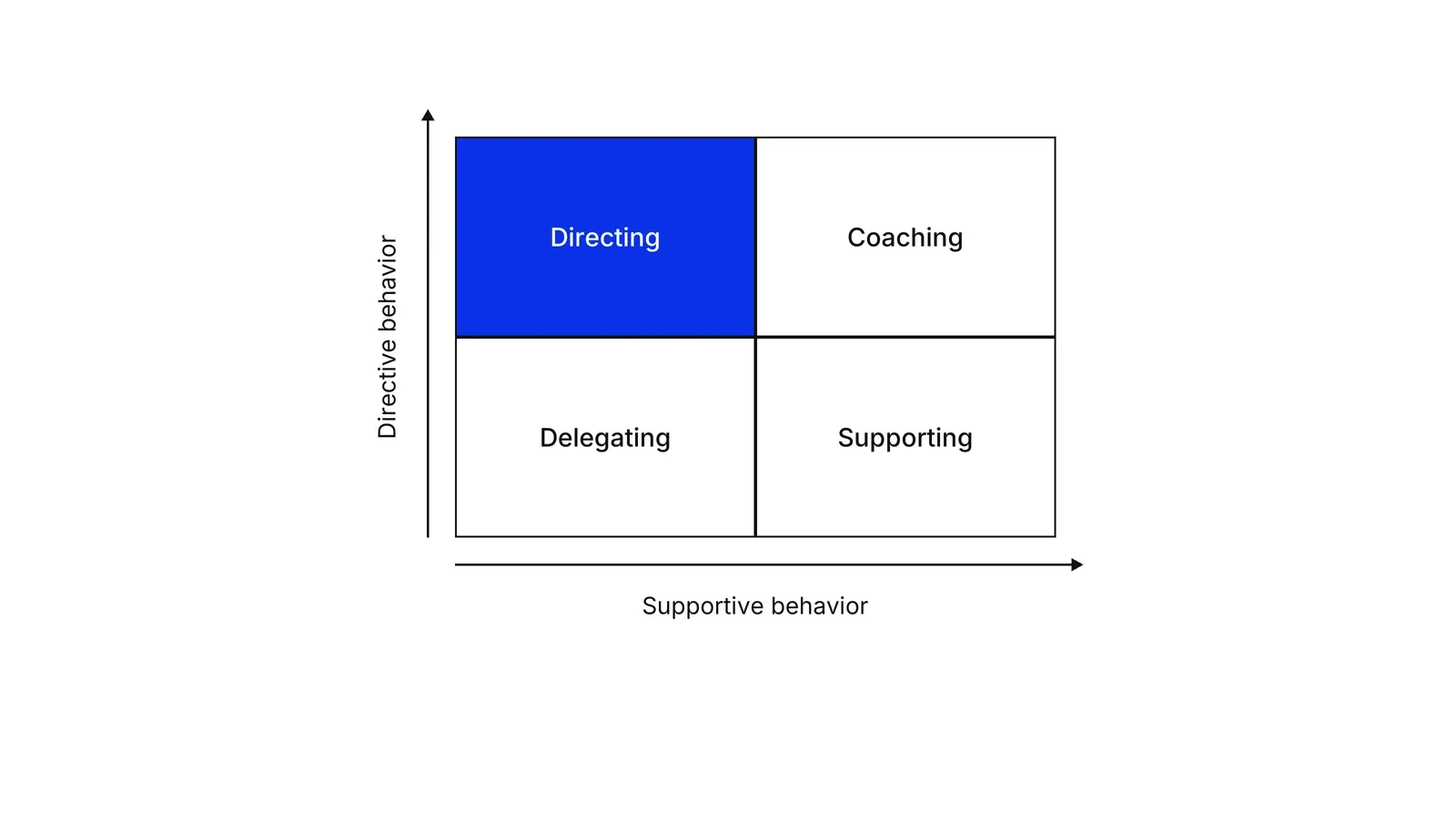
| Style | Directive | Supportive | CLS labels | SLII labels |
|---|---|---|---|---|
| S1 | High | Low | Telling | Directing |
| S2 | High | High | Selling | Coaching |
| S3 | Low | High | Participating | Supporting |
| S4 | Low | Low | Delegating | Delegating |
No style is best in general. The model says the right one depends on the person and the task.
How do you pick a style?
You pick it by rating the person’s readiness for that task: how able they are, and how confident and willing. CLS names four readiness levels, from R1, unable and insecure, to R4, able and confident. R1 matches S1, R2 matches S2, and so on up to R4 with Delegating.
Readiness belongs to the task. A manager who rates the whole person will under-direct a strong analyst on her first day with new software, and over-direct her on the report she has run for years.
Two models under one name
Situational Leadership and SLII are now two products. Both companies describe the split, so each account carries a vendor’s interest. CLS says Blanchard left in 1979 to found Blanchard Training and Development, now The Ken Blanchard Companies. A different CLS page says the early 1980s, so the date is not settled. CLS says Blanchard introduced SLII in 1985 in Leadership and the One Minute Manager, written with Pat and Drea Zigarmi.
On 23 August 2018 the two companies settled a trademark lawsuit. CLS keeps the name Situational Leadership. Blanchard’s licence to use “Situational Leadership II” ended two years later, and its model is now SLII.
| Situational Leadership (CLS) | SLII (Blanchard) | |
|---|---|---|
| Follower term | Readiness, R1 to R4 | Development level, D1 to D4 |
| Level labels | Unable and insecure, unable but confident, able but insecure, able and confident | Enthusiastic beginner, disillusioned learner, capable but cautious, self-reliant achiever |
| Development path | Dynamic, not linear or predictable, says CLS | Linear and evolutionary, says CLS’s description of SLII |
| Stated basis | Leadership research and organizational behavior | Revised after client feedback and group development research, per CLS’s summary |
The CLS points-of-distinction page argues that a beginner is not always enthusiastic and that team development is a different thing from task development. We read this as a product dispute. We found no independent test that compares the two versions.
What does the research say?
Independent tests have mostly failed to confirm the core claim that matching style to readiness raises performance. Graeff’s 1983 critique in the Academy of Management Review pointed at the vague idea of maturity and at the LEAD questionnaire used to measure style. Studies since then:
| Study | Sample | Finding |
|---|---|---|
| Vecchio, 1987 | 303 teachers, 14 high schools | Support for low maturity, partial for moderate, none for high, as summarized by Sanchez Santa-Barbara |
| Goodson et al., 1989 | Not stated in abstract | Predicted interaction not supported |
| Blank et al., 1990 | Not stated in abstract | Assumptions not supported |
| Norris and Vecchio, 1992 | 91 nurses | Direction fits theory, not significant |
| Cairns et al., 1998 | 151 senior executives | 18 matches, 126 mismatches |
| Vecchio et al., 2006 | 860 West Point cadets | No clear evidence of the predicted interaction |
| Thompson and Vecchio, 2009 | 357 employees, 80 supervisors | Revised version predicted worse than the original |
A later line of work by Thompson and Glaso is kinder. In a 2018 Norwegian study, the predictions held when leader and follower agreed on the follower’s level. A 2017 test of SLII with 573 working professionals found followers who reported a fit between needed and received style scored better on nine of ten outcomes. Both studies rely on survey ratings from the same people, so they show association, not that the style caused the result.
Our reading: the model is a useful checklist of questions and a weak predictor. The behaviors it names are only part of what Yukl’s 2012 review sorts into four meta-categories and 15 component behaviors.
Why is readiness hard to judge?
Because people misjudge it, managers included. Kruger and Dunning found that participants in the bottom quartile on tests of humor, grammar and logic placed themselves at the 62nd percentile when they scored near the 12th, in their 1999 paper. A self-rating of “I’m ready” is weak evidence, and so is a manager’s gut feeling. Compare outputs and talk it through with the person.
Where it fits in a team
For a small growth group, the question comes up each time someone changes role. A new lead in a growth team structure may need Directing on budgets and Delegating on creative. The weekly check-ins of an operating rhythm give you a regular moment to re-rate each task. A Growth Lab plan starts from who owns which workstream, and the style conversation follows from that.
How to apply Situational leadership, step by step
- Pick one task per person. Write down a concrete task, not a job title: run the weekly ad report, onboard a merchant, close a ticket queue. The model works on tasks, so a senior person can be new at one of them. Result: a list of person and task pairs.
- Rate ability and commitment on that task. For each pair, ask two questions. Can this person do the task without help? Do they have the confidence and motivation to do it well? Use recent work as evidence, not your impression of the person. Result: a rating of low or high on each question.
- Choose the style the rating points to. Unable and unsure points to Directing. Unable but keen points to Coaching. Able but unsure points to Supporting. Able and confident points to Delegating. Result: one named style per pair.
- Check your rating with the person. Describe the style you plan to use and ask how it sounds. Research on leader and follower ratings found the theory held up better when both sides agreed on the person's level. Result: an agreed level, or a known gap to discuss.
- Act the style out. Directing means a clear plan, a deadline and checkpoints. Coaching adds the reasons and invites questions. Supporting means asking before telling. Delegating means agreeing on the outcome, then staying out of the way. Result: a changed way of running the next one-to-one.
- Review at a set date. Put a date two to four weeks out to reassess the pair. When the person improves, move one step toward more freedom. When results slip, move back a step and ask why. Result: a style that follows the person's progress.
Examples
A new campaign analyst on a familiar and an unfamiliar task
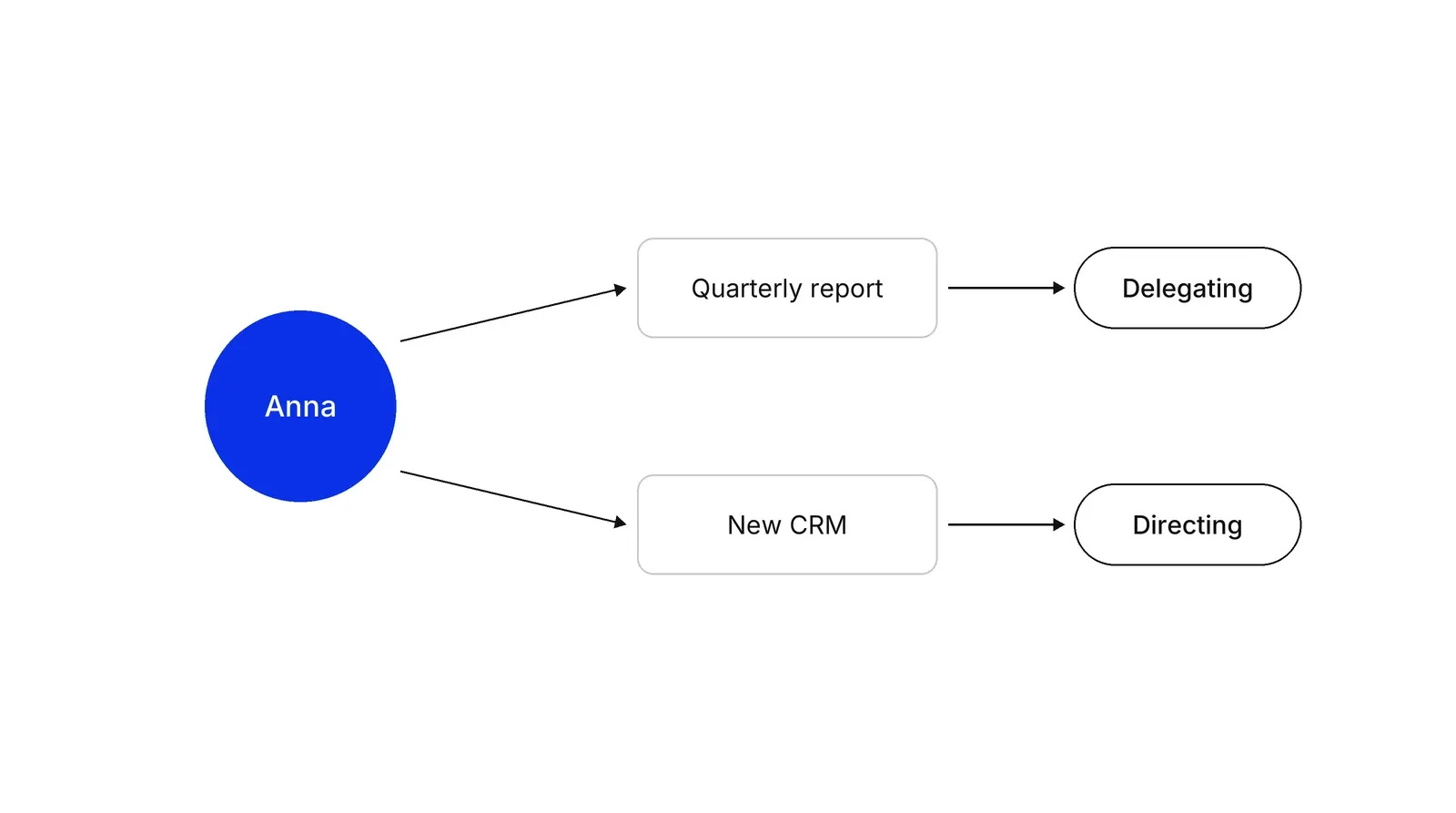
Illustrative, no real company implied. Anna has run the quarterly performance report eight times and rarely asks for help. Her manager delegates it: one line on the goal, then silence until delivery. The same week Anna starts on a new CRM. She has never used it and is excited. Her manager sits with her for the first sessions, shows the exact steps and sets a Friday check. One person, two styles, in the same week.
A payments operations team after a hire leaves
Illustrative. A cross-border payments team loses its reconciliation lead. Two analysts take over the work. One has done it before and feels unsure after a recent error, so the manager supports: listens, asks what she would do and agrees. The other has never reconciled a settlement file and is keen, so the manager directs: written checklist, daily review, a named person to ask.
A clinic front desk with a new booking system
Illustrative. A dental clinic moves to online booking. A receptionist with ten years of experience is fluent with patients but unsure of the software and worries about double bookings. The practice manager coaches: explains why the system flags clashes, demonstrates, then lets her book while she watches. A week later the same receptionist, now confident in the tool, needs only a monthly check.
When to use it
Use it when you manage people with uneven experience, such as a team that mixes veterans and new hires, or a person who is strong in one task and new to another. It gives a manager a short list of questions to ask before deciding how much to direct. It also suits conversations where someone feels micromanaged or abandoned.
When not to use it
Do not rely on it as a tested prediction of team performance, because controlled studies have not confirmed its core claim. It also says little about strategy, culture or motivation beyond the single task. When the real problem is unclear goals, a missing skill that training cannot fix or a trust break, change those first.
Common mistakes
- Rating the person instead of the task, so a strong performer in one area gets no guidance in a new one.
- Relying on your own impression of readiness, when confident people are often the ones who overrate their skill.
- Using one style on everyone because it fits your habits, which defeats the point of the model.
- Treating the four styles as a ladder to climb once, when people can slide back after a change of tool, role or pressure.
- Buying a vendor course and quoting its claims as research results, when the independent evidence is thinner.
FAQ
What are the four situational leadership styles?
The four styles combine directive and supportive behavior. Telling or Directing is high direction and low support. Selling or Coaching is high on both. Participating or Supporting is high support and low direction. Delegating is low on both. The labels differ between the Hersey and Blanchard versions, but the grid is the same.
What is the difference between Situational Leadership and SLII?
They share one 1969 origin but are separate products since Ken Blanchard left Paul Hersey's firm. The Center for Leadership Studies teaches Situational Leadership and treats development as non-linear. The Ken Blanchard Companies teach SLII, which describes a path from enthusiastic beginner to self-reliant achiever. A 2018 settlement fixed the names.
Who created situational leadership theory?
Paul Hersey and Ken Blanchard published the first version in May 1969, as the Life Cycle Theory of Leadership in the Training and Development Journal, per the Center for Leadership Studies. They built on the Ohio State leadership studies and William Reddin's work. Blanchard later developed his own version, SLII, with colleagues.
Does situational leadership theory work?
The evidence is weak. Several tests in the 1980s and 2000s did not find the predicted match between style and follower readiness, and a 2009 study of Norwegian banks found a revised version predicted worse than the original. Later work found support only when leader and follower agreed on the follower's level.
How do you tell which development level a person is at?
Ask about ability and commitment on one task, and use recent work as evidence. Do not rely on self-rating alone: in a classic study, people in the bottom quartile rated themselves at the 62nd percentile while scoring at the 12th. Comparing your view with the person's own is the better test.
Sources
- Center for Leadership Studies, Situational Leadership: Research-Based Positioning Compared to Position-Based Research (2013 white paper, vendor material)
- Center for Leadership Studies, Situational Leadership and SLII: Points of Distinction (2013, vendor material)
- Center for Leadership Studies, The History of the Situational Leadership Framework (vendor material)
- Center for Leadership Studies, Situational Leadership model overview (vendor material)
- Center for Leadership Studies, CLS and The Ken Blanchard Companies Resolve Intellectual Property Litigation, 23 August 2018
- Ken Blanchard, Drea Zigarmi, Robert B. Nelson, Situational Leadership After 25 Years: A Retrospective, Journal of Leadership Studies 1(1), 1993
- Emilio Sanchez Santa-Barbara, Teoria del liderazgo situacional en la Administracion local, Psicothema 12(3), 2000
- Claude L. Graeff, The Situational Leadership Theory: A Critical View, Academy of Management Review 8(2), 1983
- Claude L. Graeff, Evolution of Situational Leadership Theory: A Critical Review, The Leadership Quarterly 8(2), 1997
- Robert P. Vecchio, Situational Leadership Theory: An Examination of a Prescriptive Theory, Journal of Applied Psychology 72(3), 1987
- Goodson, McGee, Cashman, Situational Leadership Theory: A Test of Leadership Prescriptions, Group and Organization Studies 14(4), 1989
- Blank, Weitzel, Green, A Test of the Situational Leadership Theory, Personnel Psychology 43(3), 1990
- Norris, Vecchio, Situational Leadership Theory: A Replication, Group and Organization Management 17(3), 1992
- Cairns, Hollenback, Preziosi, Snow, A Study of Hersey and Blanchard's Situational Leadership Theory, Leadership and Organization Development Journal 19(2), 1998
- Vecchio, Bullis, Brazil, The Utility of Situational Leadership Theory: A Replication in a Military Setting, Small Group Research 37(5), 2006
- Geir Thompson, Robert P. Vecchio, Situational Leadership Theory: A Test of Three Versions, The Leadership Quarterly 20(5), 2009
- Geir Thompson, Lars Glaso, Situational Leadership Theory: A Test from Three Perspectives, Leadership and Organization Development Journal 36(5), 2015
- Geir Thompson, Lars Glaso, Situational Leadership Theory: A Test from a Leader-Follower Congruence Approach, Leadership and Organization Development Journal 39(5), 2018
- Zigarmi, Roberts, A Test of Three Basic Assumptions of Situational Leadership II Model, European Journal of Training and Development 41(3), 2017
- Gary Yukl, Effective Leadership Behavior: What We Know and What Questions Need More Attention, Academy of Management Perspectives 26(4), 2012
- Justin Kruger, David Dunning, Unskilled and Unaware of It, Journal of Personality and Social Psychology 77(6), 1999
Last updated Oct 9, 2026


Fractional COO or embedded operations team? How to choose at Series A
The two models solve different problems: how to tell which one your company needs, and what each costs in time and control.

What operational systems successful fintech startups use: lessons from ten companies
Starling, Monzo, Qonto, bunq, Lunar, Pleo, Tide, Ramp, Mercury and Column scaled on four operating systems. Regulators' findings show what breaks when one of them lags behind growth.

What a revenue operations manager actually owns
Pipeline definitions, CRM hygiene, forecasting and the handoffs between marketing, sales and success. What the role covers, and how it differs from sales ops.