MEDDIC and MEDDPICC
MEDDIC is a six-part checklist for complex B2B deals, Metrics, Economic buyer, Decision criteria, Decision process, Identify pain and Champion, that a seller keeps updating until the deal closes.
MEDDIC is a qualification method for complex B2B sales. It tracks six things about a single deal: Metrics, Economic buyer, Decision criteria, Decision process, Identify pain and Champion. A seller uses it to see which parts of a deal are proven and which are guesses, and keeps updating it until close. MEDDICC adds Competition, and MEDDPICC adds Paper process.
- Origin
- Dick Dunkel, with Jack Napoli and John McMahon, at PTC; credit is disputed, 1990s; 1996 per MEDDICC
- Level
- 301 · Advanced
- Fits
- Scale-up, Enterprise
- Time to apply
- 45 minutes to fill a first deal sheet, then 10 minutes per deal each week
- What you need
- one live deal worth the effort, with a long cycle and several people involved · notes from the last two or three calls with the buyer · a seller or manager willing to mark guesses as guesses
MEDDIC is a qualification method for complex B2B deals: a seller checks six facts about one opportunity, Metrics, Economic buyer, Decision criteria, Decision process, Identify pain and Champion, and keeps checking them until the deal closes. The point is to tell proven facts from hopes. A deal with a signed-off business case and a buyer inside who is pushing for you looks very different from one with a friendly contact and a forecast date.
BANT filters a lead once, early. MEDDIC follows the deal from the first serious call to the signature, which is why teams selling to buying groups tend to adopt it.
The six checks
Each letter is a question the seller must be able to answer with evidence from the buyer.
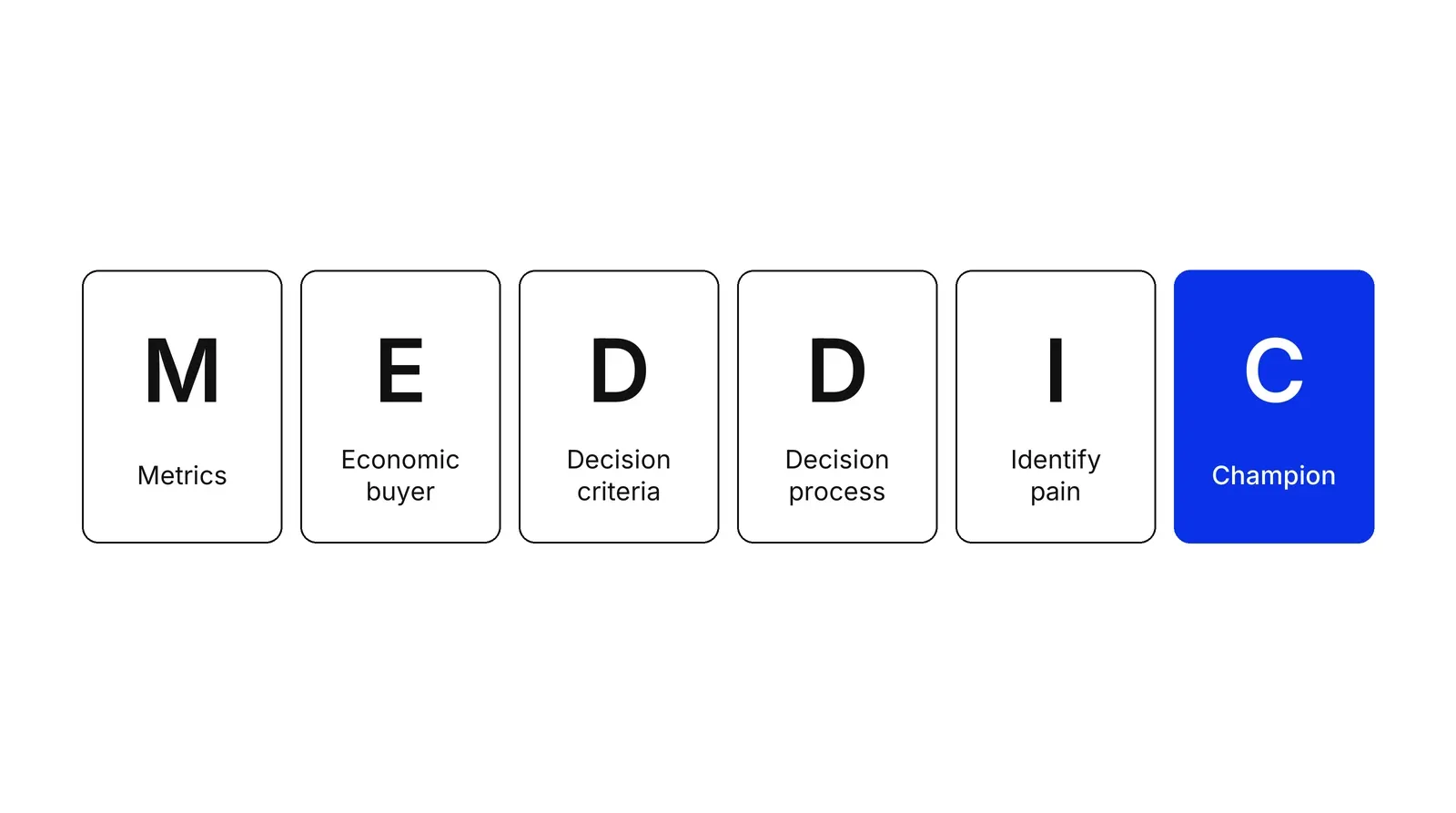
MEDDICC defines Metrics as the quantifiable measures of value your solution can provide. For the clinic group in the examples on this page, that is fewer no-shows, priced by someone in finance. The economic buyer is the person with overall authority in the buying decision. Decision criteria are the principles, guidelines and requirements the buyer uses to judge your solution, and the decision process is the series of steps the buyer will take to decide.
Identify pain means you have found a problem that is strong enough to make the buyer act. MEDDICC’s own site spells the letter out as identifying, indicating and implicating the pain, and MEDDIC Academy asks whether the pain is strong enough to drive action. The Champion is a person with power, influence and credibility inside the buyer who wants you to win. Darius Lahoutifard of MEDDIC Academy puts it as “No champion. No deal.”
The champion idea is older than MEDDIC. Korn Ferry’s page for Strategic Selling, the Miller Heiman method, lists identifying and developing coaches as a learning objective, so sellers were already told to find an ally inside the account. What MEDDIC adds is a hard test: the champion must do something for you.
From MEDDIC to MEDDICC and MEDDPICC
The extra letters came later and are still debated.
| Version | Adds | What it asks |
|---|---|---|
| MEDDIC | nothing | Do you know the six facts about this deal? |
| MEDDICC | Competition | Which alternative person, vendor or initiative could win instead? |
| MEDDPICC | Paper process | What steps follow the decision before the contract is signed? |
MEDDICC defines Competition as any alternative person, vendor or initiative, which includes doing nothing. MEDDIC Academy argues competition is already inside decision criteria, so the letter is optional.
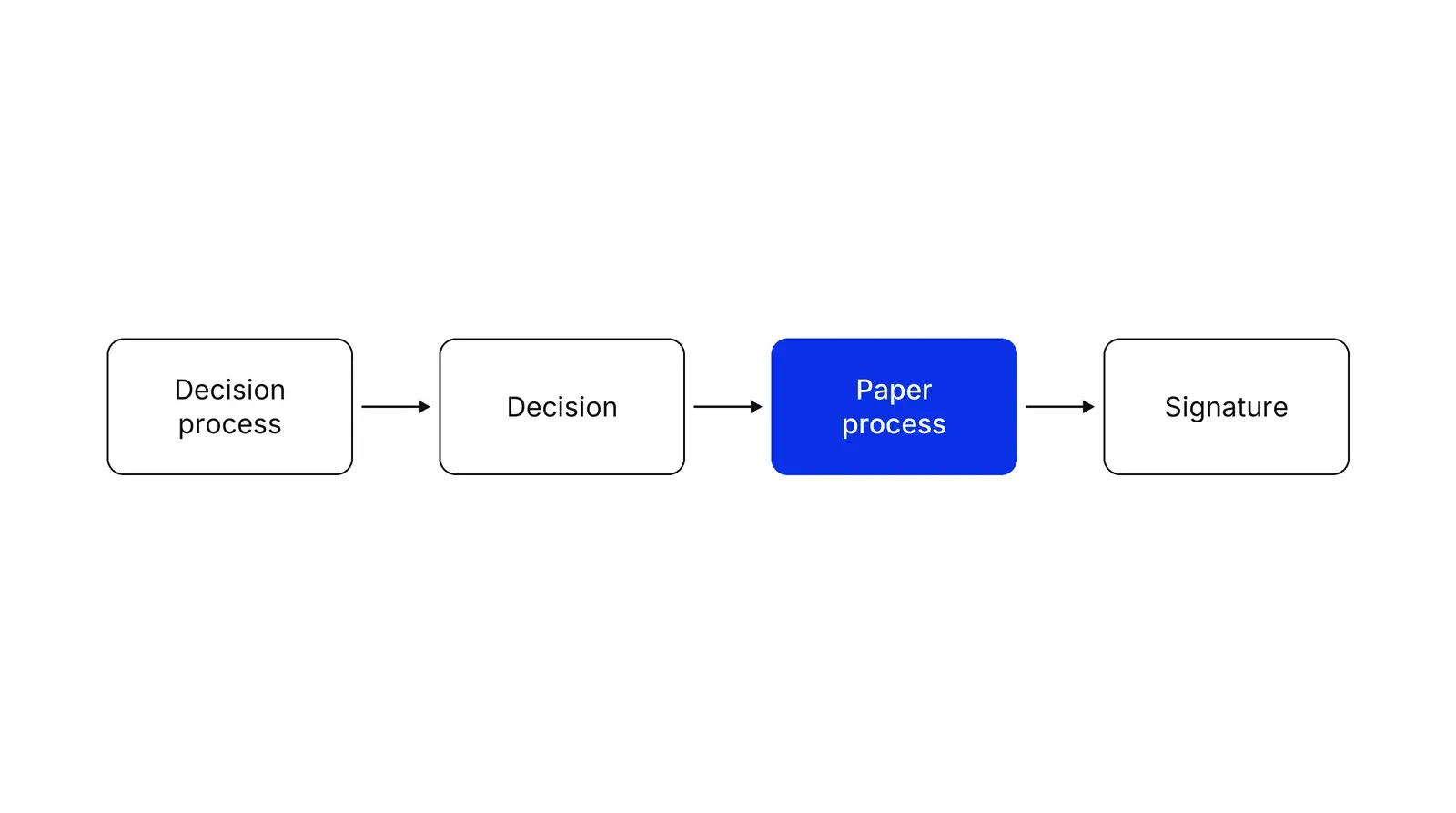
The paper process is the series of steps that follow the decision process. In practice that means security review, legal, procurement and the purchase order. MEDDIC Academy notes that a champion can speed these steps up but usually cannot change them, and advises finding out about them early.
Where MEDDIC came from, and what is disputed
The name and the company are agreed: MEDDIC comes from PTC, a software company, in the 1990s. Everything else varies by source, so here is who says what.
| Source | What it says |
|---|---|
| MEDDICC (Andy Whyte’s training company) | Created in 1996 by Dick Dunkel, working under SVP John McMahon alongside Jack Napoli |
| Dick Dunkel, interview on MEDDICC’s podcast | Built for an intermediate sales training class at PTC in Waltham, Massachusetts, after Ann Gary, head of sales development, brought him in. Class discussion of why deals are won, lost or slip produced six themes, McMahon said “Let’s run with it”, and Jack Napoli and Dale Dahlmann were on the team. Dunkel says his own part was mostly the packaging |
| MEDDIC Academy (Darius Lahoutifard) | No single creator. It came from PTC’s sales leaders in the early 1990s and was formalized later by PTC’s training facilitators |
| Salesforce blog | Credits Jack Napoli alone |
Dunkel’s interview is the nearest thing to a first-hand account. It is a transcript on the website of the company that sells MEDDICC training, so it is not independent. We could not find an account in Napoli’s own words, so what is said about his role comes from Dunkel and from others.
The year is also soft. Dunkel says in that interview that MEDDIC “turns 25 this spring”; the episode is listed in April 2021, which fits 1996, but he does not state the year himself.
What the PTC growth numbers show
MEDDICC’s history page says MEDDIC helped take PTC’s sales organization from $0 to $1 billion in ten years, and that attrition became a serious threat once the team reached roughly 300 reps. PTC’s own filings with the US Securities and Exchange Commission give the revenue path below. The fiscal 1996 10-K lists the first five years, and the fiscal 1998 10-K405 shows the year PTC passed $1 billion.
| PTC fiscal year (ends 30 September) | Total revenue, per PTC’s 10-K |
|---|---|
| 1992 | $98.4 million |
| 1993 | $179.3 million |
| 1994 | $267.0 million |
| 1995 | $394.3 million |
| 1996 | $600.1 million |
| 1998 | $1,018.0 million, per the 1998 10-K405 |
The 1998 figure follows the Computervision acquisition. These are company revenue, not sales organization numbers, and nothing in the filings credits a qualification method. Treat “MEDDIC built a billion-dollar sales team” as a marketing story, not a measured result.
Why it fits how companies buy
A complex purchase is made by a group. Forrester’s 2026 State of Business Buying puts the typical decision at 13 internal stakeholders and nine external influencers, and says both numbers rise for complex or strategic purchases. Forrester also finds procurement professionals are decision-makers in 53% of buying cycles, which is why the paper process matters. Older research by Brent Adamson and Matthew Dixon found 5.4 stakeholders on average, so the number depends on the study and the year. MEDDIC’s economic buyer and champion rows exist to find the few people who matter in that crowd.
Gong Labs, the research arm of a sales analytics vendor, studied 1.8 million new-business deals from 2024. It found 77% were multi-threaded, closed-won deals had about twice as many buyer contacts as deals that did not close, and large strategic wins averaged 17 contacts. That is correlation: larger deals involve more people, and promising deals may attract more of them. It supports not relying on one contact. It does not show that adding contacts causes wins.
How MEDDIC differs from BANT and SPIN
| BANT | SPIN Selling | MEDDIC | |
|---|---|---|---|
| What it is | An early filter on a lead | A way to ask questions in a conversation | An inspection of a whole deal |
| When | Before a rep invests time | During discovery calls | From first serious call to close |
MEDDICC’s own comparison says BANT can serve SDRs and inside sellers as an early filter, and teams often hand the opportunity to a seller who works it with MEDDICC. SPIN Selling supplies questions that fill the pain and metrics rows. Where the deal sits in the pipeline is covered in sales process stages, and the handoff from marketing in MQL and SQL.
A Growth Lab plan for a sales team starts from agreeing what evidence a deal needs before it moves to the next stage.
How to apply MEDDIC and MEDDPICC, step by step
- Pick the deals that deserve it. Apply MEDDIC to deals with several decision-makers and a cycle of months, not to small deals that close in a call or two. Result: a short list of deals, usually the top ten by value.
- Draw the sheet with one row per letter. Make a one-page sheet with a row for Metrics, Economic buyer, Decision criteria, Decision process, Identify pain, Champion, and Paper process and Competition if you use the longer versions. Each row has two columns: what you know, and how you know it. Result: an empty sheet that cannot be filled with opinions.
- Fill it from evidence and mark the gaps. Write only what the buyer has said or shown, with the date. Anything you assumed goes in a separate list called gaps. Result: a sheet where blanks are visible.
- Test the champion. A champion has power, influence and credibility inside the buyer, in MEDDICC's definition. Ask this person for something that costs them effort: an intro to the economic buyer, or the real decision criteria. Result: either a proven champion or a friendly contact who is only a coach.
- Reach the economic buyer through the champion. Agree with the champion how to meet the person who controls the budget, and what you will bring: a number the buyer cares about. Result: a booked meeting, or a clear answer that you cannot get one.
- Work backwards from the target date. Write every step of the decision process and, after it, the paper process: security review, legal, procurement, signature. Put a date and an owner on each. Result: a timeline that shows whether the close date is believable.
- Review gaps every week. In each pipeline review, ask only about the gaps and what will close them this week. Result: a list of next actions per deal, and a clear signal when a deal has too many gaps to forecast.
Examples
A software vendor selling a booking system to a clinic group
Illustrative. A group of 12 clinics sees 6,000 appointments a month, and 9% are no-shows. Metrics: cutting no-shows from 9% to 6% saves 180 appointments a month, which the finance director can price. Economic buyer: the group's managing director, not the clinic manager who asked for the demo. Champion: the operations lead, who agrees to introduce the vendor and to share the real criteria. Decision process: a pilot at two clinics, then the board. Paper process: a data protection review and a signed processing agreement, which the vendor books in week one rather than week ten. The deal sheet shows one gap, no access yet to the managing director, so that becomes the week's task.
A payments provider selling to a marketplace
Illustrative. A marketplace pays out to 3,000 sellers a month and spends 4 hours per payout run on reconciliation. Pain: late payouts cause seller complaints, and the head of finance has said the quarter-end close is delayed by them. Decision criteria: the compliance team requires a licensed partner, and engineering requires an API with test mode. Competition: the marketplace's own bank. The vendor's sheet shows the compliance review has not started, so the paper process is the real risk to the date.
When to use it
Use it for deals with several decision-makers, a cycle of months and a price that justifies preparation. It suits scale-ups and enterprise teams whose forecast depends on a few large deals, and managers who need a shared language for inspecting them.
When not to use it
Skip it for high-volume sales that close in one conversation, where a short filter such as BANT is enough. Skip it as a form that reps fill in for their manager rather than a tool for their own thinking. It does not teach discovery questions; SPIN Selling covers that.
Common mistakes
- Treating it as a script. MEDDICC's own guidance says a scripted checklist "feels like an interrogation". Use the letters to prepare and to review, and let the conversation follow the buyer.
- Naming a friendly contact as the champion. A contact who likes you but has no power or will not spend effort for you is a coach, and a deal with only a coach is single-threaded.
- Confusing the economic buyer with the person who signs. The economic buyer controls the money, and the signature can sit with legal or procurement, which is why the paper process exists.
- Filling every row with assumptions. Each entry needs a source and a date, or it belongs in the gaps list.
- Using it only at the end of the quarter. It works as a weekly habit, because gaps found early are cheap to close.
FAQ
What does MEDDIC stand for?
Metrics, Economic buyer, Decision criteria, Decision process, Identify pain and Champion. MEDDICC adds a second C for Competition, and MEDDPICC adds a P for Paper process. Some teams read the I as Implicate the pain, which MEDDICC's own site uses.
Who created MEDDIC?
Sources disagree. MEDDICC, the training company, credits Dick Dunkel at PTC under John McMahon, with Jack Napoli, dating it to 1996. Dunkel himself says he mainly packaged ideas from colleagues. MEDDIC Academy says it had no single creator and came from PTC's early-1990s sales leaders.
What is the difference between MEDDIC and MEDDPICC?
MEDDPICC adds two letters to MEDDIC: Competition, any alternative person, vendor or initiative, and Paper process, the steps between the buyer's decision and the signature. MEDDIC Academy says competition is already covered by decision criteria, so the letters are a choice about emphasis, not a different method.
How is MEDDIC different from SPIN Selling?
SPIN Selling is a way to ask questions in a conversation so the buyer states the need. MEDDIC is a way to inspect a whole deal: what you know about the money, the people and the process. A seller can use SPIN questions to fill in MEDDIC's pain and metrics rows.
Is MEDDIC only for enterprise sales?
It is built for complex deals with several decision-makers, which is why Force Management describes enterprise sellers as its audience. For a deal that closes in one call, it is more preparation than the deal needs. Many teams use BANT at the lead stage and switch to MEDDIC once a real opportunity exists.
Sources
- MEDDICC (Andy Whyte's company), Who created MEDDIC? The history behind the framework
- MEDDICC, MEDDIC / MEDDPICC sales methodology and process
- MEDDICC, MEDDICC versus other qualification frameworks like BANT
- MEDDICC, Andy Whyte, MEDDICC: The Ultimate Guide to Staying One Step Ahead in the Complex Sale (book page)
- Masters of MEDDICC, episode 4 with Dick Dunkel, interview transcript
- Masters of MEDDICC, episode 4 listing, Dick Dunkel: the inventor of MEDDIC (Buzzsprout)
- Masters of MEDDICC, episode 5 listing, John McMahon (Buzzsprout)
- Corporate Visions, The Emblazers podcast episode 3: Dick Dunkel on keeping sales qualification simple
- Flowstate Sales, Who invented MEDDIC? Interview with creator Dick Dunkel
- MEDDIC Academy (Darius Lahoutifard), Everything you ever wanted to know about MEDDIC and MEDDPICC
- MEDDIC Academy, MEDDIC sales methodology and checklist
- MEDDPICC.net, MEDDPICC definition and timeline
- Force Management, MEDDICC sales qualification methodology
- Salesforce blog, MEDDIC sales methodology
- Dave Kellogg, Kellblog, The Qualified Sales Leader: a must-read book for product-oriented founders
- Parametric Technology Corp, Form 10-K for fiscal 1996, US SEC
- Parametric Technology Corp, Form 10-K405 for fiscal 1998, US SEC
- Korn Ferry, Strategic Selling with Perspective (Miller Heiman Group)
- Forrester, The State of Business Buying 2026, press release, January 2026
- Gong Labs, Dan Morgese, Data shows top reps don't just sell, they orchestrate, April 2025
- Gong, The data-backed guide to multi-threading and team selling
- DestinationCRM, Required Reading: Selling to Influencers (Brent Adamson and Matthew Dixon on The Challenger Customer)
Last updated Oct 9, 2026


Marketing agency or growth system: when a company outgrows its agency
An agency is the right call while the founder still runs most of the company. Once the business starts copying itself into new locations or markets, it needs a system that sets goals, tests hypotheses and owns the result.

Why healthcare marketing agencies stall: the short, mid and long wins model we use with clinics
Most agencies own the click and nobody owns the front desk. How we structure clinic work in three horizons, the research behind each one, and one year of results.

Why channel tests stall after month three
Most paid channel tests do not end with a decision. They end when the budget runs out, the attribution model changes, or everyone quietly stops looking at the dashboard.