Rumelt's strategy kernel (Good Strategy / Bad Strategy)
Richard Rumelt's kernel says every good strategy has three parts, a diagnosis of the challenge, a guiding policy for dealing with it and coherent actions that carry it out, and it gives you four signs for spotting a bad one.
Rumelt's strategy kernel is the three-part structure that UCLA professor Richard Rumelt set out in Good Strategy/Bad Strategy (2011): a diagnosis that names the critical challenge, a guiding policy that sets the overall approach to it, and coherent actions that work together to carry the policy out. He pairs it with four hallmarks of bad strategy: fluff, failure to face the challenge, mistaking goals for strategy, and bad strategic objectives.
- Origin
- Richard P. Rumelt, 2011 (term bad strategy coined 2007)
- Level
- 301 · Advanced
- Fits
- Small and mid-size, Scale-up, Enterprise
- Time to apply
- half a day for a first draft of the kernel, then one session to test it against the four hallmarks
- What you need
- an honest account of what is going wrong or what stands in the way, with the numbers behind it · the current strategy document or plan, if one exists, to test against the hallmarks · one leader with the authority to choose one approach and drop the others
Rumelt’s strategy kernel is a test of whether a plan is a strategy at all. Richard Rumelt, a strategy professor at UCLA Anderson, argues that every good strategy contains three parts: a diagnosis of the challenge, a guiding policy for dealing with it, and coherent actions that carry the policy out. Anything missing one of the three is, in his terms, bad strategy, however polished the document looks.
He set out the idea in a June 2011 McKinsey Quarterly article, “The perils of bad strategy”, adapted from his book Good Strategy/Bad Strategy, published by Crown in July 2011. The book made the 2011 Financial Times and Goldman Sachs Business Book of the Year shortlist. In the same article Rumelt says he coined the term bad strategy in 2007, at a Washington seminar on national-security strategy, and his examples range from Nvidia to the US Army in Iraq.
Rumelt built the idea on decades of research. A 2007 McKinsey Quarterly interview credits him with the first statistical link between corporate strategy and profitability in 1972. His 1991 paper in the Strategic Management Journal found that business-unit effects explain far more of the differences in profit than industry membership does. If what a company does matters more than where it competes, then how it decides what to do matters a great deal.
What are the three parts of the kernel?
The kernel is diagnosis, guiding policy and coherent action, in that order. In the book’s introduction, Rumelt calls it the essential logical structure of a good strategy. Each part depends on the one before it: actions only make sense against a policy, and a policy only makes sense against a diagnosis.
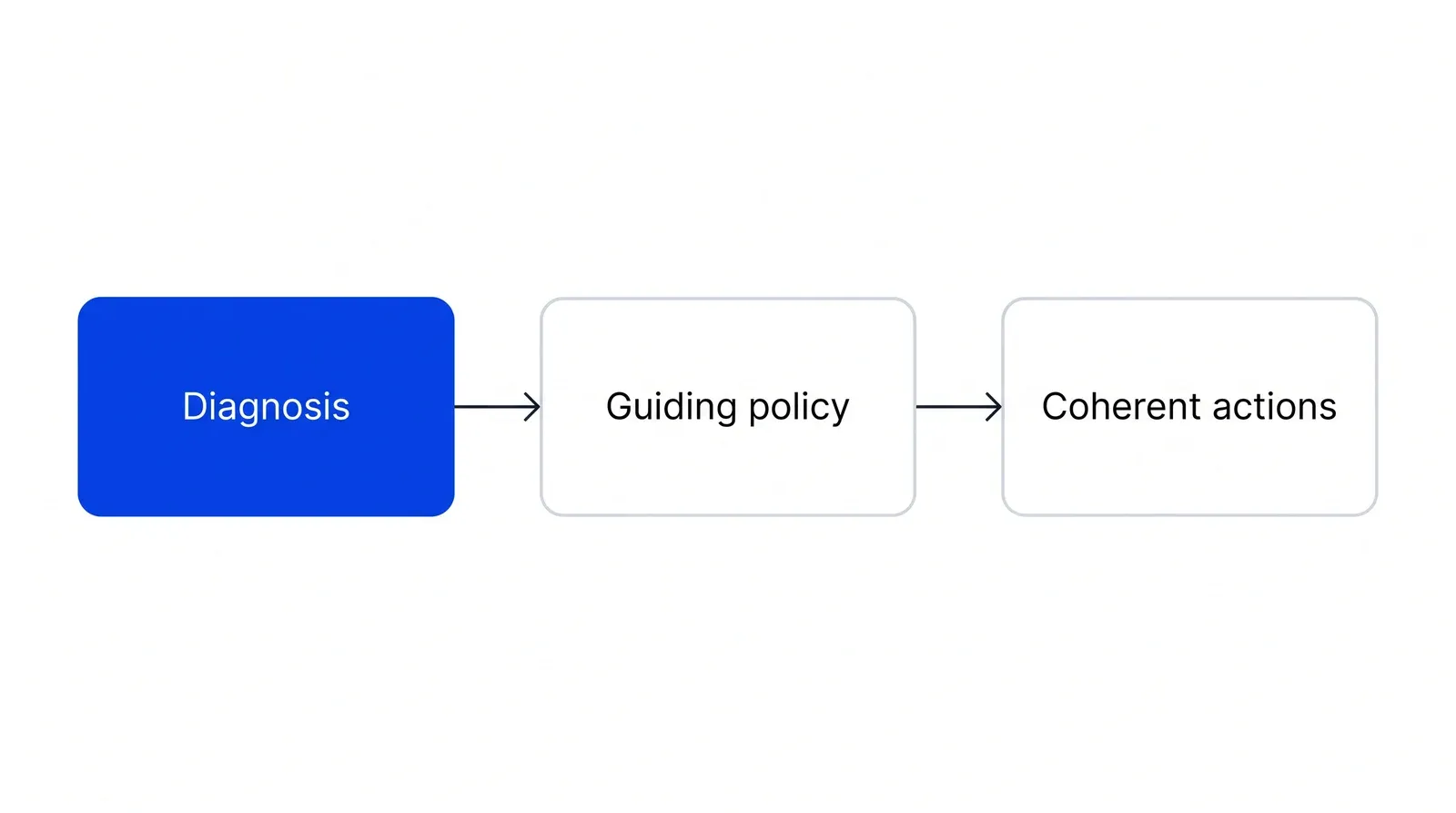
| Part | What it answers | Nvidia, as Rumelt tells it |
|---|---|---|
| Diagnosis | What is really going on, and which part of it matters most? | “We are losing the performance race” to 3Dfx |
| Guiding policy | What overall approach will we take? | Ship a new chip every 6 months, against the industry’s 18 |
| Coherent actions | What specific, coordinated moves carry it out? | Three overlapping development teams, heavy simulation, control of driver software |
Diagnosis
A diagnosis explains the nature of the challenge. Rumelt’s McKinsey article says a good one simplifies a complicated situation by picking out the few aspects that are critical. This is the step most plans skip. A plan that opens with “grow revenue 20%” has stated an ambition and said nothing about what is in the way.
Guiding policy
A guiding policy is the overall approach chosen to overcome the obstacles in the diagnosis. Rumelt compares it to a signpost: it marks the direction without describing every step of the trip. A good policy rules options out. Nvidia’s choice of a six-month cycle meant it would not compete by spreading effort across many product types.
Coherent actions
Coherent actions are the policies, resource commitments and moves that carry out the guiding policy, and they must support one another. Michael Porter makes a related point in “What Is Strategy?”: advantage comes from activities that fit together, and rivals cannot copy a whole system as easily as one part of it. A list of unrelated initiatives, however sensible each one is, fails this test.
The four hallmarks of bad strategy
Bad strategy is more than the absence of good strategy. Rumelt condensed its signs into four hallmarks, each with a case in his 2011 article.
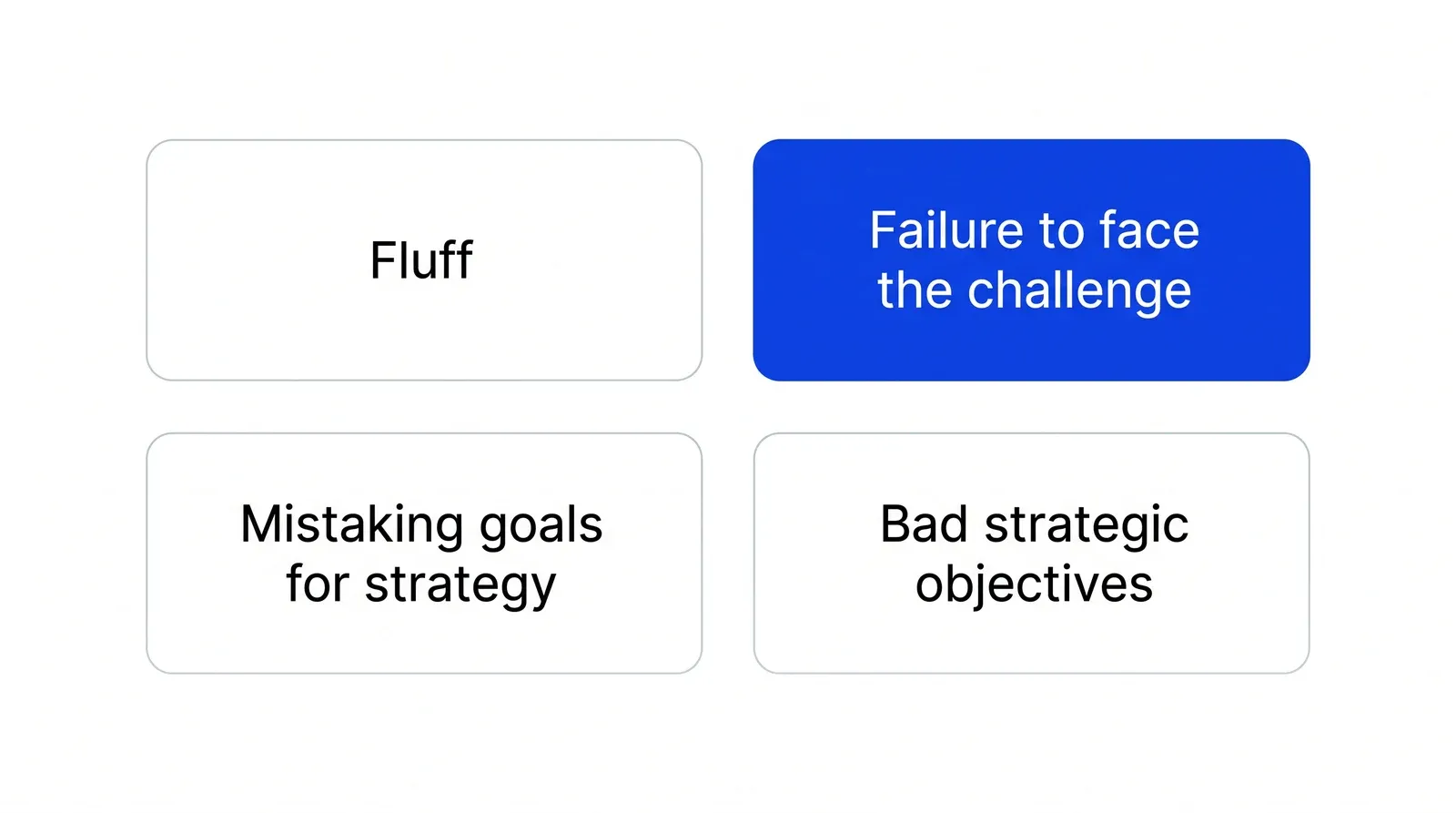
| Hallmark | What it looks like | Rumelt’s example |
|---|---|---|
| Fluff | Buzzwords restating the obvious | A bank whose strategy was “customer-centric intermediation”, which means being a bank |
| Failure to face the challenge | The real problem is never named | International Harvester’s 1979 plan ignored poor plants and labor relations |
| Mistaking goals for strategy | Targets and willpower in place of a plan | A CEO’s “20/20 plan”: 20% annual growth and a 20% margin, with no account of how |
| Bad strategic objectives | A long list of things to do, or blue-sky targets as hard as the problem | A city plan with 47 strategies and 178 action items, one of which was to create a strategic plan |
The last hallmark has a positive mirror. Good objectives are close enough to reach with the resources an organization already has. Rumelt devotes a chapter of the book to these proximate objectives, opening with Kennedy’s goal of landing on the moon.
Why is bad strategy so common?
Rumelt gives two main causes. The first is the inability to choose. In 1992 he watched executives at Digital Equipment Corporation split three ways between hardware systems, customer solutions and chips. Asked to reach consensus, they settled on a statement that DEC would provide high-quality products and be a leader in data processing, which committed the company to nothing. Rumelt connects the deadlock to Condorcet’s voting paradox and to the work of Kenneth Arrow, who shared the 1972 Nobel economics prize and is known for showing that individual preferences cannot always be combined into a fair group choice. DEC agreed to a takeover by Compaq in January 1998.
The second cause is template-style planning: fill in a vision, a mission, a set of values and some aspirations labelled as strategies. Rumelt says corporations, school boards and government agencies adopted this format widely. Henry Mintzberg made a related argument about formal planning in Harvard Business Review in 1994, and Roger Martin returned to it in “The Big Lie of Strategic Planning” in 2014.
How the kernel compares with other strategy frameworks
The kernel describes what a finished strategy must contain. Other frameworks describe which choices to make. They work well together, as the table shows.
| Framework | Core question | What it adds to the kernel |
|---|---|---|
| Rumelt’s kernel | Is this a strategy or a wish list? | A test for any plan |
| Playing to Win (Lafley and Martin) | Where to play and how to win | Five linked choices, from aspiration to management systems |
| Strategy diamond (Hambrick and Fredrickson, 2001) | Do we have answers on arenas, vehicles, differentiators, staging and economic logic? | A checklist of choices a complete strategy covers |
| Porter’s generic strategies | Lowest cost or a premium, broad or narrow? | The source of competitive advantage |
Limits of the kernel
The kernel tells you a diagnosis is needed but gives little method for finding it. Rumelt’s later book, The Crux (2022), addresses that gap by asking leaders to find the part of a challenge that is both solvable and offers the most progress.
The evidence for the kernel is a set of cases, not a statistical study, and the cases are read with hindsight. Rumelt admits as much: he writes that good strategy almost always looks simple and obvious in retrospect. Treat the kernel as a strong discipline for writing and reviewing strategy, not as a proven predictor of results. In Pushers’ Growth Lab work, the diagnosis step comes before any channel plan or budget.
How to apply Rumelt's strategy kernel (Good Strategy / Bad Strategy), step by step
- Write down the challenge, not the goal. Describe what stands between the organization and where it needs to be, in two or three sentences. Leave targets such as revenue growth out of this step. Result: a short statement of the obstacle that the whole team recognizes as true.
- Diagnose the critical part. Of everything that is going wrong, pick the one or two factors that explain most of it and that you can do something about. Test the diagnosis by asking what evidence would prove it wrong. Result: a one-paragraph diagnosis that names the critical factor and says why it matters more than the rest.
- Choose a guiding policy. Pick one overall approach to the diagnosed problem and write down the alternatives it rules out. A guiding policy that rules nothing out is still a goal. Result: one sentence stating the approach, plus a short list of options you are deliberately setting aside.
- Design actions that reinforce each other. List the concrete moves that carry out the policy: budgets, hires, process changes, product decisions. Check that each one makes the others more effective and that none of them pulls against the policy. Result: three to six coordinated actions with owners and dates.
- Set near-term objectives you can reach. Turn the first actions into objectives the team can achieve with the resources it already has, in weeks or months. Rumelt calls these proximate objectives. Result: a short list of objectives that are hard but clearly feasible.
- Test the result against the four hallmarks. Read the draft looking for fluff, a missing or vague challenge, goals dressed as strategy, and long or unreachable objective lists. Rewrite any part that fails. Result: a kernel that fits on one page and survives a skeptical reader.
Examples
Nvidia's six-month release cycle
Rumelt's own worked example in McKinsey Quarterly (2011). After Nvidia's first product failed and rival 3Dfx took the lead in 3D graphics chips (1995), the diagnosis was that the company was losing the performance race. The guiding policy was to release a faster chip every six months instead of the industry's usual 18. The coherent actions were three development teams on overlapping schedules, heavy investment in simulation and emulation to avoid delays, and taking back control of driver software from board makers. Rumelt reports that Intel entered discrete 3D graphics (1998) and left a year later, while 3Dfx's creditors started bankruptcy proceedings against it (2000).
International Harvester's 1979 plan
Rumelt's example of failure to face the problem. The company's 1979 corporate strategic plan combined five divisional plans and aimed to raise market share in each business and cut costs, with a profit forecast shaped like a hockey stick. It did not mention what Rumelt calls the real problem: inefficient plants and the worst labor relations in US industry, which had held margins at about half of competitors' for years. After a six-month strike the company sold off businesses, and the truck division became Navistar.
A clinic group with falling repeat visits (illustrative)
Illustrative, no real company implied. A group of four dental clinics sets a goal of 15% growth and a list of 30 initiatives. A kernel rewrite starts with the diagnosis: most first-time patients never book a second visit because no one schedules the follow-up before they leave. Guiding policy: every first visit ends with a booked next appointment. Coherent actions: the front desk books it at checkout, the scheduling system holds slots for follow-ups, and the clinic tracks second-visit rate weekly. The other 27 initiatives wait.
When to use it
Use the kernel when a leadership team has a plan full of goals but cannot say how it will reach them, when an annual planning cycle produces a long list of initiatives, or when a business faces one hard problem (a stronger rival, falling retention, a regulatory change) and needs a focused answer. It also works as a review tool: read any strategy document and check whether it contains a diagnosis, a policy and coordinated actions.
When not to use it
It helps little when the problem is purely operational and the fix is already known, since there is nothing to diagnose. It also does not replace industry or competitor analysis: the kernel tells you what a finished strategy must contain, not how to gather the facts for the diagnosis, which is where tools such as five forces or a SWOT come in.
Common mistakes
- Writing a goal such as 20% growth in the diagnosis slot. A diagnosis explains what is in the way; a target only says where you want to be.
- Choosing a guiding policy so broad that it excludes nothing, such as being customer-focused, which turns the kernel back into fluff.
- Listing actions that are each sensible but do not support one another, so the plan becomes a to-do list with a strategy label on it.
- Asking a large group to agree on the policy by consensus. Rumelt's DEC case shows how a group with conflicting views settles on a statement that commits to nothing.
- Treating the kernel as a template to fill in once. Rumelt presents a strategy as a hypothesis, so the diagnosis should be revisited when the evidence changes.
FAQ
What is the kernel of good strategy?
It is Richard Rumelt's name for the logical structure every good strategy shares. It has three parts: a diagnosis that explains the nature of the challenge, a guiding policy that sets the overall approach to it, and coherent actions that are coordinated to carry that policy out. Rumelt introduced it in his 2011 book Good Strategy/Bad Strategy.
What are the four hallmarks of bad strategy?
Rumelt lists fluff, which is buzzwords that hide the lack of thought; failure to face the challenge; mistaking goals for strategy; and bad strategic objectives, either a long list of things to do or blue-sky targets as hard as the original problem. He says he condensed the list from discussions with senior executives after 2007.
What is the main idea of Good Strategy Bad Strategy by Richard Rumelt?
The book argues that most documents called strategy are really goals, visions or slogans. A good strategy honestly names the main obstacle and gives a focused, coordinated way to overcome it. Rumelt sets out the kernel, explains why bad strategy is common, and describes sources of power such as proximate objectives, chain-link systems, design, focus and advantage.
What is the difference between a goal and a strategy?
A goal states where you want to be, such as doubling revenue. A strategy explains how you will get there given the obstacles in the way. Rumelt calls mistaking goals for strategy a hallmark of bad strategy: a plan built only on targets leaves the hard part, deciding what to do, to someone else.
How is The Crux different from Good Strategy Bad Strategy?
The Crux, a 2022 PublicAffairs title, builds on the earlier book. It asks leaders to focus on challenges rather than goals and to find the crux: the part of a challenge that is both solvable and offers the most progress. In practice it extends the diagnosis step of the kernel.
Sources
- Richard Rumelt, The perils of bad strategy, McKinsey Quarterly, June 2011
- Richard P. Rumelt, Good Strategy/Bad Strategy, Crown, 2011, Penguin Random House book page
- Profile Books, Good Strategy/Bad Strategy, preview: contents and introduction (PDF)
- UCLA Anderson School of Management, Richard Rumelt faculty page
- Hachette Book Group, Richard Rumelt, The Crux: How Leaders Become Strategists, PublicAffairs, 2022
- McKinsey Quarterly, Strategy's strategist: An interview with Richard Rumelt, November 2007
- LSE, Good Strategy/Bad Strategy: the difference and why it matters, public lecture by Richard Rumelt, 20 October 2011
- Publishers Weekly, Shortlist announced for Financial Times Business Book of the Year, September 2011
- Richard P. Rumelt, How much does industry matter?, Strategic Management Journal 12(3), 1991, IDEAS record
- Michael E. Porter, What Is Strategy?, Harvard Business Review, November-December 1996
- Henry Mintzberg, The Fall and Rise of Strategic Planning, Harvard Business Review, January-February 1994
- Roger L. Martin, The Big Lie of Strategic Planning, Harvard Business Review, January-February 2014
- Donald Sull, Rebecca Homkes, Charles Sull, Why Strategy Execution Unravels, and What to Do About It, Harvard Business Review, March 2015
- Harvard Business Review Press, A.G. Lafley and Roger Martin, Playing to Win, expanded edition
- Donald C. Hambrick, James W. Fredrickson, Are You Sure You Have a Strategy?, Academy of Management Executive 15(4), 2001
- Academy of Management, AOM Today, Strategy questions plague CEOs (the strategy diamond), August 2025
- Chris Bradley, Martin Hirt, Sven Smit, Have you tested your strategy lately?, McKinsey Quarterly, January 2011
- NVIDIA, Corporate timeline
- Digital Equipment Corporation, Form 8-K on the merger agreement with Compaq, January 1998, SEC EDGAR
- NobelPrize.org, Kenneth J. Arrow, Facts, Prize in Economic Sciences 1972
Last updated Oct 9, 2026


Marketing agency or growth system: when a company outgrows its agency
An agency is the right call while the founder still runs most of the company. Once the business starts copying itself into new locations or markets, it needs a system that sets goals, tests hypotheses and owns the result.

Why healthcare marketing agencies stall: the short, mid and long wins model we use with clinics
Most agencies own the click and nobody owns the front desk. How we structure clinic work in three horizons, the research behind each one, and one year of results.

Why channel tests stall after month three
Most paid channel tests do not end with a decision. They end when the budget runs out, the attribution model changes, or everyone quietly stops looking at the dashboard.