Monetizing Innovation
Monetizing Innovation is Simon-Kucher's method for pricing a new product before it is built: ask customers what they would pay while the product is still a concept, then design the product around that answer.
Monetizing Innovation is a product-development method from Madhavan Ramanujam and Georg Tacke of Simon-Kucher & Partners, set out in their 2016 Wiley book. It says to measure customers' willingness to pay while the product is still a concept, then decide features, packaging and price from that evidence, instead of building first and pricing at launch.
- Origin
- Madhavan Ramanujam and Georg Tacke (Simon-Kucher & Partners), 2016
- Level
- 301 · Advanced
- Fits
- Startup, Scale-up
- Time to apply
- two to three weeks for a first round of customer conversations on one concept
- What you need
- a product concept described in a page or a mockup, before specs are final · access to 15 to 30 people who could realistically buy it · a product owner and a commercial owner in the same room
Monetizing Innovation is a method for pricing a new product before it exists. Madhavan Ramanujam and Georg Tacke, both of the pricing consultancy Simon-Kucher & Partners, set it out in a 2016 book from Wiley with the subtitle “How Smart Companies Design the Product Around the Price.” Ramanujam is a partner and board member in the firm’s Silicon Valley office, and Tacke is its co-CEO. Wiley’s press release says its lessons come from the firm’s thirty years and more than 10,000 projects.
The claim is simple: find out what customers will pay for specific features while the product is still a concept, and build only what that evidence supports.
Price first, then product
Most teams design, build and launch, and only then set a price. The method reverses the order: the first conversation with customers is about money, and the answer shapes the specification.
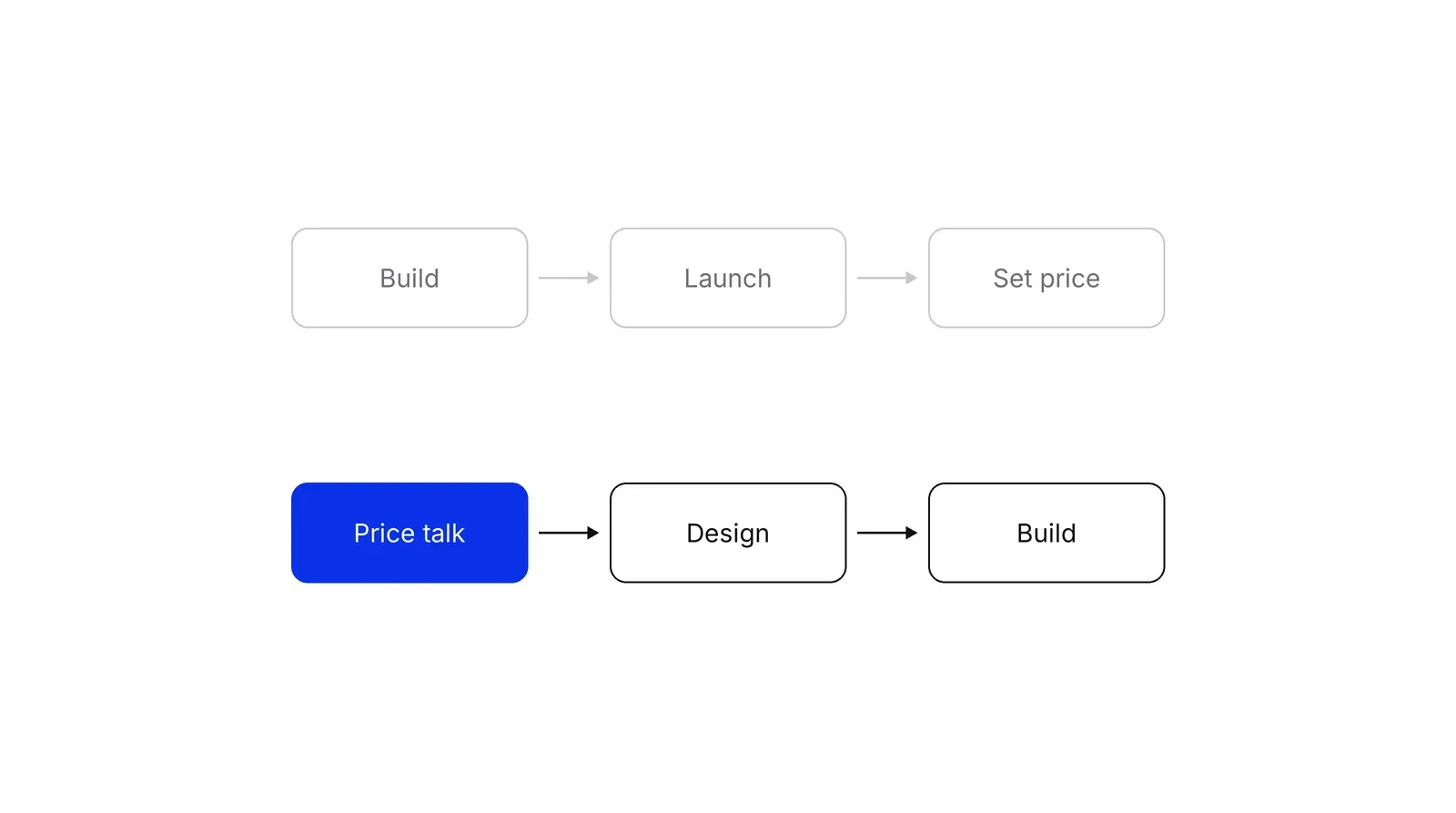
Tacke argues in Founding Fuel that this means asking target customers at the start of innovation, not adding every feature and hoping pricing fixes the result. He also says monetization is a leadership responsibility, since someone has to make engineering and marketing work from the same evidence.
Where does the 72% come from?
The book’s headline number is that 72% of innovations miss their financial targets or fail entirely. It appears in Wiley’s description and Simon-Kucher’s own pages, and none of them gives a sample or a definition of failure.
The nearest source is a 2014 Harvard Business Review piece, which reports that 72% of all new products do not meet their revenue targets. First Round Review attributes the number to a 2014 Simon-Kucher study. A mirrored copy of the HBR piece describes a biennial survey run with the Professional Pricing Society, with about 1,600 executives and managers in over 40 countries. We could not find the questionnaire, so the figure rests on self-reported answers from the authors’ own survey.
Other researchers dispute the wider claim. Castellion and Markham argue in the Journal of Product Innovation Management that the popular “80% of new products fail” idea is a myth, and cite empirical studies since 1977 putting failure at 40% or less. Their abstract does not mention Simon-Kucher’s number, and the two measure different things: missing a target is not the same as failing. Read 72% as “most launches in the authors’ survey underperformed their own plan.”
Four ways innovations fail
Simon-Kucher names four failure types, each a mismatch between product and price.
| Type | What happens | Typical fix |
|---|---|---|
| Feature shock | Too many features, none that stand out, and a price that is too high | Segment customers, build tiers |
| Minivation | Right product for the market, priced too low | Test price sensitivity, raise price |
| Hidden gem | A strong idea never properly brought to market, often because it sits outside the core business | Give it its own owner and budget |
| Undead | A product customers do not want, built before anyone asked | Ask about willingness to pay before engineering and stop if no price works |
The Fire phone, for which Amazon’s 10-K records $170 million of charges, is Ramanujam’s example of feature shock; he also cites an Asus mini-notebook at €299 as a minivation that sold out. These are his readings of public events.
The willingness-to-pay talk
The central practice is the willingness-to-pay talk. Ramanujam describes it in First Round Review: show the concept, then ask what price would be acceptable, what would be expensive, and what would be prohibitively expensive. Acceptable suits a growth goal. Expensive is a price buyers would pay but dislike. Prohibitive marks the ceiling where they walk away.
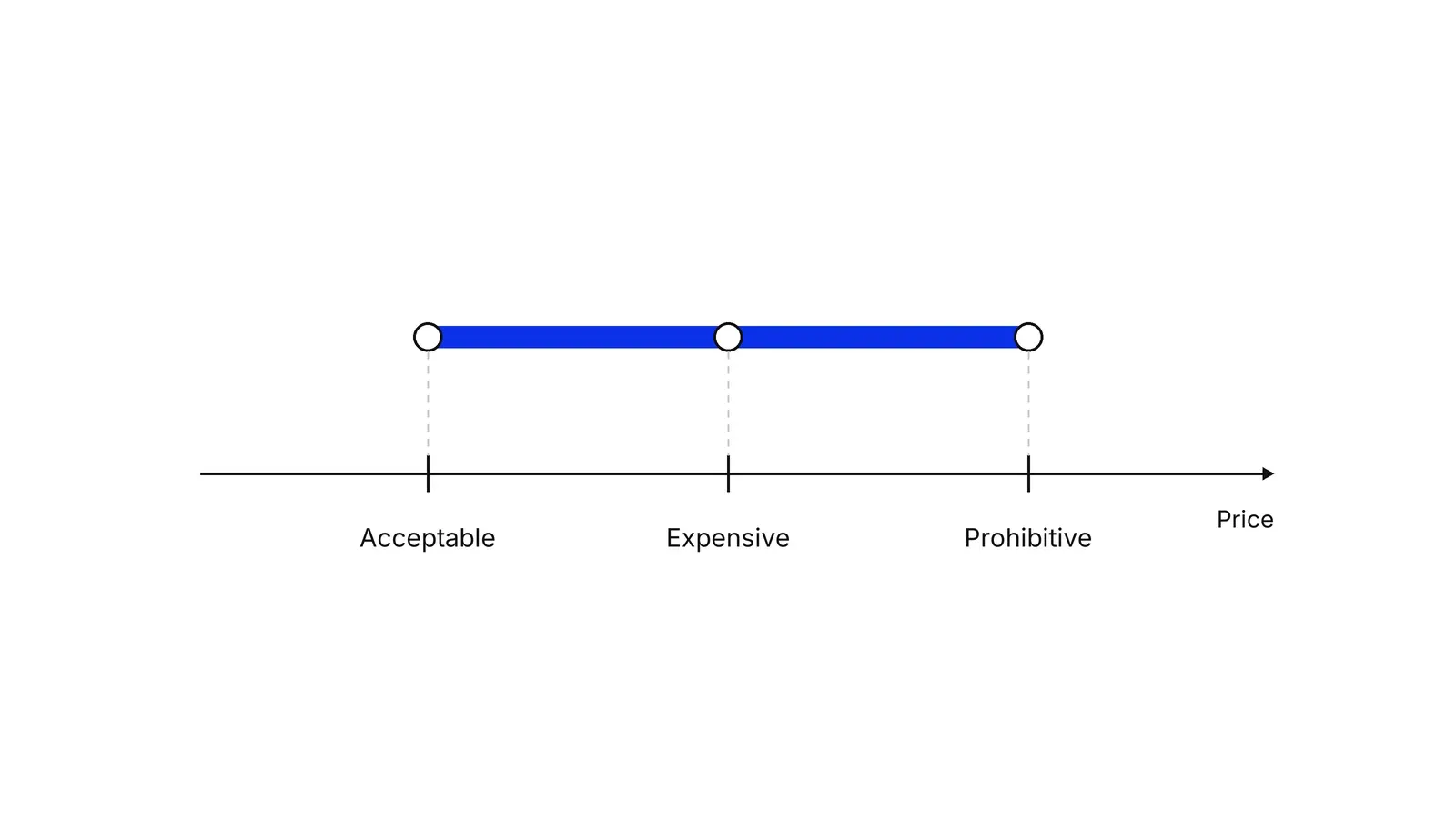
Run across many customers, the answers show price cliffs, where demand drops sharply, and psychological thresholds, such as $51 losing buyers that $49.99 keeps. The questions resemble the Van Westendorp price sensitivity meter, which asks four related questions and plots where the curves cross.
Nine rules
Simon-Kucher summarises the method in nine rules: hold the willingness-to-pay conversations before building; segment customers; decide features and bundles from needs and willingness to pay; choose the monetization model; set a pricing strategy with goals and reaction rules; build an outside-in business case; communicate value, with marketing and sales involved early; use psychological pricing that has been tested; and keep price integrity by trying at least three non-price actions before cutting price.
Bundling and packaging link to offer architecture, and the early-stage logic overlaps with finding product-market fit.
How to measure willingness to pay
Simon-Kucher advises using direct questioning only as a supplement to indirect techniques. Direct methods, such as asking an open price question or running Van Westendorp or Gabor-Granger, are fast. Indirect methods, led by conjoint analysis, infer value from the trade-offs people make between feature bundles at different prices; MaxDiff ranks which features matter most.
Academic work is cautious about all of it. Miller, Hofstetter, Krohmer and Zhang compared four willingness-to-pay methods against real purchase data and found that incentive-aligned approaches had a slight advantage, with the best method depending on the market. Hofstetter and colleagues report that the plain direct question suffers hypothetical bias, though a corrected version proved accurate enough for decisions in two studies.
What the evidence does not show
The method comes from a consultancy, and the book’s evidence is the firm’s own project record. We found no independent trial that compares teams using the nine rules with teams that do not. John Gourville of Harvard Business School adds a different reason new products fail: buyers resist changing their behavior, whatever the price. A price tested on a concept does not measure that resistance. A Growth Lab plan starts from the same discipline, putting the revenue question next to the build question before budget is committed (Growth Lab).
How to apply Monetizing Innovation, step by step
- Write the concept in the buyer's words. Describe what the product does, for whom and what it replaces, in a page or a mockup. Leave the price off. Result: one concept sheet that a buyer can read in two minutes.
- Have the willingness-to-pay talk. Show the concept to target customers and ask what price would be acceptable, what would be expensive, and what would be so expensive they would reject it. Result: three price answers per person, noted separately.
- Split the answers by segment. Group respondents by who they are and what they need, because willingness to pay differs between groups. Result: a price range per segment, not one average.
- Test which features carry the price. Use a method such as conjoint analysis or MaxDiff to see which features raise the price customers accept and which only add cost. Result: a short list of features to build, bundle or drop.
- Choose how you will charge. Decide the model (subscription, usage, one-off, free tier) and the price level together, since the model changes how buyers read the price. Result: a charging model with a target price per segment.
- Build the business case from outside in. Estimate value, price, cost and volume from customer evidence, then ask for a go or no-go. Result: a decision to build, change the concept or stop.
Examples
Amazon's Fire phone
[Amazon's 10-K](https://www.sec.gov/Archives/edgar/data/0001018724/000101872415000006/amzn-20141231x10k.htm) records $170 million of charges in the third quarter of 2014, primarily for Fire phone inventory and supplier commitments. Ramanujam files it under feature shock, a product loaded with features none of which stood out, with a price to match. Whether a willingness-to-pay test would have caught it is his reading, not something the filing says.
A payments startup testing a settlement feature
Illustrative, no real company implied. A cross-border payments startup wants to add same-day settlement for online pharmacies. Before engineering starts, the team shows the concept to 20 pharmacy finance managers and asks for acceptable, expensive and prohibitive fees. If most answers cluster around a fee that does not cover the extra cost of fast settlement, the team learns that before writing code.
A dental clinic pricing a membership plan
Illustrative, no real clinic implied. A clinic with 400 patients a month considers a yearly membership covering cleanings and check-ups. It describes the plan on one page, asks 25 regular patients what yearly price feels acceptable, expensive and out of the question, and sorts the answers by patients who come twice a year and those who come once. Two plans at two prices may fit better than one.
When to use it
Use it before committing build budget to a new product, a new tier or a new pricing model, and when a launched product sells but margins stay thin or sales never push back on price. It fits teams where engineering has been deciding the roadmap and nobody owns the revenue question.
When not to use it
Skip it for small tweaks to a mature product with years of sales data, where live price tests tell you more. It also adds little when you have no target customers to talk to yet, in which case product-market fit work comes first.
Common mistakes
- Asking customers what they would pay only after the specification is frozen, when the answer can no longer change the product.
- Averaging all answers into one price instead of reading them by segment, which hides the group that would pay far more.
- Treating stated prices as final. Customers answering a survey face no real purchase, so use the answers to find a range and confirm with a price test.
- Leaving the commercial owner out of the innovation team until launch week.
- Quoting the 72% failure figure as a law of nature without saying who measured it and how.
FAQ
What is Monetizing Innovation?
It is a 2016 Wiley book by Madhavan Ramanujam and Georg Tacke of Simon-Kucher & Partners, and the method it teaches. The central idea is to design the product around the price: learn what customers will pay for specific features before development, then build only what that evidence supports.
Where does the 72% innovation failure rate come from?
The authors say 72% of innovations miss financial targets or fail entirely ([Wiley](https://www.wiley.com/en-us/Monetizing+Innovation%3A+How+Smart+Companies+Design+the+Product+Around+the+Price-p-9781119240860)). A [2014 Harvard Business Review piece](https://hbr.org/2014/09/the-silent-killer-of-new-products-lazy-pricing) reported that 72% of new products miss revenue targets, and [First Round Review](https://review.firstround.com/its-price-before-product-period/) ties it to a 2014 Simon-Kucher study. We found no published questionnaire, so treat it as the authors' own figure.
What are the nine rules of Monetizing Innovation?
Simon-Kucher lists them as: hold willingness-to-pay conversations before building, segment customers, decide features and bundles from needs and willingness to pay, choose the monetization model, set a pricing strategy, build an outside-in business case, communicate value, use tested psychological pricing, and protect price integrity.
How do you measure willingness to pay for a new product?
Direct questions such as the Van Westendorp meter are quick, while indirect methods such as conjoint analysis infer value from choices. Simon-Kucher advises using direct questions only as a supplement to indirect ones. Researchers also find that hypothetical answers are biased, so confirm with a live price test when you can.
What are monetization models for a product?
They are the ways a product charges: one-off sale, subscription, usage-based, freemium, or a metric tied to customer outcomes. The book's fourth rule says the model can affect adoption and price perception as much as the price level, so choose it together with the price.
Sources
- Wiley, Monetizing Innovation: How Smart Companies Design the Product Around the Price (Ramanujam, Tacke), 2016, publisher page
- Wiley, press release for Monetizing Innovation, 4 May 2016
- Simon-Kucher, Drive your growth: monetize your innovations
- Madhavan Ramanujam, Sara Yamase, Drive Your Growth, Monetize Your Innovations, The Pricing Advisor, September 2019
- Simon-Kucher, Monetizing Innovation book page
- Harvard Business Review, The Silent Killer of New Products: Lazy Pricing, September 2014
- Goodreads author blog, mirrored copy of The Silent Killer of New Products: Lazy Pricing
- First Round Review, It's price before product, period (Madhavan Ramanujam)
- Founding Fuel, Innovation the smart way, an interview with Georg Tacke
- Simon-Kucher, Mastering product launch strategies
- Simon-Kucher, Product research: how to build products that truly resonate
- Simon-Kucher, Value-based pricing: definition, strategies and success factors
- Castellion and Markham, Perspective: New Product Failure Rates: Influence of Argumentum ad Populum and Self-Interest, Journal of Product Innovation Management 30(5), 2013
- John T. Gourville, Eager Sellers and Stony Buyers: Understanding the Psychology of New-Product Adoption, Harvard Business Review, June 2006
- Amazon.com, Form 10-K for fiscal year 2014
- Klaus M. Miller, Reto Hofstetter, Harley Krohmer, Z. John Zhang, Measuring Consumers' Willingness to Pay: Which Method Fits Best?, GfK Marketing Intelligence Review 4(1), 2012
- Reto Hofstetter, Klaus M. Miller, Harley Krohmer, Z. John Zhang, A De-biased Direct Question Approach to Measuring Consumers' Willingness to Pay, arXiv, 2020
- Paul E. Green, V. Srinivasan, Conjoint Analysis in Marketing: New Developments with Implications for Research and Practice, Journal of Marketing 54(4), 1990
- Sawtooth Software, Van Westendorp pricing sensitivity meter
- Sawtooth Software, Choice-based conjoint
- Sawtooth Software, MaxDiff
Last updated Oct 9, 2026


Marketing agency or growth system: when a company outgrows its agency
An agency is the right call while the founder still runs most of the company. Once the business starts copying itself into new locations or markets, it needs a system that sets goals, tests hypotheses and owns the result.

Why healthcare marketing agencies stall: the short, mid and long wins model we use with clinics
Most agencies own the click and nobody owns the front desk. How we structure clinic work in three horizons, the research behind each one, and one year of results.

Why channel tests stall after month three
Most paid channel tests do not end with a decision. They end when the budget runs out, the attribution model changes, or everyone quietly stops looking at the dashboard.