Category design
Category design is a playbook for defining a new market category around a problem buyers had not named, then making your company the one people picture when they think of that category.
Category design is a strategy, set out in the 2016 book Play Bigger by Al Ramadan, Dave Peterson, Christopher Lochhead and Kevin Maney, in which a company defines a new problem and a new market category to solve it, then works to become that category's leader, which the authors call the category king. It treats naming and framing the market as a management job.
- Origin
- Al Ramadan, Dave Peterson, Christopher Lochhead, Kevin Maney (Play Bigger), 2014 report; 2016 book
- Level
- 301 · Advanced
- Fits
- Startup, Scale-up
- Time to apply
- two to four weeks to write and test the point of view, then six to eighteen months of consistent execution
- What you need
- ten to twenty interviews with buyers about the problem, recorded in their own words · a CEO willing to own the category story, not delegate it to marketing · a product that already solves the problem for at least a handful of customers
Category design is a strategy for creating a new market category and becoming the company most associated with it. The idea comes from three Silicon Valley advisers, Al Ramadan, Dave Peterson and Christopher Lochhead, and journalist Kevin Maney, who together wrote Play Bigger (HarperBusiness, 2016). Their argument, in the publisher’s description, is that the biggest winners “create new demand where none existed” instead of fighting for share in a market someone else defined.
The book grew out of a 2014 report by the authors’ advisory firm, Time to Market Cap, which called category design “an emerging discipline in technology companies.” Founders, venture investors and B2B software marketers use it most. Lochhead and Maney still teach it through Category Pirates and Category Design Advisors.
What is a category king?
A category king is the company buyers think of first when they think of a category, and against which they judge every rival. The authors’ examples include Salesforce, Uber, Airbnb, Workday and Facebook. Being first does not make you king. Peter Golder and Gerard Tellis studied about 500 brands in 50 product categories and found that almost half of market pioneers fail, while the eventual leaders entered on average 13 years after the pioneer.
Rory McDonald and Keith Krach make the same point in MIT Sloan Management Review: pioneers often create a market and then fail to dominate it. Once a king emerges, the also-rans lose media attention, investors and customers. Category design aims at that position in buyers’ heads. Shipping first is neither required nor enough.
Where the 76% figure comes from
The claim that category kings take 76% of a category’s value is the authors’ own analysis, and it measures something narrower than the usual quote. The Time to Market Cap report built a database of 974 financing and acquisition transactions for US venture-backed technology companies founded since 2000. The authors then picked 35 companies they judged to be category kings, using five criteria of their own, and added up valuations.
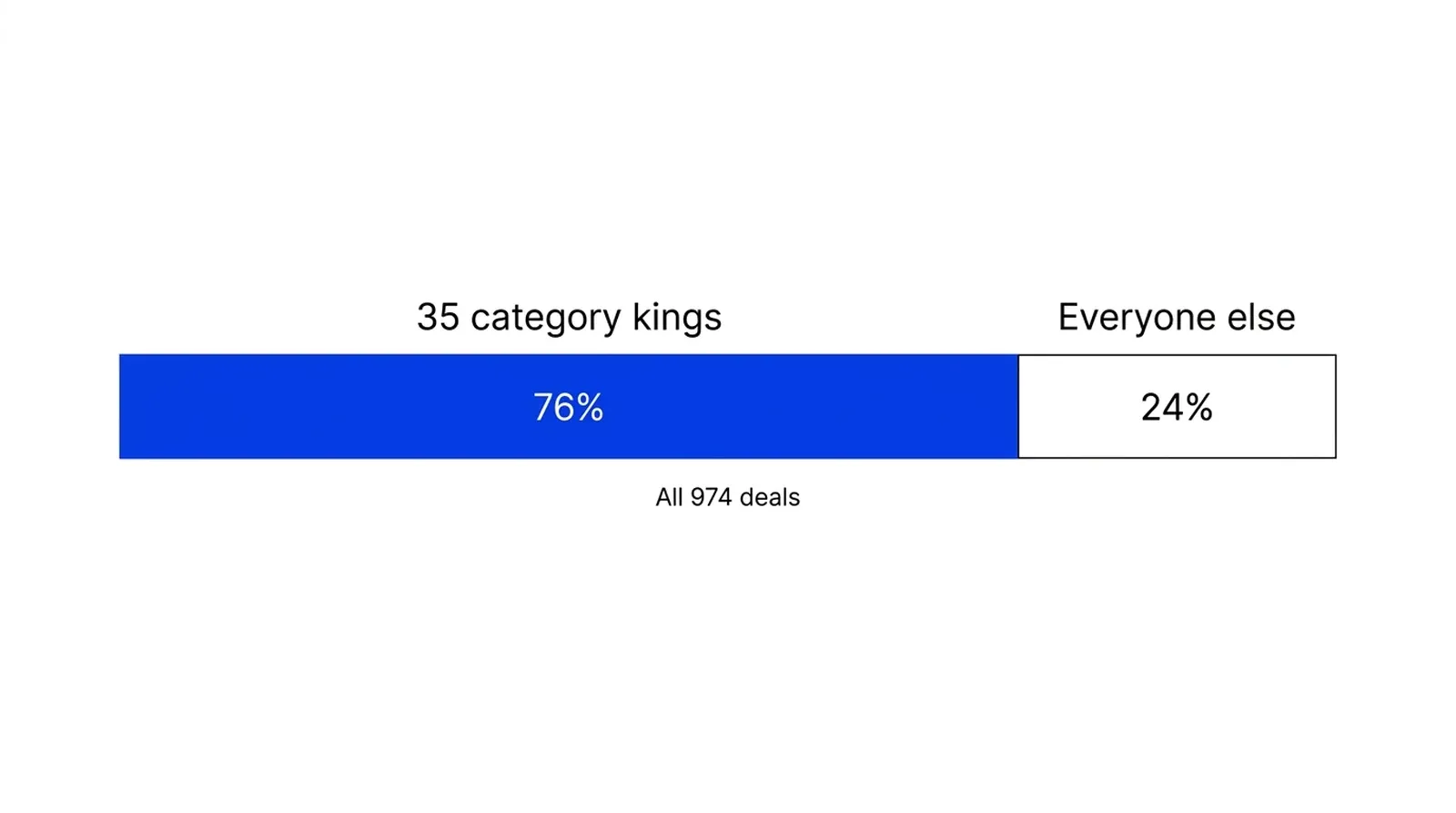
According to Table 2 of the report, the 35 kings were worth $439.6 billion against $137.5 billion for everyone else, which is 76% of the total. By founding era the share was 71%, 79% and 72%. Several limits follow from the report’s own method notes:
| What the figure says | What it does not say |
|---|---|
| 35 chosen companies held 76% of the whole sample’s value | That the leader of any one category takes 76% of that category |
| Valuations as of October 2014, private rounds at post-money value | That those valuations were discounted for risk or held up later |
| US venture-backed tech founded since 2000 | Anything about other industries or countries |
| Kings selected by the authors after the fact | An independent or peer-reviewed test |
Picking winners after the outcome is known is exactly the bias Golder and Tellis warned about, since leaving out the companies that failed inflates any measured advantage. Treat 76% as evidence that value in venture-backed tech is highly concentrated, which few would dispute, and as the authors’ marketing for their method.
How category design works
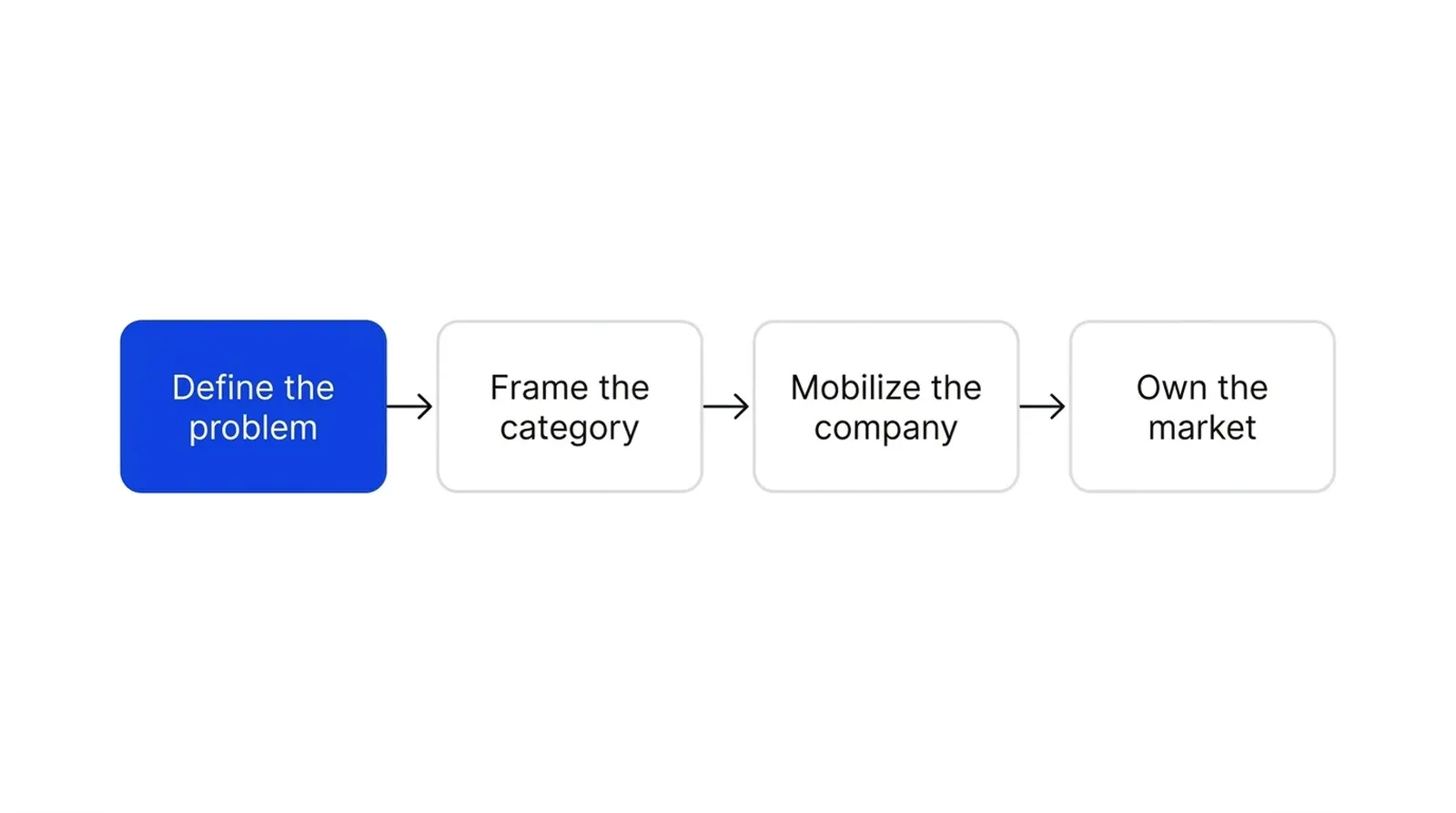
The method starts with the problem and leaves the product for later. Play Bigger’s current four-step blueprint reads: define the problem, frame the category, mobilize the company, own the market.
The central document is a point of view: a short argument about how the world works today, why that is failing, and what the new way looks like. The report scores kings partly on how well they use a point of view to define the problem and say why buyers should care. Lochhead’s later work at Category Pirates describes a “magic triangle” in which the category, the product and the company are designed together, so the story, the roadmap and the business model say the same thing.
Then comes a concentrated launch, which the authors call a lightning strike. Salesforce’s own launch is a well-documented example. Its company history records a 2000 launch themed The End of Software, with actors staging a mock protest outside a Siebel Systems conference. The target of the launch was installed software as a whole, so buyers compared Salesforce with a way of working they were tired of rather than with one vendor’s feature list. HubSpot, by its own account, introduced inbound marketing in a similar way, giving a name to a method before selling the tool for it.
What research says about new categories
Academic work supports the core idea that categories shape demand, and adds conditions that limit it. Ezra Zuckerman found that US firms not covered by analysts who specialised in their industries traded at a discount from 1985 to 1994: markets penalise what they cannot classify. Mark Kennedy showed that early entrants benefit from press coverage that links them to a few rivals, because a group of similar firms makes a new category look real.
Two findings cut against the lone-king story. Chad Navis and Mary Ann Glynn’s study of US satellite radio found that once the category gained legitimacy, attention shifted to differences between firms. Fernando Suarez and colleagues argue that the best time to enter is after a dominant category forms but before a dominant design settles, which leaves room for later entrants. Rodolphe Durand and Mukti Khaire separate category creation by firms from emergence that no single firm controls. Category design is a bet that you can do the first.
Category design, blue ocean and crossing the chasm
All three deal with new markets but answer different questions.
| Framework | Main question | Main tool |
|---|---|---|
| Category design | How do we name a new market and own it? | Point of view, category name, launch |
| Blue ocean strategy | How do we make rivals irrelevant on value and cost? | Strategy canvas, eliminate-reduce-raise-create grid |
| Crossing the chasm | How do we move from early adopters to the mainstream? | One beachhead segment, whole product |
In Pushers’ Growth Lab work, the category question comes before channel plans, because a company creating a category and one competing inside an existing category need different messages, buyers and budgets.
How to apply Category design, step by step
- Name the problem before the product. Write down the problem your buyers have, how they cope with it today and what that costs them. Use their words from interviews, not your feature list. Result: a one-paragraph problem statement that a buyer would recognise and agree with.
- Check whether a new category is needed. Ask whether buyers already file this problem under an existing category. If they do and you are simply better, compete in that category with sharp positioning. Result: a written yes or no on whether you are creating a category or entering one.
- Write the point of view. Describe the old way, why it fails now, and the new way your category makes possible. Keep it short enough for a salesperson to say in two minutes. Result: a one-page point of view signed off by the CEO.
- Name and frame the category. Pick a plain, descriptive category name that buyers, analysts and journalists can repeat without your brand attached. Test two or three names with buyers. Result: a category name and a one-sentence definition.
- Line up the company behind it. Align product roadmap, sales pitch, hiring, pricing and investor story with the same point of view. A category story told only by marketing will not stick. Result: a list of what each team changes, with owners and dates.
- Launch with one concentrated push. Put the category in front of the market in one coordinated moment: an event, a report, a customer launch, press. The book calls this a lightning strike. Result: a dated launch plan and three measures, such as share of search for the category name, inbound demos and analyst mentions.
Examples
Salesforce and the end of software
Salesforce incorporated in March 1999 and, according to its own company history, launched in 2000 at an event themed The End of Software, backed by a mock protest outside a Siebel Systems conference. The company framed the problem as software you install and maintain yourself, and offered itself as the way out of that whole category. Play Bigger's 2014 report lists salesforce.com among its category kings.
Keurig and single-serve coffee
Eddie Yoon and Linda Deeken opened their 2013 Harvard Business Review article on category creators with Keurig. Coffee had been brewed for more than 500 years, yet Keurig's pod machines, sold to homes from 2004, reached more than $3.8 billion in US sales of machines and pods in 2012 and more than 40% of coffeemaker dollar share, with each K-Cup costing roughly ten times as much per cup as traditional brewing.
A payments startup deciding whether to create a category
Illustrative, no real company implied. A fintech startup pays out earnings to 20,000 freelance drivers for ride and delivery platforms. Its sales team pitches it as cheaper payroll software and loses deals on price. Interviews show platforms see a different problem: drivers quit when they wait days for money. The team frames the category as instant earnings access, rewrites the pitch around churn, and measures it. If a platform with 10,000 drivers loses 5% a month and instant payouts cut that to 4%, that is 100 fewer drivers to replace each month.
When to use it
Use category design when buyers have a problem that no existing category describes well, when your product would be judged unfairly against the features of an established category, or when a new technology makes a different way of working possible and nobody has named it yet. It fits founders and growth-stage companies that can commit the whole leadership team to one story for at least a year.
When not to use it
Skip it when buyers already have a clear category for what you sell and you are simply better or cheaper; sharp positioning inside that category is faster and cheaper. Skip it when the product does not yet solve the problem for real customers, because a category story cannot cover a gap in the product. Be careful in regulated markets such as healthcare and payments, where regulators and procurement rules often define the categories for you.
Common mistakes
- Inventing a category name for a product that buyers already understand, which forces them to learn a new word for no gain.
- Treating category design as a naming or messaging exercise owned by marketing, while product, sales and pricing carry on unchanged.
- Quoting the 76% category king figure as proof that the leader of any category takes three quarters of its value; the authors' report does not measure that.
- Putting the brand name in the category name, so analysts and rivals have no neutral term to repeat.
- Declaring victory after the launch event, when research on new categories shows the contest moves to differences between firms once the category is accepted.
FAQ
What is a category king?
A category king is the company most closely identified with a market category, the one buyers name first and compare others against. Play Bigger's authors use the term for companies like Salesforce, Uber and Airbnb. A category king is not always the first mover; MIT Sloan Management Review authors note that pioneers often fail to dominate the categories they create.
Do category kings really take 76% of the value?
The figure comes from the authors' 2014 Time to Market Cap report. It found that 35 companies they selected as category kings held 76% of the value of 974 US venture-backed tech deals. It is the share of a whole sample held by hand-picked winners, not each king's share of its own category, and it was not peer reviewed.
How is category design different from blue ocean strategy?
Both aim at uncontested demand. Blue ocean strategy, from Kim and Mauborgne, reshapes the value curve of an industry by removing and adding factors. Category design focuses on naming a problem and a category, then making one company synonymous with it through a point of view and a launch. The two can be used together.
What do you need to create a new category?
You need a problem buyers recognise but no existing category describes, a product that already solves it for some customers, a short point of view that explains the old way and the new way, a plain category name others can repeat, and leaders who will tell the same story across product, sales, hiring and investors for a year or more.
Is category design only for tech startups?
No, although most of the authors' evidence comes from US venture-backed technology companies. Their own examples include IKEA, and the Keurig case in Harvard Business Review comes from consumer goods. The method is harder in regulated markets, where regulators and payers often define categories, and for small firms that cannot fund a sustained launch.
Sources
- Play Bigger Advisors (Ramadan, Lochhead, Peterson, Maney), Time to Market Cap report, 2014
- Ramadan, Peterson, Lochhead and Maney, Play Bigger, HarperBusiness, 2016 (Internet Archive record)
- Leadership Now, Play Bigger publisher description
- Play Bigger, category design advisory and four-step blueprint
- Christopher Lochhead, Play Bigger and follow-on category design books
- Category Pirates (Lochhead, Yoon, Cole), category design newsletter and Magic Triangle
- Category Design Advisors (Kevin Maney), strategic category design
- Insight Partners, Play Bigger: The Science Behind Category Design, 2018
- Harvard Business Review, Yoon and Deeken, Why It Pays to Be a Category Creator, 2013
- Harvard Business Review, Suarez and Lanzolla, The Half-Truth of First-Mover Advantage, 2005
- Harvard Business Review, Kim and Mauborgne, Blue Ocean Strategy, 2004
- MIT Sloan Management Review, McDonald and Krach, How Would-Be Category Kings Become Commoners, 2020
- Journal of Marketing Research, Golder and Tellis, Pioneer Advantage: Marketing Logic or Marketing Legend?, 1993
- Strategic Management Journal, Lieberman and Montgomery, First-Mover Advantages, 1988
- Strategic Management Journal, Suarez, Grodal and Gotsopoulos, Perfect Timing? Dominant Category, Dominant Design, and the Window of Opportunity for Firm Entry, 2015
- Academy of Management Review, Grodal, Gotsopoulos and Suarez, The Coevolution of Technologies and Categories During Industry Emergence, 2015
- Journal of Management, Durand and Khaire, Where Do Market Categories Come From and How?, 2017
- Academy of Management Journal, Santos and Eisenhardt, Constructing Markets and Shaping Boundaries, 2009
- Administrative Science Quarterly, Navis and Glynn, How New Market Categories Emerge: Satellite Radio, 1990-2005, 2010
- American Sociological Review, Kennedy, Getting Counted: Markets, Media, and Reality, 2008
- American Journal of Sociology, Zuckerman, The Categorical Imperative, 1999
- Salesforce, The History of Salesforce
- HubSpot, Inbound marketing
Last updated Oct 9, 2026


Marketing agency or growth system: when a company outgrows its agency
An agency is the right call while the founder still runs most of the company. Once the business starts copying itself into new locations or markets, it needs a system that sets goals, tests hypotheses and owns the result.

Why healthcare marketing agencies stall: the short, mid and long wins model we use with clinics
Most agencies own the click and nobody owns the front desk. How we structure clinic work in three horizons, the research behind each one, and one year of results.

Why channel tests stall after month three
Most paid channel tests do not end with a decision. They end when the budget runs out, the attribution model changes, or everyone quietly stops looking at the dashboard.