Four fits
The four fits is Brian Balfour's growth framework that checks whether a company's market, product, acquisition channel and business model line up with each other, because product-market fit alone does not explain why some products grow fast and others stall.
The four fits is a growth framework published by Brian Balfour, former VP of Growth at HubSpot, in a 2017 essay series. It says a company needs four alignments to grow to $100M+ in revenue: market-product fit, product-channel fit, channel-model fit and model-market fit. Each fit depends on the others, so changing one element, such as price, means rechecking all four.
- Origin
- Brian Balfour, 2017
- Level
- 301 · Advanced
- Fits
- Startup, Scale-up
- Time to apply
- a two-hour working session for a first draft of all four hypotheses, then a review every quarter or after any change to price, market or main channel
- What you need
- retention curves for your main customer cohorts · a breakdown of new customers by acquisition channel for the last two or three quarters · your annual revenue per user (ARPU) and what it costs to acquire a customer in each channel · an estimate of how many potential customers exist in your target market
The four fits is a growth framework that checks whether four parts of a business line up: the market, the product, the channel that brings customers, and the business model. Brian Balfour, who was VP of Growth at HubSpot before founding Reforge, according to his Reforge profile, published it in a series of essays in 2017. He says it draws on his work with more than 40 tech companies.
His starting question was why some companies reach $100M+ with relative ease while others struggle despite good execution. In the opening essay he calls the first group Smooth Sailers and the second Tugboats. His answer was that a great product is necessary but not enough. He cites Soldsie, a tool for selling through Instagram and Facebook that had decent retention and organic growth, yet grew too slowly for venture capital.
What are the four fits?
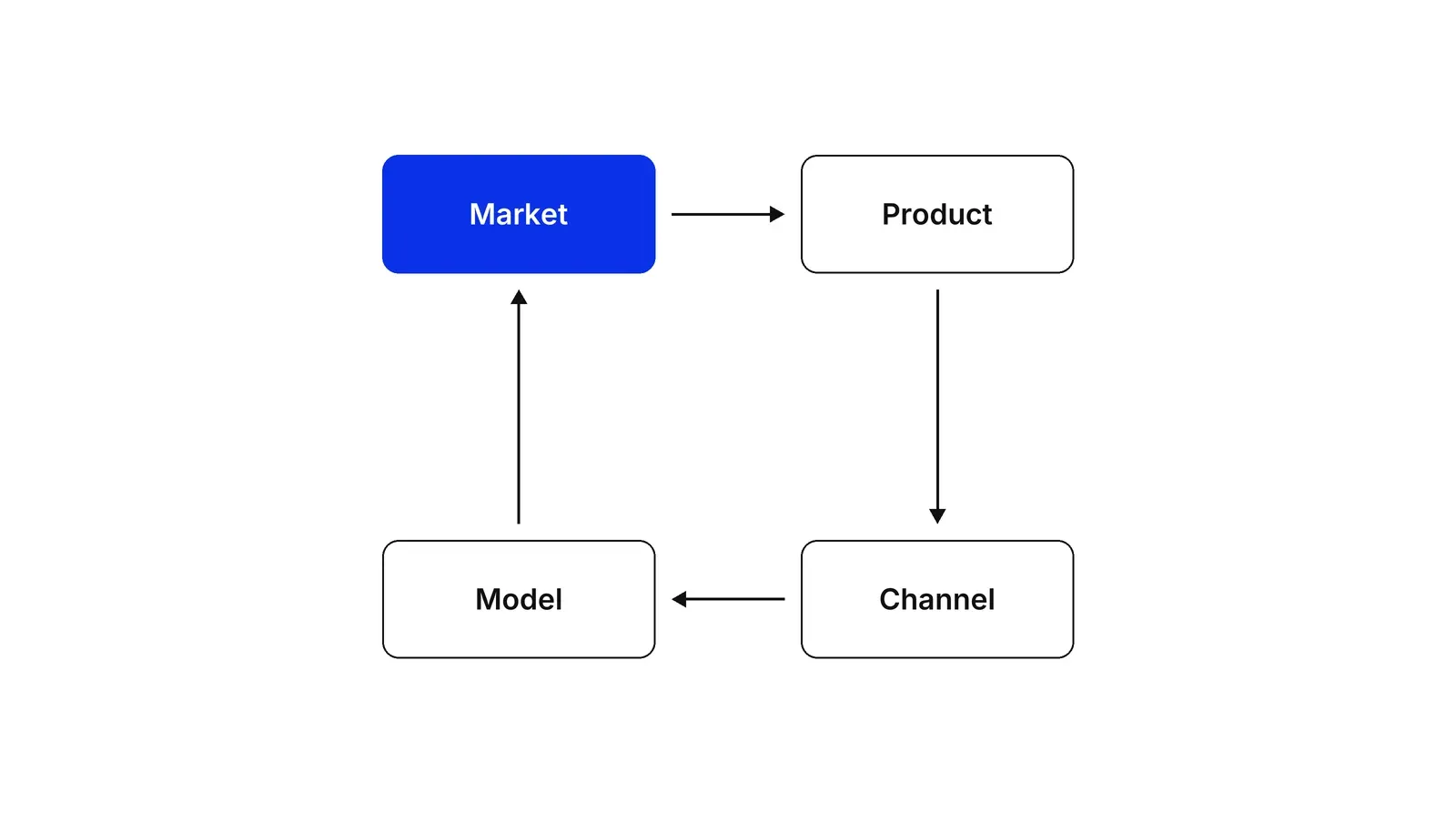
The four fits are the four pairs formed when you go round the loop of market, product, channel and model. Each pair has to work.
| Fit | Question it answers | Balfour’s short rule |
|---|---|---|
| Market-product | Does the product solve a real problem for a defined group? | Start with the market, not the product |
| Product-channel | Is the product shaped for the channel that will bring users? | Shape the product for the channel |
| Channel-model | Can your price pay for that channel? | The model decides the channels |
| Model-market | Is the market big enough at that price? | ARPU times reachable customers must clear your goal |
Balfour’s lessons essay adds three rules. You need all four fits to reach $100M+. You write hypotheses for all of them but prove them one at a time, starting with market-product fit. And because they form one system, changing one element means revisiting the others.
His HubSpot Sales case study shows the third rule at work. A free email-tracking extension with a $10 tier grew weekly users from about 2,000 to 100,000 through virality and Facebook ads. But at $120 ARPU, Balfour calculates, it needed about 1 million paying users, 33% to 50% of its target market. The team kept HubSpot’s mid-market customers and changed the other three: a $50 tier, content marketing and sales, and annual contracts.
Market-product fit: why the market comes first
Market-product fit is Balfour’s reordering of the familiar term. Marc Andreessen’s 2007 essay defined product-market fit as being in a good market with a product that can satisfy it. Balfour puts the market first because, as he writes in Market Product Fit, the problem is experienced in the market, not in the product.
He describes the market by category, who the customer is, their problem and their motivation. He describes the product by its core value, its hook, the time it takes a new user to get value, and what makes them stay. His main measure is a retention curve that flattens rather than sliding to zero. The intuition check is blunt: would growth continue if you switched marketing off? The product-market fit page covers the survey and retention tests in more detail.
Product-channel fit: build for the channel
Product-channel fit means the product is built around how its main channel works. In his product-channel essay Balfour points out that Facebook, Google and email providers set the rules of their channels, and a startup cannot change them. A product that grows by virality needs fast time to value and gets better as a user’s contacts join. A product that grows through search on user content needs users to create millions of unique pages.
He also argues that distribution follows a power law. The idea comes from Peter Thiel, quoted in Traction as saying it is very likely that one channel is optimal. Balfour’s observation is that a company with product-channel fit gets 70% or more of its growth from one channel at any given time. That is why he advises testing one or two channels at once rather than many. The Bullseye framework is a practical way to run those tests.
Channel-model fit and the danger zone
Channel-model fit is the match between what a customer pays and what it costs to acquire them. Balfour’s channel-model essay says the model has two parts that matter: how you charge (ads, freemium, trial, transaction) and annual revenue per user. He uses annual ARPU rather than lifetime value because a startup needs to earn back acquisition costs in about a year. That matches David Skok’s SaaS guideline of recovering acquisition cost within 12 months.
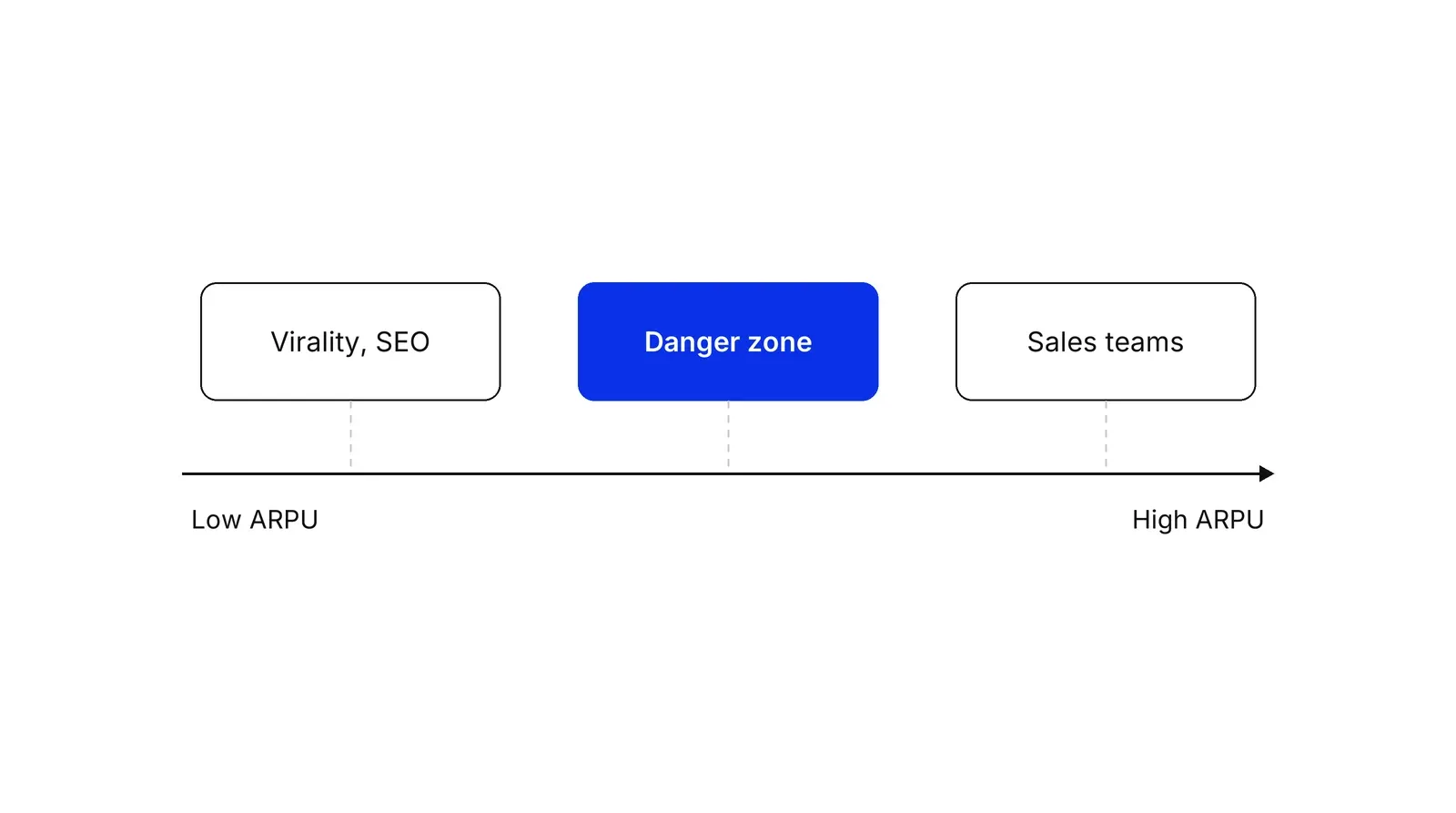
At the low end, ad-funded products such as Facebook and WhatsApp grew through near-free channels. At the high end, Balfour lists Palantir and Veeva, with six- and seven-figure contracts that pay for enterprise sales. The middle is what he calls the danger zone: a $500 product is hard to sell from an ad, yet too cheap to pay for a sales rep. Tom Tunguz estimated in 2016 that many startups put sales teams on accounts of $3,000 a year and up.
The danger zone is contested. Tunguz looked at public software companies and found contract values at IPO running smoothly from $87 to $780,000 with no gap. Balfour replies that this data only shows survivors. Both points can hold: companies do succeed in the middle, but usually with a patchwork of channels and slower growth.
Model-market fit: the $100M arithmetic
Model-market fit asks whether the market is big enough at your price. Balfour’s model-market essay reduces it to one line: ARPU times the number of customers in the market times the share you can capture must reach $100M. He builds on Christoph Janz’s 2014 post, which named five ways to get there.
| Janz’s label | Customers needed | Revenue per customer per year |
|---|---|---|
| Flies | 10 million | $10 |
| Mice | 1 million | $100 |
| Rabbits | 100,000 | $1,000 |
| Deer | 10,000 | $10,000 |
| Elephants | 1,000 | $100,000 |
Balfour’s version calls the middle group Moose rather than Deer; the numbers are the same. For SaaS without strong network effects he treats about 10% market share as a starting assumption, and says a plan that needs 50% or more should worry you.
Why the fits keep breaking
The fits change because channels and markets change. Andrew Chen’s law of shitty clickthroughs records banner click-through rates falling from 78% in 1994 to 0.05% for Facebook ads in 2011. Platforms also change their terms. In a 2025 essay Balfour describes how Facebook opened its developer platform in 2007, then restricted notifications and invites from 2009 to 2012. He now argues ChatGPT may become the next such platform, a view he set out on Lenny’s Podcast. When a channel moves, the product and model built around it usually have to move too. Pinterest is the standard case. Facebook reported in 2012 that daily Facebook visitors to Pinterest rose more than 60% within a month of its Open Graph launch. When Facebook later closed that route, Pinterest rebuilt around search traffic, a shift from social driven growth to SEO that Casey Winters describes.
In Pushers’ Growth Lab the four hypotheses go on one page before any channel budget is set, so a pricing or channel change can be checked against the other three.
How to apply Four fits, step by step
- Write one hypothesis for each element. Describe the market (category, who, problem, motivation), the product (core value, time to value), the main channel and the model (how you charge and annual ARPU) in one or two lines each. Result: four written hypotheses on one page.
- Check market-product fit first. Look at cohort retention. Balfour's quantitative test is a retention curve that flattens instead of falling to zero. If it keeps falling, stop here and work on the product or the market definition. Result: a yes or no on whether the base exists.
- Find the channel that brings most growth. Break new customers down by channel. Balfour observed that companies with product-channel fit get 70% or more of growth from one channel at a time. Then list what that channel demands of the product, such as fast time to value for virality. Result: one named primary channel and the product traits it requires.
- Match channel cost to revenue per user. Compare annual ARPU with the cost of acquiring a customer in the chosen channel. Balfour uses annual ARPU because startups need payback in about a year. Result: a statement of whether your price can pay for your channel, or whether you sit in the middle danger zone.
- Run the market-size arithmetic. Divide your revenue goal by ARPU to get the customers you need, then divide by the number of customers in your market. Balfour treats about 10% share as a starting rule of thumb for SaaS without strong network effects and says 50% or more should worry you. Result: a share figure that is either plausible or a reason to change market or model.
- Recheck all four after any change. When you change price, enter a new segment or lose a channel, go back through every fit. Result: an updated one-page hypothesis sheet with the date of the change that triggered it.
Examples
HubSpot Sales: from freemium to mid-market
Balfour's case study describes HubSpot's sales product from 2014 to 2016. It began as Signals, a Chrome extension that tracked email opens, free with a $10 unlimited tier. Virality and Facebook ads drove about 70% of growth and weekly active users rose from about 2,000 to 100,000. The market math failed: at $120 ARPU the team needed about 1 million paying users, 33% to 50% of the 2 to 3 million salespeople it targeted. After about 18 months it chose HubSpot's mid-market customers, cut the $10 tier, dropped virality and paid ads for content marketing and sales, and sold a $50 tier with minimum seats and annual deals. Balfour notes these are not official HubSpot figures.
Pinterest: when the channel changed, the product changed
In February 2012 Facebook reported that daily Facebook visitors to Pinterest had grown more than 60% within a month of its Open Graph integration. Balfour writes that Pinterest's growth relied on sharing through Facebook's API, and when Facebook shut that down around the end of 2012, growth slowed. Pinterest moved to search traffic from user-generated pages and repositioned the product from social network to personal utility. Casey Winters, who later led growth there, describes joining as the company moved from social driven growth to SEO.
A payroll app for dental practices
Illustrative, no real company implied. A startup sells payroll software to dental practices at $1,000 a year and finds that practices stay once they switch, so market-product fit looks real. Reaching Balfour's threshold at that price needs 100,000 paying practices. If its country has 60,000 practices, the model cannot fit the market even at 100% share. The team has three options: raise ARPU by adding benefits and tax filing, expand to other outpatient clinics, or accept a smaller business. Each option changes the product and channel too, so all four fits have to be rechecked.
When to use it
Use it when a product has good retention but growth is slow or expensive, before changing pricing or packaging, when the main acquisition channel is flattening or a platform changes its rules, or when deciding whether to move up or down market. It suits venture-backed companies that need to know whether a venture-scale path exists at all.
When not to use it
Skip it before anyone uses the product: without market-product fit the other three fits have nothing to stand on, and channel tests will look bad whatever you choose. It also adds little for a business that does not aim for venture-scale revenue, where Balfour's revenue threshold is the wrong yardstick, or for a mature company with many products, where each product needs its own analysis.
Common mistakes
- Treating product-market fit as the finish line and pouring money into acquisition before checking whether any channel suits the product and price.
- Changing price on its own, for example raising it to lift revenue, and then being surprised when the viral or paid channel that worked at the old price stops working.
- Spreading effort across many channels for safety. Balfour argues one channel usually drives most growth at any time, and diversification is mainly a hedge against losing it.
- Selling one product, one model and one channel to enterprise, mid-market and small businesses at once, which pulls the product in three directions.
- Skipping the market arithmetic and discovering late that the plan needs a third or more of every possible customer.
FAQ
What are Brian Balfour's four fits?
They are market-product fit, product-channel fit, channel-model fit and model-market fit. Balfour set them out in a 2017 essay series and argued that a company needs all four to reach venture-scale revenue in a venture-backed timeframe. The fits affect each other and change over time, so they are reviewed together.
Why does Balfour say market-product fit instead of product-market fit?
He puts market first because the problem lives in the customer's world, not inside the product. A team should define the market, its problem and motivations, then build a product for it. He learned this at Viximo, where he says $5M went into a solution looking for a problem.
What is channel-model fit?
It is the match between how a company acquires customers and how it makes money. Balfour's rule is that the model, meaning how you charge and annual revenue per user, decides which channels can work. Ad-funded consumer apps need near-free channels like virality, while six- and seven-figure enterprise contracts can pay for outbound sales.
What is the ARPU-CAC danger zone?
It is Balfour's name for the middle of the revenue-per-user range, where a product costs too much to sell through cheap channels such as ads or virality but earns too little to pay for sales teams. He says companies there fail more often. Tom Tunguz found no such gap in public SaaS contract values, so the claim is debated.
How is the four fits framework different from the Bullseye framework?
Bullseye, from the book Traction, is a method for testing channels and picking the one that works. The four fits is a check on whether the chosen channel matches your product, your price and your market size. Teams can use Bullseye to find a channel and the four fits to see whether it can carry the business.
Sources
- Brian Balfour, Four Fits series index
- Brian Balfour, Why Product Market Fit Isn't Enough, June 2017
- Brian Balfour, Market Product Fit, July 2017
- Brian Balfour, Product Channel Fit Will Make or Break Your Growth Strategy, July 2017
- Brian Balfour, Get Out of the ARPU-CAC Danger Zone with Channel Model Fit, July 2017
- Brian Balfour, Model Market Fit, July 2017
- Brian Balfour, Applying the Four Fits, August 2017
- Brian Balfour, Four Fits Case Study: HubSpot Sales Product, October 2017
- Brian Balfour, The Next Great Distribution Shift, June 2025
- Reforge, Brian Balfour profile
- Lenny's Podcast, Why ChatGPT will be the next big growth channel, with Brian Balfour, August 2025
- Christoph Janz, Five ways to build a $100 million business, October 2014
- Marc Andreessen, The only thing that matters, June 2007
- Tomasz Tunguz, Is there a no man's land in SaaS ACVs?, April 2017
- Tomasz Tunguz, The smallest ACV to justify an inside sales team, July 2016
- Andrew Chen, The law of shitty clickthroughs
- David Skok, For Entrepreneurs, SaaS metrics 2.0
- Gabriel Weinberg and Justin Mares, Traction, 2014, chapters 1 to 3
- Facebook for Developers, Early success stories: Timeline apps and Open Graph, February 2012
- Casey Winters, About (Casey Accidental)
- First Round Review, How Superhuman built an engine to find product-market fit, 2018
Last updated Oct 9, 2026


Marketing agency or growth system: when a company outgrows its agency
An agency is the right call while the founder still runs most of the company. Once the business starts copying itself into new locations or markets, it needs a system that sets goals, tests hypotheses and owns the result.

Why healthcare marketing agencies stall: the short, mid and long wins model we use with clinics
Most agencies own the click and nobody owns the front desk. How we structure clinic work in three horizons, the research behind each one, and one year of results.

Why channel tests stall after month three
Most paid channel tests do not end with a decision. They end when the budget runs out, the attribution model changes, or everyone quietly stops looking at the dashboard.